


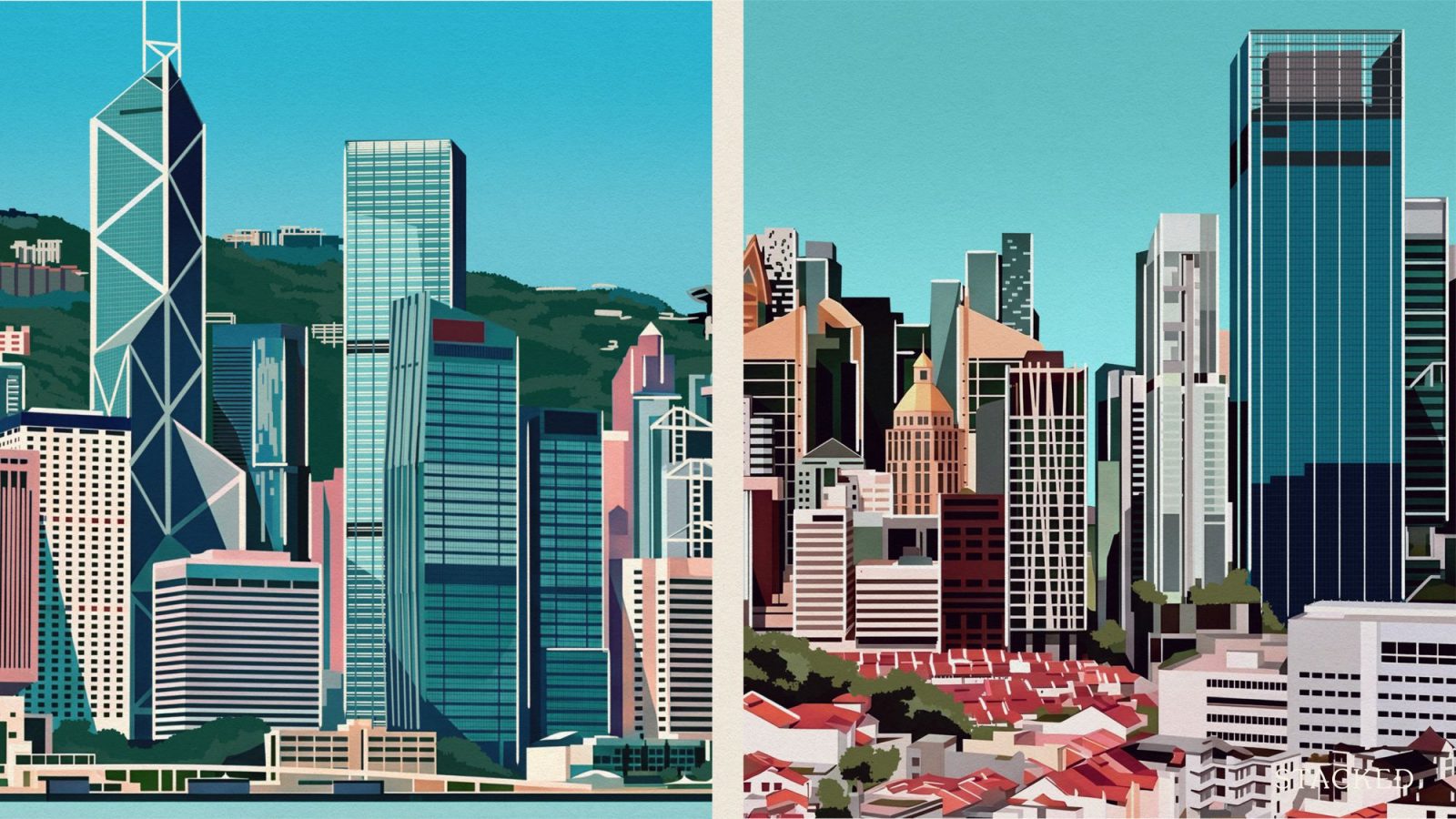
Since the 1980s, comparisons between Singapore and Hong Kong have characterised the competition between the two cities as a race to the top, as the two leading financial hubs in the Asia Pacific compete to attract global capital to their shores.
As both cities sought to position themselves as pro-business hubs for global companies and wealth looking for a base in Asia, early perceptions tried to characterise the rise of one city as meaning the demise of the other.
But the narrative has changed as Hong Kong and Singapore carve out complementary roles in the international financial market.
The shift began in 2019 when Hong Kong real estate saw a tough period as protests and Covid-19 pandemic-era border closures disrupted business and cut the city off from the region. Overall recovery has been slow, and office rents in Central in 2025 are still 37% below their peak in 2019, according to market research from Savills.
Meanwhile, Singapore has rebounded at a stronger pace since the end of the Covid-19 pandemic. Its office rents dipped during the Covid-19 pandemic but have climbed since, as the city-state reopened its borders before Hong Kong. In Singapore, prime CBD office rents fell about 10% from 2019 to early 2021, but have recovered decisively since then, according to market data from Colliers.
But Hong Kong has found a new engine to spur growth. With US–China political tensions making it more challenging to access equity and capital, mainland Chinese companies turned to Hong Kong to raise money. The city became a gateway for Chinese firms going global, and a place for their founders and investors to park their capital outside mainland China.
In 2026, office markets in both cities are thriving, but for very different reasons. Hong Kong is becoming a gateway for mainland Chinese capital and the firms that manage it, while Singapore is growing as a regional hub for technology and artificial intelligence (AI) firms.
This year, Grade A office rents in Hong Kong are expected to increase at a faster pace than in Singapore. But that growth is limited to the very top of the market, and it carries more risk. Here’s why.
Hong Kong's IPO-Driven Triple A Office Demand
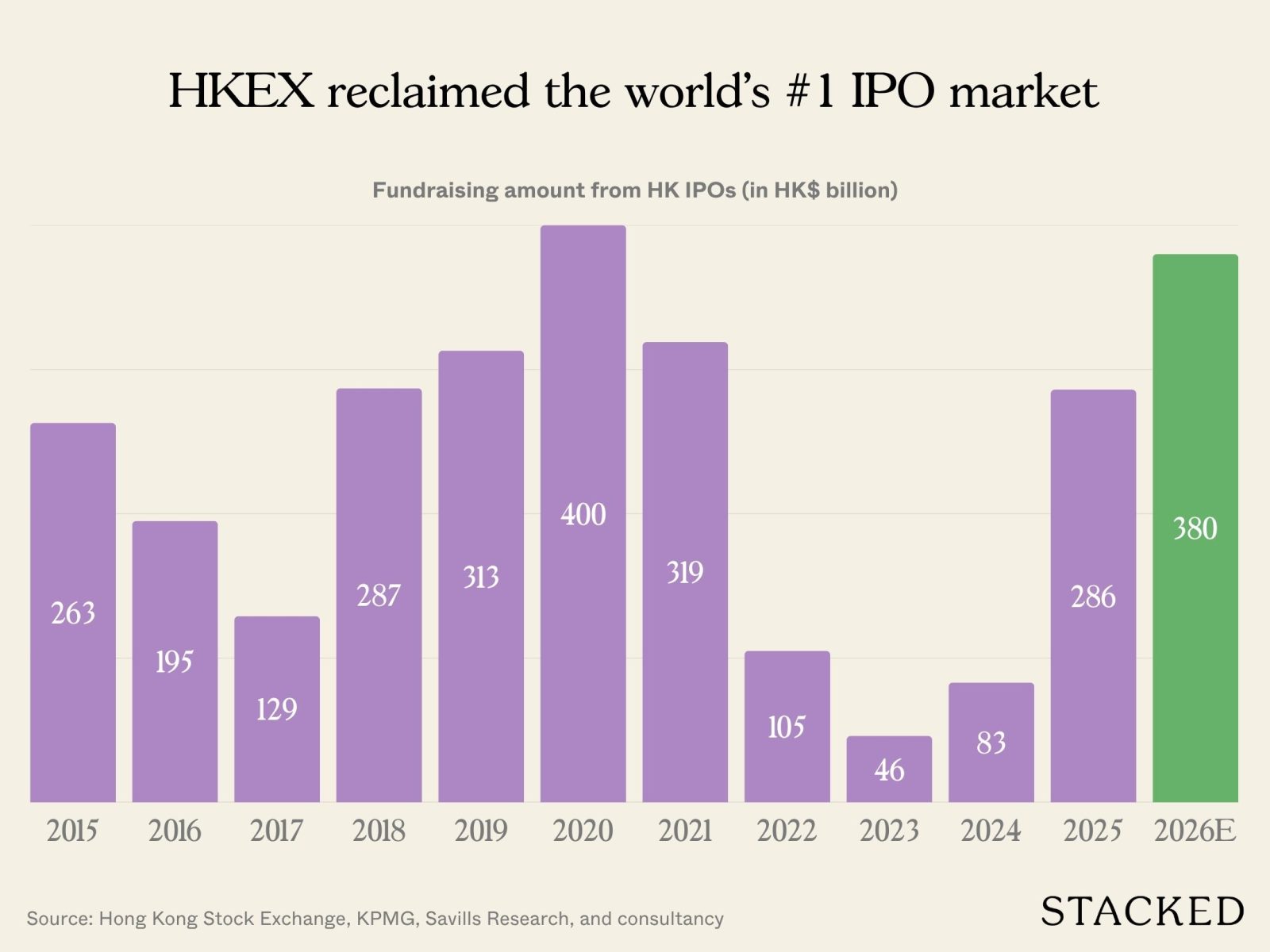
The strong growth in Hong Kong's office market is primarily being driven by the rapid growth of its stock market and a rise in Chinese companies listing on the Hong Kong stock market (HKEX) - but not for the reasons you'd expect.
According to market research by Savills, it's not the companies launching initial public offerings (IPOs) that are leasing more office space, but the financial firms that manage the IPO cash. Most of these IPO companies, like industrial EV battery maker CATL and F&B bubble tea chain Mixue this year, do not operate in Hong Kong, even though they list on HKEX.
Founders and major shareholders find billions in their pocket overnight and set up single-family offices in Hong Kong to manage their newly created wealth, according to Savills.
About 60% of the US$2.9 trillion in cross-border wealth held in Hong Kong comes from mainland China. Savills also cited a survey by the Hong Kong Trade Development Council (HKTDC), which found that 83% of mainland Chinese companies expanding overseas choose Hong Kong as their preferred base for services like finance, legal and tax - with 31% of respondents picking Singapore as their base.
Jane Street is currently the largest hedge fund tenant in Hong Kong, with about 130,000 sq ft, and has committed to new space at New Central Harbourfront that will roughly double its footprint to about 271,000 sq ft, according to Savills.
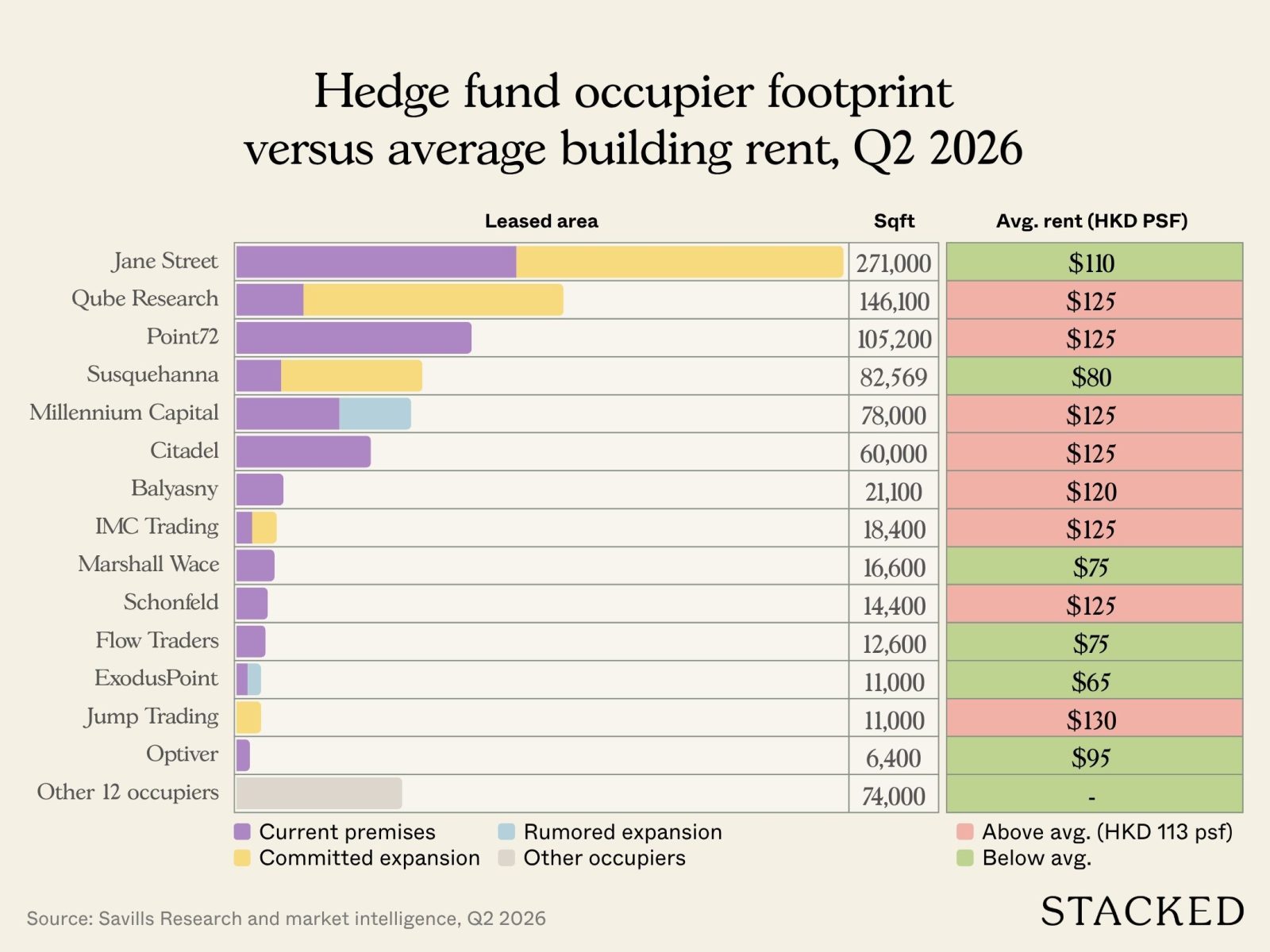
Savills said that the 26 hedge and private equity funds in Hong Kong that it tracks collectively occupy about 550,100 sq ft of prime Grade A office space in Hong Kong today. That’s set to grow by about 69% to 928,400 sq ft after pre-committed and unreported office moves are completed in the coming months.
Likewise, the real estate consultancy adds that hedge funds made up 18% of Hong Kong’s net office demand last year.
This Has Sparked the Early Signs of a Rental Recovery in Hong Kong
This IPO-led capital rush has caused a recovery in Hong Kong's office sector, which has seen rents atrophy since 2019. Overall rents in the prime office market are up 1.3% q-o-q in 2Q2026, with Triple A office spaces leading the way.
Nevertheless, there is still a long way for the market to return to its pre-pandemic levels, with prime rents still down 42.7% from their peak in 1Q2019.
But leasing demand is on a positive trajectory, with rents for these Triple A offices - which Savills refers to as Central Grade A office space - increasing by 15.0% y-o-y. These include landmark commercial developments like One and Two International Finance Centre, AIA Central, and The Henderson.
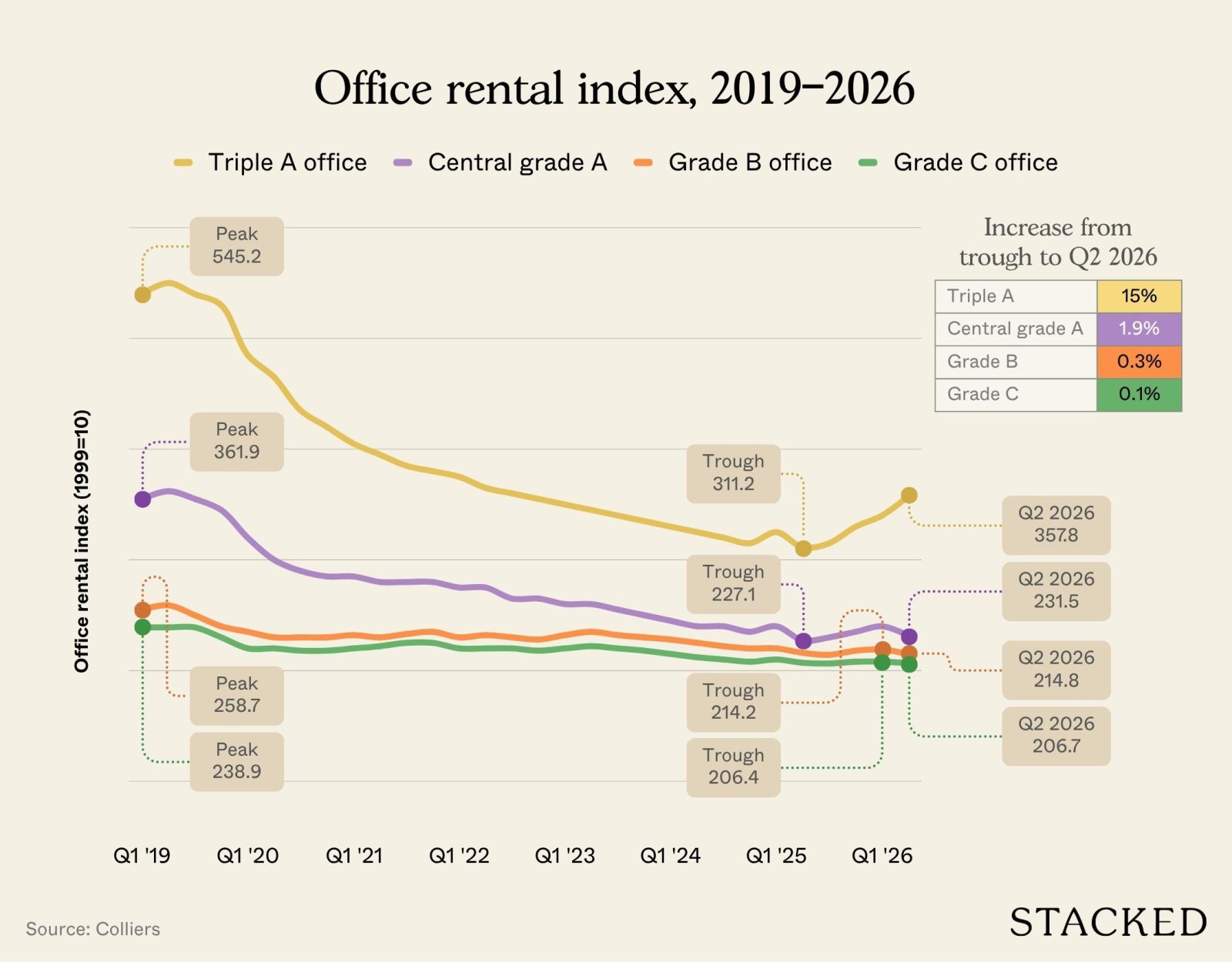
Meanwhile, the rest of the office market - including non-Central Grade A, Grade B and Grade C offices - only grew 1.9%, 0.3% and 0.1%, respectively. According to Savills, a "triple-A rebound (in the office market) reflects financial institutions' expansion into premium Central offices, not a broader market-wide recovery."
How Has Singapore's Office Market Fared By Comparison?
While the office market in Hong Kong has been through a major upheaval over the past seven years, Singapore has grown slowly but steadily.
Overall office rents in the city-state fell by about 10% during the Covid-19 pandemic, according to market research from Colliers. And since bottoming out in 1Q2021, office rents have climbed even as new supply was added, most notably IOI Central Boulevard Towers in 2024.
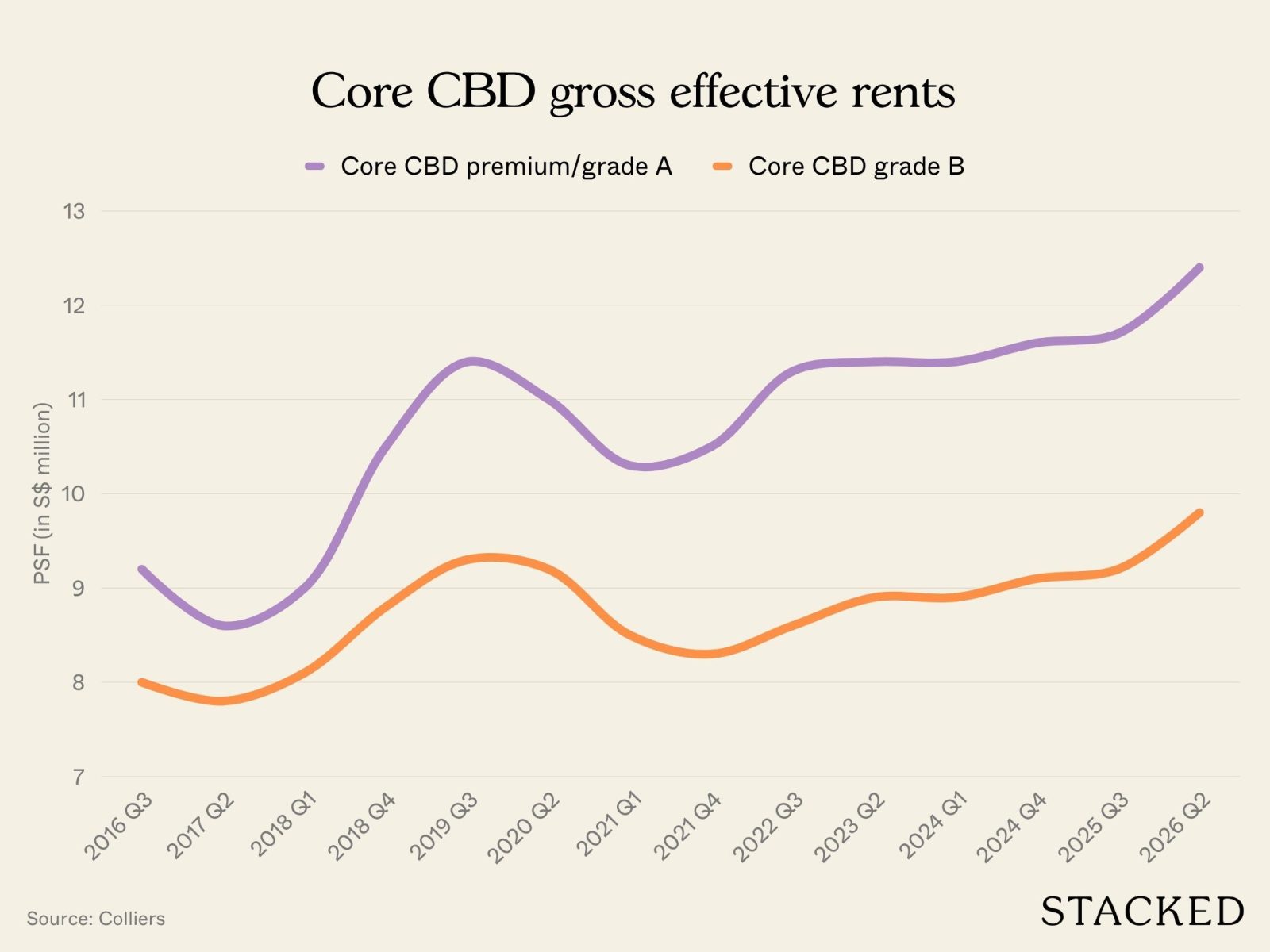
So far this year, rents for Singapore office space have continued to rise, according to data by Colliers. The consultancy says that most new-to-market tenants are technology firms and non-bank financial companies (such as fintech startups) setting up offices in Singapore, or expanding their existing footprint.
Flexible co-working office spaces are an established segment of the market, and for many new businesses these flexi-spaces are a first step before moving up to higher-quality space, in an ongoing 'flight-to-quality' trend.
For instance, OpenAI is reportedly moving from a co-working space and into the newly completed Shaw Tower, where it is reportedly going to take up about 100,000 sq ft.
In Singapore, the rise of AI and tech firms isn’t pulling demand away from the Grade A Core CBD space. If anything, it’s adding to it.
But Colliers said that these rental increases are actually due to a lack of supply more than a surge in demand. The overall scarcity of prime office in Singapore will continue to put upward pressure on rents, especially given the dearth of projects in the pipeline in the next two years.
Since IOI Central Boulevard Towers was completed in 2024, no major new Grade A office tower has opened in the CBD. Newport Tower is the only one due in 2027, and the larger projects in the pipeline - namely The Clifford, The Skywaters, and One Comcentre - won’t open until 2028.
In the third quarter of this year, Core CBD Grade A rents rose 1.8% q-o-q to S$12.45 psf a month. This closely matches the previous quarterly growth of 1.9% in 2Q2026. Meanwhile, vacancy rates fell to 2.7% in 3Q2026 compared to 3.3% in the quarter before.
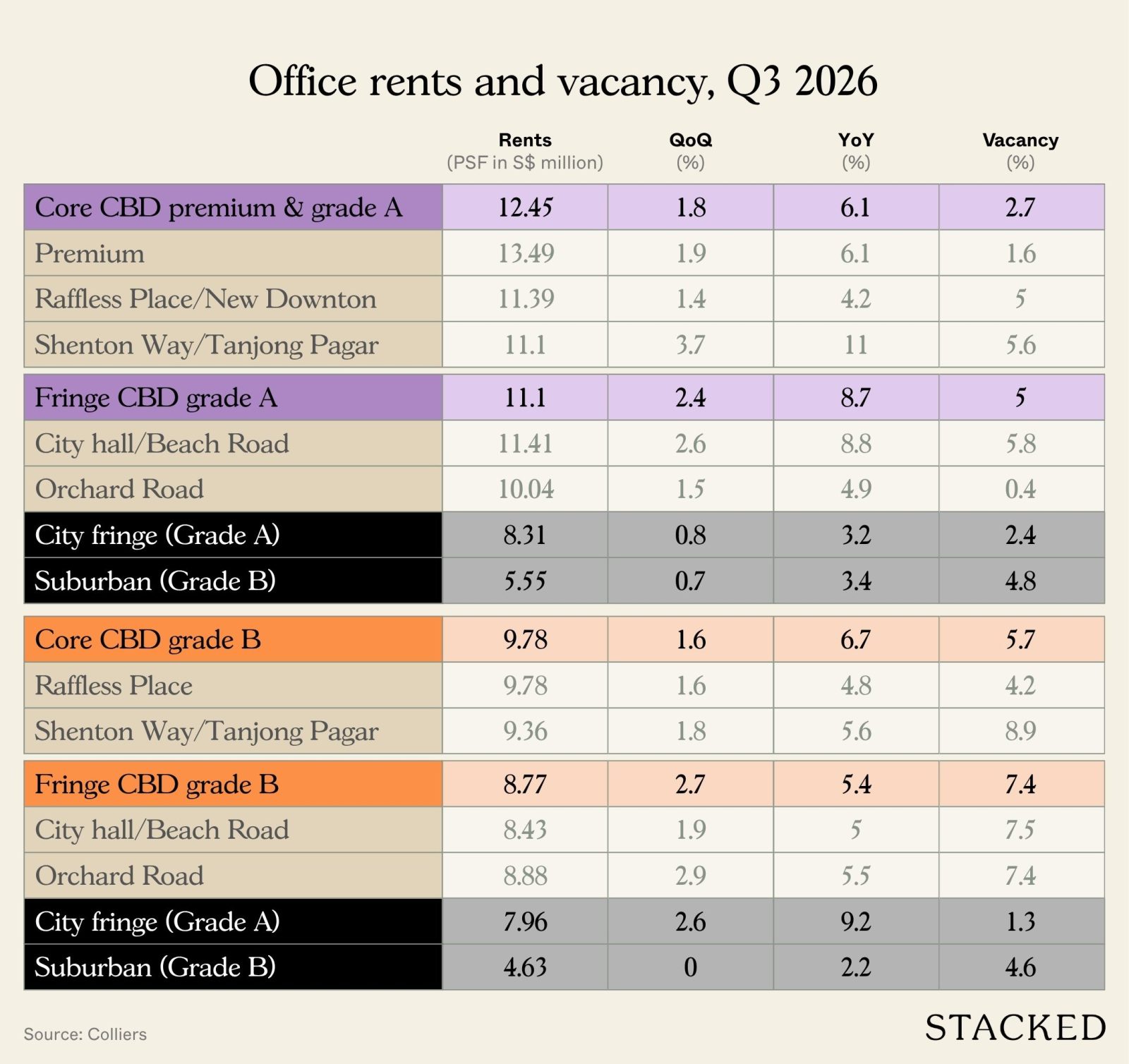
Colliers shares that Core CBD Grade A rents grew 6.1% y-o-y in 3Q2026, while other office segments (Fringe Grade A, Core CBD Grade B and Fringe Grade B supply) also grew, between 5% and 9% y-o-y, depending on the segment.
How Has This Translated Into The Performance Of HK and Singapore Office REITs?
In general, the performance of the office real estate investment trust (REIT) market shows that picking the right asset matters as much as picking the right city.
Keppel REIT is one of the most office-focused S-REITs, with stakes in Ocean Financial Centre, Marina Bay Financial Centre and One Raffles Quay. About 79% of its portfolio is in Singapore, with the rest in Australia, South Korea and Japan.
According to financial intelligence firm Morningstar, the REIT was trading at about S$0.86 in early September, around 30% below the REIT’s net asset value, and with a yield of about 6.1%.
On the other hand, Suntec REIT and CapitaLand Integrated Commercial Trust (CICT) have fared better. Suntec REIT is one of the few S-REITs that are trading higher this year, about 1.4% as of early September, according to Morningstar. Its Singapore offices are almost fully let, and rents on renewed leases rose about 10% in the first half of 2026.
Meanwhile, CICT, Singapore’s largest REIT, raised its payout per unit by 7.1% in the first half of 2026, and has been trading above the value of its assets.
Hongkong Land, a property company with offices in both cities, has done better still. Besides its Central portfolio, it manages and invests in the Singapore Central Private Real Estate Fund (SCPREF), which holds stakes in One Raffles Quay, Marina Bay Financial Centre Towers 1 and 2, and Asia Square Tower 1.
Its shares have climbed about 44% from their 52-week low to around US$8.50, a sign of growing confidence in its Central offices. Even so, as of September they traded about 40% below book value and yielded around 3%, below the roughly 5% offered by Singapore office REITs.
That performance isn’t just down to Hong Kong. As a company rather than a REIT, Hongkong Land carries far less debt, which leaves it less exposed when interest rates rise, according to the Morningstar report.
Champion REIT, a Hong Kong-listed office REIT, shows that Hong Kong exposure isn’t enough. Although it owns Three Garden Road in Central, its payout per unit fell 9.7% in the first half of 2026. The office tower is about 82% occupied, and rents on its existing leases are still falling as older, pricier leases expire. The REIT's managers don't expect rent renewals to reverse this trend until next year at least.
Turning back to the Singapore and Hong Kong office market.
The traditional drivers of office demand in Singapore remain intact, with non-bank financial institutions continuing to expand. But occupiers are assessing their space requirements carefully, and there is no structural deterioration in leasing activity, says Colliers.
Looking ahead, Singapore's Ministry of Manpower described the labour market outlook as "positive but cautious" in its July business expectations polls, with firms pursuing growth while remaining measured on manpower expansion.
Meanwhile, in Hong Kong, prime areas like Central and West Kowloon are the preferred areas by global financial institutions and hedge funds. The rebound in Triple A office space will continue to be driven up by capital market activity and IPO activity.
But the focus for these occupiers in Hong Kong will be more polarised, with select areas benefitting from selective recovery, at the expense of secondary/non-core districts.


0 Comments