


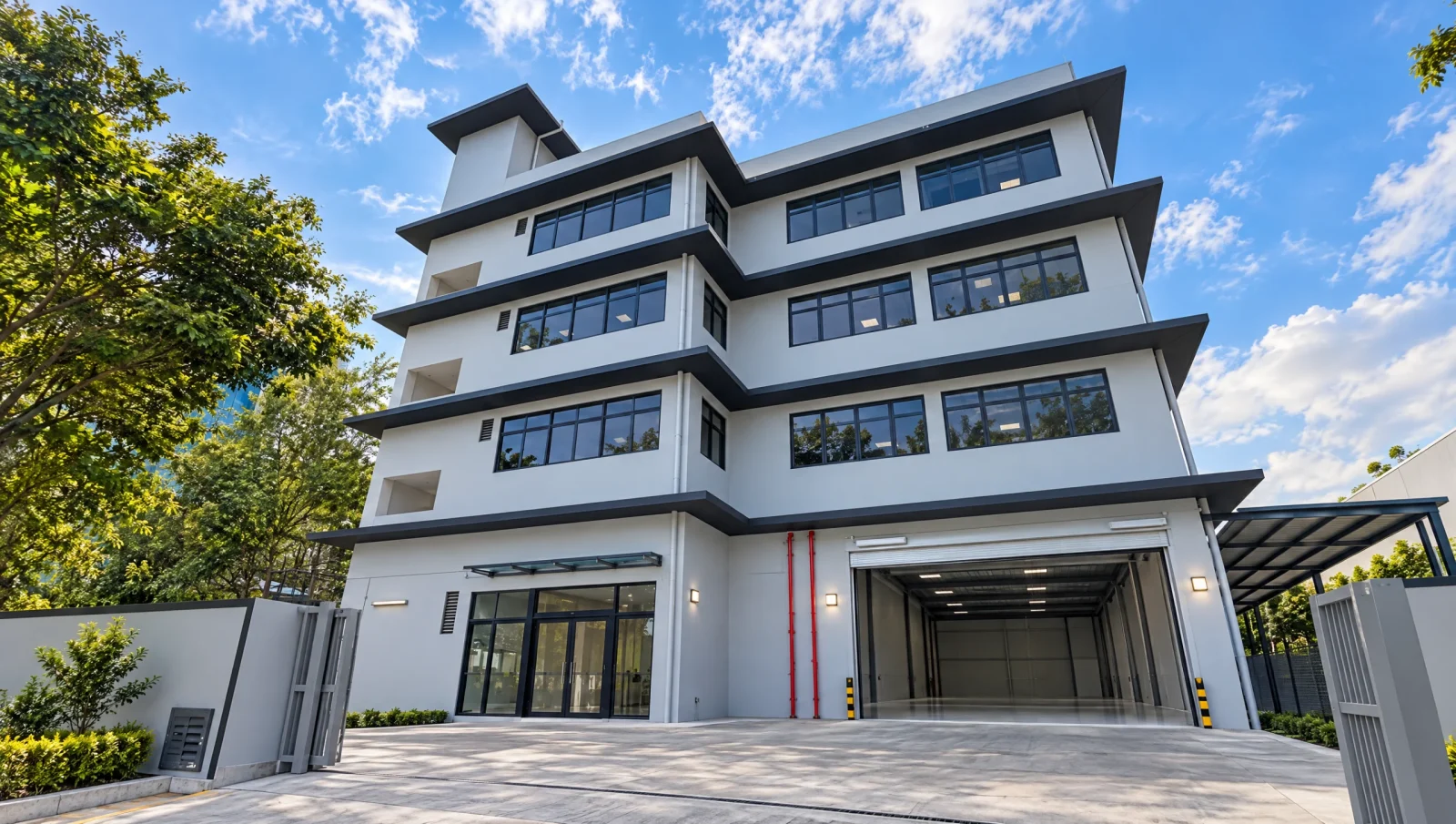
Two factory-converted workers' dormitories in Tuas have been put up for sale at a guide price of $20 million and $25 million, respectively.
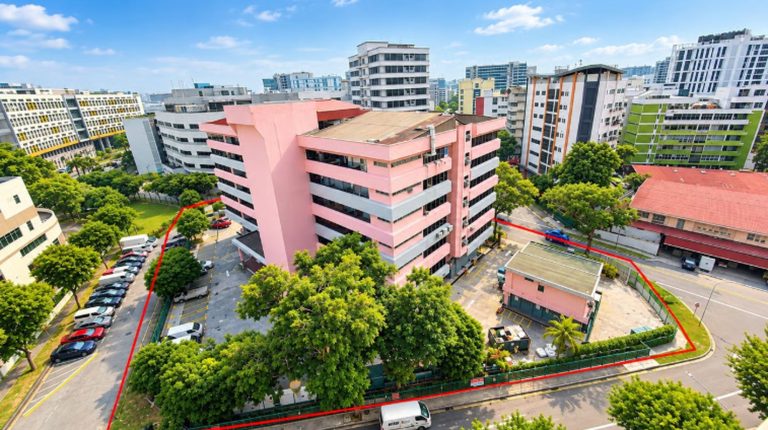
Both properties sit along Tuas View Close, and the more expensive $25 million property is a four-storey dorm. It obtained its TOP in 2026 and is fully tenanted. Crucially, the owner has applied for approval to add two more floors, which would raise its total capacity from 196 to about 250 beds, if approved.
The second property is a five-storey dorm with 200 beds, and has a price tag of $20 million. It is still under construction and is expected to be completed by September 2027.
According to Alan Lin at SRI, the exclusive marketing agent managing the sale of these two properties, the properties can be bought individually or collectively.
In all, the $45 million acquisition cost for both properties would add 396 beds, or about 450 if the upgrade is approved, to the portfolio of an asset owner or business owner.
Both industrial properties have 60-year leases that are approximately halfway complete. "Their tenure makes them more appealing compared to typical factories on JTC land, which need JTC’s approval before a sale," says Lin. He adds that JTC factories also carry a recurring land rent.
The seller is a local developer of industrial properties and landed homes.
Previously, the sites along Tuas View Close housed ageing factory properties, and the developer purchased them with the intention of redeveloping the plots into new mixed factory and dormitory buildings.
A portfolio of newly built worker dorms
Since the sites are zoned for industrial use, URA regulations state that dorms can account for more than 49% of each building’s floor area. The remaining 51% must remain for industrial use, such as production spaces.
The $25 million property sits on a 17,097 sq ft plot, with a built-up area of 32,406 sq ft. That works out to a land rate of about $1,462 psf, or about $127,600 per bed.
That property was completed about six months ago and is fully tenanted, with all 196 beds leased at approximately $500 per month. Besides the dorm, it has production spaces that can be used for storage or light industrial work.
At $500 per bed, the dorm brings in a total rental income of about $98,000 a month, or roughly $1.18 million a year. That’s a gross yield of about 4.7% based on the current guide price, before counting income from the production space.
Lin shares that the seller has also sought approval from URA for permission to add two more floors to the building, raising its total capacity to about 250 beds. "This move, if approved, would maximise the allowable built-up area of the site and boost the expected yearly rental income that the dorm would be able to rake in," he says.
Given how rare it is to find new workers' dormitories with this capacity on the market today, he is confident that prospective buyers will recognise the value of the property and its competitive but fair price.
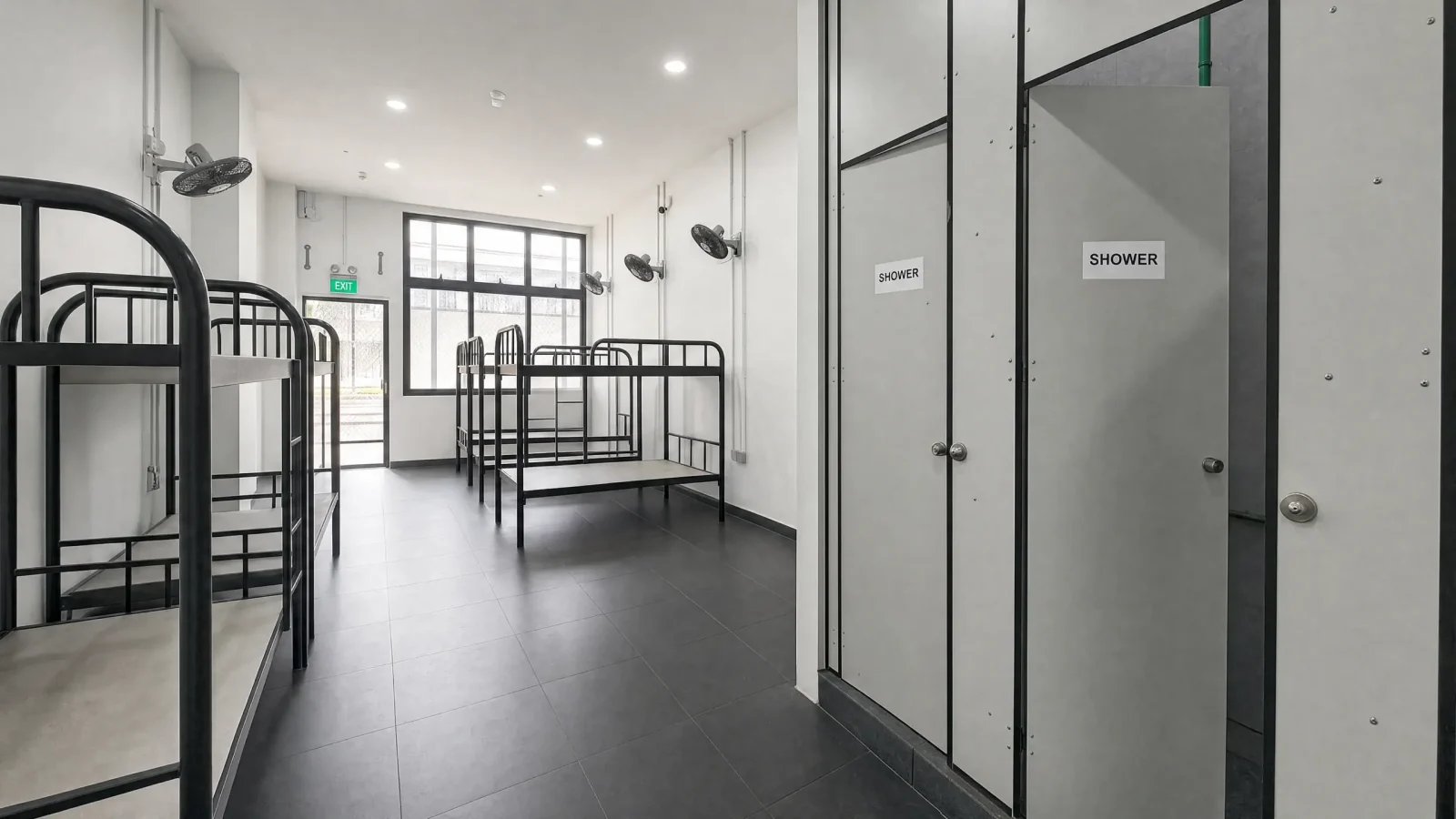
On the other hand, the $20 million property sits on a smaller plot of 14,807 sq ft, but the property has a larger built-up area of 36,983 sq ft spread over five floors. The asking price works out to a land rate of about $1,351 psf, or $100,000 per bed.
Alongside its 200-bed dorm, it will have production space, a minimart and a canteen, which can be leased to small business tenants. The property is expected to obtain its TOP in September 2027.
Purpose-built dorms vs factory-converted dorms
Factory-converted dorms (FCDs) make up a relatively small slice of the industrial real estate market in Singapore, and most fall under MOM’s Class 2 (100 to 299 beds) or Class 3 (300 to 999 beds) licences.
These types of properties typically sell at much lower prices compared to the large-scale Purpose-built Dorms (PBDs), which are usually designated Class 4, with 1,000 beds or more.
Familiar institutional operators for these large-scale PBDs include Centurion, which has a portfolio of about 41,900 beds in Singapore. Its market share means that it owns roughly one in 11 of worker dorm beds in the country.
Centurion Accommodation REIT debuted on the Singapore Exchange last year, and marked the first pure-play portfolio of purpose-built worker and student housing assets on the mainboard. It had an initial market capitalisation of $1.51 billion, and raised a total of $771.1 million during its initial listing.
Investment interest in the worker dormitory segment has grown as the sector has increasingly become institutionalised on the back of rising demand, as industrial businesses and manufacturing companies increase their headcount of foreign workers in Singapore.
Last year, US-based private equity firm Bain Capital bought over a Singapore worker housing portfolio from international asset manager Blackstone. The portfolio included a set of four PBD properties in a deal worth $750 million.
However, FCDs serve a different group of owners and buyers: namely smaller capitalised investors, or construction and manufacturing firms that want to run their business and house their workers in one site.
In general, FCDs are either 'ancillary' or 'secondary' components of an industrial property. Ancillary dorms can only house the factory owner’s own workers, while secondary dorms can also house other companies’ workers.
The pair of Tuas properties for sale are secondary dorms, which makes them flexible for owner-occupiers and investors alike, says Lin. He adds: "The purchase price is within the budget of most local business owners, who usually have about less than 100 foreign workers".
Lin says that many Singapore-based construction firms with 100 to 200 workers could run their office and warehouse from the production space and house their workers on the same site. “Most of the enquiries we’ve been getting [are from] end users,” he says.
Dormitory sector experiencing increased growth
Singapore had 467,328 dorm beds across 1,566 dormitories as of June 2026, according to MOM data cited by the Dormitory Association of Singapore (DASL) and Knight Frank.
At least six more PBDs, with around 47,000 beds, are due to be completed over the next few years, including MOM’s second government-built dorm at Sengkang West.
Demand is also rising alongside supply, with the number of work permit holders in construction, marine shipyard and process industries increasing each year. Singapore had 482,600 work permit holders as of December 2025, a yearly increase of 5.6%.
Meanwhile, there has been an unbroken increase in rental growth rates since the end of the Covid-19 pandemic. When borders reopened, builders rushed to clear a backlog of delayed projects and hired more foreign workers as a result.
The average monthly bed rent rose 83.3%, from $270 in the first half of 2019 to $495 in the first half of 2026, according to DASL and Knight Frank. Rents in the west, including Tuas, averaged $460, compared with $535 in the central zone and $525 in the east.
Overall, occupancy rates also shot up after the pandemic, with islandwide dorm occupancy rates growing from about 70% in H22020, to over 95% in H12026. From January to June 2026, the west saw the tightest occupancy rates in Singapore at 98.3%, though islandwide occupancy eased to 95.8% as new beds were progressively completed.
Institutional investment demand is growing for quality dormitory assets
Investment interest in workers’ dormitories as a mainstream asset class has grown in recent years, as investors pick up on the attractively high yields that these properties have been able to attract, according to Lin.
He adds that a completed, or soon-to-be completed, industrial property with a component of worker dorms rarely comes up for sale. And when it does, it is quickly snapped up.
There is also a strong preference for newer properties, or recently renovated dorms, which is due to heightened MOM dormitory standards. Under the Dormitory Transition Scheme, most existing dorms must be retrofitted to better living standards by 2030.
"As asset owners focus on retrofitting their dormitories, we will likely see some downtime in the worker dormitory market as some properties operate on reduced capacity or shut down for renovations," says Lin. He expects that it will take the market at least six months to reposition most of the smaller capacity dorms, and up to two years for the larger PBD properties to meet the new standards.
Looking ahead, the pipeline supply could tighten again as operators retrofit older dorms to meet MOM’s new standards by 2030. The government has also stepped up land supply for PBDs to fill in this gap. Five sites, totalling about 40,200 beds, are being released between 2026 and early 2027.
During this period of transition in the industry, the market has accounted for temporary closures to push up demand for dorms that already comply with the new standards, says Lin.


0 Comments