


Shophouse transactions in Singapore hit new lows this year, with just 75 recorded transactions year-to-date. This year also recorded the lowest transaction volume in the past nine years, according to a latest market report by Huttons Asia.
The sales figure compares relatively poorly to 92 shophouse deals recorded in 2025, and the strong sales record in the years that preceded it. Transaction data indicates that the shophouse market last peaked in 2021, when there were over 250 shophouses which changed hands.
Five years ago, market volatility caused by the Covid-19 pandemic caused investors to flock to safe assets, increasing demand for big-ticket and long-tenured shophouses, such as conservation shophouses. The total value of shophouse deals in 2021 reached more than $2 billion.
The transaction volume then declined to new lows in 2024 before rebounding slightly in 2025. In terms of total sales volume, the market report by Huttons states that this year will likely end with a total sales volume worth $675 million, an 18% decrease compared to the $823 million registered in 2025.
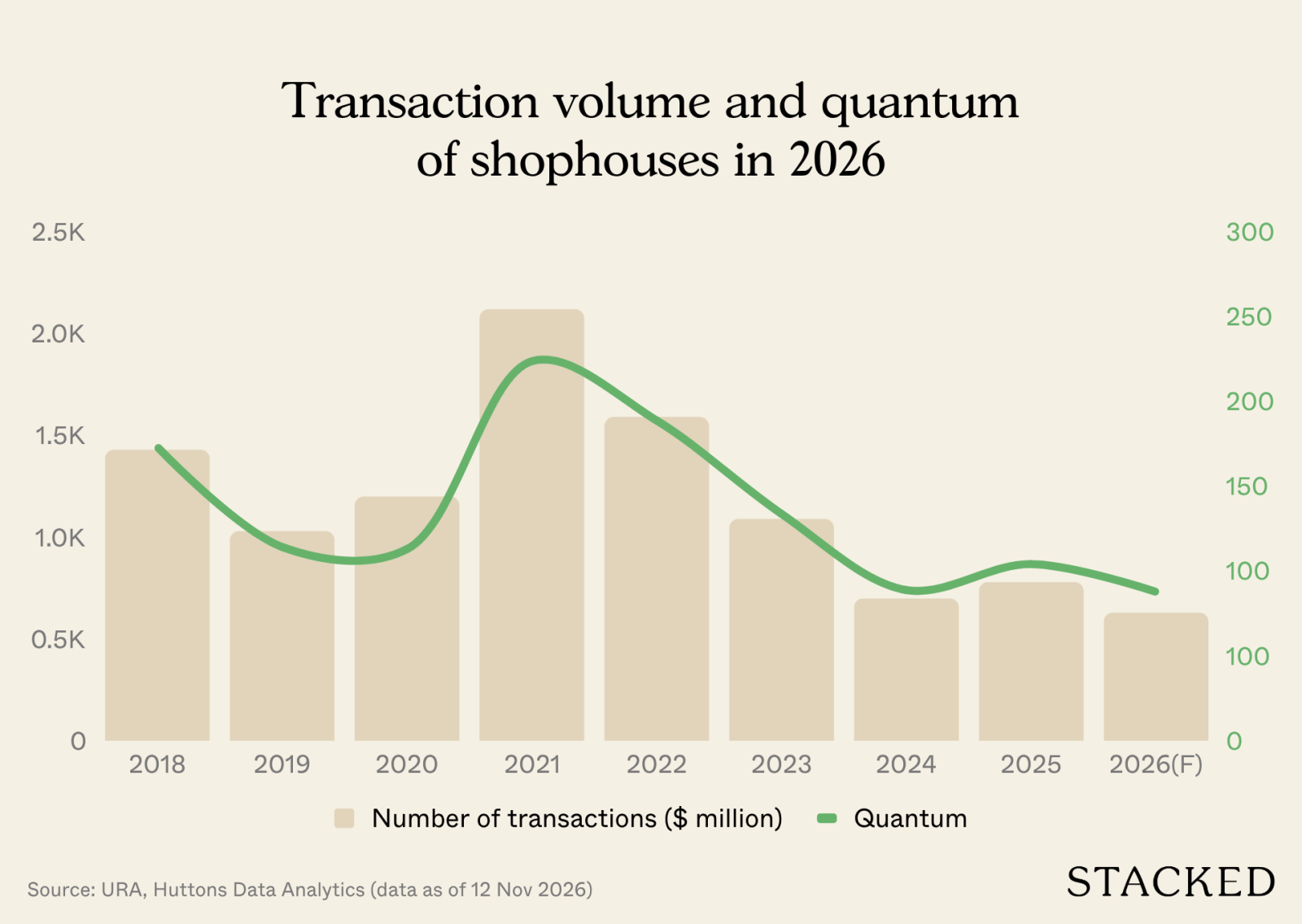
The market report by Huttons states that the total sales value of registered shophouse deals has declined decisively in the last five years. In 2026, retail investors accounted for the majority of shophouse buyers, and they primarily targeted sub-$10 million assets in Districts 7 and 8.
On the other hand, many institutional property funds focused on investment-grade shophouses with value-add potential. Shophouse properties in Districts 14 and 15 also remained popular among investors, says Huttons.
A greater proportion of smaller-ticket deals closing
The report by Huttons also points to the US-Iran conflict that started in February this year and shocked global markets, as the chief cause behind a more cautious sentiment among real estate investors this year.
In the first three months of this year, over 60% of shophouses sold went for less than $5 million. This was also the quarter that saw the highest proportion of so-called 'small-dollar' shophouse sales since 2Q2020, according to the Huttons report.
With most investors taking a less-than-optimistic geopolitical outlook, investors who still want to close deals will likely focus their buying attention towards smaller value properties that come with relatively less risk and loan quantums.
Shophouses that are listed for less than $5 million are mainly 99-year leasehold properties in non-central regions, or smaller-sized properties that have a built-up area of less than 2,000 sq ft.
However, the report also shares that Huttons believes investment confidence will gradually return to this supply-constrained segment as the market and investors make the assessment that most of the geopolitical risks are largely contained.
The dip in shophouse sales this year is due to the limited availability of capital that can be deployed
There's a strong chance that the lower volume and transaction quantums in the shophouse market this year are the result of a price expectation mismatch between buyers and sellers this year, as opposed to low average yields.
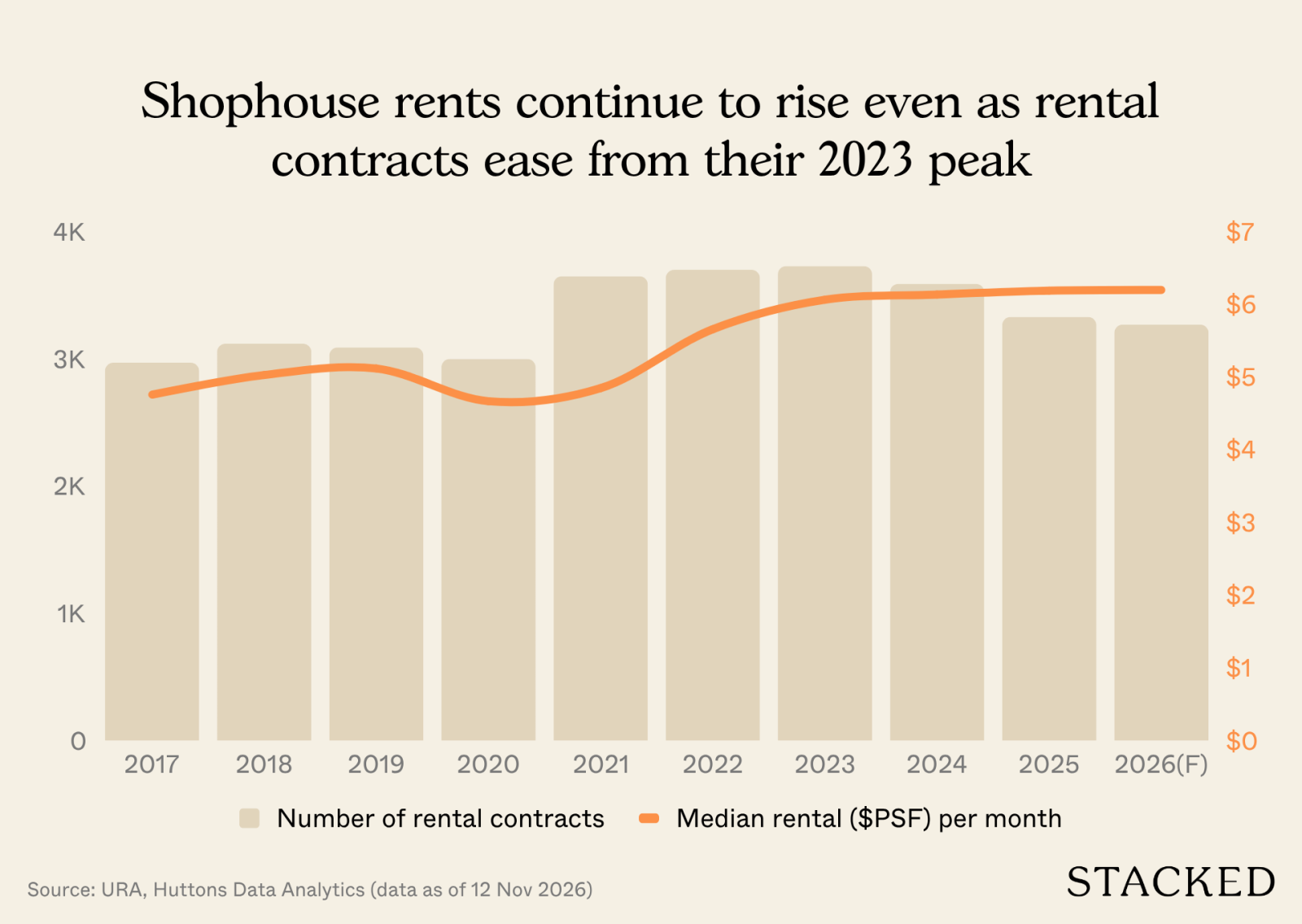
In general, shophouse rents have been relatively steady compared to recent price movements. Rents fluctuated between $5 and $6.50 psf per month in the last 9 years, and average shophouse rents were about $6.50 this year, unchanged since 2025, according to data compiled by Huttons.
Buyers who face higher hurdles deploying capital this year also expect prices that are much lower than most sellers' expectations.
Especially in the shophouse segment, sellers are less likely to budge if they deem an offer is too low, because of the persistent demand to own this asset class in Singapore as well as the scarcity of the asset itself. There are approximately 6,500 historic conservation shophouses in Singapore.
"As investors look for entry points into the market, many are turning to 99-year leasehold shophouses, which offer a more accessible price quantum," the report said.
The largest shophouse deal this year was a three-unit portfolio sale at Holland Village
Singapore family office TL Developments paid $70 million for three adjacent freehold shophouses at 29B/29C, 31/31A and 33/33A Lorong Liput earlier this year. The properties have a combined built up area of 7,542 sq ft.
The family office bought the properties with their existing tenancies, which included a Pet Lovers Centre, Natureland Spa, Tai Cheong Bakery, Yee Cheong Yuen Noodle Restaurant, and a coffee shop in the Holland Village enclave.
If no other transactions towards the end of the year top this, then it'll be the largest transaction this year.
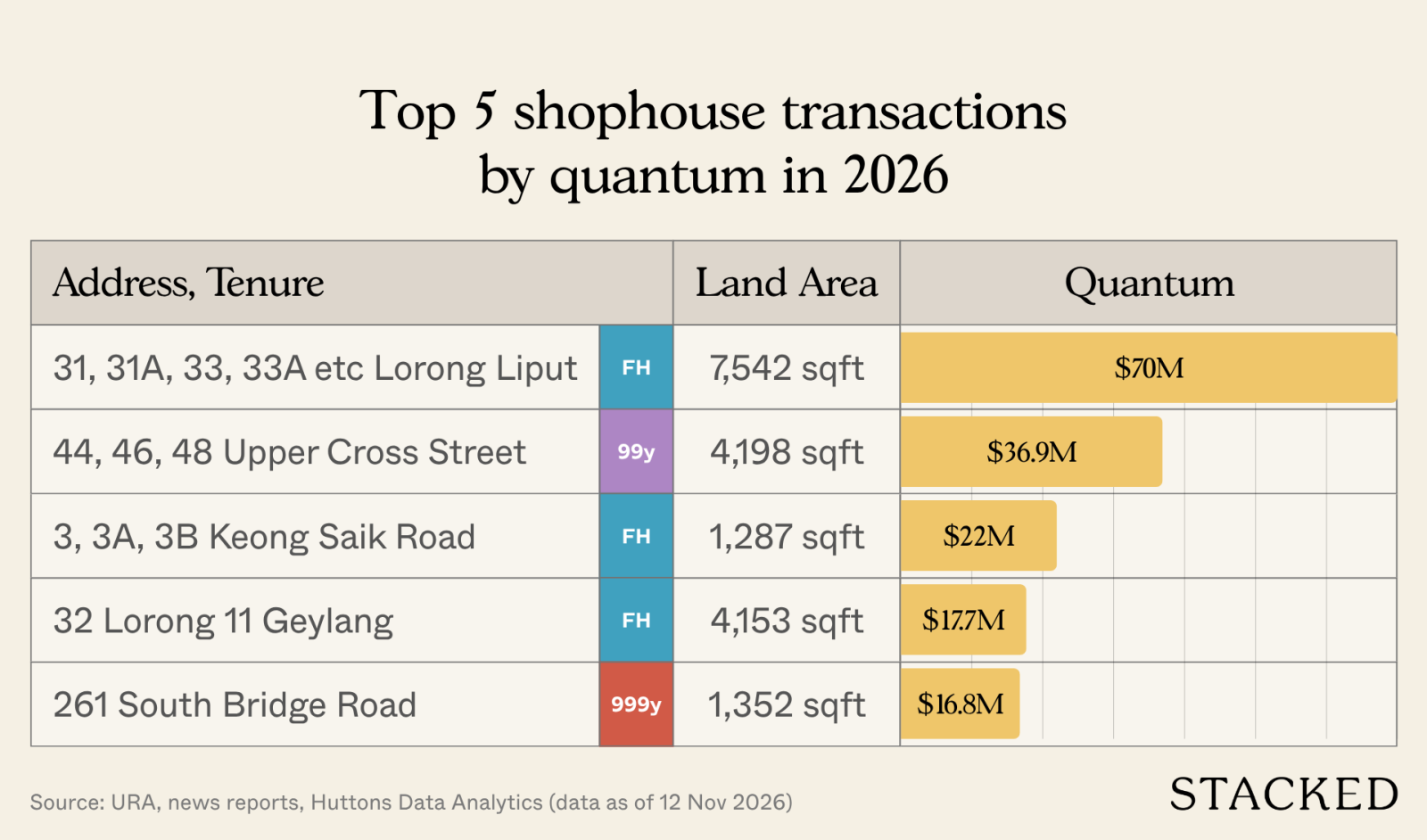
That portfolio deal came ahead of a $36.9 million sale for a trio of shophouses at 44, 46 and 48 Upper Cross Street. The 99-year leasehold shophouses operate as a mixed-use commercial development with 17 serviced apartments on the upper floors and three retail units at street level.
The second-runner up will likely be the sale of a freehold shophouse in Keong Saik that was sold for $22 million to a Japanese family office. That property has a total built-up area of 1,287 sq ft, according to Huttons.
Outlook for the shophouse market in 2027
As one of the few commercial real estate asset classes with minimal foreign ownership restrictions in Singapore, shophouses will always stand to benefit from finite supply and tightly held ownership.
Moreover, Singapore remains a premier hub for ultra-high net-worth individuals to preserve and manage wealth in the city-state. This is reflected in the number of family offices that can be found here, which surpassed 2,000 at the end of last year.
While the prospect of rising interest rates may compress the spread between net yields and borrowing costs, prompting some buyers to pivot toward lower-quantum assets, overall transaction activity is set to rebound, the Huttons report states.
The agency predicts that the sales volume in the shophouse market could see about 130 deals closed, as buying interest picks up in the coming months.


0 Comments