


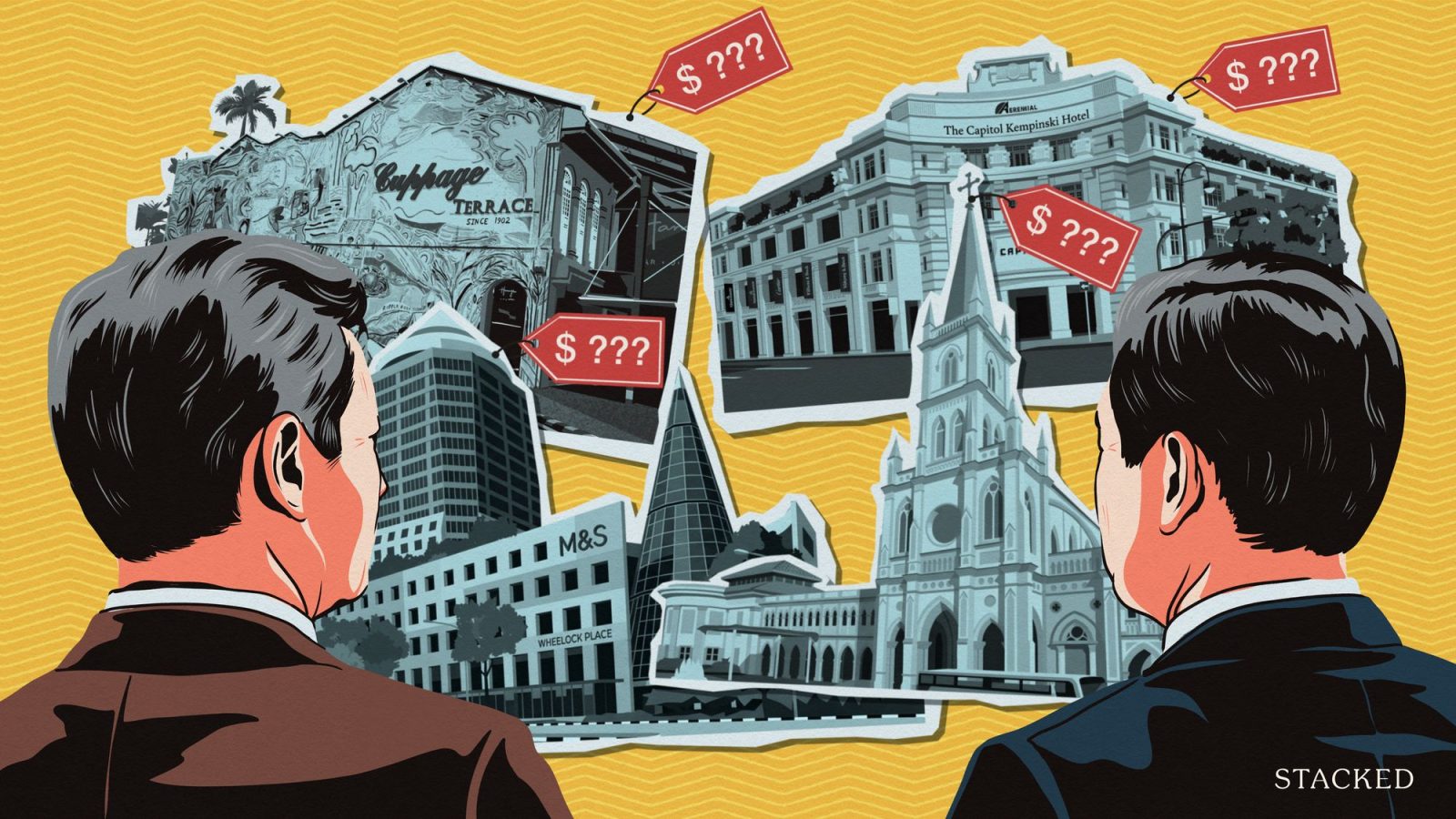
Prime real estate in Singapore has always caught the eye of international investors and asset managers, but this year we saw two prominent property conglomerates move decisively deeper into Singapore's commercial property market.
These two international real estate conglomerates have bought, or are deliberating buying, some of Singapore’s best-known buildings, and this is elevating their market presence in Singapore's real estate scene.
Hongkong Land and IOI Properties have closed several big deals this year, and are reportedly in talks to acquire more prime assets, rounding out their portfolio with some of Singapore's best-known buildings. If these deals close, they could collectively be worth about $11 billion.
In October, news reports emerged that the real estate companies were in talks to potentially acquire properties like One Raffles Place, CHIJMES, the Capitol Kempinski, as well as some prime Orchard Road malls.
It's the latest in a developing trend that we have noticed this year, which has seen an uptick in big-ticket deals for Singapore’s landmark buildings, or 'marquee assets.' These are prestigious, valuable and strategically located properties.
The market for these multi-million deals was considerably busy last year too. Total yearly investment sales volume hit S$36.1 billion, the highest that the market had seen in eight years, according to market data compiled by Colliers.
But this year is a different ball game altogether. So far, we've seen the likes of CapitaLand Integrated Commercial Trust (CICT) agree to buy Paragon shopping mall for S$3.9 billion; meanwhile, Malaysian property group IOI Properties paid about S$2.48 billion for Asia Square Tower 2.
Singapore's marquee assets are extremely capital intensive to acquire, and they often require investors to take out large loans and have low yields compared to their purchase price.
So why are buyers moving now, especially with borrowing costs also edging up?
In short, the Middle East conflict and an uncertain rate outlook have made buyers more cautious, slowing deals in the third quarter, according to a market analysis by Savills published last quarter.
But 2026 as a whole has seen the most investment sales in Singapore on record, suggesting that Singapore stands as a preferred destination and safe haven for long-term real estate investment in an uncertain global environment.
Other deals this year are also focused on redevelopment opportunities, encouraged by some URA incentive schemes. On the other hand, a few are part of capital recycling strategies by REITs and real estate managers to sell mature buildings to fund new ones.
Keen purchasing and investment activity by IOI Properties
Malaysian developer IOI Properties, which still has a significant proportion of its investment assets in Malaysia and other international markets, owns about $12 billion of prime Singapore commercial space. Its flagship property in Singapore is IOI Central Boulevard Towers, one of the newest Grade A office skyscrapers in the Central Business District.
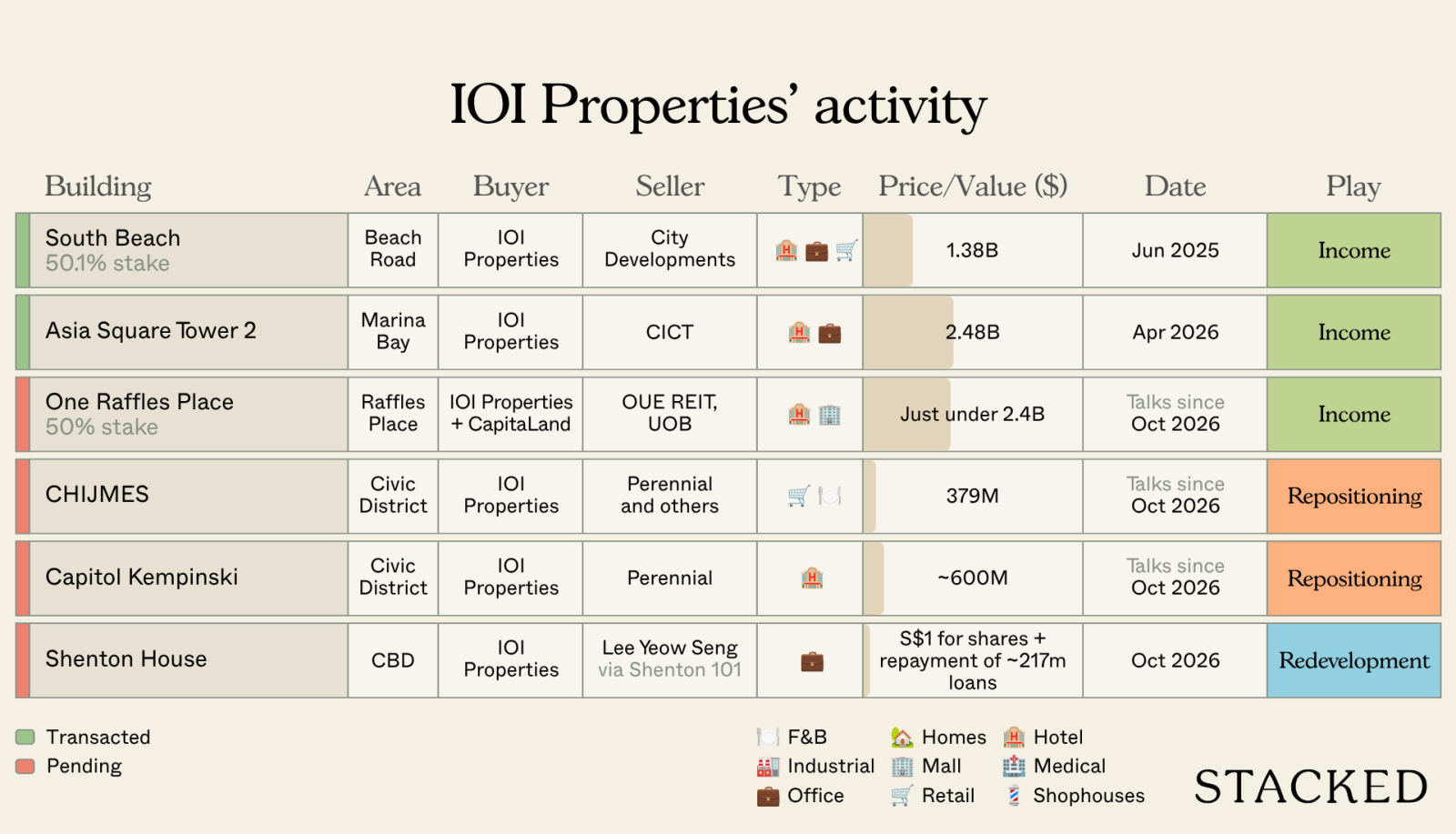
Last year, the company also paid S$1.38 billion for City Developments’ 50.1% stake in South Beach. This year, it agreed to buy Asia Square Tower 2 for about S$2.48 billion, and it is in talks to buy over CapitaLand Investment's stake in One Raffles Place, in a deal that is said to be worth just under S$2.4 billion.
News reports also suggest that IOI is looking to increase its investment in some key buildings in the Civic District. It is currently conducting due diligence on a deal to acquire CHIJMES and the Capitol Kempinski Hotel, which may be bundled into a deal worth about S$979 million.
Hongkong Land is also increasing its investment portfolio of Singapore properties
Hongkong Land is already one of the biggest landlords in Hong Kong’s Central district.
The company describes its focus as “ultra-premium” property in Asian gateway cities, from Grade A offices to luxury retail. It also owns prime property in Hong Kong, as well as in mainland China and Jakarta.
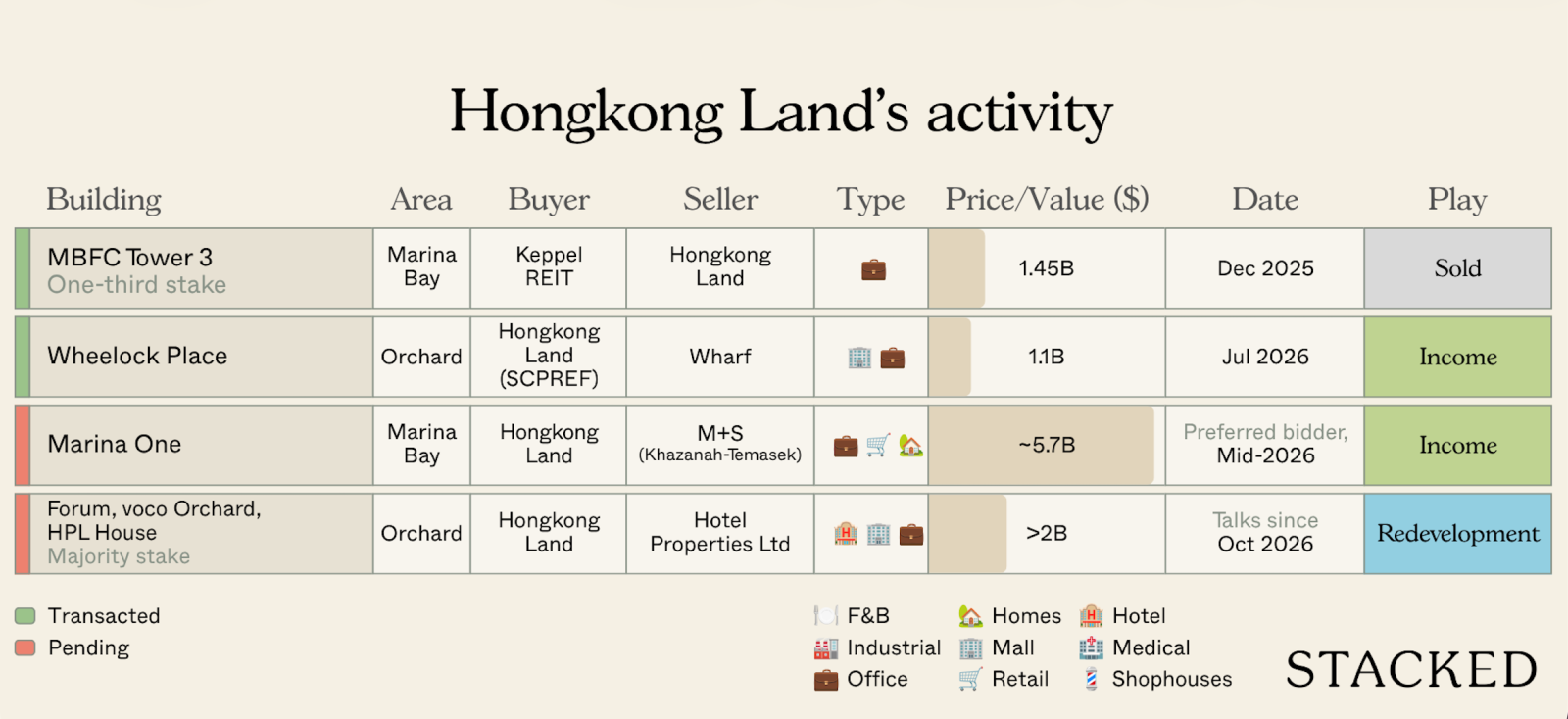
The company launched the Singapore Central Private Real Estate Fund (SCPREF) in February this year with S$8.2 billion of assets, backed by Qatar Investment Authority and Dutch pension fund APG. The assets comprised prime office properties including MBFC, One Raffles Quay, One Raffles Link and Asia Square Tower 1.
The group has also divested some of its assets and recycled the capital to fund new acquisitions. It sold its stake in MBFC Tower 3 for S$1.45 billion in December. In July, its new fund bought Wheelock Place for about S$1.1 billion, with the help of extra equity from Hongkong Land.
Hongkong Land is reportedly in the lead to buy Marina One, which was marketed for about S$5.7 billion. Market analysts expect that the building will likely end up as an asset under SCPREF.
The company is also in early talks to buy a majority stake in three Orchard Road buildings owned by Hotel Properties: Forum Mall, the voco Orchard hotel, and HPL House.
It's not just these two property groups which have been active in the market
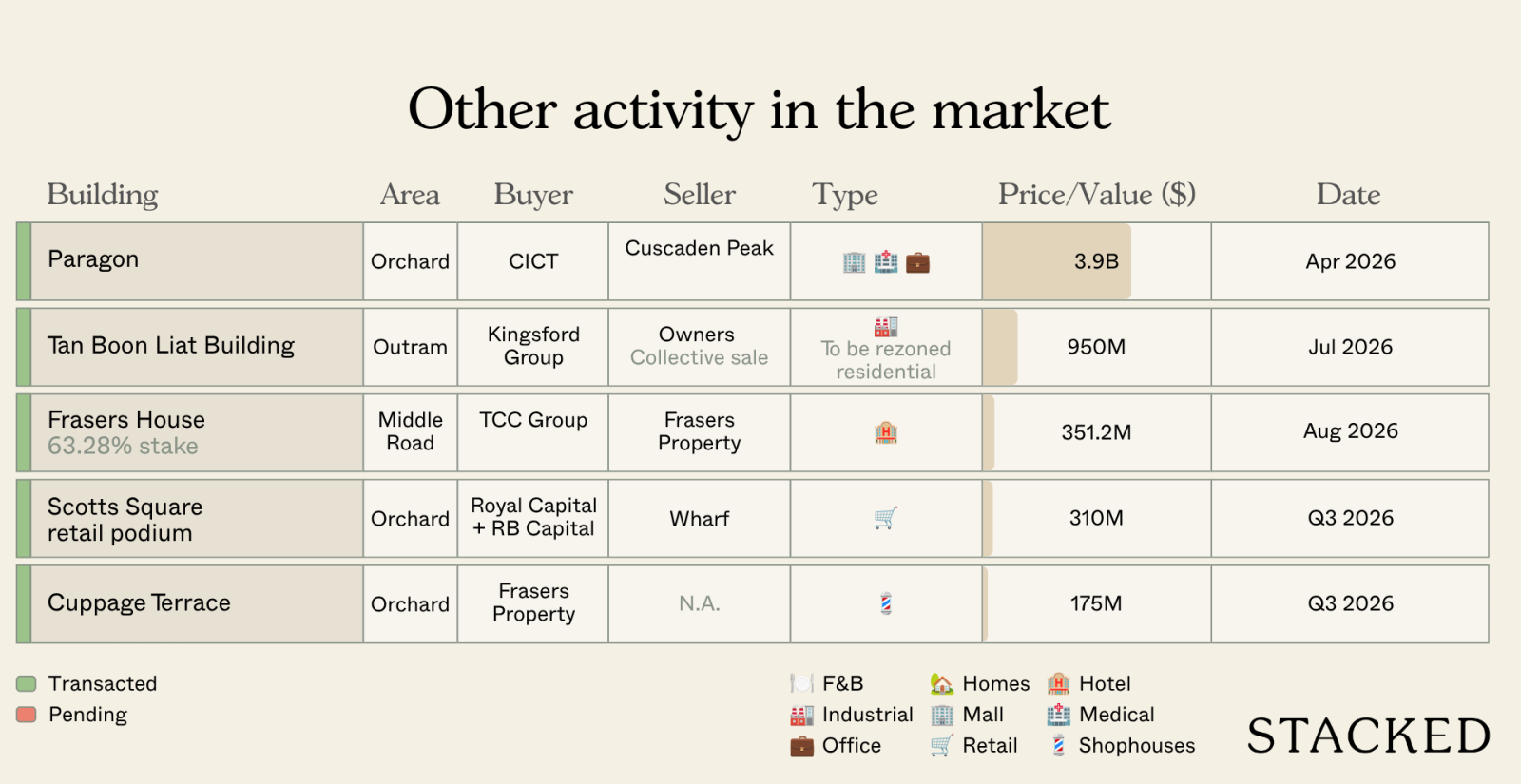
In April, CapitaLand Integrated Commercial Trust bought Paragon for S$3.9 billion, one of the year’s biggest property deals in Singapore.
Likewise, Hong Kong's Wharf Real Estate Investment Company exited Singapore completely, selling Wheelock Place to Hongkong Land’s fund and Scotts Square retail podium to Royal Capital and RB Capital for S$310 million.
Local players have also been busy finding deals and closing transactions. Frasers Property bought the rear plot of The Centrepoint in a S$391.9 million collective sale, then picked up Cuppage Terrace, a row of 17 conservation shophouses next door, for S$175 million from Royal Holdings.
The high purchase price could suggest that some of these brand-name trophy assets may record relatively low yields in the long run. But they more than make up for it in terms of absolute capital gains.
Furthermore, over the past few months, the positive yield spread over the cost of borrowing has shrunk because financing costs have ticked up. When the interest rate on loans sits between 2 and 2.5% in 3Q2026, the immediate net cash return is tight.
But despite low yields and high borrowing costs, institutional funds and international asset managers are still pouring billions into these trophy assets. IOI's net debt reached about 85% of equity by the end of June this year. But the developer said it plans to ease the load by bringing in outside investors through a private fund and a Singapore REIT targeted for 2027.
So Why Are Investors Still on the hunt for assets to acquire?
A handful of prime commercial buildings - especially Grade A Core office developments like Marina One, One Raffles Place and Asia Square Tower 2 - are seen as attractive investments for a wide range of institutional investors.
This is especially true as uncertainty in most international capital markets has led to a persistent 'flight to quality' trend amongst investors.
Even though some of these trophy assets may be recording relatively low yields, they are some of the most rentable properties in Singapore, as tenants are often large financial and technology firms, says Jeremy Lake, Managing Director, Investment Sales & Capital Markets, at Savills Singapore.
As a result, demand for tenancy is unlikely to wane, even during potential economic downturns, he says. Moreover, these properties are also seen as a good store of value, on top of their steady rental income and low vacancy rates.
Conservation shophouses are often seen the same way. Their supply is fixed, many sit on freehold land, and commercial ones carry no ABSD, which makes them popular for family offices looking to acquire wealth-preservation assets.
That was likely the thinking behind Frasers Property's acquisition of a row of 17 Peranakan shophouses on Orchard Road, best known for its strip of bars and restaurants, known as Cuppage Terrace, for $175 million.
"Singapore offers diversification and is a stable and low-risk market which appeals to many overseas-based real estate players and investors. In addition, the Singapore currency is strong," said Lake, adding: "Different investors have different motivations, but these factors are foundational."
A Wave of Capital Recycling might be upon us
There is a chance that the investment market in Singapore could see a wave of marquee asset transactions in the coming months, as the timeline for previous big-ticket transactions means that many asset owners will be looking to capitalise on gains earned these past few years.
At the moment, most REIT units are trading below the book value of their buildings. At this price, it's not lucrative for REITs to raise funds by issuing new units, and it's better to sell off their assets to free up cash for new deals.
Commenting on the sale of Asia Square Tower 2 to IOI for S$2.48 billion in April, CICT reportedly said that the assets had “reached a mature phase in its property cycle".
In the eyes of several market watchers, this is the perfect storm for a marquee sale: a property group looking to free up some cash to buy elsewhere, while a foreign company looks for a prime asset to make a splashy entry into Singapore's market.
Hongkong Land has done the same. In December 2025, it sold its stake in Marina Bay Financial Centre Tower 3 to Keppel REIT for S$1.45 billion, counting the sale towards its goal of recycling up to US$10 billion of capital. In July, its new private fund, SCPREF, bought Wheelock Place for about S$1.1 billion.
But some asset divestment and acquisition moves will be focused on redevelopment opportunities in Singapore. This may be the case for several Orchard Road assets which are primed for redevelopment or repositioning in the next few years.
Some developers will tap into the government's incentives, which are aimed at supporting developers in upgrading key precincts along Orchard Road, with the lure of unlocking larger square footage in the prime retail district.
"Redevelopment opportunities along Orchard Road are highly sought after. There will always be buyers if the price is not excessive," says Lake, adding that the government is also trying to revitalise Orchard Road, which excites many existing property owners there.
However, prime Orchard Road assets are rarely available for sale, and properties usually stay with their sponsors as an anchor to their portfolio. But this year, Wharf Real Estate Investment Company exited Singapore entirely after selling its remaining assets here - Wheelock Place and the Scotts Square retail podium.
"There are few top-quality premium office buildings for sale, so availability is the issue. These are the ones which investors are keen on," says Lake.
Most developers will be looking towards URA's Strategic Development Incentive Scheme, which allows owners in strategic locations (including Orchard) to apply for more floor area or a change of use if they redevelop, unlocking real estate equity.
But since the plan is for large-scale urban transformation, often owners have to collaborate with their neighbours to be eligible for the incentives. From a commercial and operational standpoint, developers almost always prefer to acquire the entire stretch of land outright rather than team up externally, which might explain some of the aggressive acquisition we've seen on Orchard Road's retail belt.
Several owners have already used the schemes. HPL won approval to combine its three adjoining plots, home to Forum, voco Orchard and HPL House, into a single 1.23 million sq ft mixed-use project. Faber House, now becoming a NoMad hotel, is another SDI project on Orchard, which Hongkong Land is reportedly in talks to buy.
Lake also said that these retail assets are higher yielding compared to most prime office developments in the CBD at about 4 to 5%, since owners have to take on more risk with less certainty in retail income than office space.
But the opportunity isn’t limited to Orchard. IOI is also betting on the Civic District and its potential as a lifestyle-luxury hub.
If IOI’s negotiations for CHIJMES and the Capitol Kempinski go through, it plans to reposition the buildings to accommodate more luxury offerings.
This includes bringing in luxury fashion retailers into CHIJMES and replacing Kempinski with an ultra-luxury hotel brand. This move would round out the group's foothold in the civic district, alongside South Beach and its JW Marriott hotel nearby.
Overall, the landscape of big-ticket marquee assets in Singapore looks set to be even busier next year. This could have repercussions in the coming years as familiar malls and office buildings change hands and welcome a new tenant mix.



0 Comments