



When a married couple separates but does not formally divorce, what happens to the properties that either spouse goes on to buy?
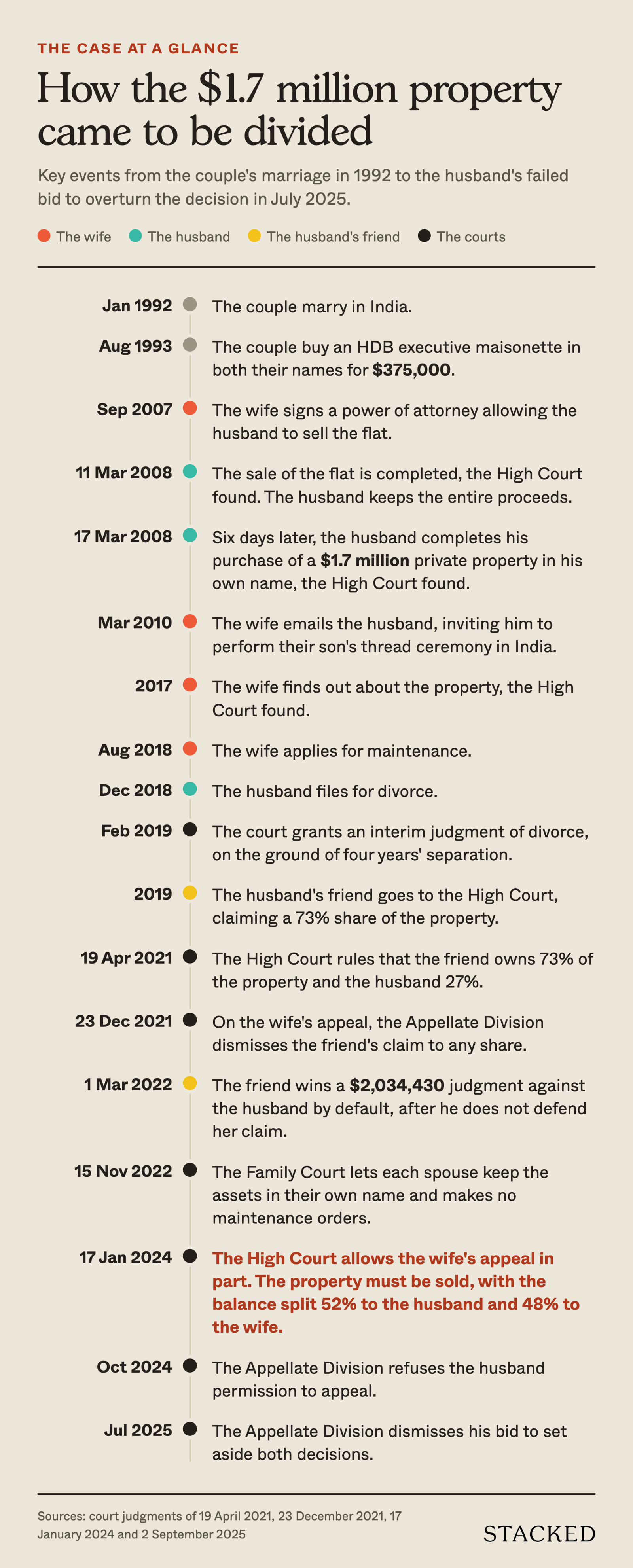
In one case, a husband sold the couple's HDB flat in 2008 and bought a $1.7 million private property in his own name, without his wife's knowledge. She would only find out about the property nine years later.
When the couple eventually divorced, the Family Court ordered that each spouse retain the assets held in their respective names.
The High Court, however, came to a different conclusion.
In a judgment on 17 January 2024, Senior Judge Chan Seng Onn found that the private property had been purchased entirely with matrimonial assets. He ordered that the property be sold, with the wife entitled to 48% of the remaining proceeds after certain deductions.
The wife had agreed to sell their HDB flat on the understanding that they would buy another home
The couple married in India in January 1992, and bought an HDB executive maisonette in Singapore for $375,000 the following year. The flat was registered in both their names.
For much of their marriage, the husband lived in Singapore while the wife lived in India, where she raised their son almost single-handedly.
In September 2007, before returning to India, the wife signed a power of attorney authorising her husband to sell the flat on her behalf.
According to the wife, she had agreed to this because her husband had promised to buy them a bigger home. While the husband denied making such a promise, the High Court judge subsequently accepted the wife's account that she had agreed to the sale on the understanding that the flat would be replaced with another property.
The couple separated in September 2007.
Their HDB flat was sold in March 2008, and the husband retained the entire net proceeds, comprising $121,247 in cash and about $162,543 refunded to his CPF account.
That same month, he completed the purchase of a $1.7 million private property in his sole name.
The wife only found out about the property in 2017. She applied for maintenance in August 2018, and about four months later, the husband filed for divorce. An Interim judgment was granted in February 2019.
The Family Court initially allowed each spouse to keep the assets in their own name
In November 2022, the Family Court judge found that the only matrimonial asset to be considered was the HDB flat.
The judge considered the wife's claim that the proceeds from the flat had been used to purchase the private property to be an afterthought, given that more than a decade had passed.
Taking the view that the marriage had effectively ended much earlier, the judge ordered a clean break, with each spouse retaining the assets held in their respective names.
The wife appealed to the High Court.
One of the arguments put forward by the husband's side was that despite being married for about 27 years, the couple had spent only 492 days together.
Why did the High Court consider the $1.7 million property a matrimonial asset?
Under Section 112 of the Women's Charter, matrimonial assets can include properties acquired during a marriage, even if they are held in the name of just one spouse.
As a starting point, the court generally determines the pool of matrimonial assets as at the date of interim judgment, unless the circumstances warrant using a different date.
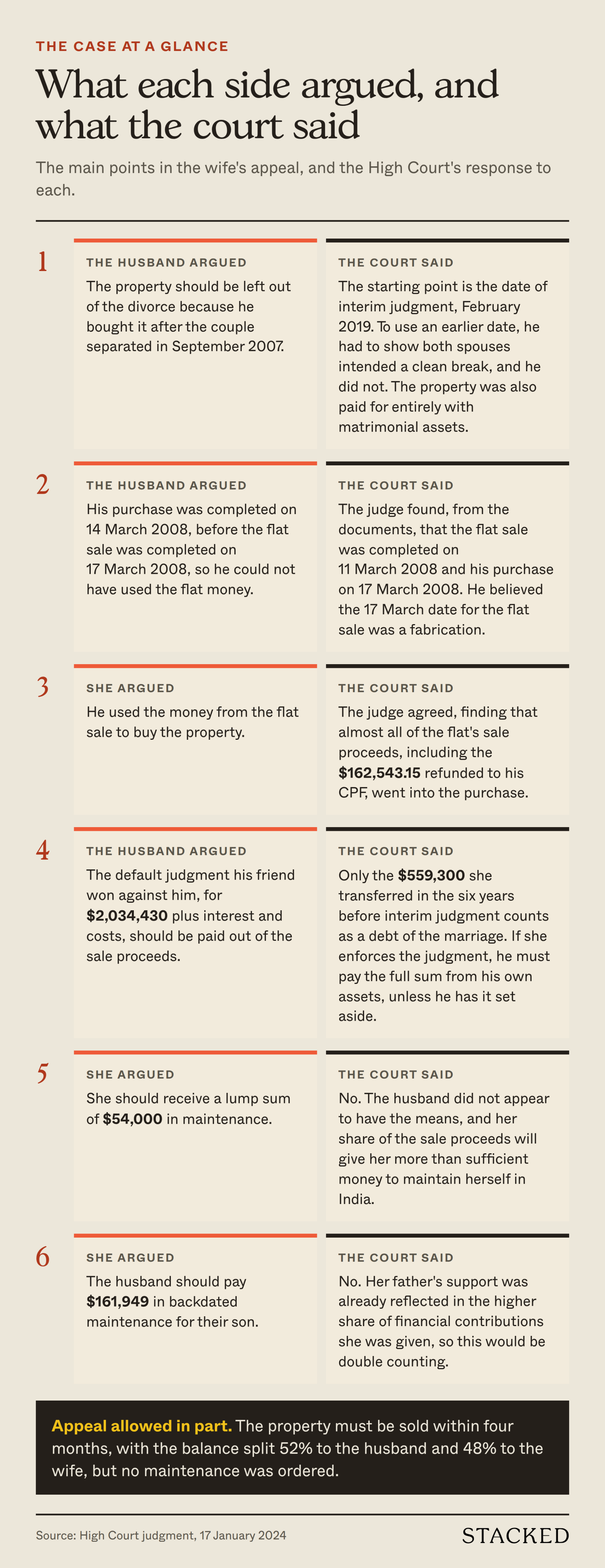
The husband argued that the private property should be excluded as he had purchased it after their separation in September 2007.
However, there were several issues with his argument.
1. The dates of the two property transactions
Much of the dispute centred on which property transaction had been completed first.
The husband claimed that he had completed the purchase of the private property on 14 March 2008, three days before the sale of the HDB flat. As such, he argued that he could not have used the proceeds from the flat to fund the purchase.
The judge, however, found that the HDB sale had actually been completed on 11 March 2008, based on documents relating to the transfer of the flat.
The purchase of the private property was completed six days later, on 17 March 2008, when OCBC released a short-term loan used to finance the purchase.
The judge believed that the husband had fabricated the completion date of the HDB sale to support his argument.
He also noted that the husband could simply have produced his bank statement to demonstrate that he had not used the sale proceeds, but had chosen not to disclose it.
Another telling detail was that the husband had taken out a bridging loan of $161,870 for the private property purchase. This was subsequently repaid using the CPF monies refunded from the HDB sale.
Ultimately, the judge found that almost the entire net proceeds from the HDB sale had gone towards the purchase of the private property. The remaining savings and CPF monies used to fund the purchase were also matrimonial assets.
2. The couple had not mutually agreed to a clean break
Although the couple had been separated since 2007, this did not necessarily mean that assets acquired after that point should be excluded from the division.
The judge explained that for an earlier cut-off date to be considered, there should at least be evidence that both spouses intended to make a clean break, financially and otherwise.
In this case, the wife had continued to reach out to the husband after their separation. In one email sent in March 2010, she invited him to participate in their son's religious ceremony in India, signing off with "With Luv".
The judge also found that the husband's attempts to conceal the property were calculated to deprive the wife of her share of it in the eventual divorce.
He took the view that the husband should not be placed in a more favourable position simply because he had cut ties with his wife and failed to financially support their son during the separation.
How did the court arrive at a 52:48 split?
Using the couple's CPF contributions as a rough indication of their respective earnings, the judge initially assessed their financial contributions at 98.5% for the husband and 1.5% for the wife.
The wife's share was subsequently adjusted upwards to 11.5%, taking into account the husband's trading losses of $480,000 and the financial support provided by her father over the years.
Financial contributions, however, were only one part of the equation.
As the wife had been their son's primary caregiver since birth, the judge assessed their non-financial contributions at 85% for the wife and 15% for the husband.
Giving equal weight to both types of contributions and taking a broad-brush approach, the judge arrived at a final division of 52% for the husband and 48% for the wife.
A friend of the husband also claimed that he owed her over $2 million
Another complication was the involvement of a female friend of the husband, who was a co-borrower and guarantor on the $1.36 million housing loan for the private property.
She had previously claimed a 73% share of the property in separate court proceedings, with the husband's support. While she initially succeeded, that decision was subsequently overturned on appeal by the wife.
The friend then sued the husband for $2,034,430, which she claimed to have lent him. As the husband did not defend the claim, she obtained a default judgment against him in March 2022.
The husband wanted this amount to be deducted from the proceeds of the property sale.
While the judge accepted that the friend had transferred substantial sums to the husband, he was not satisfied that these were ordinary loans made at arm's length, given their close relationship.
Instead, he recognised only $559,300 as a matrimonial debt, based on the sums transferred in the six years preceding interim judgment.
Should the friend seek to enforce the full judgment against the husband, he would have to satisfy it from his own assets unless he managed to have it set aside. The wife would not be liable for the debt.
What did the High Court ultimately decide?
The High Court ordered that the private property be sold on the open market within four months of the judgment, with both spouses jointly handling the sale.
The proceeds were to be distributed as follows:
- The outstanding housing loan, agent fees, legal fees and other expenses relating to the sale would be paid first.
- A sum of $559,300 would then be paid to the husband to account for the recognised matrimonial debt.
- The remaining proceeds would be divided, with 52% going to the husband and 48% to the wife.
Any CPF refund that the husband was required to make in relation to the private property would have to come out of his own share of the sale proceeds.
He was also ordered to pay the wife a further $56,861.39 from his share, to account for the division of their other matrimonial assets, which amounted to about $129,552.
The wife's claims for maintenance and backdated maintenance for their son were dismissed.
The judge found that the husband was not in a financial position to pay maintenance, while the wife's expected share of the property sale proceeds would be sufficient for her to maintain herself in India. The financial support provided by her father had also already been taken into account in the division of matrimonial assets, so awarding backdated maintenance for their son would have amounted to double counting.
The husband subsequently sought permission to appeal against the decision, but this was refused in October 2024.
In July 2025, his application to set aside both decisions was also dismissed, as the Appellate Division found that it did not have the jurisdiction to hear the application.
Neither ruling changed the High Court's orders.
As the judgments do not disclose the eventual selling price of the property, we do not know how much either spouse ultimately received.
A separation is not necessarily a clean break when it comes to property ownership
For homeowners, the main takeaway from this case is the distinction between being separated and being divorced.
The judge pointed out that the husband could have filed for divorce once four years of separation had passed, or sought a deed of separation to establish an earlier financial clean break.
Even if he had filed for divorce at the earliest opportunity in September 2011, however, the property purchased in 2008 would still have formed part of the matrimonial assets in this case.
So while the couple had been separated for more than a decade by the time the interim judgment was granted, this did not mean that the wife had forfeited her interest in the assets accumulated during that period.
As this case shows, the fact that a property was purchased after separation, and registered solely in one spouse's name, does not in itself mean that the other spouse has no claim to it.
You can read the full High Court judgment and the subsequent Appellate Division judgment on eLitigation.



0 Comments