


Usually, when a marriage breaks down and the question of property ownership arises, it can become a sore point that drags out the divorce process. In a recent legal case, a disagreement over who gets to keep living in the home escalated the matter, especially when one spouse is the sole owner of the property in question.
The case brought to the Family Justice Courts involved a wife who changed the locks on her husband’s property, rented out her own HDB flat, and then asked the courts to let her and her two daughters stay in his home until their divorce proceedings were over.
Ultimately, in a judgment dated 19 October 2026, Justice Teh Hwee dismissed the wife’s appeal, finding that she was not asking for a reasonable period to move out, but effectively seeking to remain in the property indefinitely.
It's an eye-catching case that prompts us to consider the wider issue of property ownership in the midst of a divorce, and just how much right a spouse has to remain in a home that doesn't legally belong to them.
How did the dispute begin?
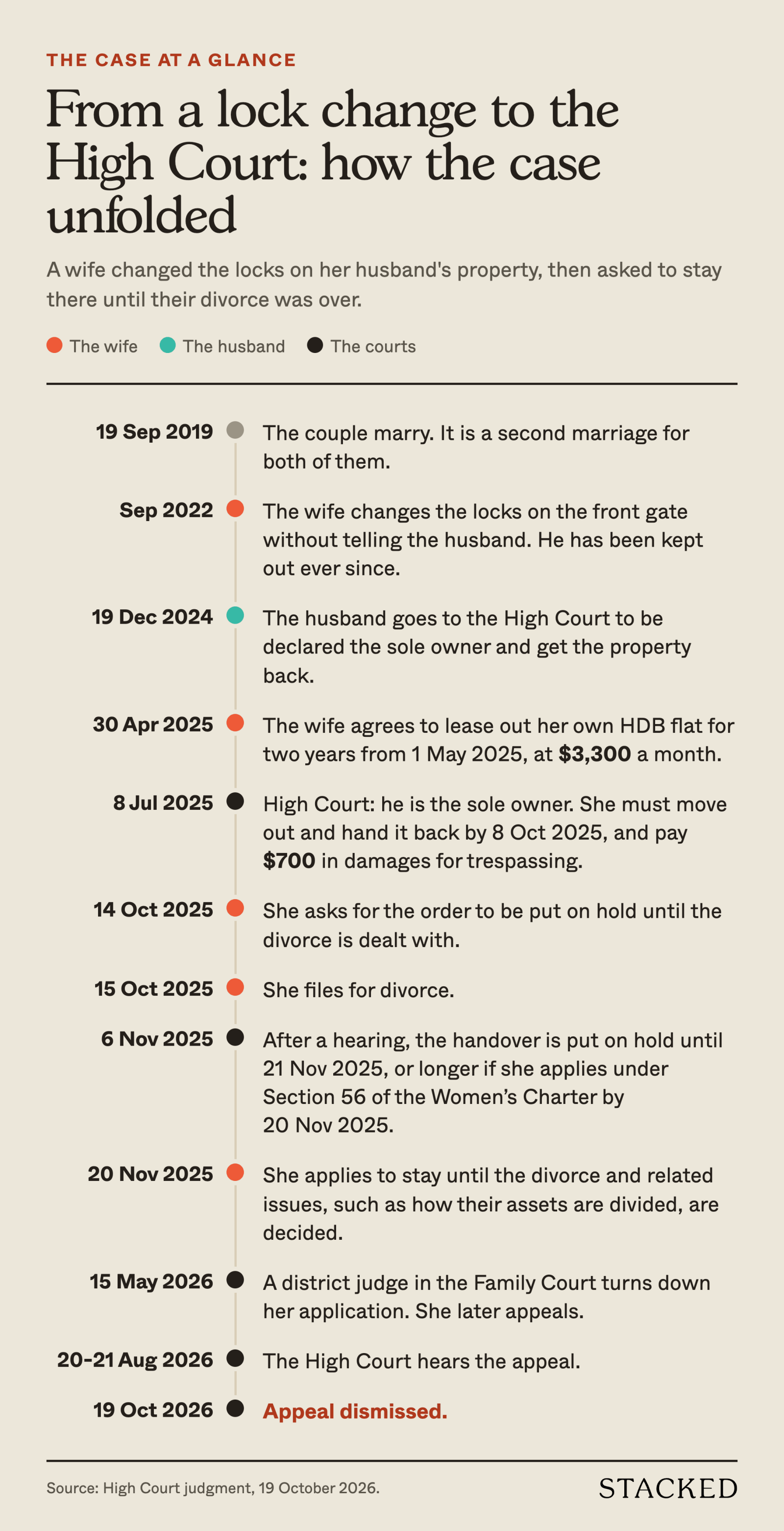
According to court documents, this couple married in September 2019. It was the second marriage for both, and they each had children from their previous marriage.
The property at the centre of the dispute had been purchased by the husband during his first marriage, and its ownership had been transferred solely to him after that divorce. The wife and her two daughters had been living there with him since at least August 2020. Crucially, the wife was also the sole owner of a HDB flat.
But this marriage broke down during the Covid-19 pandemic lockdown, and things came to a head in September 2022 when the wife changed the locks on the property’s front gate without informing her husband.
Despite his attempts to resolve their differences, he was unable to regain access to his own home. More than two years later, in December 2024, the husband took the matter to the High Court, seeking to regain possession of his property.
But the wife contested the claim, arguing that it was their matrimonial home and that she had an 'equitable interest' in the property by virtue of a 'common intention constructive trust'.
Further complicating matters, while that dispute was ongoing, the wife proceeded to lease out her HDB flat. In April 2025, she signed a two-year tenancy agreement for $3,300 a month. This fateful decision would later become an important factor in the ruling against her claim.
The husband won his case, but the wife wanted to stay
In July 2025, the High Court ruled that the husband was the property’s sole owner and ordered the wife to move out by 8 October 2025. She was also ordered to return the property’s keys and access devices, as well as pay $700 in damages for trespassing.
The three-month period to move out had been granted at the request of her own lawyer. She did not appeal against the ruling.
However, six days after the deadline, the wife returned to court seeking to delay the order until their divorce proceedings, which included the division of matrimonial assets, had been resolved.
She filed for divorce the following day.
The High Court put the order on hold, and said the hold would continue if she applied to the Family Justice Court under Section 56 of the Women’s Charter by 20 November 2025.
She subsequently asked for permission for herself and her daughters to remain in the property, preferably without her husband living there, until the divorce proceedings were concluded. But the Family Justice Courts rejected her application in May 2026, prompting her to appeal to the High Court.
Why did the High Court reject her appeal?
The central issue was whether Section 56 of the Women’s Charter allowed the wife to continue occupying a property that legally belonged to her husband.
Under this provision, the court can resolve disputes between spouses over property ownership or possession. However, it does not give the court the power to change who owns the property. Instead, the court may allow a spouse who does not own the home a reasonable period to make alternative living arrangements.
In her judgment published on October 19, Justice Teh found that the wife was asking for something quite different. Rather than seeking a fixed period to move out, she wanted to remain until the divorce and related proceedings were concluded, with no definite end date.
This would effectively prevent the husband from reclaiming his own property for what the judge described as a period of "her own choosing".”
Justice Teh also pointed out that allowing someone to continue living rent-free while divorce proceedings dragged on could create an incentive to delay those proceedings. Moreover, there were several other factors working against the wife.
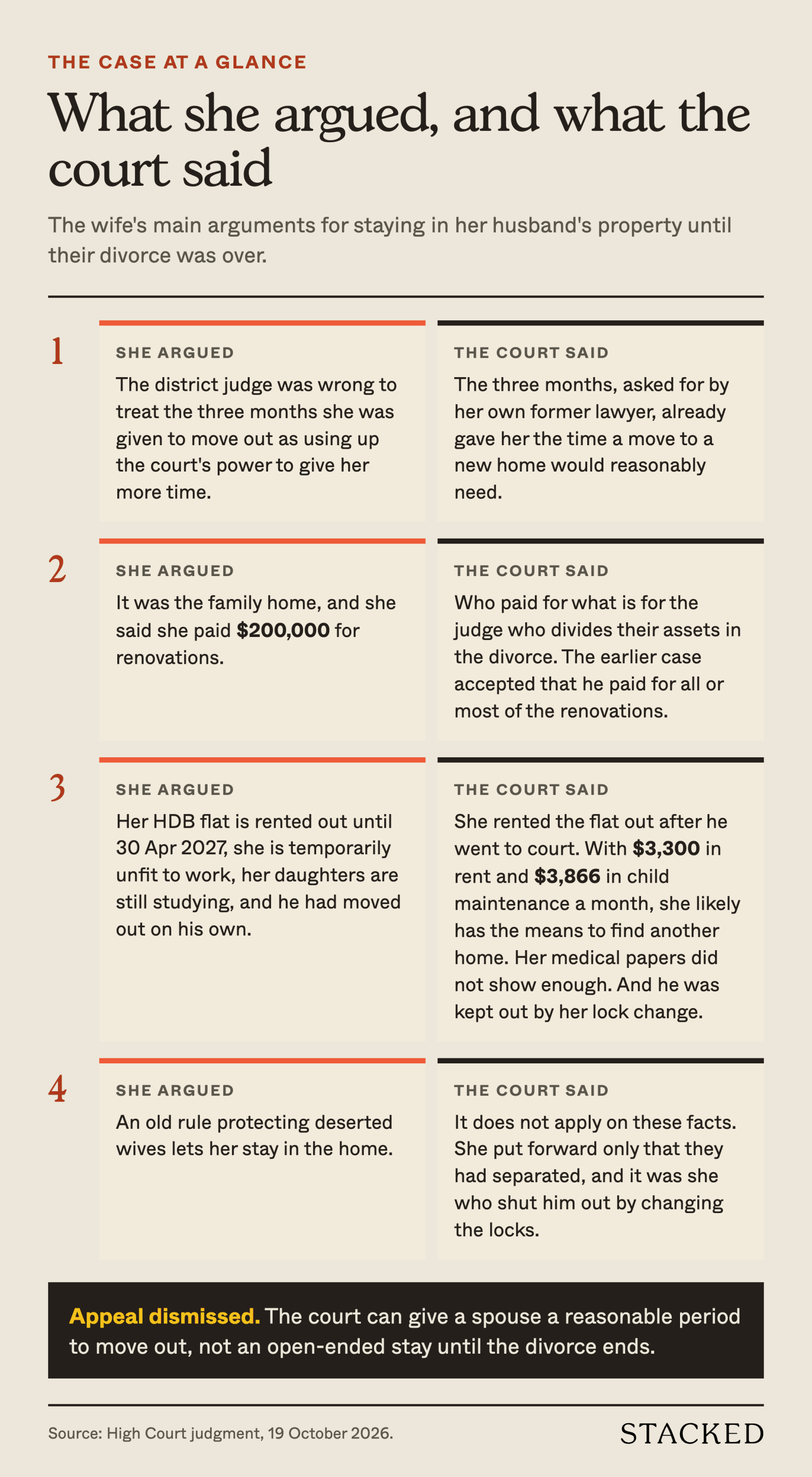
First, she had already been given three months to move out.
This was granted at the request of her former lawyer, and the court considered it a reasonable period for her to make alternative arrangements.
Second, she had another property of her own.
The wife argued that her HDB flat was rented out until April 2027, and that she needed the rental income to support herself and her daughters.
However, she had signed the tenancy agreement after her husband had already commenced legal proceedings. The judge noted that she would have known by then that her continued occupation of his property was uncertain, yet chose to rent out her flat anyway.
She also received $3,300 a month in rental income, along with $3,866 in monthly child maintenance from her former husband. According to the judge, this suggested that she likely had the means to find alternative accommodation, even if she could not immediately move back into her HDB flat.
Third, the husband had been unable to live in his own property for years.
The marriage had been relatively short, and the husband had been locked out of his property since September 2022.
The wife argued that he had left the property voluntarily and was already living elsewhere. But the judge rejected this, pointing out that it was the wife’s decision to change the locks that had prevented him from returning.
What about her $200,000 renovation claim?
The wife also argued that the property had been their family home and claimed to have spent $200,000 on renovations. However, Justice Teh found that neither argument justified allowing her to remain.
In earlier proceedings, the court had accepted the husband’s argument that he had paid for all or most of the renovations. But the wife did not appeal against those findings.
More importantly, Justice Teh explained that renovation contributions were a separate matter for the court handling the division of matrimonial assets. In other words, the wife could still be entitled to a share of the matrimonial assets during the divorce, regardless of whether she was allowed to continue living in the property.
The wife also cited medical conditions that she said prevented her from working. However, the judge found that the medical evidence was insufficient to support her claim, noting that her inability to work had been described as temporary.
Justice Teh also explained that Section 56 was not intended to address a spouse’s financial needs. Those matters should be dealt with through the appropriate maintenance proceedings.
What happens next?
Justice Teh ultimately dismissed the wife’s appeal. But the judgment did not specify when the wife would have to hand over the property, and either party could apply for further orders to give effect to the decision.
The division of the couple’s matrimonial assets would also be dealt with separately as part of their divorce proceedings.
For homeowners, the case highlights an important distinction between owning a property and having a potential claim to matrimonial assets. Even if a property was used as the family home, or one spouse contributed towards renovations, that does not automatically give them the right to continue living there while divorce proceedings are ongoing.
We also learnt that the court may allow a reasonable period for someone to find alternative accommodation, but that is different from allowing them to remain indefinitely.
Perhaps the most interesting detail is the wife’s decision to rent out her own HDB flat while the dispute was already before the courts. Although she argued that she needed the rental income, the court considered the timing significant. She had effectively made her own alternative accommodation unavailable even though, as Justice Teh pointed out, she would have known she might have to leave her husband’s property.
It’s a reminder that in property disputes, the decisions made while legal proceedings are ongoing can sometimes be just as important as the circumstances that led to the dispute in the first place.




0 Comments