



When a marriage breaks down, ownership of the family home can quickly become a sore point, and it gets worse if the home changed hands between the spouses along the way.
In one recent case, a husband transferred his HDB flat, which he had bought before his marriage, to his wife. Later he also transferred his share of a condo unit, which they had bought together.
In the divorce, the wife argued that neither property should count as a matrimonial asset.
But the court ruled against her.
On 19th November 2026, Justice Kwek Mean Luck of the High Court found that both properties were matrimonial assets, and hence ordered the wife to pay or transfer $575,990+ to the husband. This was made up of a balancing payment, to achieve the overall division of their matrimonial assets, plus a $40,000 loan she owed him.
It's an interesting case that raises a broader question: what happens to a property that one spouse transfers to the other, during a marriage.
How did the dispute begin?
The judgment does not name the couple, who married in May 2011 and have three children.
Before the marriage, the husband had bought an HDB flat as the matrimonial flat for his first marriage.
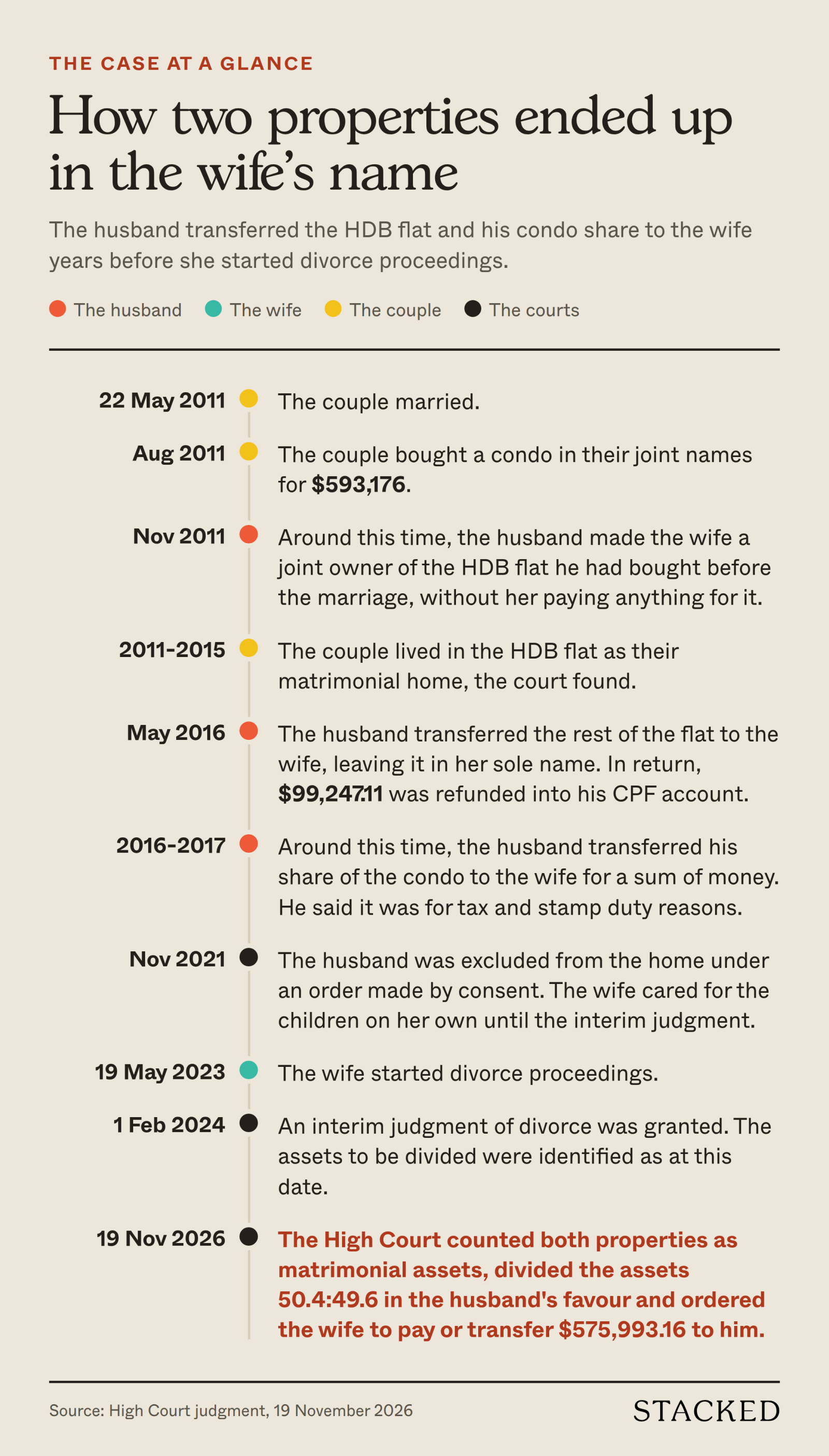
Later in August 2011, the couple bought a condo in their joint names for $593,176.
Around November 2011, the husband made his wife a joint owner of the HDB flat, without her paying anything for it.
Then, in May 2016, he transferred the remaining half of the flat to her, leaving it in her sole name.
In return, about $99,247 was refunded into his CPF account. This comprised around $76,394 in cash from his wife's bank account, and about $22,853 from her CPF account.
Around 2016 or 2017, he also transferred his share of the condo unit to her, for a sum of money. He said the transfer was made for tax and stamp duty reasons.
In May 2023, the wife started divorce proceedings.
An interim judgment of divorce was granted in February 2024, and both sides accepted that the assets to be divided would be the ones at that date.
Both properties were in the wife's name, but the husband said they should still be divided
You'll notice that by the time of the divorce, both the HDB flat and the condo unit were in the wife's sole name.
She argued that neither was a matrimonial asset.
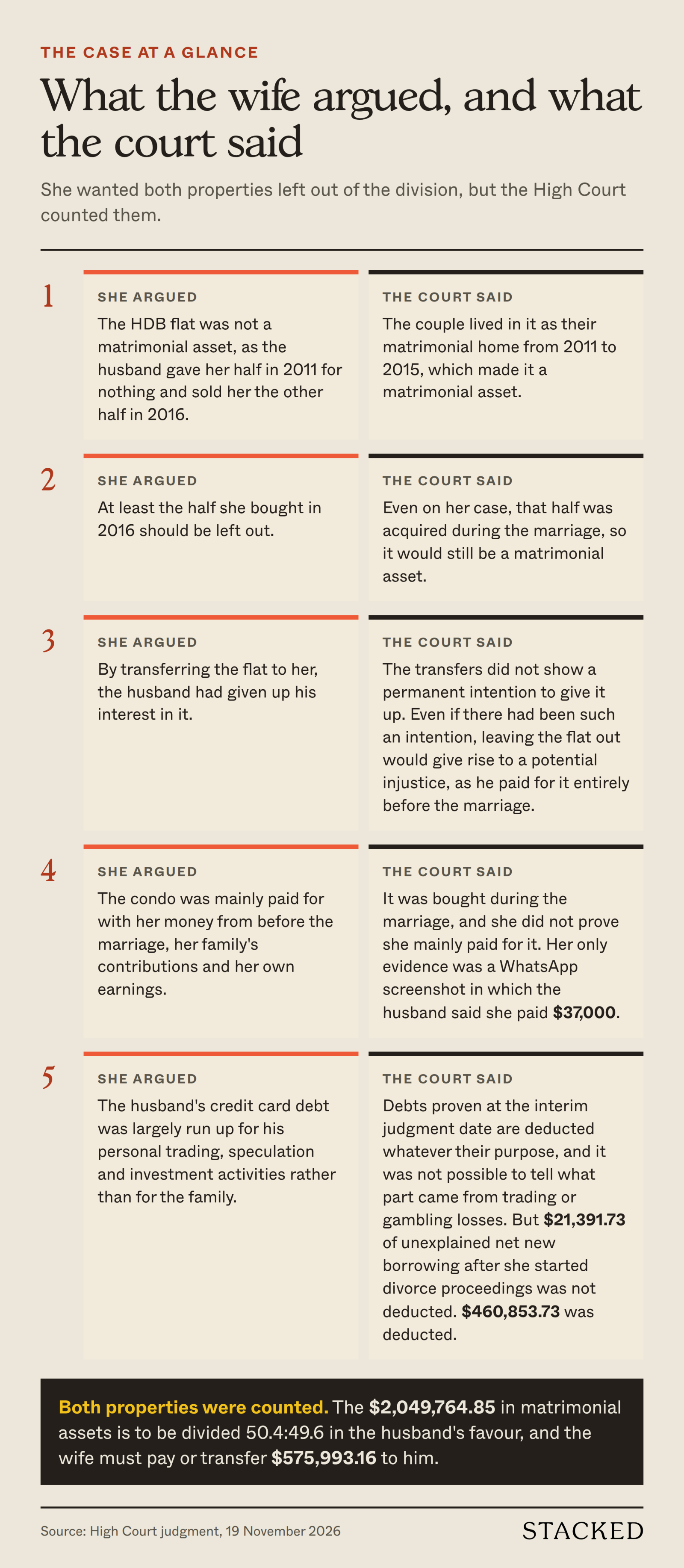
In her view, the husband had given her half of the flat in 2011 for nothing, and then sold her the other half in 2016, thus giving up his interest in it.
As for the condo, she argued that it was mainly paid for with her money from before the marriage i.e., her family's contributions and her own earnings.
The husband disagreed, saying both properties were matrimonial assets; and that the family had used the flat as their matrimonial home for the better part of a decade.
He also said he had paid about $55,000 in cash and about $42,000 from his CPF towards the condo's 20% downpayment, though the judge later did not accept the $55,000 figure, which was based on his memory and brief records.
Why did the High Court count both properties as matrimonial assets?
Under Section 112 of the Women's Charter, the court divides a divorcing couple's matrimonial assets in a manner it considers equitable.
These generally include assets acquired during the marriage, but can also include an asset bought before it or received as a gift, particularly if the asset was used as the matrimonial home.
This in fact was the deciding point: the judge found that the couple had lived in the HDB flat as their matrimonial home from 2011 to 2015.
As the judge noted, citing the Court of Appeal, the matrimonial home is a matrimonial asset "whenever and however acquired".
There were several other factors working against the wife:
First, the judge did not think the transfers reflected the husband's permanent intention to give up his interest in the flat.
The husband's evidence was that the transfers involving the flat were part of a family arrangement, and the couple kept living in the flat as their home after the 2011 transfer.
Also on the wife's own evidence, the 2016 transfer came about from her suggestion to help her husband, by giving him funds.
Second, even if there had been such an intention, leaving the flat out would give rise to a potential injustice: the husband had paid for the flat entirely before the marriage.
Third, the condo was bought during the marriage, so the judge found it was a matrimonial asset, and it was up to the wife to prove otherwise.
She claimed to have paid $132,000 towards it, but her only evidence was a WhatsApp screenshot, which was undated and did not provide sufficient proof.
The judge also noted that leaving the condo out entirely would be unjust, as the husband had made substantial contributions towards buying it.
The husband further asked for over $476,700 in credit card debt to be deducted
The husband asked for over $476,700 in credit card debt to be deducted, from the assets to be divided.
He said the cards had funded the couple's investment properties, whose rent went towards the mortgages and card interest.
The wife however, claimed these debts were largely run up for his personal trading, speculation, and investment activities, and not for the family.
She pointed to documents that, according to her, contained his admissions about a gambling addiction. The husband however, contended that he had signed these under pressure, a point the judge did not need to decide.
The judge said any debt that existed at the interim judgment date had to be deducted, whatever it was used for. What it was used for is weighed instead when assessing each side's contributions. Even if only debts taken on for the family could be deducted, the judge found it was not possible to tell what part of the debt came from trading or gambling losses.
The judge also did not deduct around $21,391 of net new borrowing on his cards between May 2023, when the wife started divorce proceedings, and the interim judgment.
In the end, the judge deducted around $460,853, made up of the roughly $450,438 the husband owed on 19 May 2023, and around $10,415 in accrued interest from then until the interim judgment.
How did the judge arrive at the asset split?
On the money each side put into the assets, the judge assessed the split at about 59.8 / 40.2 in the husband's favour.
On contributions to the family however, such as caring for the children, it was 65% to the wife and 35% to the husband.
The husband did not dispute that the wife was the primary caregiver, and that she cared for the children on her own from November 2021.
Giving both equal weight produced a split of about 47.4 / 52.6 in the wife's favour.
However, her failure to produce statements for some of her bank accounts in China changed that.
The wife had been ordered to produce statements for specific accounts there, but did not do so for some of them, and her explanations, such as one account having been closed, were not backed by any correspondence with the banks. The judge found that, on the face of it, there was a case of concealment.
As their value could not be worked out without the statements, the judge gave the husband an extra 3% instead, bringing the final split to 50.4 / 49.6 in his favour.
What happens next?
The matrimonial assets of around $2,049,764 are split into roughly $1,033,081 for the husband, and about $1,016,683 for the wife.
As assets of around $497,088 were already in the husband's name, the wife must pay or transfer around $535,993 to him.
Adding a $40,000 loan she admitted owing him, the total comes to just over $575,990.
This is to be paid within six months of the judgment.
The judgment does not say which property, if any, will be sold. But the judge noted that, depending on the arrangements, the wife may have to sell or refinance some of the properties in her name.
For homeowners, the case highlights an important distinction between whose name is on a property, and how it's treated in a divorce.
Transferring both properties to the wife did not stop them from being matrimonial assets, as the flat had been the family home, and the condo was bought during the marriage.
Another interesting detail is that, although the HDB flat had been in the wife's sole name since 2016, the judge still assessed the financial contributions to it to be in the husband's favour.
The judge explained that this assessment looks at contributions to acquiring an asset, not at how ownership came to be held.
With no evidence of what the husband actually paid for the flat, the judge used a 2011 valuation of $332,000 as a stand-in for his contribution, less the $99,240+ refunded into his CPF account. The judge also treated the roughly $76,390 in cash as coming from the family's savings, and split it equally between the couple.
It's a reminder that, in this case at least, the court looked past whose name was on the title. The emphasis was on how each property was paid for, and how they were used.





0 Comments