


The latest quarterly statistics on Singapore's retail and office property markets showed positive growth trajectories in both segments last quarter, but market watchers are more bullish on one than the other.
According to the 3Q2026 real estate statistics, published by URA on Oct 23, office rents in the Central Region rose 0.8% q-o-q, matching the quarterly growth registered in 2Q2026.
Meanwhile, retail rents in the Central Region recorded a quarterly increase of 0.7% in 3Q2026, following the 0.6% q-o-q increase that the segment clocked in the previous quarter.
On the surface, the latest figures seem to suggest that both real estate segments are moving in tandem, but when other demand and supply factors are considered, as well as broader macroeconomic shifts, most market analysts are generally less upbeat about retail properties compared to the office market.
In short, the retail market is still exposed to rising operational costs and relatively weaker consumer spending. On the other hand, office landlords can bank on resilient demand from existing corporate tenants as well as newer entrants like international tech firms setting up a base in Singapore.
In addition, the limited supply of new office space over the next few years will continue to support office rents, especially newer Grade A office space in the Central Business District (CBD), in the next two years or so.
“Office rents are expected to rise further, underpinned by sustained occupier demand and limited new supply. As vacancy rates fall and competition for available space stiffens, landlords are continuing to raise their asking rents," said June Chua, Head of Singapore Leasing at Newmark.
Other market analysts like Tricia Song, Head of Research, Singapore and Southeast Asia, at CBRE are particularly bullish towards core CBD Grade A rents, which grew at a faster rate last quarter compared to the overall office sector.
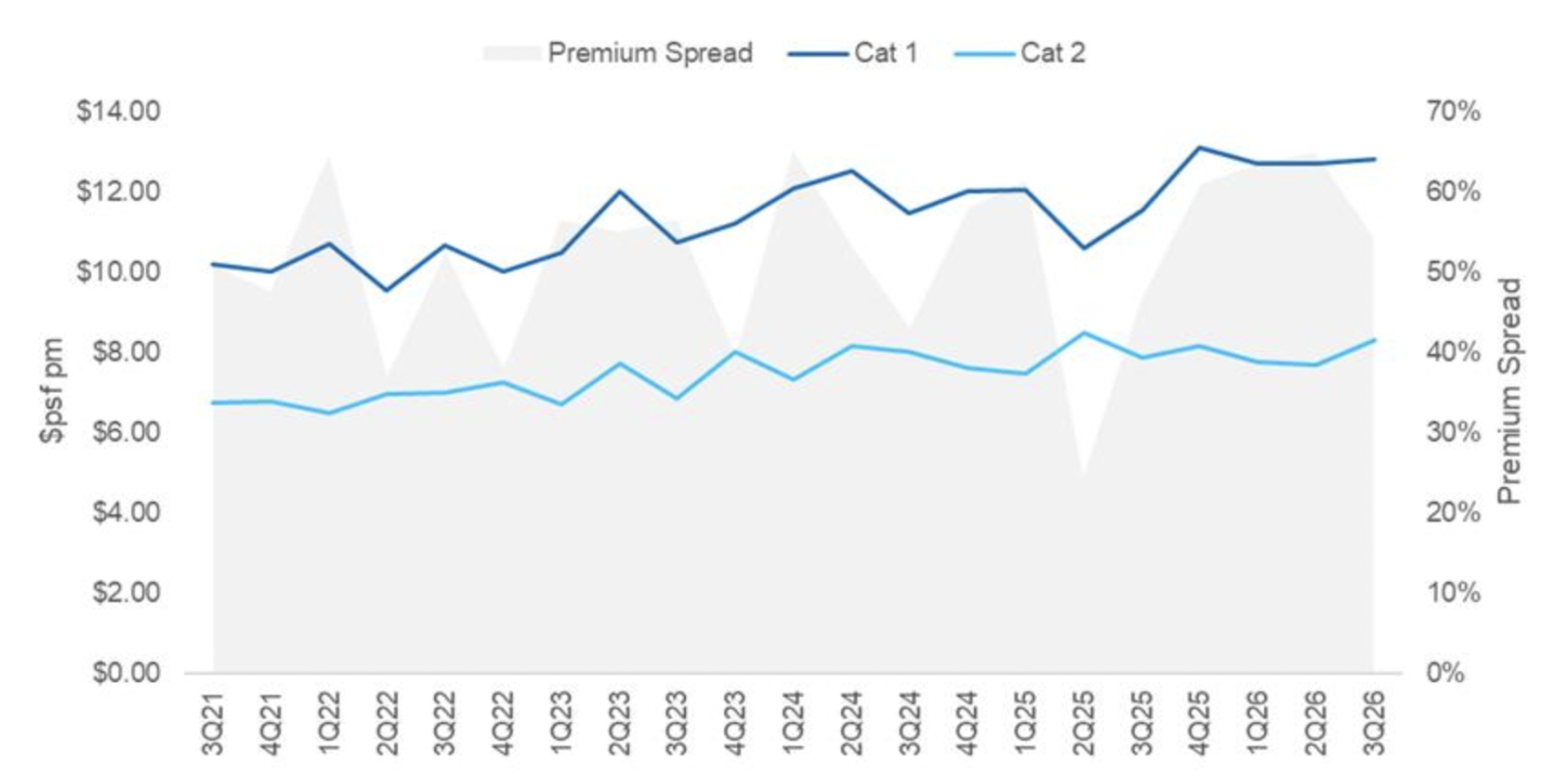
According to market data compiled by CBRE, core CBD Grade A rents rose 2.0% q-o-q to $12.75 psf per month (pm) in 3Q2026, a significant performance boost compared to the 0.8% q-o-q growth registered in the previous quarter. Meanwhile, office vacancy rates in the core CBD Grade A segment fell to 2.6% in 3Q2026 from 3.3% in the previous quarter.
Even after taking into account heightened geopolitical tensions and an uncertain interest rate environment, office market fundamentals in Singapore are likely to remain supportive, says Wong Xian Yang, Head of Research, Singapore & SEA, at Cushman & Wakefield (C&W).
He cites market data compiled by C&W which indicates that CBD Grade A office rents have grown 3.8% YTD in 2026, and the consultancy maintains its forecast of 4-5% growth in CBD Grade A rents for the full year.
On the other hand, several consultancies were more measured on the retail outlook. The headwinds faced by the retail sector include manpower shortages, higher operating costs - exacerbated by the ongoing Middle East conflict - and intense e-commerce competition, says Song.
However, she adds that positive market factors such as increased inbound tourism and events, a relatively low supply of new retail space, and various retailer upgrade initiatives will keep the growth trajectory of the retail market largely positive.
Market watchers are more bullish on certain types of office properties over others
The latest quarterly statistics indicate that while there was a 0.8% q-o-q growth across the entire office sector as a whole, office submarkets in some city-fringe locales grew at a stronger pace. Office rents in those areas rose 2.5% q-o-q in 3Q2026, against the quarterly increase of 0.5% in the Central Area over the same period.
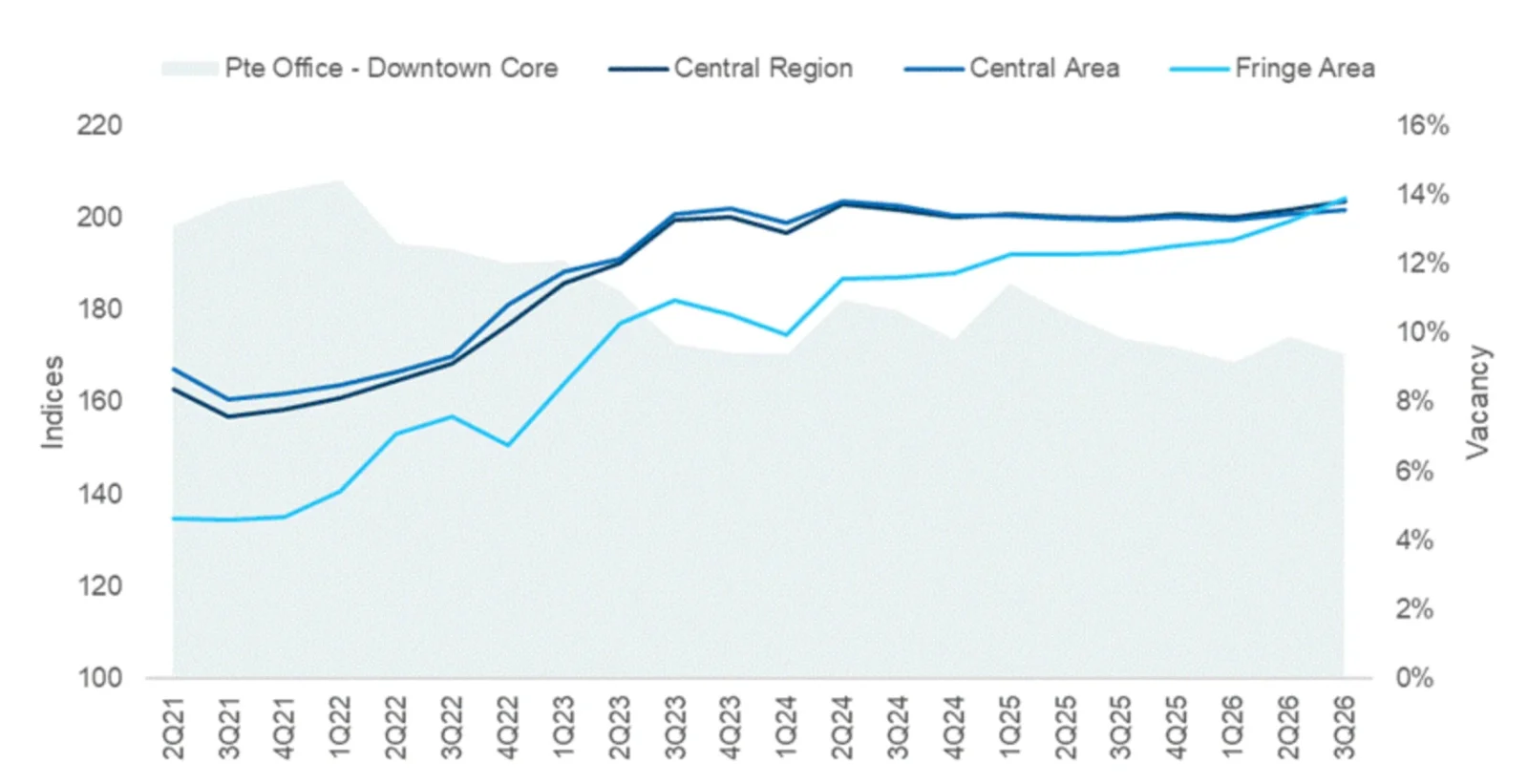
Locations in the Central Area include core planning areas like the Downtown Core, Orchard, Outram, Rochor and the Singapore River.
Meanwhile, city-fringe locations consist of other areas in the Central Region, such as Novena, Bukit Merah, Kallang, Geylang and Queenstown.
Some market analysts opined that the bulk of office demand in city-fringe locations might be coming from small- and medium-sized enterprises (SMEs) as well as startups, who are finding more affordable office rentals outside of the Central Area.
Chua of Newmark says that rents in older and non-prime buildings in some city-fringe locations recorded a notable uplift last quarter. "This potentially reflects the spillover effect of higher rents in the Grade A office segment," she says.
But market watchers overwhelmingly pointed to demand from technology and artificial intelligence (AI) firms moving into Singapore as the main driver of office rents and prices in recent months.
That can include different types of firms, from the highest-valued AI firms setting up shop in Singapore's core CBD office buildings, to smaller startups who choose flexible office space in fringe areas.
In many cases, foreign firms that are just dipping their toes in the Singapore market might choose to start off in flexible office spaces but then later move into permanent space when they know they want a deeper foothold in the city.
For example, Anthropic is at The Executive Centre in Ocean Financial Centre, and Manus AI is at Industrious in Keppel South Central. Both are flexible office space leases within Core CBD Grade A buildings.
OpenAI reportedly runs from a flexible space in CapitaSpring, but is in talks for about 120,000 sq ft of dedicated space at Shaw Tower, according to CBRE.
“Technology and AI firms continue to drive demand for larger office spaces, with some shifting from serviced offices into their own premises, signalling a deeper commitment to Singapore and the region," said Chua of Newmark.
Although URA data shows Central Area rents underperforming compared to some city-fringe areas, it's important to note that demand is still high in Core CBD Grade A offices: a smaller selection of high-quality offices in the heart of the central area.
Future supply of new office space is limited
The growing demand for prime office space in Singapore from firms moving into the city-state is certainly one piece of the puzzle, but many market watchers also cite that the limited pipeline supply of new office spaces in the coming years is also driving growth.
In 3Q2026, the overall office vacancy rate fell to 10.0% from 11.0% in 2Q2026. This is attributed to the closure of 79 Anson and HarbourFront Centre for redevelopment.
The 23-storey office building at 79 Anson Road is set to be redeveloped after the asset owner, United Engineers, a unit of Yanlord Land Group, announced redevelopment plans to turn the freehold site into a new 28-storey mixed-use development. It will reportedly feature 10 storeys of Grade A office space and 12 storeys of 255 serviced apartment units.
Meanwhile, HarbourFront Centre closed on July 27 this year, after owner Mapletree announced plans to redevelop the site into a 33-storey mixed-use development featuring office spaces, retail shops, and green spaces. The new project is expected to be completed by 2031.
The removal of the office spaces at 79 Anson Road and HarbourFront Centre likely shrank the island-wide office stock by about 775,000 sq ft.
Looking ahead, the price of offices will be sensitive to planned pipeline supply, which is also scarce in the coming years. There is 1.011 million sq ft of new office space planned to open in 2027. For context, that's a relatively low figure compared to the 3.43 million sq ft that is expected to enter the market in 2028, which will likely see more seismic price shifts in the market.
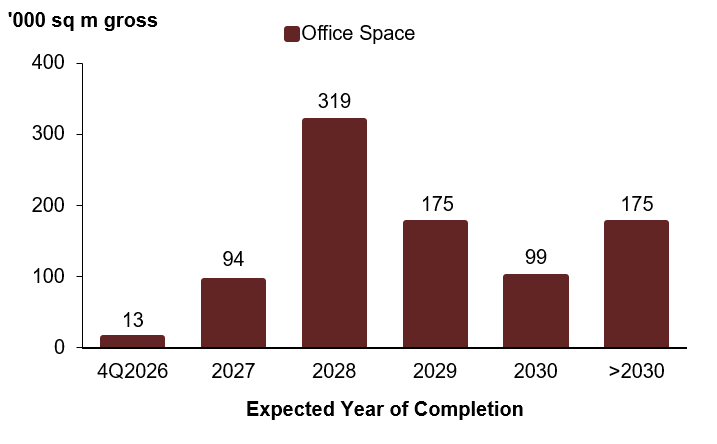
“With limited near-term supply and few options for contiguous premium space, conditions remain firmly landlord-favourable," says Song of CBRE.
In 2028, several new projects are set to be completed, including One Comcentre, a redevelopment of the former Singtel ComCentre along Exeter Road. The upcoming mixed-use development is jointly developed by Singtel and Australian developer Lendlease, with the latter managing the property.
One Comcentre will feature two 20-storey Grade A office towers as well as six floors of amenities, including food courts, medical suites, fitness and wellness facilities, and a 400-seater auditorium.
“Upcoming developments such as One Comcentre, together with better transport links, could strengthen established office hubs outside the core CBD, giving occupiers more choice and making these locations stronger alternatives to a traditional CBD address,” says Chua of Newmark.
Other upcoming developments that will inject new office space include The Clifford, a redevelopment of the former Clifford Centre by Singapore Land, and The Skywaters, a redevelopment of the former AXA Tower led by Perennial Holdings.
On the Retail Side
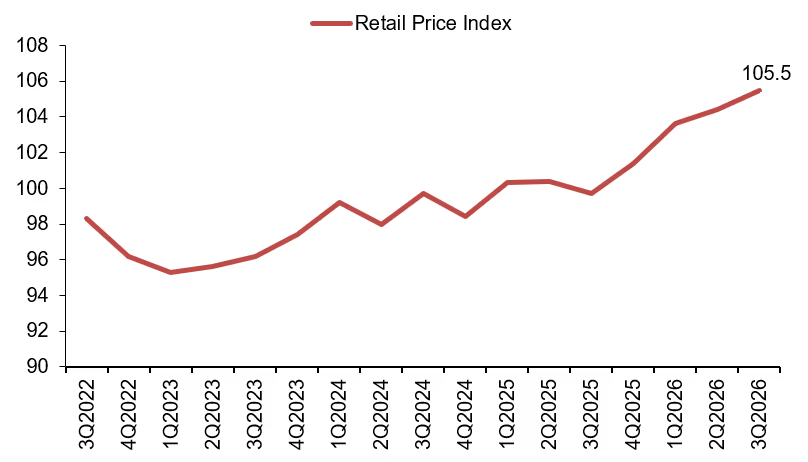
The latest quarterly statistics indicate that retail prices grew 1.1% q-o-q in 3Q2026, a marginal improvement compared to the 0.8% q-o-q growth registered in 2Q2026.
Overall, retail property prices across Singapore have seen decisive growth over the last few years, keeping pace with the broad recovery in the retail market since the end of the Covid-19 pandemic.
This is likely due to growth in suburban retail properties in popular and established residential neighbourhoods, which have performed well consistently over the past few years.
In fact, the suburban market - also known as the Outside Central Region (OCR) - was the only area where occupied retail space grew in 3Q2026, with about 64,000 sq ft added this past quarter, reversing a 129,000 sq ft drop in 2Q2026.
Retail vacancies in the OCR also fell from 5.2% to 4.7% last quarter, and Song of CBRE attributes this to resilient consumer demand from heartland estates and regular consumer footfall.
At Tampines Mall, retailers such as Sephora, Dior Beauty and Paris Baguette have taken over former anchor spaces. This underscores continued demand for well-positioned assets with strong catchment demographics and footfall, says Wong of C&W.
But more broadly, market watchers say that the retail sector is under pressure, facing e-commerce competition, manpower shortages and higher costs.
As Song points out, major retailers like True Fitness, Crystal Jade and Japan Home have closed or cut outlets in recent months. She also cited that retail sales fell y-o-y in July and August this year, which may hint at weaker consumer confidence amid layoffs and inflation.
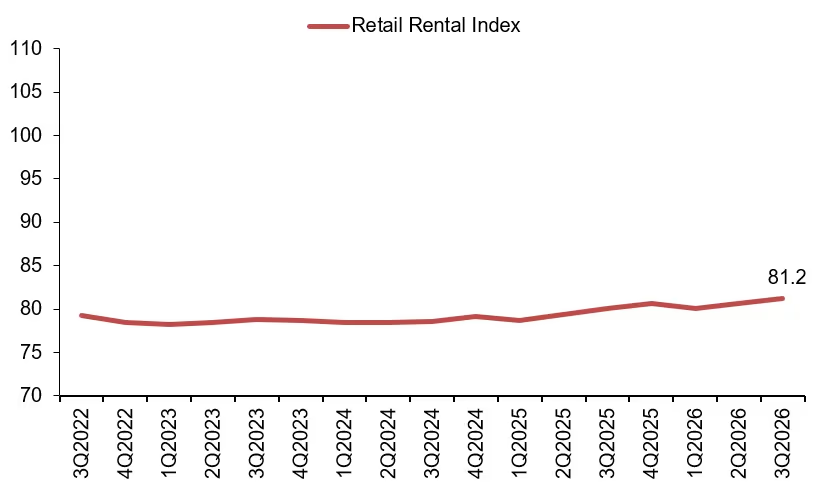
Retail rents grew 0.7% q-o-q in 3Q2026, marginally besting the 0.6% quarterly growth recorded in the previous quarter.
However, occupied retail space shrank by about 226,000 sq ft in 3Q2026, but that’s a smaller decrease compared to the 398,000 sq ft that exited the market in 2Q2026. The reduction in retail space is largely attributed to the closure of HarbourFront Centre.
Meanwhile, vacancy rates held steady at 6.5%, but only due to the proportion of retail space that exited the market.
Orchard Road is still the bellwether of the retail market
Prime retail space in Orchard Road is projected to perform well, driven by tourism and buzzy foreign retail openings. The prime shopping belt remains the first choice for international brands making their Singapore debut, says Wong of C&W.
London streetwear brand Palace recently opened at Scotts Square, and Korean footwear label Rockfish at ION Orchard. Thai fashion label Gentlewoman and Japanese doughnut chain I’m Doughnut are set to follow in the coming months.
“With only 4% of upcoming supply expected in Orchard Road, supply pressures within Singapore’s prime shopping belt are expected to remain limited, supporting rental growth in prime retail assets,” says Wong.
But retailers should remain cognisant of nascent trends, such as the conversion of some retail spaces into other uses. Taste Orchard is becoming JustCo Place, a co-working space, and Orchard Central has also announced an office conversion. These are some of the most impactful changes along Orchard Road in recent years.
The overall retail outlook is still positive
In general, most market analysts have a positive outlook towards prime retail rents and the overall retail market in Singapore as a whole.
CBRE says that the 0.7% quarterly rental growth in 3Q2026 was largely underpinned by expansion demand from F&B and fashion brands such as Chick-fil-A, Loulouca, Pop Bakery, In Good Company and Polène. It expects prime retail rents to rise 1% to 2% this year, helped by tourism spending, a busy pipeline of concerts and events, and limited new supply.
Overall, rental growth will likely be led by tier one shopping malls which continue to draw keen retailer interest, including dominant malls with high footfall, strong brand and good connectivity.

0 Comments