


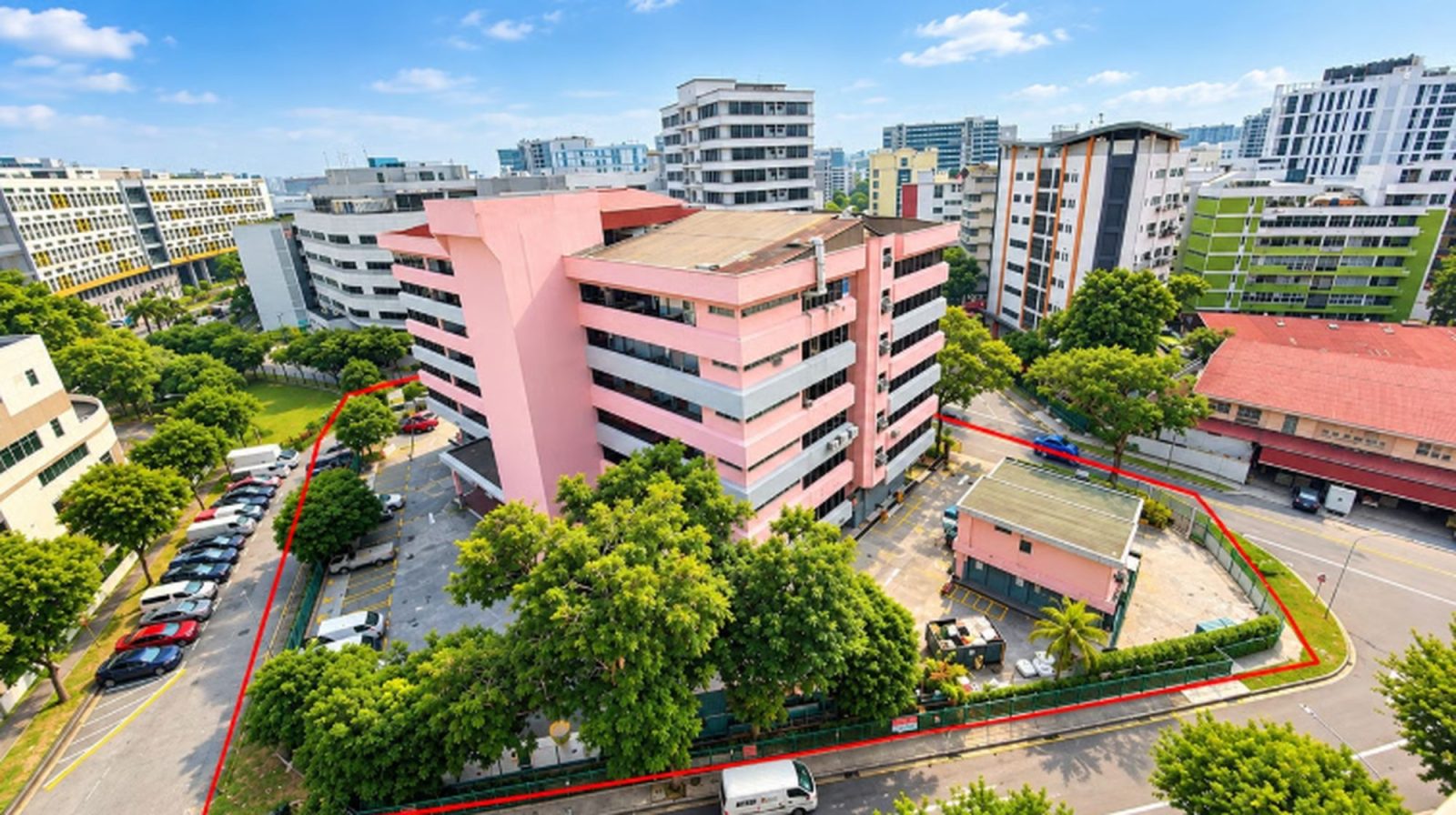
A freehold industrial building in the Tai Seng–MacPherson precinct has just been sold for $121.8 million in a collective sale brokered by Knight Frank Singapore.
The price is 16% above its $105 million guide price, after the public tender that closed on Oct 23 drew more than a dozen bids. Knight Frank announced the sale on Nov 5 but has not named the buyer.
Notably, the collective sale price works out to about $1,059 psf on the seven-storey building's existing gross floor area (GFA) of 114,969 sq ft, an increase from the $913 psf at the guide price. This also makes it the highest $psf price (in terms of land rate) for a large industrial site in the area since 2021.
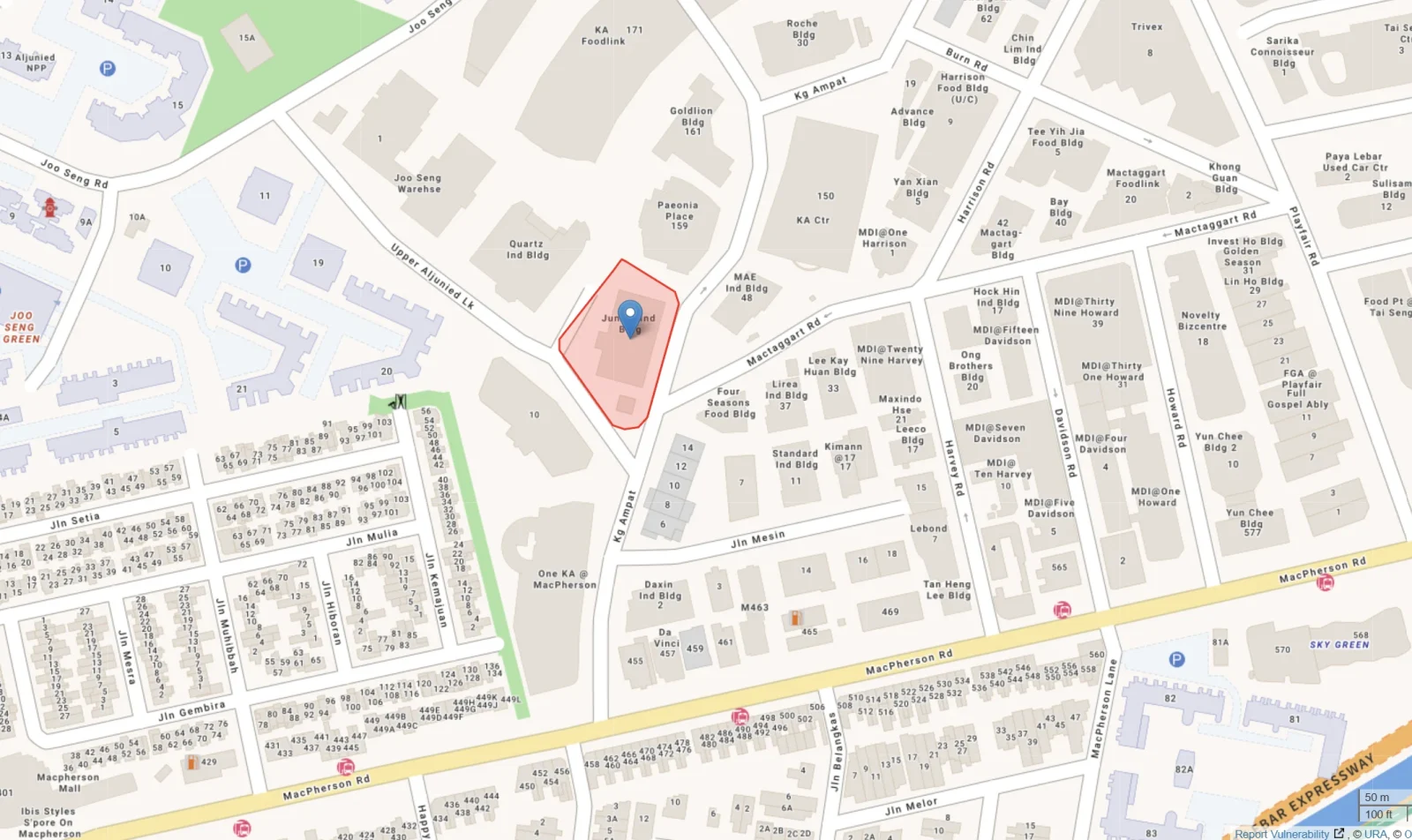
The industrial property at 153 Kampong Ampat, also known as Junjie Industrial Building, is a multi-user industrial building on a freehold plot of about 43,354 sq ft in District 13. It occupies a corner plot at Kampong Ampat and Upper Aljunied Link, and Tai Seng MRT station on the Circle Line is about 700 metres away.
The site is zoned Business 1 (B1), with a gross plot ratio of 2.5 under the 2025 Master Plan. This land zoning means that it can be used for relatively cleaner and lighter industrial uses.
URA rules state that at least 60% of the floor area in each B1 unit must be used for industrial purposes, such as light manufacturing, food packing, printing, e-business or media work. The remaining 40% can go to supporting uses like offices, showrooms, meeting rooms, a canteen or a workers' dormitory.
Why are freehold B1 spaces in such high demand?
The price of B1 multiple-user factories rose 40% q-o-q in 3Q2026, according to the latest quarterly statistics by JTC. The increase in price means that this segment of the industrial property market is at its highest level since at least 2010.
On the other hand, the same quarterly statistics indicated that the price within the B2 industrial segment rose 25% q-o-q in 3Q2026, and is still below its 2012 peak.
"As demand for industrial space evolves, well-located freehold sites that offer scale and flexibility in redevelopment are increasingly sought after, particularly where opportunities of this nature remain limited," says Melvin Chay, Interim Head of Capital Markets at Knight Frank.
The scarcity of freehold industrial land sites is the crucial part here, since most industrial land in Singapore is held on short land leases of about 30 years in most cases. For example, in June 2012, the government cut the maximum lease on industrial sites sold through its land sales programme from 60 years to 30 years.
Freehold tenure accounts for most of the price premium in this en bloc sale
Resale caveats reflect whole-building sales by land area, so the table below compares the land $psf prices.
Recent whole-building sales of B1 sites with a 2.5 plot ratio, Tai Seng–MacPherson area
| Property | Sold | Tenure | Land area (sq ft) | Price | $PSF of land |
|---|---|---|---|---|---|
| 153 Kampong Ampat | Nov 2026 | Freehold | 43,354 | $121.8M | $2,809 |
| Macpherson Industrial Complex | May 2025 | Freehold | 49,410 | $103.9M | $2,103 |
| Science Arts Building | May 2024 | Freehold | 15,882 | $29.33M | $1,847 |
| Cheng Meng Building | Sep 2023 | Freehold | 24,699 | $39.99M | $1,619 |
| KA Place | Apr 2023 | 99 years from 1959 | 41,082 | $35.38M | $861 |
A close comparison to the collective sale of 153 Kampong Ampat is the sale of Macpherson Industrial Complex along Lorong Bakar Batu. That property is a slightly larger freehold site that was also able to command a 17% premium above its guide price after it was sold in May 2025. The collective sale tender drew 12 bids on its first collective sale attempt, which was marketed by ETC.
Other smaller plots have also fetched high prices, such as the en bloc sale of a 7,698 sq ft site at 15 Harvey Road that went for a land rate of $3,637 psf - or $27.99 million - after it was sold in April 2025.
To showcase the premium that freehold tenure can command, consider the en bloc sale of KA Place, which sits on a similar-sized plot and has the same land zoning, but whose 99-year leasehold tenure started in 1959, giving it 35 years left on its lease when it was sold for $35.38 million in April 2023.
Although the average price of B1 industrial buildings has been on an upward trajectory in recent years, the commanding price premium that 153 Kampong Ampat was able to exert cannot solely be attributed to the market-wide performance. More likely, its freehold tenure helped to propel its high enbloc price.
We see a similar trend in the strata market, where JTC's sub-indices show how heavily buyers weigh the land tenure in their valuations. Since 2Q2021, prices of multi-user factory units with more than 60 years left have risen 40%, while those with 30 years or less have risen just 6% and are still below their 2015 peak.
Enbloc beneficiaries are getting well above what their units would fetch on the resale market
Transaction records also indicate that units at 153 Kampong Ampat rarely change hands, with caveats showing just 10 resale transactions since 1996.
A 2,691 sq ft unit on the fourth floor sold for $690,000 ($256 psf) in December 2009, and it later sold for $1.8 million ($669 psf) in June 2022. The most recent resale is a 3,100 sq ft unit that fetched $2.17 million ($700 psf) when it was sold in March 2023.
Based on the collective sale price of $1,059 psf - or $121.8 million - this means that this same 3,100 sq ft unit could have come to at least $3.28 million before costs, 51% above its 2023 price. JTC's B1 index rose about 24% between 1Q2023 and 3Q2026, which puts that unit at roughly $865 psf today, and the collective sale rate is about 22% above that.
The price leaves a strata developer little room
Knight Frank says the bids came from three groups: industrial developers looking at strata redevelopment, owner-occupiers who want a sizeable freehold building for their own operations, and investors studying the site for workers' dormitory use.
URA has indicated it is willing to support secondary workers' dormitory use at the site, subject to planning submissions and approvals.
Of the three groups, strata developers would find it hardest to make a profit at this price.
One reason is that the existing building is larger than the plot ratio allows, since a new building here can have up to 108,385 sq ft of floor area, which is about 6,600 sq ft (6%) less than the building has today.
If a new building is capped at that smaller size, the buyer is paying about $1,124 psf for the area it can build, instead of the reported $1,059 psf. It is not yet clear whether a new building on the site would be allowed to keep the extra space.
That $1,124 psf is the land rate, and doesn't account for any future construction costs, and it is already above the $973 psf median price across the 53 freehold strata resale transactions in the area this year. Only nine of those 53 resales reached that price threshold, and all were units under 2,000 sq ft, with the highest at $1,371 psf at HH @ Kallang.
Transaction data also suggests that industrial units of 2,000 sq ft to 3,200 sq ft - the range of units at 153 Kampong Ampat - were able to fetch median $psf prices of $760 psf, with none of the deals fetching higher than $1,011 psf. This means that a developer would likely have to build much smaller units to sell them above the land cost.
The latest new strata project on the same street, One KA @ MacPherson, sold its units at a median price of $796 psf when it launched for sale in 2022, though it has a 41-year leasehold tenure.
For owners of other older freehold industrial buildings, two freehold B1 tenders 18 months apart have now each beaten their guide by 16% to 17%, which gives the next collective sale committee a firmer track record to convince owners.


0 Comments