


Hi Stacked,
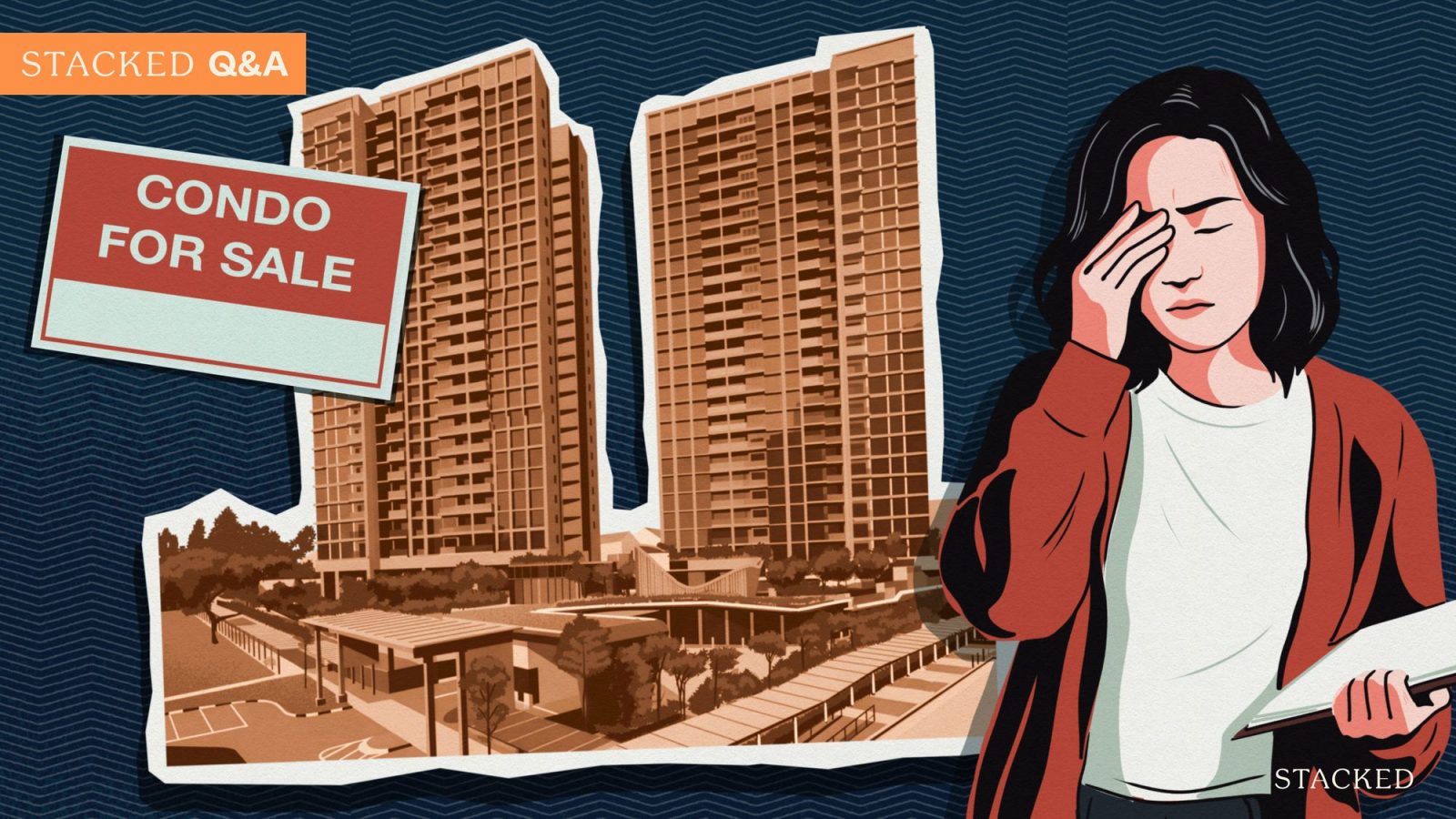
I own a two-bedroom, one-bathroom unit of around 674 sq ft at AMO Residence. It is a mid-floor unit with an unblocked view and is vacant. I had planned to live there or keep it as an investment property.
Since that purchase, I have found a partner, and I would like to sell that property to buy a bigger home. But it has been on the market for over six months, attracting more than 20 viewings but only one low-priced offer. I've changed agents twice with no positive result.
The two-bedder was purchased for $1.424 million, and I have an outstanding loan of $1 million at an interest rate of 1.48%. I've used about $238,000 from my CPF. In terms of my financial position, my annual income is more than $200,000, and I have about $200,000 in cash savings.
I hope to sell the unit for around $1.65 million, and it is currently listed from $1.599 million - in a bid to attract more enquiries. There are many resale listings at AMO Residence, some with existing tenancies. My monthly mortgage is about $3,800, and the maintenance fee is $414.
Here are my options:
- continue to market the unit
- rent it out for a year and sell with tenancy
- move in for now
- let my partner buy a resale property (though choices may be limited due to income) or apply for a BTO flat alone
- still attempt to sell it and buy a larger resale property (possibly a three-bedder in my own name)
I've also been told that prospective buyers are waiting for the sales launch of Thomson Reserve, while others are eyeing Lentor Gardens Residences. In addition, owner-occupiers may prefer a two-bedroom, two-bathroom layout instead.
Is my asking price of $1.65 million realistic, or would accepting a lower price be advisable over paying the holding costs? My previous agents have recommended waiting until the end of October, or renting the unit out and selling it leased.
Thank you!
(This is part of an ongoing series where we answer reader questions about the property market. If you have one of your own, send it to stories@stackedhomes.com)
(This is part of an ongoing series where we answer reader questions about the property market. If you have one of your own, send it to stories@stackedhomes.com.)
Hi, and thanks for writing in!
Based on what you've shared, it sounds like your unit has no trouble drawing prospective buyers' interest. In our view, attracting more than 20 viewings in six months is a decent turnout.
But the low-priced offer suggests that buyers aren't convinced the unit is worth your asking price, especially when they compare it with the other options available to them.
But AMO Residence is a standout development, and it was one of the best-performing new launch projects when it hit the market in 2022, selling over 98% of its total units.
The 372-unit, 99-year leasehold condo is located along Ang Mo Kio Rise in District 20. According to transaction records, the last unit sold by the developer was lodged in April 2025. Since then, the project obtained its TOP in 4Q2025, although we understand it has yet to reach legal completion.
Based on what you have shared, we estimate that your unit is about 678 sq ft, and there are 68 units of this type at AMO Residence, along with 24 smaller two-bedders of 614 sq ft and 92 larger ones of 743 sq ft.
We'll start by comparing your asking price with recent sales at AMO Residence, and then the launch prices of nearby new projects. Then, we can examine what each option means for your finances and your next home.
Is $1.65 million realistic based on recent transactions?
To find out, we looked at two-bedroom transactions at AMO Residence which were caveated from the start of 2025 to date. It reveals that only two units matching your unit size were sold over this period, and both transacted for $1.6 million.
The first is a developer sale unit on the 16th floor that was sold for $1.6 million ($2,359 psf) on 14 April 2025. The next unit is on the fourth floor and was sold in a sub-sale for $1.6 million ($2,359 psf) on 12 September 2025.
Taking these two transactions into account, it would seem that your advertised starting price of $1.599 million is broadly in line with past sales. However, your target price of $1.65 million is 3.1% (or about $50,000) higher than prevailing price expectations for that unit size. Thus, some buyers would need to be convinced that your mid-floor unit featuring an unblocked view is worth that extra amount.
However, we also admit that basing this on just two transactions is not a fair representation of how much more buyers will pay for a higher floor unit, or one with a better view, and only one of the units sold changed hands on the secondary market.
Meanwhile, of the 28 units that have transacted at AMO Residence so far this year, four were the larger 743 sq ft two-bedders which fetched between $1.77 million and $1.91 million. It suggests that buyers looking for a two-bedder in this project may prefer the variants that have a larger layout.
Moreover, your target price of $1.65 million also works out to about $2,448 psf, which falls within the $2,382 psf to $2,564 psf price range that the larger two-bedroom units at AMO Residence have typically commanded.
How does your unit compare to new launches nearby?
Taking a step back, the performance of nearby new launch projects seems to back up the view that most prospective buyers are waiting for the sales launch of Thomson Reserve.
As of September this year, Lentor Gardens Residences sold 304 of its 499 units, nearly three months after its initial sales launch in July 2026. There are about 195 unsold units at that project.
Crucially, Lentor Gardens Residences has two-bedroom units of 678 sq ft, which match the unit you own. Two of these units were sold in early October for $1.596 million and $1.624 million, and the more expensive unit is located on the sixth floor. There are project differences, but as a rough estimate, it's a close comparison to your mid-floor unit.
However, the same stated size may not mean the same amount of space. Lentor Gardens Residences was developed under the revised gross floor area harmonisation rules, which exclude non-liveable areas such as aircon ledges from its stated size.
Since AMO Residence was launched before these changes, a 678 sq ft unit at Lentor Gardens Residences should, in theory, offer more usable space than one of the same stated size at AMO Residence. We recommend comparing the actual floor plans before you count on your unit's size as a selling point.
Meanwhile, Thomson Reserve, which held its public preview on Oct 17 and will launch for sale on Oct 31, will add 1,268 new private homes to the area. Its developers - CapitaLand Development, UOL Group, and Singapore Land - have stated that the 592 sq ft two-bedroom units start from $1.544 million.
Among the two-bedroom units available at Thomson Reserve, 416 are two-bedders of 678 sq ft.
Two-bedroom prices prospective buyers will be comparing your unit against
| Development | Unit type | Size | Price reference |
| AMO Residence - your unit | 2-bedroom, 1-bathroom | 674 sq ft | $1.65 million target |
| Thomson Reserve | 2-bedroom, 1-bathroom | 592 sq ft | From $1.544 million |
| Lentor Gardens Residences | 2-bedroom, 2-bathroom | 646 sq ft | Lowest available price of $1.5713 million |
Given your target selling price, a buyer would pay $106,000 more than the starting price at Thomson Reserve.
They would also pay $78,700 more than the cheapest two-bedder at Lentor Gardens Residences, which also has a second bathroom. Compared with similar-sized units at Lentor Gardens Residences, the difference ranges from $26,500 to $54,200.
On the other hand, your unit has an advantage that these new launch projects cannot match. It is completed, and prospective buyers can view it in person and move in once the sale completes. This could appeal to a buyer who needs a home soon, or an investor who wants to start collecting rent right away.
Overall, six months on the market without a suitable offer suggests that $1.65 million is more than what most buyers are willing to pay for a unit of that type and size right now.
You might have a better outcome if your advertised price is better supported by recent sales, and we think buyers weighing up the newer options are unlikely to pay much more than that for the view alone.
What would selling at a lower price financially mean for you?
Now let's look at how a lower selling price would affect the money you'd have to purchase your next home.
Based on your outstanding loan and CPF refund numbers, which include the amount you withdrew and the accrued interest, we estimated your cash proceeds at three possible selling prices. We also assumed an agent commission of 2% plus 9% GST, and legal fees of $3,000.
| Selling price | $1,550,000 | $1,600,000 | $1,650,000 |
| Outstanding loan repayment | $1,003,445 | $1,003,445 | $1,003,445 |
| CPF refund, including accrued interest | $238,462 | $238,462 | $238,462 |
| Agent commission, including GST | $33,790 | $34,880 | $35,970 |
| Legal fees | $3,000 | $3,000 | $3,000 |
| Estimated cash proceeds | $271,303 | $320,213 | $369,123 |
If you sold your unit for $1.6 million, this might leave you with cash proceeds of about $320,213. Combined with your additional cash savings of $200,000, this gives you about $520,213 to work with - on top of the $238,462 that would be returned to your CPF account.
In other words, lowering your price from $1.65 million to $1.6 million would reduce your cash proceeds by about $48,910.
Even at the lower price, you would still be selling your unit for $176,000 more than what you paid for it. After deducting the stamp duty and legal fees from your purchase, as well as the costs of this sale, you'd make roughly $93,885, before accounting for the mortgage interest you've paid so far.
Would accepting a lower selling price be better compared to holding on to the unit?
Your mortgage instalment and monthly maintenance fee add up to monthly payments of about $4,214. But not all of this is a holding cost, since part of each instalment goes towards repaying your loan and builds equity in your unit.
On your outstanding loan of $1.003 million at an interest rate of 1.48%, your monthly interest comes to about $1,238. This means that roughly $2,562 of your $3,800 instalment goes towards the principal, while your interest and maintenance costs add up to about $1,652 a month.
| Additional holding period | Mortgage and maintenance payments | Estimated principal repaid | Estimated interest and maintenance expenses |
| 3 months | $12,642 | $7,687 | $4,955 |
| 6 months | $25,284 | $15,375 | $9,909 |
| 12 months | $50,568 | $30,749 | $19,819 |
The $48,910 sum which you may have to give up by lowering your price is about five times what you'd spend on interest and maintenance over another six months.
So, based on these figures alone, it doesn't make sense to drop your price by $50,000 just to avoid six months of holding costs. However, this only holds if a buyer eventually pays $1.65 million for your unit, and there is no guarantee of that.
If you hang on for six more months and still end up selling at $1.6 million, you would have spent about $9,909 without getting a higher price, while delaying your move.
Your current interest rate of 1.48% also helps keep your holding costs low. With three-month compounded SORA at 1.24% on Oct 16, a floating-rate package at SORA plus the bank's usual margin would likely cost about the same or more. So if your fixed-rate period is ending soon, your holding costs would likely rise.
Likewise, the price of your next home could change while you wait. If larger homes go up by 2% in the meantime, this would add $50,000 to a $2.5 million purchase, which is the same amount you are holding out for at AMO Residence.
Should you rent out the unit, keep it vacant, or move in?
Renting out your unit would help ease your monthly costs, but based on recent rental trends at AMO Residence, it is unlikely that the rent will fully cover this amount. Rented units between 600 and 700 sq ft fetched a median rent of $3,500 a month, ranging from $3,200 to $4,200.
| Monthly rent | Mortgage and maintenance | Monthly shortfall |
| $3,200 | $4,214 | $1,014 |
| $3,500 | $4,214 | $714 |
As we mentioned earlier, part of your instalment goes towards repaying your loan, so some of that monthly shortfall still ends up as equity in your unit.
But if your unit is tenanted, it will make it somewhat more challenging to sell the unit. Buyers who want to move in would have to wait for the lease to end, which could rule out many of the owner-occupier buyers that likely make up most of the buyers market.
An investor may be happy to take over a unit with a tenant, but at your target price, your estimated rent works out to a gross rental yield of just 2.33% to 2.55%, before expenses. Moreover, these investors already have plenty of tenanted units to choose from. URA's records show that 111 leases were signed at AMO Residence since January this year, about three in 10 of its 372 units.
Thus, keeping your unit vacant could help it stand out from these listings. It also lets you schedule viewings freely, keep the unit in good condition, and offer buyers the option to move in as soon as the sale completes.
If you want to sell soon, we'd keep the unit vacant. Moving in is also a reasonable option for now if the space works for you and your partner, since you'd be able to use the unit, keep it in good condition, and still offer vacant possession to a buyer.
Whether moving in saves you money depends on how much you're currently paying for your home. If you do move in, we'd keep spending on furniture and renovations to a minimum, since you do not intend to live there long-term.
On the other hand, renting makes more sense if you decide to hold on to AMO Residence for longer. The rental income would help, but keep in mind that your sale could be pushed back by at least the length of the lease.
Should you sell and buy a larger home, or have your partner buy separately?
Since the goal is to have a larger home for you and your partner, the plans for that home should guide what you do with the two-bedroom unit at AMO Residence.
If your finances allow, owning two properties separately (one as your shared home and AMO Residence as an investment) could help you meet both your housing and investment goals.
If your partner buys the next home alone while you keep your unit, they would be buying as a first-time homeowner and would not be subject to Additional Buyer's Stamp Duty (ABSD), assuming they are a Singapore citizen.
But that home would need to fit within your partner's borrowing capacity, which you've mentioned may be limited. You would also have to keep paying for the unit at AMO Residence.
Your partner could apply for a BTO flat alone as a single, but they would need to be at least 35 years old and earn no more than $8,000 a month. Even then, the flat would take several years to be built.
On the other hand, selling the unit at AMO Residence and buying a larger resale home in your own name would free up the equity in your current unit. Using a $1.6 million sale, here's what your income, CPF and cash could support.
| Estimated budget assuming monthly income of $17,500 with a 30-year loan tenure at 4% interest | Estimated budget assuming monthly income of $17,500 with a 25-year loan tenure at 4% interest | Estimated budget assuming monthly income of $17,500 with a 20-year loan tenure at 4% interest | |
| Estimated maximum loan | $2,016,064 | $1,823,480 | $1,588,335 |
| CPF | $238,462 | $238,462 | $238,462 |
| Cash | $523,213 | $523,213 | $523,213 |
| Total funds | $2,777,739 | $2,585,155 | $2,350,010 |
| BSD based on total funds | $108,486 | $98,857 | $87,100 |
| Estimated affordability* | $2,669,253 | $2,486,298 | $2,262,910 |
Your budget comes to around $2.26 million to $2.67 million, depending on your loan tenure. On a 30-year loan, though, the 75% loan-to-value limit would cap your loan at about $1.97 million, which brings the top of that range closer to $2.63 million.
These estimates also assume that your loan ends by the time you turn 65. If your loan tenure goes beyond that age, the loan-to-value limit drops to 55%, which would significantly increase the amount of cash and CPF you need upfront.
We would also set aside budget for renovation, moving costs and an emergency fund.
The low end of this price range could fetch you resale options for larger-sized private homes in some city-fringe or suburban neighbourhoods.
Of the 1,570 suburban (or Outside Central Region) condo resale transactions - for units that span 950 to 1,300 sq ft, roughly the size of a three-bedder - that were recorded this year, about 89% were sold for $2.26 million or less, at a median price of $1.7 million.
So, what should you do?
Based on what you've shared, we'd lean towards selling the unit at AMO Residence and buying a larger home in your own name. Your income, CPF and the equity in your current unit can support this, without relying on your partner's borrowing capacity.
Keeping the unit at AMO Residence while your partner buys separately only works if their budget can get both of you a home that meets your eventual goal of a larger home. If it means settling for a smaller home or a less ideal location, we wouldn't hold on to the unit at AMO Residence for that.
When it comes to your selling price, we'd be flexible about your $1.65 million target. The past transactions involving your unit type support your advertised price but fall short of your target selling price, and similar-sized new units at Lentor Gardens Residences have been selling for slightly less.
Finally, the $48,910 you'd give up by accepting a relatively lower selling price of $1.6 million is about 2% of a $2.48 million home. In our opinion, if accepting a fair offer gets you into the right home sooner, that 2% is likely to matter far less than the price you pay for your next one.

0 Comments