


Hi Stacked,
My wife and I are in our mid-30s and we have two children. We own a landed home at Springside Walk, which we bought for $3 million in 2017. The 3,456 sq ft home is jointly owned by my wife (70%) and me (30%). We also own a 1,248 sq ft unit at Clydeswood, which we purchased for $1.353 million in July 2021. We have equal ownership of this condo unit, which we currently reside in.
In June 2027, we plan to rent an apartment that is 1 km from the primary school that we intend to register our child in. We also hope to acquire a 'final property' at the end of that 30-month rental.
My wife and I have a combined annual income of $600,000, excluding CPF. Our outstanding loans are: $900,000 for the landed house on Springside Walk, and $520,000 for the unit at Clydeswood.
We are weighing the option of selling the unit at Clydeswood, decoupling the landed home at Springside Walk into my wife's sole name, and then buying the next property under my name to avoid ABSD.
Alternatively, we could keep paying both mortgages - but rent out the unit at Clydeswood, and continue to live in a rented unit (for about $6,000 a month) until we've saved enough for the final property. A third option would be to sell the unit at Clydeswood and buy a final property that is near the desired primary school.
Overall, we would like a final home that costs us $4 - $5 million, while minimising unnecessary costs. We'd also like to retain at least two properties that could be eventually passed on to our children.
Thank you!
(This is part of an ongoing series where we answer reader questions about the property market. If you have one of your own, send it to stories@stackedhomes.com)
(This is part of an ongoing series where we answer reader questions about the property market. If you have one of your own, send it to stories@stackedhomes.com.)
Hi, and thanks for writing in!
While you've laid out three options, from our perspective there are really four worth comparing: namely, sell the unit at Clydeswood and decouple the landed home at Springside Walk; keep both properties and continue to rent; sell the Clydeswood unit and buy a home near the school; or sell both properties and replace them with two new properties.
Each results in a different financial position at the end of the road, but the one which we would weigh most heavily is the choice that you didn't list.
Before we go any further, the word 'final' in this context is also worth scrutinising. This is because you are both in your mid-30s, with a strong household income and savings, as well as two young children whose needs will look completely different in 15 years' time.
Therefore, a home that works well for your family for the next 15 to 20 years is a good purchase on its own terms, even if you move again after that. We would caution that if you treat the next purchase as the last one you'll ever make, it might unnecessarily narrow your search more than it needs to.
The challenge for many buyers today isn't access to information.
It's interpreting that information in a way that makes sense for their finances, goals, and stage of life.
Over time, that's also why we decided to work with agents who shared the same data-driven and advisory-led approach behind our editorial, consultants who could help readers think through decisions more objectively, rather than simply push transactions.
Today, the team has worked with more than 2,000 clients across over $5B in property transactions.
What each property is worth and what decoupling costs you
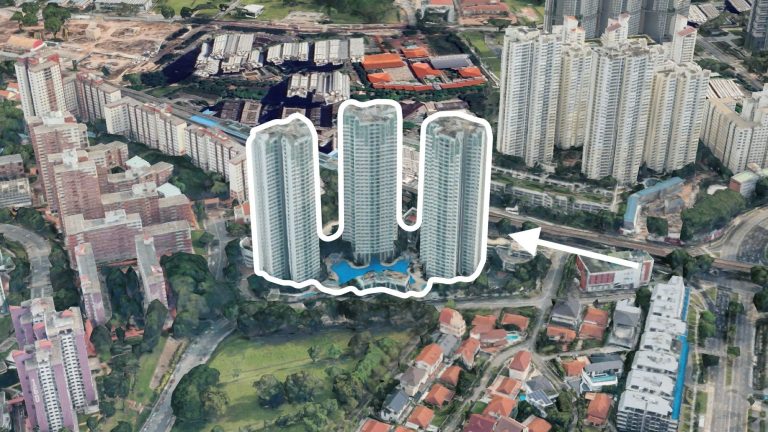
To offer some context on your existing properties: Springside Walk is a freehold landed estate on Springside Avenue in District 26, and Clydeswood is a freehold condo on Daisy Road in District 13.
Based on transactions compiled from Jan 2025 to Aug 2026, landed homes along Springside Walk sold for an average of $4.29 million across different land sizes.
Your 3,456 sq ft property is next to a 3,935 sq ft landed home that sold for $5.08 million in February 2026 - so we'll work with a conservative price tag of $4.5 million for your landed home.
After paying off your $900,000 outstanding loan, that leaves roughly $3.6 million in combined cash and CPF proceeds before selling costs.
The resale volume at Clydeswood is thinner. Over the same period of time, only one unit changed hands: a 1,152 sq ft unit that transacted for $1.88 million. Your unit is slightly larger at 1,248 sq ft, so we'll use the same figure as a working estimate.
After paying your $520,000 outstanding loan, that's about $1.36 million in proceeds. Sell both properties, and you’d unlock close to $4.96 million combined, before other transaction costs and legal fees.
However, if you keep the property at Springside Walk and decouple it - so your wife takes full ownership - and buy the next home in your name, the calculations differ. Your 30% share is worth $1.35 million at the estimated valuation of $4.5 million.
Estimated cost of decoupling your 30% share of Springside Walk
| Sale price (of 30% share) | $1,350,000 |
| BSD | $38,600 |
| 5% cash downpayment | $67,500 |
| 20% cash/CPF downpayment | $270,000 |
| 75% loan | $1,012,500 |
To avoid triggering the additional buyer’s stamp duty (ABSD), it's advisable to sell the unit at Clydeswood first. This means your wife owns no other property when she takes over the share of the Springside Walk landed home.
In that order, her upfront funding requirement comes to $376,100 including the buyer’s stamp duty (BSD). Her total mortgage rises to about $1.64 million, made up of the existing $630,000 balance and a new $1.01 million loan.
Splitting the proceeds of the Clydeswood unit gives each of you roughly $680,000. Her $680,000 share would cover that funding requirement with about $303,900 to spare, while you realise a profit of $1.08 million.
On your side, we estimate that your $680,000 share plus an individual borrowing capacity of roughly $2.02 million, assuming $300,000 income, a 30-year tenure and 4% interest, gives you around $3.78 million in total purchase funds.
But there's the constraint. Your proposed $4 to $5 million budget, sitting entirely in your name, would fall short by several hundred thousand dollars at minimum, before stamp duty, legal fees and reserves on the new purchase.
Reaching that price range this way would mean finding additional savings, or your wife freeing up funds she'd otherwise want to keep for the landed property's mortgage.
Springside Walk has grown more slowly compared to comparable benchmarks
Before you decide whether keeping the landed home at Springside Walk is worth that cost, let's look at how the properties in that estate have actually performed over time.
Based on our analysis of transactions since 2016, landed prices there rose from $1,438 psf in 2016 to $2,195 psf in the first half of 2026, an annualised growth rate of 4.32% over nearly ten years.
Average $PSF
| Year | Landed properties in The Springside landed estate | FH landed properties in D26 | All FH landed properties |
| 2016 | $1,438 | $1,166 | $1,259 |
| 2017 | $1,441 | $1,273 | $1,273 |
| 2018 | $1,499 | $1,287 | $1,388 |
| 2019 | $1,412 | $1,236 | $1,428 |
| 2020 | $1,502 | $1,234 | $1,443 |
| 2021 | $1,548 | $1,363 | $1,585 |
| 2022 | $1,782 | $1,547 | $1,816 |
| 2023 | $2,040 | $1,709 | $1,975 |
| 2024 | $1,975 | $1,834 | $2,018 |
| 2025 | $2,321 | $2,076 | $2,157 |
| 2026 (Up to June) | $2,195 | $1,951 | $2,269 |
| Annualised | 4.32% | 5.28% | 6.07% |
Overall, we found that the annualised figure trails the price performance of freehold landed homes in District 26, which grew at an annual rate of 5.28%. Meanwhile, the islandwide freehold landed market clocked price growth of 6.07% over the same period.
Transaction prices at Springside Walk also started at a higher $PSF in 2016 compared to the D26 average, which may explain the slower percentage growth even though it's still pricier in terms of its $PSF.
Even when we consider rental income, it doesn't change the picture very much. Landed homes at Springside Walk rented at an average of $6,435 a month, based on rental caveats lodged from 2025 to June 2026.
On your assumed $4.5 million value, that's a gross yield of just 1.72%, before property tax, maintenance and potential vacancy periods.
At that point, the case for keeping the home at Springside Walk rests on future capital appreciation and your preference for landed living, rather than the potential rent it might bring in.
Clydeswood's growth looks strong, but resale volume is too scarce to be trustworthy
The performance of resale units at Clydeswood looks good at first glance. Its resale price climbed from $1,055 psf in 2021 to $1,632 psf in 2025, an annualised rate of 11.54% per year.
This beats every benchmark we compared it against, including freehold and 99-year leasehold condos in District 13 and across the island.
Average $PSF
| Year | Clydeswood (resale) | FH non-landed properties in D13 (resale) | All FH non-landed properties (resale) | 99y LH non-landed properties in D13 (resale) | All 99y LH non-landed properties (resale) |
| 2021 | $1,055 | $1,382 | $1,585 | $1,520 | $1,227 |
| 2022 | $1,179 | $1,477 | $1,708 | $1,710 | $1,370 |
| 2023 | $1,317 | $1,547 | $1,797 | $1,875 | $1,516 |
| 2024 | $1,658 | $1,854 | $2,002 | $1,616 | |
| 2025 | $1,632 | $1,734 | $1,937 | $2,057 | $1,683 |
| Annualised | 11.54% | 5.84% | 5.13% | 7.85% | 8.22% |
But we'd be careful about reading too much into that growth rate. Clydeswood is a 36-unit development that typically records just one to four resale transactions per year, and there were no sales in 2024 or the first half of 2026.
A handful of transactions a year means a single unit's floor, layout facing, or condition of the unit can swing the whole year's price average. There's also too little recent data to determine what your own unit could realistically sell for.
Its rental figures face the same problem. There were just three leases involving three-bedroom units recorded from 2025 to Jun 2026, which fetched an average rent of $4,350 a month - this works out to a gross yield of about 2.78% on the $1.88 million working estimate, from just three rental caveats.
Given your priority of securing a suitable family home, we'd lean toward taking a satisfactory offer to realise whatever value you can claim on the Clydeswood unit, rather than holding it for the prospect of future growth.
Broadly speaking, we feel that a development that sells a handful of units each year isn't one where you want to be stuck waiting for a buyer when you actually need to sell.
Keeping both properties while you rent leaves less cash to spare
Your second proposal was to keep both properties: rent the unit at Clydeswood out, and continue renting your own home for $6,000 a month until you've saved enough.
On paper, the rental income from both properties looks like it should be enough to cover that.
A combined rental income of $6,435 from Springside Walk and $4,350 from Clydeswood adds up to $10,785 a month, well above your expected rental cost of $6,000 per month.
But that gross figure still has to service estimated combined outstanding loans of $1.42 million, on top of property tax, maintenance, agent fees and any vacant months where you lose out on rental income.
The $4,785 which you might have left over after paying off your own rent leaves you with a lot less flexibility.
You'd likely be topping it up from your salaries rather than letting the properties fund themselves. It's worth separating cash flow from cost here, since the interest and rent you pay don't go towards building equity.
We don't think this path is wrong, but it buys you time rather than building efficiently toward your final home. Much of your net worth stays tied up in two properties that, as shown above, aren't earning much for their capital values today.
A home near the primary school still has to rely on its own merits
Your third idea of selling the unit at Clydeswood and buying a property near your children's primary school has a straightforward appeal - it removes the uncertainty of rent.
However, we'd caution against letting school proximity become the deciding factor on its own.
Restricting your search to a tight radius around one school can mean compromising on space, resale demand or long-term appreciation, for a convenience that matters only during a relatively short stretch of your children's lives.
If a property near the school also meets your broader criteria on liveability and investment merit, then it's worth pursuing. But if it only ticks the school box, renting nearby for those years while expanding your choice from a wider pool keeps your options open.
An option worth exploring: sell both, buy two replacements
The option we'd give the most weight to wasn't one that you listed. This involves selling both properties and buying two new ones, one under each of your names.
Together, we estimate that the $4.96 million in combined proceeds and roughly $2.02 million in borrowing capacity each give you a combined funding pool of about $8.99 million before purchase costs.
That's the rough ceiling on what's available, and you'd still want to set aside reserves instead of exhausting your funds.
A home at your stated $4 million to $5 million target includes a BSD of $179,600 to $239,600, so a substantial slice of that capital already goes to upfront transaction costs.
This route also means you don't have to revert to the landed home at Springside Walk because you already own it. Instead, you get to decide fresh how your wealth should be split between the home you'll actually live in and a second property for your children.
You could replace the property at Springside Walk with another landed home and a condo, or move to two condos if facilities and lower upkeep matter more to you now. These options preserve your goal of holding two properties.
The downside to this route is the cost. Selling both means twice the agency fees, BSD, legal fees, and renovation costs. That only pays off if the replacements you find are genuinely better suited to your family than what you have now.
So, what should you do?
Out of everything that we have considered so far, we think that exiting Clydeswood at a fair price is the step we're most confident about. Its price growth may look good on paper, but a development with only one or two transactions a year leaves you with little control over your own timeline when the time comes to sell.
The landed home at Springside Walk is more challenging to make a definitive call. While the value of the landed homes in the estate has appreciated, it is slower than the broader freehold landed market.
Moreover, decoupling it only gets you to about $3.78 million in your own name, still short of the $4 - $5 million that you're after.
Selling both properties and shopping for two replacements that actually fit your current priorities is the option we'd weigh most seriously. But only if you can find homes that are worth the switch.
Finally, we wouldn't treat the end of your 30-month rental as the only point at which this decision gets made. If a suitable home at the right price turns up well before then, you're in a strong enough position to act on it rather than waiting out the lease.
At Stacked, we like to look beyond the headlines and surface-level numbers, and focus on how things play out in the real world.
If you'd like to discuss how this applies to your own circumstances, you can reach out for a one-to-one consultation here.
And if you simply have a question or want to share a thought, feel free to write to us at stories@stackedhomes.com. We read every message.



0 Comments