



After a robust performance in 2024 and 2025, there are signs that a combination of geopolitical volatility and a heightened interest rate environment is putting pressure on the Asia Pacific real estate investment trust (REIT) market.
The US war with Iran that started in February this year exacerbated concerns about persistently high global price inflation, while a more hawkish US Federal Reserve has weighed on sector performance, according to the Morningstar report.
A report by investment research firm Morningstar Asia indicates that most of the mature REIT markets in Asia, including Singapore, remain under pressure amid concerns over higher interest rates in the coming months.
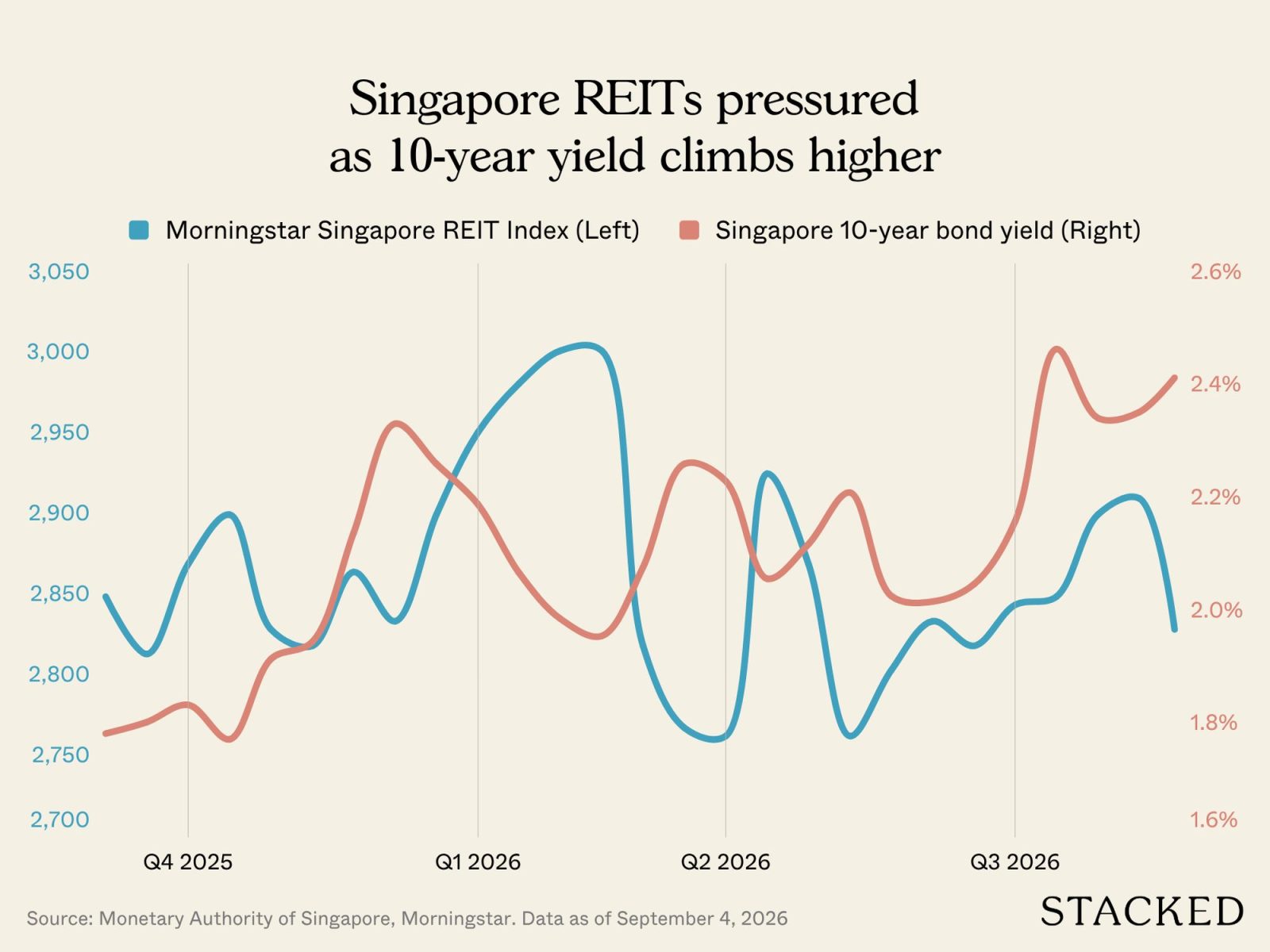
Singapore REITs are facing pressure as the 10-year bond yield climbs higher. In general, REIT performance moves in the opposite direction to Singapore government bond yields. When those yields increase, as they have over the past two quarters, REITs tend to fall as they become less attractive investments.
An index of Singapore REITs monitored by Morningstar puts the aggregate return on their basket of REITs at just under 2.0%, while the returns on Singapore 10-year bond yields are close to 2.4%.
Nevertheless, there is still plenty of positive market activity in Asia's REIT market, and the overall trajectory of mergers and acquisitions suggests that there is a broad-based market preference for scale, portfolio optimisation, and higher-quality assets, according to a separate market report by Cushman & Wakefield (C&W).
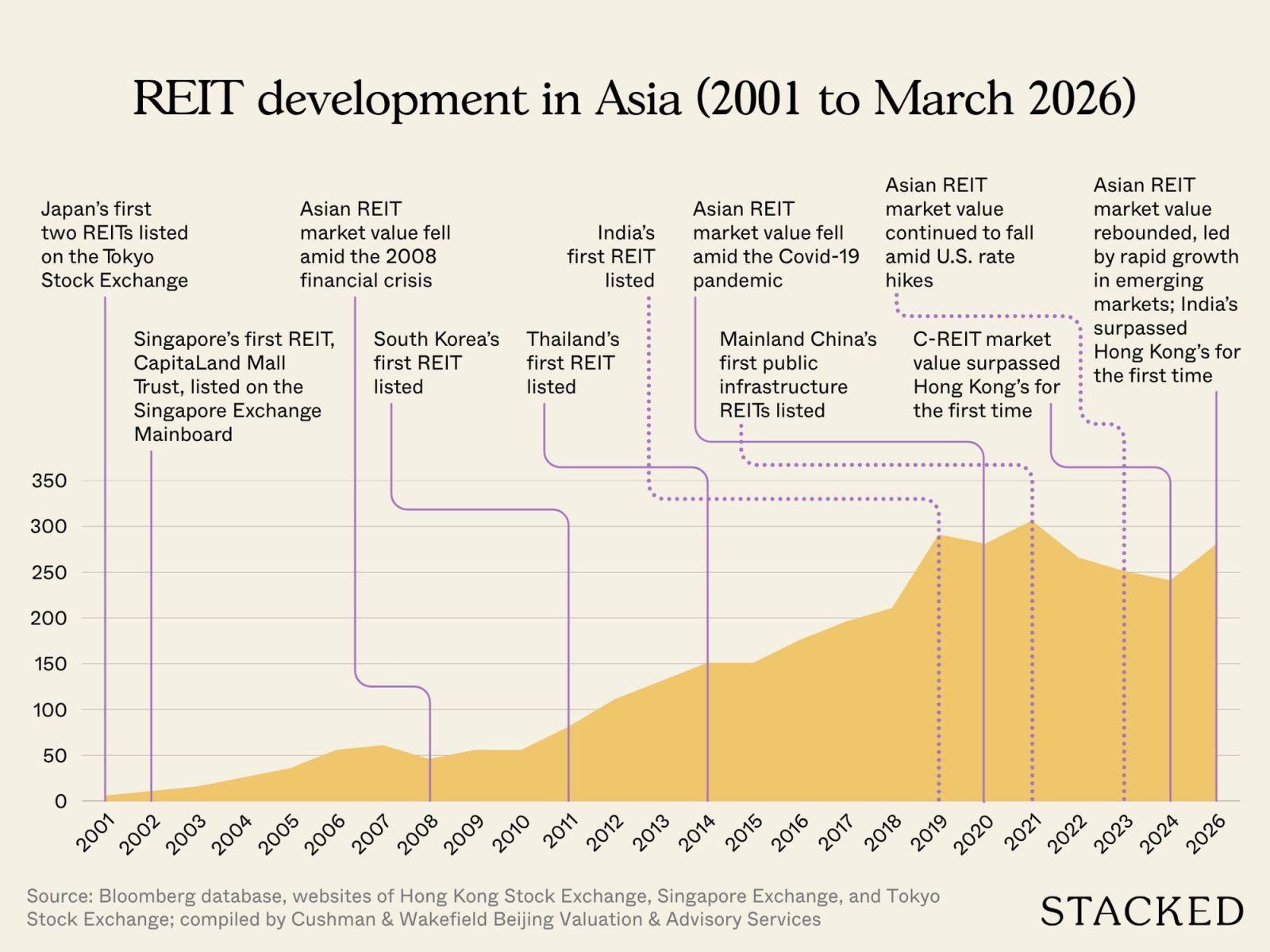
There were 289 active REITs with a combined market value of US$279.4 billion (S$356.95 billion) in Asia, as of March 31 this year. China has been the region's core driver of issuance, with 21 new listings since the start of 2025.
Although the US REIT market is still five times larger than Asia's, the C&W report says that the relatively small scale in Asia points to its substantial long-term growth potential. REITs in mature markets like Japan, Hong Kong and Singapore continue to bolster their portfolios with new acquisitions. Meanwhile, emerging markets like India and China are adding whole new funds and market segments.
Why REITs
Since the introduction of REITS in the 1960s, this type of financial product has become a popular choice for some investors, especially in Asia, where rapid urbanisation and flourishing property markets fuelled capital and rental growth across different sectors like office, retail, industrial, and hospitality.
Most REITs focus on a theme, and many hold property across several countries. For example, Keppel REIT mainly owns Grade A offices in Singapore, Australia, South Korea and Japan. Likewise, Parkway Life REIT holds hospitals in Singapore, health facilities in Japan and nursing homes in France.
In general, this allows investors to pick and choose the real estate sectors where they want to be exposed, as well as a mixed bag of different income-producing properties. Tax policies require REITs to pay out at least 90% of their taxable income to shareholders.
In Singapore, REITs are usually behind some of the most significant capital market acquisitions and disposals. In April this year, CapitaLand Integrated Commercial Trust (CICT) announced that it was selling its stake in Asia Square Tower 2 for S$2.5 billion, and acquiring Paragon shopping mall for $3.9 billion.
Steady market growth in the last two years
Throughout 2025, REIT indexes in Asia's three most mature real estate markets - Hong Kong, Singapore and Japan - rose due to the then low interest rate environment.
In all three of those markets, the average Price-to-Book ratio, or the trading price of the REIT compared to its net asset value (the valuation of all its assets minus liabilities), rose during the time frame.
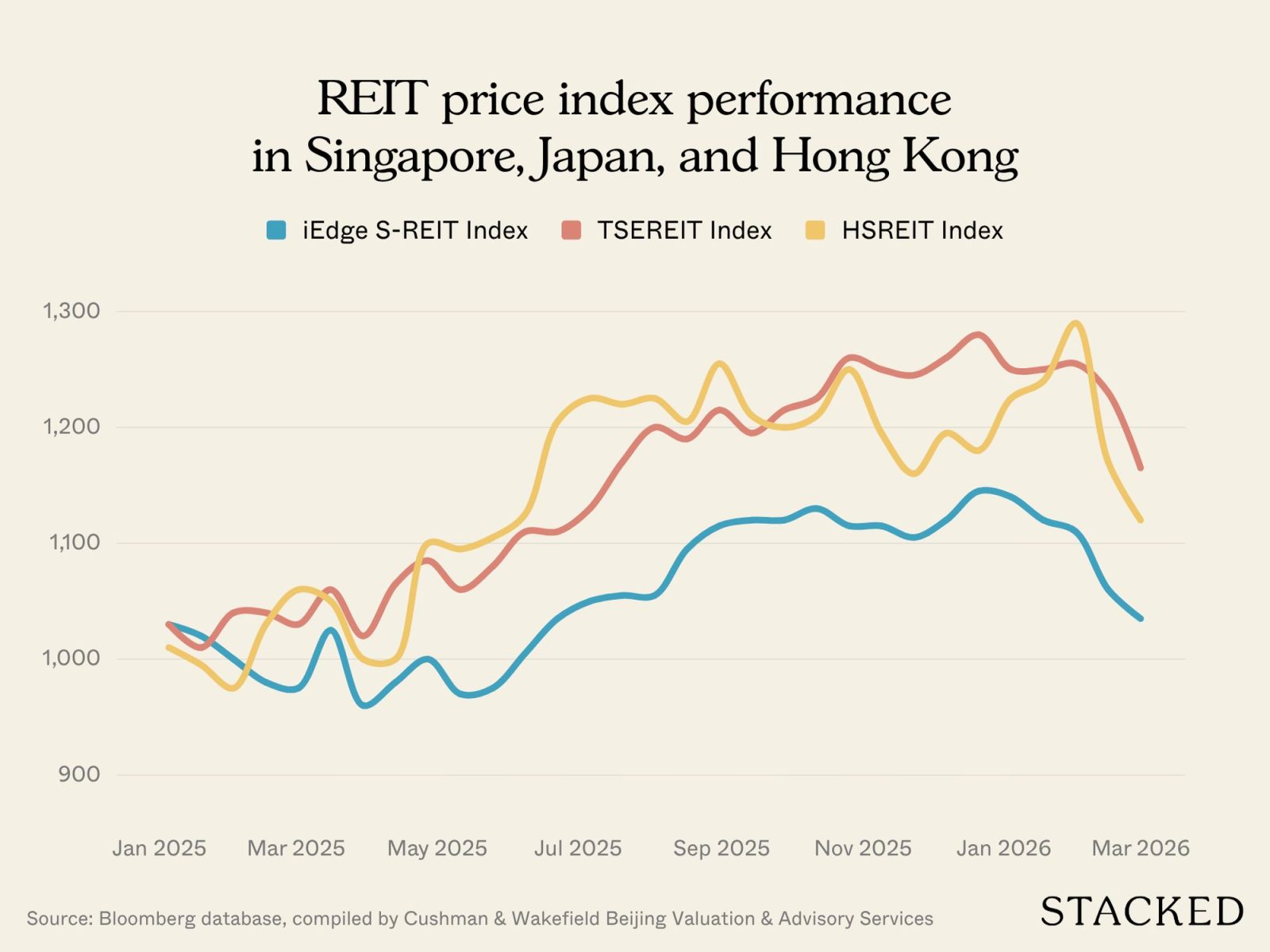
That impacted yields, or the ratio of the dividends per unit to the current unit price, across the three markets. The Singapore market was not spared either, with REIT yields tumbling in all but one sector.
The Hotel sector recorded the largest fall in yields, and Morningstar largely attributes this to the steep fall recorded by Acrophyte Hospitality Trust. The REIT's yield fell from a high of 14.4% in 2024 to just 3.5% in its latest issuance.
The reason for this dramatic decline is operational disruption from the disposal of non-core assets in its property portfolio, as well as the renovation of seven core hotels.
Meanwhile, REITs in the office segment also recorded weaker performance, with the low payouts by KORE US REIT pulling the sector average down.
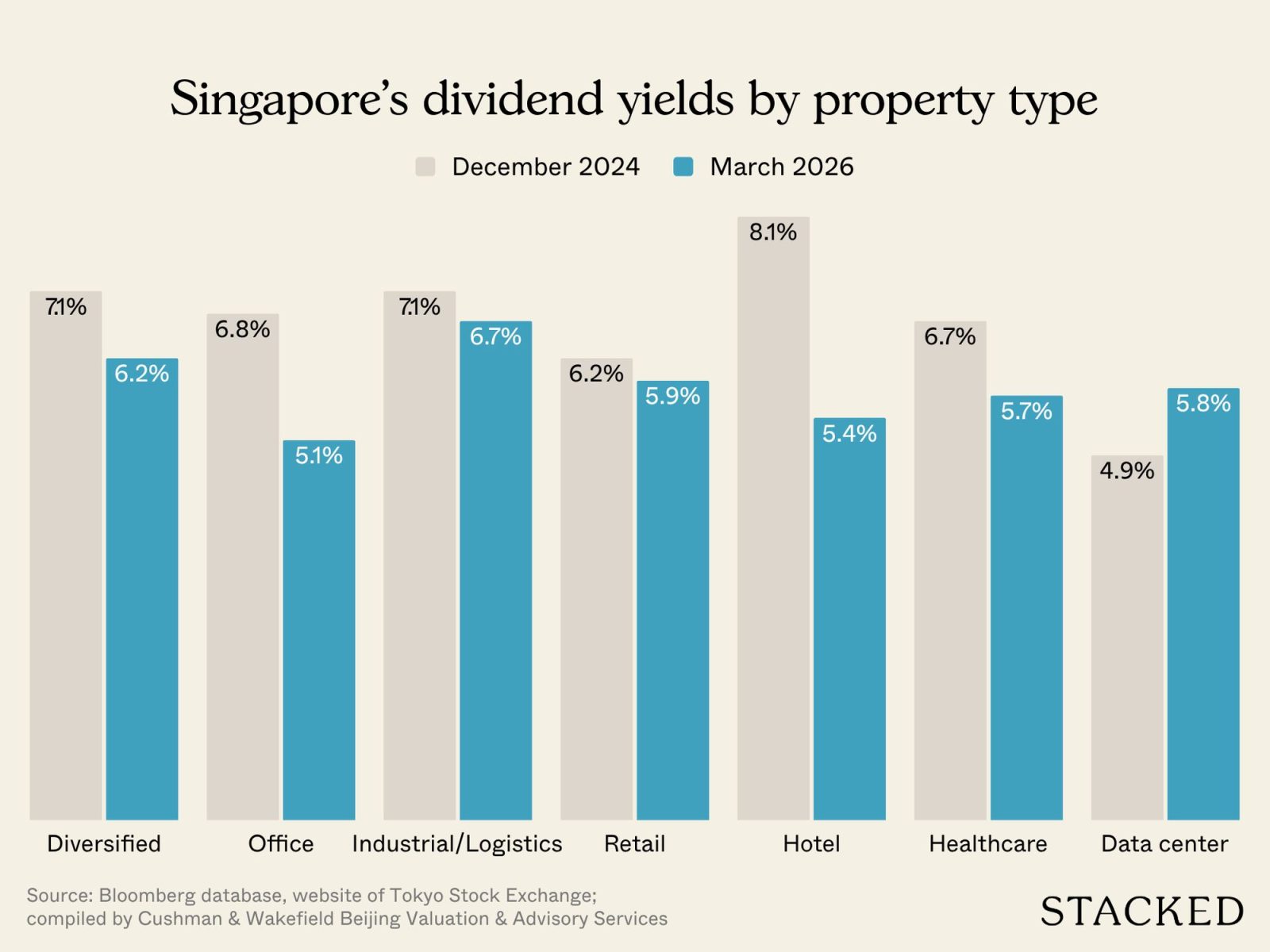
Data centres were the only sector to report a modest increase due to high utilisation rates and strong renewal-based rental growth, according to C&W. It states that the average dividend yield for data centre REITs rose to 5.8% in March this year, up from 4.9% at the end of 2024.
A note on Dividends and Yields
Overall, when choosing which REIT to invest in, its recorded yields are a useful tool in gauging the performance of the property sector it is most exposed to. But they may not be the best way to assess the quality of the fund itself.
Yields change every day based on the price of the market, as well as its perceived value. It doesn't offer a clear look at the real income growth of the REIT, which is better measured by its Distribution per Unit (DPU).
The DPU of a REIT fluctuates depending on whether the REIT's income changes through rental revisions, occupancy rates, or financing costs. It can also change when the number of units changes, if the REIT issues new ones.
Generally, most investors focus on a REIT where its DPU has held steady or grown over the past five years. A high yield means little if the DPU behind it is shrinking.
Market shifts since the start of 2026
In Singapore, shifting market dynamics led to a weak third-quarter performance, which extended the cautious sentiment that took hold in the first six months of 2026.
Based on an index of Singapore REITs monitored by Morningstar, performance faltered as Singapore 10-year bond yields rose throughout the first nine months of 2026.
The S-REIT price index by the research firm saw the sharpest drop in 1Q2026, triggered by the US-Iran war that started in February. Thereafter, S-REIT prices fell 6% in the first half of 2026, with office REITs falling 12.55% and industrial REITS also falling 9.60% over the same period.
But this also meant that falling prices temporarily pushed yields up for new buyers. The investment research firm expects that S-REITs will likely remain under pressure in 4Q2026 and over the coming months.
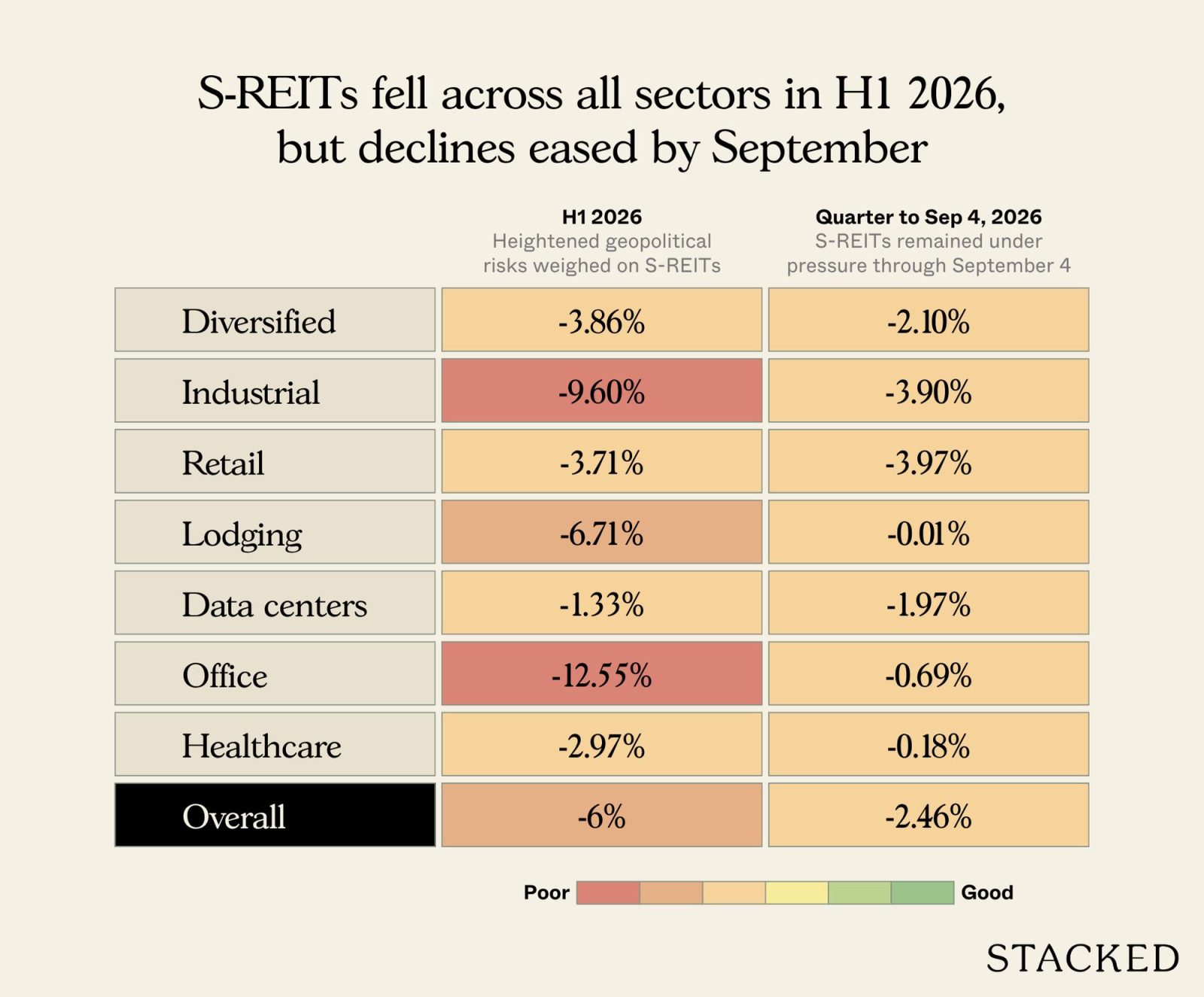
On the whole, Morningstar is of the view that most Singapore REITS are trading at a discount at the moment, citing its research that says that S-REITs generally trade at a 20% discount to their book value.
S-REITs' average P/B ratio was 0.74 at the end of 2024 and 0.77 in March 2026, according to Cushman & Wakefield. That puts Singapore between Hong Kong, which rose from 0.32 to 0.35 over the same period, and Japan, which rose from 0.81 to 0.87.
Research by C&W indicates that more than 80% of S-REITs are trading below their net asset value. Only seven REITs across the market posted a P/B ratio above 1.00, while two of the three newly listed REITs traded at a premium.
The three newly listed REITs are: NTT DC REIT (backed by NTT Group, Japan's leading IT conglomerate); Centurion Accommodation REIT (Singapore's first accommodation REIT); and UI Boustead REIT (an industrial fund with 23 properties).
For some investors, a low P/B could mean a bargain, but it may also suggest that the market and its investors are betting against the book value of the portfolio of the REIT.
But Office REITs are the most discounted
Morningstar reported that office REITs are the most discounted sector in Singapore, compared to other REITS in the retail, industrial and data centre segments.
Overall, the office market in Singapore recorded a relatively muted performance in the first half of this year. That was partly due to demand softening in the second quarter, as many businesses rightsized or relocated rather than expanded, according to Morningstar.
But the investment research firm also points out that demand for prime office space is still likely to outpace supply. Artificial Intelligence (AI) firms are growing in Singapore, which contributes to their demand for prime office space, while financial services continue to anchor demand and flight-to-quality trends.
Market data indicates that core CBD Grade A vacancy stayed at 3.3% in the second quarter of 2026. On the other hand, city-fringe office vacancies rose from 6.2% to 7.2% over the same period. This is largely attributed to the completion of Shaw Tower, a redeveloped commercial building at 100 Beach Road, which has injected 435,000 sq ft of new Grade A office space in the Bugis/Beach Road precinct.
With no significant office completions expected in 2027, Morningstar expects prime office rental growth to accelerate, supported by limited supply and resilient demand from the technology and financial services sectors.
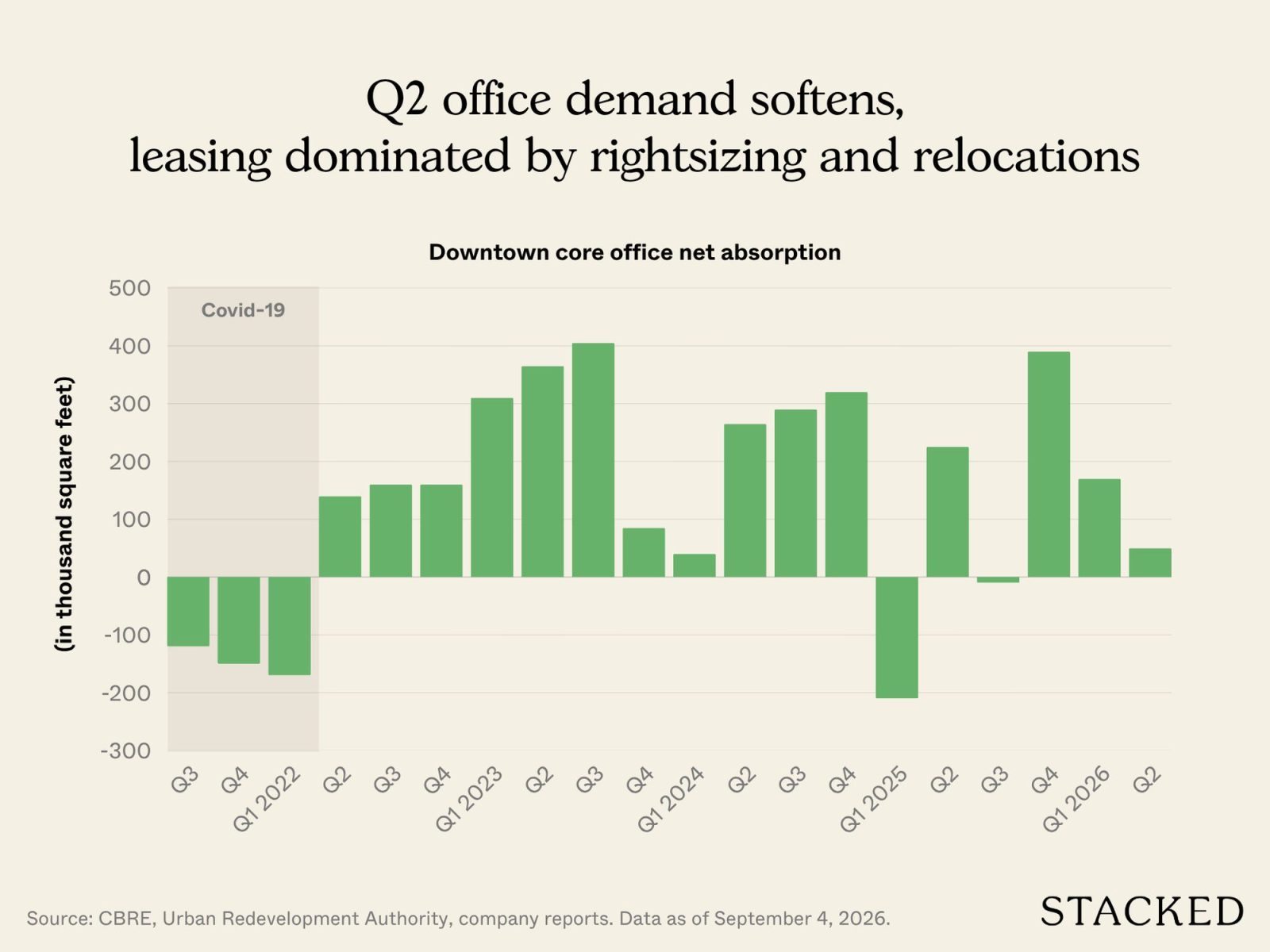
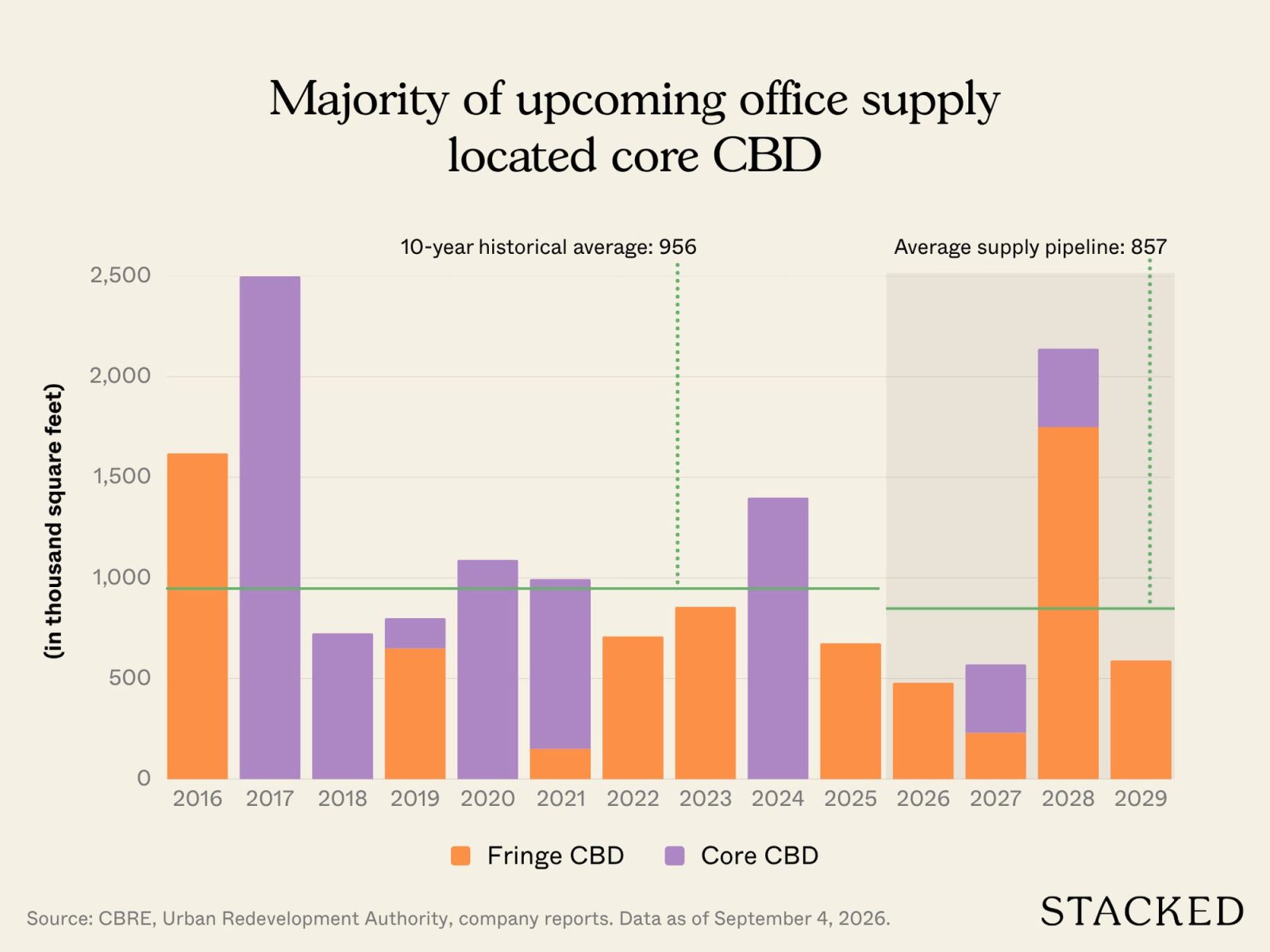
In its REIT report, Morningstar highlighted the positive prospects of two funds: Keppel REIT and CapitaLand Ascendas REIT.
Keppel REIT holds a portfolio of high-quality office assets across Singapore, Australia, South Korea and Japan. Most of its assets are Grade A offices in central business districts.
The tenant base of the properties managed by the REIT is one of the best in class, with government agencies and international banks in its register, the investment research firm says, adding: "In our view, the trust's high-quality portfolio should enable it to weather any economic uncertainty and deliver good dividends for unit holders".
Meanwhile, CapitaLand Ascendas REIT invests in properties used for industrial, logistics, and business activities in Singapore, Australia, Europe, and the US.
"In our view, its exposure to new economy sectors such as logistics and data centres benefits from strong structural demand. While its business park segment remains challenging, we think the weakness has been priced in and that the trust is currently undervalued," says Morningstar.
It expects the active portfolio management by the managers of CapitaLand Ascendas REIT, which is focused on capital recycling and asset enhancement projects, to create value for unit holders in the medium term.




0 Comments