



Some homeowners believe that a property agent’s work is limited to finding an appropriate unit for their clients, or to help them sell one. But in reality there’s a lot more to it than that, and one of the most crucial areas where help is needed is planning a well-organised timeline.
This recent case by Sheng is a good example of that: featuring in his clients’ move to a penthouse at Maplewoods. He recounts how this case involved two tenancies, two option periods, two completion timelines, a substantial renovation, and an ABSD deadline separated by a matter of days.
But what helped to smooth over the complexities was some prior familiarity. The couple in question had contacted Stacked before, and Sheng had been the agent who helped them secure their first home. This familiarity and trust greatly contributed to the positive outcome for the homeowners this time around.
The original purchase was supposed to last much longer
The couple first worked with the Stacked Consultancy team around five years ago, when they purchased a four-bedroom unit at The Tresor for approximately $3.7 million. At the time, their young family also consisted of their newborn and a helper.
When Sheng helped them pick their home at The Tresor, the purchase was grounded on two main reasons. The Tresor made sense as a family home, and Sheng was confident the future resale demand for the unit - when the family eventually put it up for sale - would be high.
The Tresor is a 999-year leasehold condominium on Duchess Road in prime District 10. The 62-unit development in Bukit Timah is close to Tan Kah Kee MRT station on the Downtown Line, as well as several schools.
“At the time, we spotted that The Tresor is one of the relatively few condominiums in the Duchess Road area that’s within one kilometre of Nanyang Primary School. It’s also around a five-minute walk from Tan Kah Kee MRT station,” says Sheng.
Moreover, the development is close to several amenities, with Coronation Plaza - which houses a supermarket nearby. The freehold tenure of The Tresor also distinguishes it from a nearby competitor, the 251-unit Duchess Crest on Duchess Avenue, which is also one of the handful of large condos in the neighbourhood.
“The only real alternatives in the area with condos of the same size, and close to the school, were the nearby landed estates of semi-etched houses and terrace houses. But those properties fetch a very high quantum,” says Sheng.
This was why the couple picked the unit at The Tresor five years ago, and had intended to stay in it for the long term.
But schooling requirements changed as the family grew
But fast forward to 2025, and the family had grown with two young children: a son and a daughter. The couple also realised that they needed more living space as the children grew up. This led to them moving out of the four-bedroom unit at The Tresor earlier than they had expected, around five and a half years after the purchase.
Sheng says that school proximity was one of the reasons that the couple felt that they needed to move to a new home. “Their original decision to live near Nanyang Primary School became irrelevant; they decided not to send the children there. The husband was an alumni of ACS, so it meant it was easier for their son to get in,” he says.
The first step, before shortlisting properties, was working out the proceeds that the sale of the unit at The Tresor might provide
This was where the qualities Sheng identified during the purchase of the four-bedder at The Tresor became important.
The condo has few direct competitors within the immediate Duchess area. The luxury Watten House, which launched for sale in 2024, had emerged as a new alternative, but its units commanded prices of more than $3,000 psf.
In contrast, the average resale price at The Tresor was around $2,500 psf - a substantially lower entry price for buyers, despite being a freehold development with a good mix of family-sized units.
This provided Sheng with a lot of confidence in marketing the unit. An initial valuation came in at approximately $4.7 million, although Sheng felt the unit could achieve slightly more. Based on the latest transaction data available at the time, he believed it was reasonable to test the upper end of the resale price range - which was $4.88 million at the time.
When the couple’s four-bedder was initially listed for sale, the number of enquiries that came in suggested that buying interest for the unit was strong. Sheng was able to schedule numerous viewings that yielded several offers from prospective buyers within the first two weeks of marketing the property.
Their 1,873 sq ft unit at The Tresor was eventually sold for $4,753,800, or approximately $2,538 psf. It illustrates the importance of picking a home with a good exit strategy in mind:
| Purchase | Sale | |
| Date | October 2019 | April 2025 |
| Price | $3,700,000 | $4,753,800 |
| Price PSF | $1,976 | $2,538 |
| Percentage Gain | - | +28.5% |
| Nominal Gain | - | + $1,053,800 |
Finding a replacement home proved more difficult than selling the four-bedder at The Tresor
The couple started to actively search for their replacement home in February/March last year. Based on an estimated sale price of the four-bedroom unit at The Tresor, the couple and Sheng knew there would be a budget of about $5.5 million for the next property purchase.
You would think that such a large figure would offer them plenty of options on the market. But they quickly realised that there were not many resale condos with units that boasted substantial liveable space that also came with proximity to SCGS or MGS. They found it challenging to find units that were at least 2,000 sq ft - the size of the home that the couple were looking for.
At one point in the property search, the couple began to consider whether a landed property would fit the bill. Sheng brought them to view a number of landed units at Illoura, a cluster housing project on Old Holland Road, and Balmoral Residences. They also viewed a small semi-detached home at Sian Tuan Avenue, as well as other landed homes at Binjai Park and Stevens Road.
| Project | What appealed to them | Main challenge |
| Binjai Park landed home | Landed living and proximity to MGS | Above $5.5 million, with perhaps another $1 million required for rebuilding |
| Illoura | Landed living and proximity to MGS | Ultimately they just decided it didn't provide a better overall fit than Maplewoods |
| Stevens Road landed home | Preferred SCGS location, and convenient for travelling to the CBD | Didn’t like the size for the given price |
| Balmoral Residences | Within the preferred SCGS area | Considered seriously, but lost out on overall space and layout efficiency |
| Sian Tuan Avenue semi-detached home | Cost-effective as it was smaller despite being a Semi-D, and close to MGS | Unusual subdivided configuration; also relatively small for a landed home |
Although the landed options - barring Binjai Park - were technically within budget, the couple weren’t entirely comfortable with most of the houses they viewed. This gradually brought their attention back to the area around MGS, and eventually to Maplewoods.
Why the Maplewoods penthouse stood out
The couple were the ones who brought to Sheng’s attention that a penthouse at Maplewoods was available on the market. It was one of the handful of projects close to MGS that offered homes of this scale, another project with these attributes is Floridian.
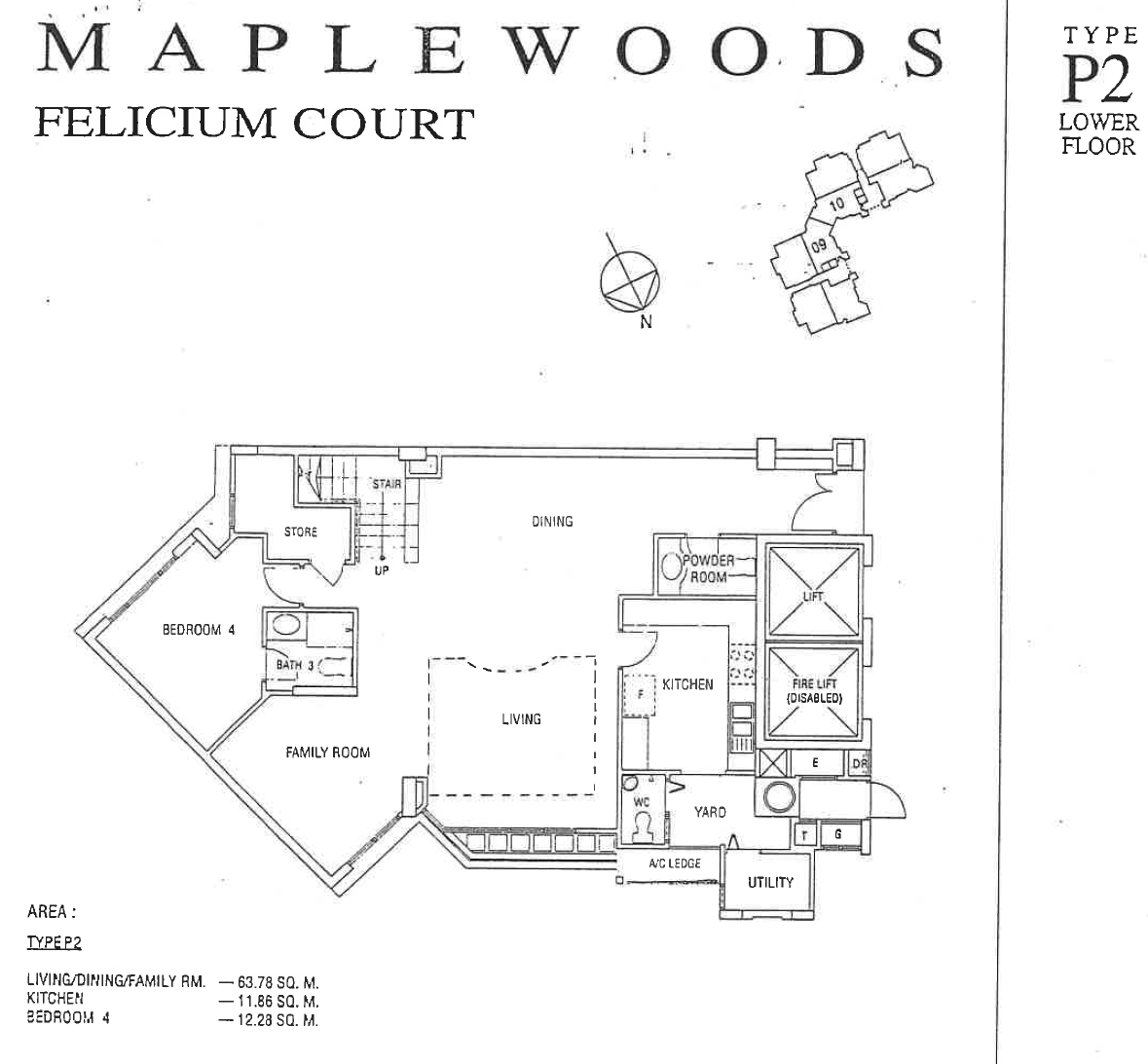
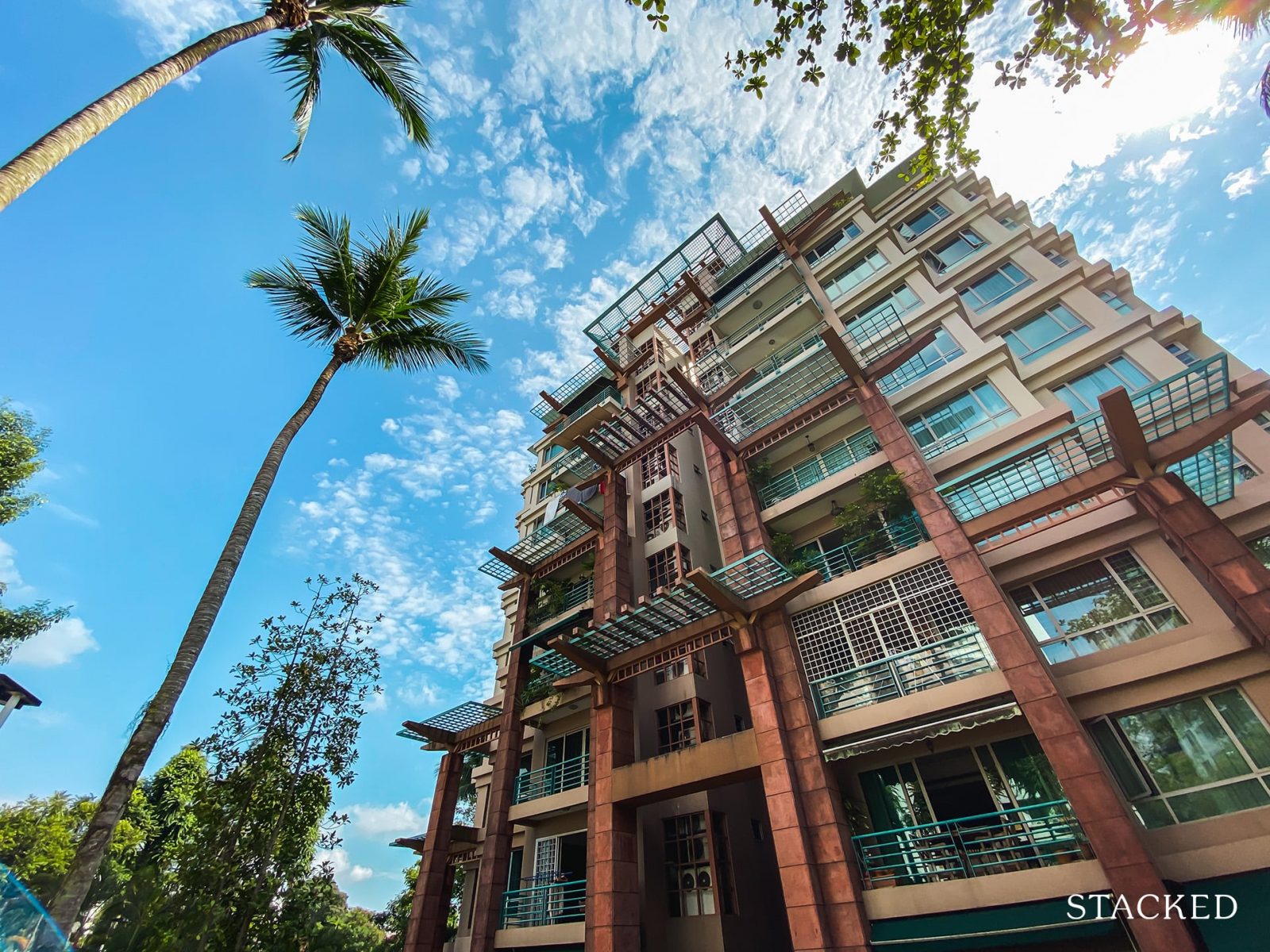
The Maplewoods penthouse on offer was a sizable 2,551 sq ft. Crucially, the unit had an efficient layout. We featured the freehold development a few years ago, and you can read our on the ground tour in this article.
In general, older penthouses like this are able to achieve their large strata areas through oversized balconies, roof terraces or other outdoor spaces. But the penthouse at Maplewoods doesn’t feature an oversized roof terrace or outdoor area, and almost all of the unit was dedicated to usable living spaces.
Although Maplewoods is a relatively older condo - built in 1997 - it is a freehold development, and the penthouse combined the needed unit size with the development’s proximity to MGS.
In addition, Maplewoods is close to King Albert Park MRT station on the Downtown Line, and will interchange with the future Cross Island Line, which meant that the couple’s children could make use of the public transport connectivity later on.
The unit seemed to meet all of their requirements, and the couple moved quickly to purchase this penthouse for $5.45 million, or approximately $2,136 psf. A feat that almost exactly matched their estimated budget.
The transaction timeline was where things became complicated
Unfortunately, the penthouse at Maplewoods was still occupied by a tenant, whose lease had another six to seven months remaining.
On top of this, the couple were also planning an extensive renovation of the penthouse, with a budget of around $500,000. Given the size of the unit, it seemed reasonable to plan for a renovation period of around six months.
As a result, the family needed a place to live for about a year after they sold the four-bedder at The Tresor. But they were not in favour of using a rental home in the interim - where they’d have to shift in their belongings, get settled, and then do it all over again once their unit at Maplewoods was ready.
“To avoid moving twice, we couldn’t look at the sale and purchase as two separate transactions. The whole timeline had to be planned backwards from when they could actually move in,” says Sheng.
The solution required three separate arrangements:
- A longer option period for the Maplewoods purchase
- A buyer for The Tresor who would accept a one-year rentback
- Different completion periods for the sale and purchase, so the CPF refund could arrive in time
They first secured a longer option for the penthouse at Maplewoods
Although the clients had not yet sold their unit at The Tresor when they found the penthouse, Sheng was sufficiently confident in its saleability to proceed with the acquisition.
But rather than employ a standard 14-day Option To Purchase (OTP) for the penthouse at Maplewoods, Sheng had to negotiate for a 42-day OTP validity period.
(For those unfamiliar with the OTP, this means the clients locked down the right to purchase the Maplewoods unit for 42 days, but had not legally completed the purchase at that point.)
With the 42-day option secured, Sheng had a wider window of time to find the right buyer for the four-bedroom unit at The Tresor. The difficulty he faced was further negotiations with the buyer: one that would allow his clients to stay on in The Tresor for one year, while the penthouse at Maplewoods was readied as their next home.
This meant negotiating a one-year rentback, which many prospective buyers rejected
Unsurprisingly, most buyers are turned off by the idea of waiting for a year before they can move into a new home. As such, an offer was made to buyers, for a one-year rentback at $10,000 per month (i.e., the buyer would effectively be getting back $120,000, for allowing Sheng’s clients to stay on another year).
Even with this offer, the condition significantly narrowed the pool of buyers. Sheng says: “The sale itself wasn’t the difficult part. We had plenty of interest. The difficult part was finding a family willing to buy, but then wait a whole year before moving in. Nearly all of the buyers who put in an offer didn’t accept the rentback”.
The timing considerations included the Additional Buyers Stamp Duty (ABSD)
Once the right buyer was secured, the next issue was ABSD. The family had obtained the OTP for the penthouse at Maplewoods first, but they still owned the unit at The Tresor.
This meant that if they exercised the OTP for the penthouse at Maplewoods before disposing of their former home at The Tresor, this would count as buying a second residential property and incurring a hefty ABSD of 20% on the purchase of the Maplewoods penthouse.
(They might subsequently have qualified for ABSD remission, but they still had to pay the ABSD upfront first. All stamp duties are payable within two weeks of completing a property purchase. This would have had a considerable impact on the initial cash outlay.)
Thus, Sheng had to sequence the transactions in such a way that the buyers exercised the OTP for the unit at The Tresor first, and exactly one day later, his clients exercised the OTP for the penthouse at Maplewoods.
(Note: For stamp-duty purposes, the relevant dates are the dates on which the respective OTPs are exercised, not their eventual sale dates.)
In this way, the couple would own no property on the date they exercised the OTP for the Maplewoods penthouse, and hence would pay no ABSD.
The ABSD aside, the clients still needed the sale proceeds from The Tresor to complete the purchase of the penthouse at Maplewoods.
To create sufficient time, the completion periods were carefully staggered. The “completion period” refers to the time between exercising the OTP and settling the transaction. Sheng arranged the periods such that:
- The Tresor sale had an eight-week completion period
- The Maple Woods purchase had a 12-week completion period
As the two OTPs were exercised just one day apart, this created a gap of approximately four weeks between the sale and purchase completions.
The sale of the unit at The Tresor would be completed first. At this point, the buyer would pay the remaining purchase price, the clients’ outstanding mortgage would be discharged, and the CPF principal and accrued interest used for the sale of the unit at The Tresor would be returned to their CPF accounts.
Those CPF funds could then be used toward the purchase of the penthouse at Maplewoods, when it was completed approximately four weeks later.
The arrangement was effective, but it left relatively little room for delay. It was a little tense, since any party acting unpredictably (e.g., the sellers changing their mind, or the tenant overstaying) could end up causing major disruptions. Thankfully, this didn’t happen.
In the end, the couple got their new penthouse at Maplewoods without having to rent during the interim, and could make the transition in one smooth move.
Key lessons from this move
We see two main takeaways from this case study.
The first is the importance of choosing the right property from the outset. When the clients bought the four-bedder at The Tresor in 2019, they had no plans to sell it in a little over five years. But family needs change, as do schooling priorities.
What protected them was that the original purchase had been made with exit flexibility in mind. The Tresor is a freehold condo that is close to an MRT station and amenities, and located within one kilometre of Nanyang Primary School. Sheng knew this would result in high saleability for future resale units, something that they could bank on once the one-year rentback became a necessity.
Crucially, the sales proceeds and profits from the sale gave them the financial capacity to upgrade to the Maplewoods penthouse. The clients had nominal returns of over $1 million in just 5.5 years, when they made an earlier-than-expected move.
The second lesson is that finding the right replacement home is only half the job. The transaction may have to be structured so that the family can make the move. A delay of only a few days could have resulted in a substantial ABSD payment, or the need for the family to move into interim accommodation.
This is where selecting a competent agent becomes vital: not just someone who can find listings and market a property, but also one who can coordinate the transaction timeline based on specific needs.
This case study is based on a recent transaction handled by Sheng, a property agent and partner property consultant with Stacked. The clients had previously purchased their home through Stacked in 2019 before returning for help with their next move. This write-up examines how the properties were selected, the trade-offs involved and how both transactions were structured.


0 Comments