


Hi Stacked,
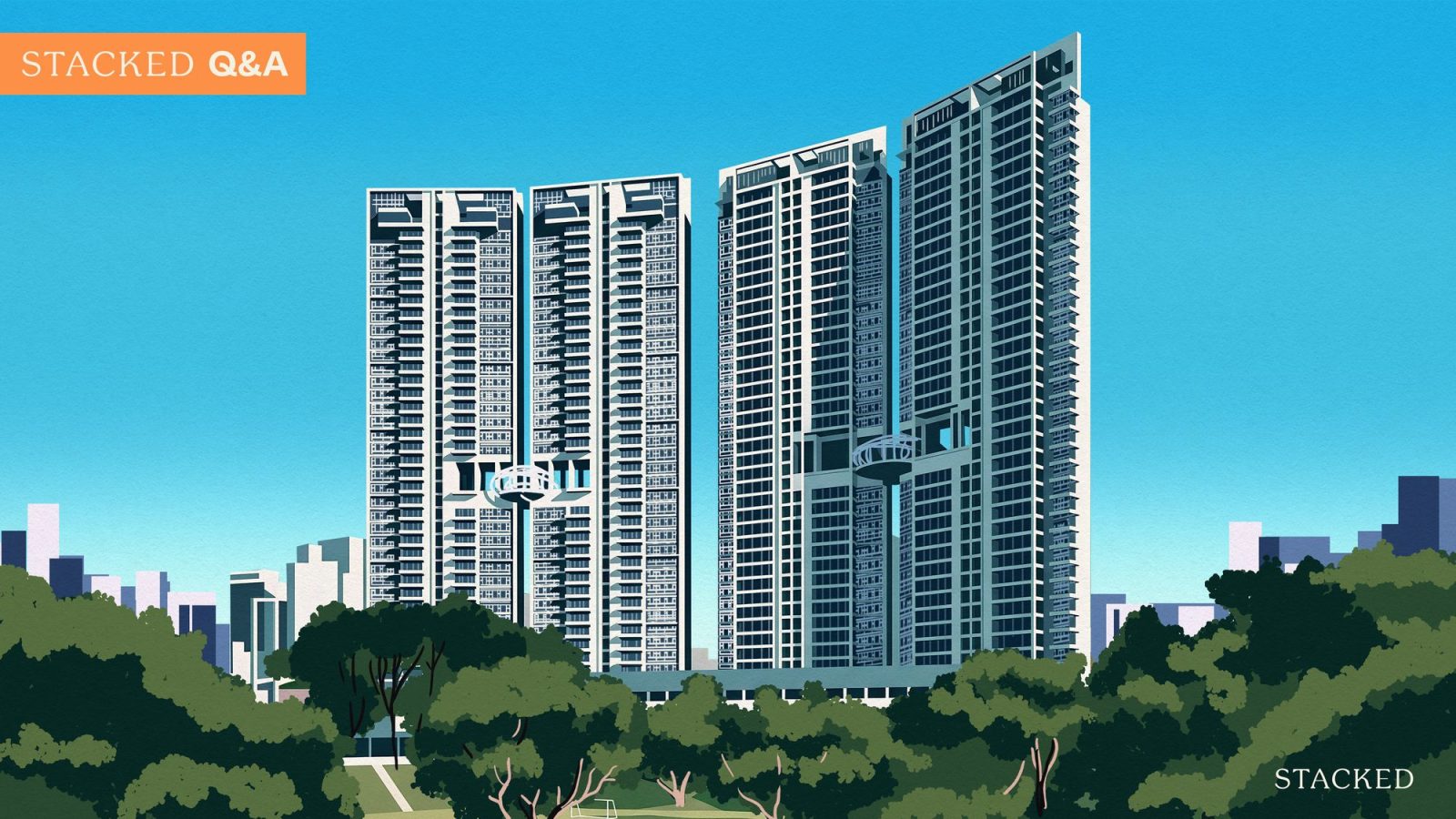
I’ve owned a four-bedroom unit at Sky@Eleven for nearly a year. It's a large-format unit that is close to 2,800 sq ft, and the size is one reason we were drawn to it.
A big format four-bedder like this was the compromise between my wife and I. She prefers the lower maintenance that a condo offers, while I grew up in a landed home and wanted a generous living area.
We always planned to move in, but for now, we are staying with my parents in order to care for them. WE decided to buy the unit at Sky@Eleven sooner rather than later, with the view that prices at the condo would only continue to climb.
Meanwhile, we have been renting out the unit, and it has raked in a gross rental yield of about 2.55%. Although this means that we still have to top up the mortgage each month, having CHIJ Primary and SJI International nearby gave us the confidence there would be steady rental demand.
However, with SJI International relocating in 2030, we are worried its move will thin rental demand, soften rental growth, and make the unit harder to sell in the future. We think that the school has always been the main reason why expat families would want to rent in that area.
Should we save up to pay the monthly mortgage amount and ride it out; or, sell now and find another large-format apartment elsewhere that would provide strong rental returns. Selling now would mean stamp duties and other costs, so it really is a last resort.
Thank you.
(This is part of an ongoing series where we answer reader questions about the property market. If you have one of your own, send it to stories@stackedhomes.com.)
Hi, and thanks for writing in!
In general, your concern that the relocation of SJI International and the negative impact this will have on the rental demand in the area is a reasonable concern for you. When SJI International vacates its campus on Thomson Road in 2030, some of the expat families who rented homes in that vicinity will likely follow the school to its new campus in Hougang.
This means that a crucial slice of the catchment of tenants that would turn to condos in the area, such as Sky@Eleven, will be as good as gone.
But how large is this slice of tenants? In our opinion, that is what your decision really spins on.
If the school was the main reason leased units at Sky@Eleven held their value and were able to be frequently rented, losing that pool of tenants is a serious problem that landlords like yourself will face.
However, if there were other reasons supporting the rental demand in that area, there is a chance that condos like Sky@Eleven would still see relatively strong rents and resale volume. Thus, the relocation of the school only slightly dents the overall demand that the area sees.
Let’s explore the different outcomes that might be possible in the coming years.
Families with children attending SJI International is only one source of demand driving Sky@Eleven
Let’s start with what proximity to the school actually contributes to the area’s rental catchment.
It is clear that being close to SJI International attracts international and expatriate families who have enrolled their children there. Moreover, being next to the school has certainly drawn some of them to pick units at Sky@Eleven over the years.
That is a real source of demand and it is the most exposed to the 2030 relocation.
But the condo also sits in an area that has a much more established and local catchment that isn’t going to change anytime soon. CHIJ Primary (Toa Payoh), a well-known school, is within 1km of the development. Three more popular schools are also in the 2km vicinity: St Joseph's Institution Junior, Pei Chun Public School, and Singapore Chinese Girls' Primary School.
For Singaporean owner-occupiers, being inside the 1km range of a sought-after primary school is a compelling reason to buy a home, and SJI International's move does not change that dynamic in that area.
We would argue that the attributes of Sky@Eleven are tougher to replace compared to the school catchment. The development has a freehold tenure, sits on a large plot, and the unit mix comprises spacious three- to five-bedroom homes.
Your own unit, at close to 2,800 sq ft, is the kind of layout developers have largely stopped building. Newer launches have shrunk their units to keep prices affordable, so a freehold, family-sized home in District 11 is now genuinely scarce.
Homes like that tend to draw owner-occupiers more than investors, and owners don’t face the financial pressures as acutely as landlords during a market downturn.
None of this means the school's move is free of cost. But the home itself is mostly untouched: a large freehold in an established schooling area, with views that newer, denser projects cannot match. SJI International was only one reason among several that supported the appeal of developments in this area.
Resale prices at Sky@Eleven have demonstrated resilience to tide through a future school relocation
If Sky@Eleven's appeal really rested on the rental demand of the nearby schools, you would expect its transaction history to be relatively more volatile. But the data does not reflect this characteristic.
Here is how its prices have performed since its sales launch, set against two benchmarks: other freehold and 999-year condos in District 11, and freehold and 999-year condos across Singapore. (For our purposes, a 999-year lease behaves like freehold.)
Average $PSF since launch (all sale types)
| Year | Sky@Eleven | D11 999y/FH non-landed private properties | All 999y/FH non-landed private properties | D11 99y non-landed private properties | All 99y non-landed private properties |
| 2007 | $1,063 | $1,095 | $1,130 | $1,239 | $885 |
| 2008 | $1,108 | $1,254 | $1,056 | $1,143 | $765 |
| 2009 | $1,126 | $1,271 | $1,066 | $1,007 | $788 |
| 2010 | $1,402 | $1,531 | $1,304 | $1,252 | $977 |
| 2011 | $1,569 | $1,613 | $1,388 | $1,468 | $985 |
| 2012 | $1,671 | $1,696 | $1,393 | $1,453 | $1,040 |
| 2013 | $1,712 | $1,812 | $1,553 | $1,520 | $1,164 |
| 2014 | $1,676 | $1,630 | $1,505 | $1,417 | $1,196 |
| 2015 | $1,590 | $1,533 | $1,438 | $1,394 | $1,104 |
| 2016 | $1,535 | $1,587 | $1,470 | $1,366 | $1,166 |
| 2017 | $1,489 | $1,783 | $1,501 | $1,317 | $1,230 |
| 2018 | $1,662 | $1,710 | $1,617 | $1,517 | $1,359 |
| 2019 | $1,663 | $1,884 | $1,798 | $1,335 | $1,474 |
| 2020 | $1,671 | $1,895 | $1,689 | $1,447 | $1,453 |
| 2021 | $1,791 | $1,913 | $1,812 | $1,463 | $1,517 |
| 2022 | $2,065 | $2,234 | $1,995 | $1,678 | $1,595 |
| 2023 | $2,116 | $2,598 | $2,111 | $1,770 | $1,783 |
| 2024 | $2,190 | $2,276 | $2,004 | $1,799 | $1,854 |
| 2025 | $2,281 | $2,238 | $2,104 | $1,809 | $2,092 |
| Annualised | 4.33% | 4.05% | 3.51% | 2.12% | 4.89% |
Based on data compiled by Stacked, transaction prices at Sky@Eleven have grown at an annual rate of about 4.33% since 2007.
That edges past both the average growth recorded among freehold condos in District 11, which recorded an average yearly increase of 4.05% over the same period, as well as the 3.51% average annual price increase of freehold condos islandwide.
Resale prices at Sky@Eleven did moderate after the introduction of the 2013 property cooling measures, from $1,712 psf to $1,489 psf by 2017. However, it recovered to $2,281 psf by 2025, which is its highest level to date.
Reflecting on the data, what stands out to us is the fact that the development has recorded relatively strong price growth despite featuring spacious unit sizes and a relatively high average resale price. Attributes like these usually result in a smaller pool of potential buyers and the most to lose when the market turns volatile.
Because you would be selling on the resale market, its resale-only track record should also be considered. Here are the figures over the past decade set against the same benchmarks.
Average $PSF (sub-sale and resale only)
| Year | Sky@Eleven | D11 999y/FH non-landed private properties | All 999y/FH non-landed private properties | D11 99y non-landed private properties | All 99y non-landed private properties |
| 2015 | $1,590 | $1,493 | $1,366 | $1,394 | $1,051 |
| 2016 | $1,535 | $1,484 | $1,393 | $1,366 | $1,140 |
| 2017 | $1,489 | $1,745 | $1,461 | $1,317 | $1,123 |
| 2018 | $1,662 | $1,706 | $1,524 | $1,517 | $1,164 |
| 2019 | $1,663 | $1,612 | $1,572 | $1,335 | $1,189 |
| 2020 | $1,671 | $1,631 | $1,488 | $1,447 | $1,159 |
| 2021 | $1,791 | $1,752 | $1,586 | $1,463 | $1,227 |
| 2022 | $2,065 | $1,814 | $1,709 | $1,678 | $1,370 |
| 2023 | $2,116 | $1,974 | $1,799 | $1,770 | $1,516 |
| 2024 | $2,190 | $2,030 | $1,856 | $1,799 | $1,616 |
| 2025 | $2,281 | $2,107 | $1,940 | $1,809 | $1,683 |
| Annualised | 3.67% | 3.51% | 3.57% | 2.64% | 4.82% |
If we consider these resale figures alone, average resale prices at Sky@Eleven have grown at an average yearly rate of about 3.67%. This puts it just ahead of the 3.51% yearly increase for freehold condos in District 11, and in line with the islandwide freehold market of 3.57%.
Although the difference in the average price growth is marginal, it backs our original point. Despite a relatively high price tag, Sky@Eleven has broadly kept pace with the wider freehold property market.
Recent URA caveats back this up. The large units like yours, between 2,500 and 3,200 sq ft, have moved from a median price of $1,799 psf in 2021 to $2,415 psf in 1H2026.
There is a trend which has moved faster than the rest: 99-year condos islandwide, at about 4.82% a year. But most of that increase stems from newer mass-market projects that launched at a lower entry price and rose quickly off that base. So, if your objective was purely capital growth, these are the types of developments you should be picking - but they also come with some trade-offs which we outline later.
However, while past price trends are useful indicators, it is also true that the market has not had time to price in the future relocation of SJI International from the area. But if the project really depended on the rental catchment from one school, it would not have held up through the shocks it has weathered to date.
More likely, buyers were paying for the freehold status, the size, the location and the scarcity of such developments in this area.
What tenants pay for and the marginal influence exerted by the international school
You’ve also expressed concern that the rental yield would decline in the years leading up to the international school’s relocation. In general, a larger freehold unit like yours earns a lower percentage in terms of rental yield.
From our experience, it costs a lot to buy a unit like this and the rent never seems to climb high enough to justify the purchase price and return on investment. That is probably why your gross rental yield of 2.55% feels thin.
The statistics in District 11 reflect this, namely that smaller units earn a higher yield while bigger ones tend to earn less.
District 11 average gross rental yield by unit size
| Year | 1-bedroom | 2-bedroom | 3-bedroom | 4-bedroom |
| 2015 | 3.42% | 2.92% | 3.07% | 3.04% |
| 2016 | 3.15% | 2.95% | 2.97% | 2.89% |
| 2017 | 2.71% | 2.82% | 2.73% | 2.87% |
| 2018 | 2.62% | 2.45% | 2.48% | 2.77% |
| 2019 | 2.88% | 2.69% | 2.49% | 2.67% |
| 2020 | 2.78% | 2.59% | 2.46% | 2.50% |
| 2021 | 2.88% | 2.49% | 2.33% | 2.50% |
| 2022 | 3.13% | 2.80% | 2.67% | 2.69% |
| 2023 | 4.09% | 3.03% | 2.95% | 2.96% |
| 2024 | 3.40% | 2.80% | 2.63% | 2.72% |
| 2025 | 3.20% | 2.78% | 2.61% | 2.67% |
We’ve compiled this dataset of rental figures which shows that an average one-bedder in the district usually recorded an average rental yield of 3.20% in 2025, while a four-bedder notched an average rental yield of 2.67%.
This means that your rental yield of about 2.55% sits right in that four-bedder range, a touch lower because freehold carries a price premium that the rent does not fully match. So, we reckon that your rental yield appears low because the unit is big and freehold, and it has less to do with weak tenant demand.
Additionally, land tenure is something buyers consider but is not something tenants consider when they shortlist properties.
A tenant does not mind whether your unit is freehold or 99-year leasehold, because they are not buying the lease. Instead, they are paying for the location of the property, the commute to nearby schools and amenities, the condo facilities, and whether the unit suits their household needs.
Most of these factors will likely remain in place well after 2030.
SJI International matters to one group in particular: international families who want to be near that campus. While the relocation will thin the pool of potential renters in the area, it does not affect the unit's central location, its size, or the other schools and amenities that pull in everyone else.
Selling now may cost you twice
We think that the case for selling has to clear a high bar. Since you are only about a year into ownership, you are still well inside the Seller's Stamp Duty (SSD) window. SSD runs from the date you bought the unit, so it applies to you now, on top of agent fees.
Then you would likely buy again; a replacement property which you would plan to move in in the future. On a comparable $5.9 million replacement, Buyer's Stamp Duty (BSD) alone comes to around $293,600, before any renovation or moving costs. That is a lot to pay simply to swap one set of uncertainties for another.
And it may not necessarily be fewer. Every project’s rental demand relies on a mix of things: schools, MRT access, nearby workplaces, lifestyle. Selling removes Sky@Eleven's exposure to SJI International, but it hands you whatever demand risks the next place comes with it.
And as the data has shown, chasing stronger capital growth would likely mean moving into newer mass market developments, the segment of the private housing market which has grown faster off a relatively lower base price.
But that means giving up something else: less space, perhaps a less central location, and usually a 99-year lease in place of your freehold property. You plan to live here one day, and may hold it far longer than you first planned. Over that time span, a leasehold property means taking into account the negative impact of lease decay.
So, what should you do?
Based on the evidence, the announcement of the international school’s relocation has not changed the project’s fundamentals. You bought a large freehold home in an established schooling area, in a layout that has seen strong buying demand and is scarce among newer projects.
Moreover, you bought it as a home to move into one day, not purely as an investment instrument. While the relocation of the international school takes away one segment of the rental demand in that area; other attributes such as its freehold tenure, unit size, proximity to other schools, and relative scarcity remains.
The price history and thin volumes point in the same direction: buyers have been paying for the whole package, not just the rental demand from one school.
If you were choosing whether to buy Sky@Eleven today, the school's exit might fairly tilt you elsewhere. But you already own a hard-to-replace home, bought at an earlier price. To give that up, you would want to see the rent or the resale price actually fall, not just hear an announcement the market has years to digest.
As 2030 nears, we suggest keeping an eye on two things: the rent your unit can actually get, and the resale price against comparable freehold condos. If either starts to slip, reassess then. Until that happens, selling means paying SSD now and BSD again, just to swap one set of risks for another. In our opinion, that is an expensive way to end up roughly where you started.

0 Comments