


Overview
The proportion of Singaporeans between the ages of 25-34 years old has increased significantly as a result of broader demographic trends. Recent population data indicates that the number of male citizens in that age group grew from 41.9% of the total population in 2020 to 47.6% in 2025.
Likewise, a sharp increase was recorded among female Singaporeans between 25–29 years old, from 69% of the total population in 2020 to 73.4% in 2025, according to the General Household Survey 2025 by the Department of Statistics (DOS).
Accompanying this demographic shift has been a growing desire among Singaporeans in these age groups to either stay single for longer or to get married later in life. As a result, singles are emerging as a growing proportion of home buyers in the private residential and resale HDB markets, at least anecdotally.
With more singles seemingly entering the housing market, or at least expressing a strong desire to own their own homes, it seems timely that the government considers how it could lower the barrier to entry towards homeownership for these Singaporeans.
A popular demand has been to lower the eligibility age for singles to buy new HDB flats, down from the current minimum age requirement of 35 years old. This has resurfaced periodically and Chee Hong Tat, the Minister of National Development, mentioned that the policy is under ‘careful review’, when he brought up the issue this July.
For singles who have been planning their finances for a potential resale flat purchase, a lowering of the minimum age offers them the benefit of a wider pool of options in the housing market - beyond waiting, renting, or buying a private property.
The housing realities faced by singles in Singapore
Even if the minimum age requirement were lowered, buying a home is a significant milestone that comes with tough financial considerations and challenges.
Foremost would be the extent of financial planning, since the purchase would rely on a single income rather than dual-income household finances. Singles are also exposed to a higher sensitivity to interest rate movements, job changes, and unexpected expenses.
If the government does go ahead to lower the eligibility age of singles buying resale of BTO flats, the buyers who benefit most are financially stable singles in their early 30s who already earn enough to comfortably clear the MSR and TDSR today. This group of buyers are currently locked out of homeownership due to their age, rather than their income, says Clive Chng, Associate Director at Redbrick Mortgage Advisory.
“It's less of a boost for lower income singles near the $7,000 grant income ceiling, since their constraint was affordability. For them, the bigger help would come from adjustments to grant quantums or income ceiling adjustments, not the age rule,” he says.
Some buyers may be concerned that they are paying too much for their home, while others may neglect to balance home ownership with longer-term goals such as retirement planning. Maximising the borrowing capacity and purchasing a property that is beyond your means can easily be overlooked during the purchasing journey.
But there are safeguards in place to ensure that homebuyers don’t overleverage themselves, and prevailing credit policies already take care of over-leveraging for homebuyers.
“MSR, TDSR and loan tenure all factor in your income, liabilities and age before a bank decides how much they're willing to lend. For HDB flats, for example, your loan eligibility is calculated using a maximum of 30% of your total income, stress tested at a 4% interest rate, even though actual mortgage rates are much lower,” Chng says.
This means that if your existing financial commitments already exceed 25% of your income, your loan eligibility gets reduced further on top of that.
Preventing HDB buyers from over-extending themselves was also why the Home Flat Eligibility (HFE) letter was introduced in May 2023. It is now the first step that outlines the key criteria including eligibility for housing type, housing grant, and available HDB loan.
Understanding the different HDB routes
Apart from renting or buying a private property, the HDB route remains a practical and viable option for single homebuyers. The options available are:
- Buying a new 2-room Flexi flat
- Buying a resale HDB flat in any location (all flat types excluding 3Gen flats)
- Buying with up to three other eligible singles
- Buying with parents under applicable schemes
- When different flat types become available depending on the purchase route
The singles' application rates for two-room Flexi BTO have run as high as 26.3 during the October 2024 BTO sales exercise. This was when singles could first apply for flats in all locations, and the application rate has tapered to around 7 for the past three BTO sales exercises through June 2026.
The most recent BTO sales exercise in June this year saw the median application rate for two-room Flexi flats for singles at 7.8, versus 0.2 for first-timer families and 0.4 for second-timer families in the same launch.
But the government has also sought to address the demand for housing among singles by increasing the overall housing supply. HDB plans to launch about 20,000 two-room Flexi flats from 2026 to 2028, a 50% increase over previous years, specifically to meet demand from singles and seniors.
Can you afford to stay in the estate you grew up in?
Broadly speaking, the relatively steep upward trajectory of resale HDB prices in recent years may be astounding to earlier generations of HDB buyers. Although resale prices in the public housing market have moderated in 4Q2025, it comes after a surge at the end of the Covid-19 pandemic and a 9.7% y-o-y increase in average resale prices in 2024.
To the current generation of buyers in their 20s and 30s, many are under the impression that a growing number of resale flats are out of reach?
Recently, I spoke to a 60-something Grab driver who bought a HDB flat in Tampines over 40 years ago, when the area was still being developed. She told me that the price of her four-room flat back then was in the low five-figures. According to her, nobody wanted to live there as the area was considered too “ulu” at the time.
This was back in 1981 when a three-room flat in the Central Region was going for approximately $34,500, and a four-room flat there could be bought for $52,800.
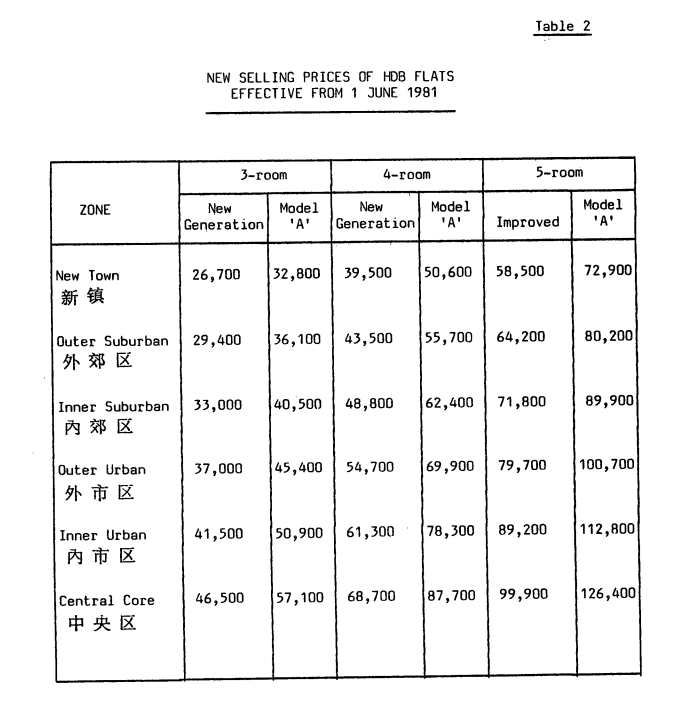
But fast-forward four decades and resale HDB prices have soared across the different parts of Singapore, although the increases are uneven across unit types. Going by HDB’s Resale Price Index, it went from 135 in 2015 and shot up to 203.6 in 4Q2025, an increase of roughly 51% over the period.
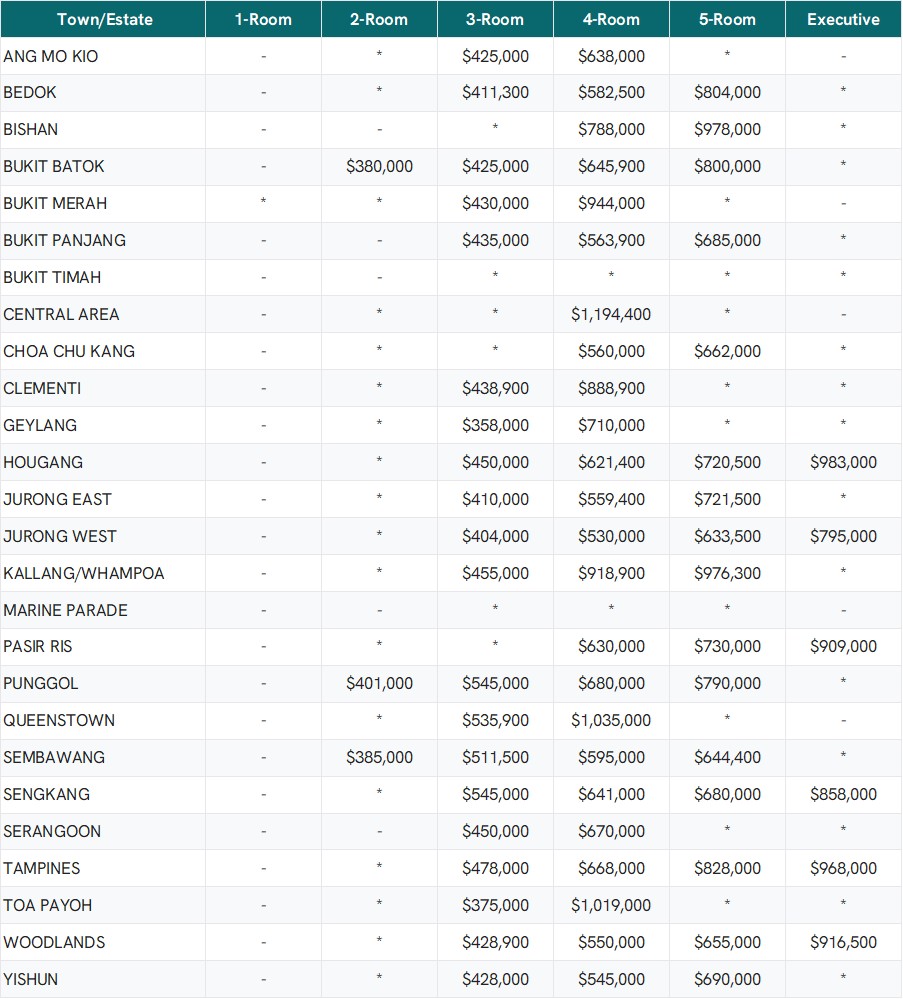
In the second quarter of 2026, it’s clear that HDB resale prices can vary quite widely based on town, flat age, floor area and location.
Average 2-room Resale Prices
| Year | Tampines | Jurong West | Bukit Merah | Punggol |
| 2015 | $240,600 | $257,663 | $270,000 | |
| 2016 | $260,000 | $239,150 | $255,251 | $273,600 |
| 2017 | $250,000 | $224,000 | $260,891 | $264,136 |
| 2018 | $268,000 | $215,787 | $240,318 | $260,821 |
| 2019 | $266,187 | $217,047 | $243,714 | $248,950 |
| 2020 | $260,250 | $228,400 | $249,934 | $250,033 |
| 2021 | $284,385 | $262,381 | $278,634 | $275,609 |
| 2022 | $326,333 | $295,952 | $301,222 | $312,328 |
| 2023 | $346,800 | $297,600 | $340,259 | $335,825 |
| 2024 | $363,033 | $321,258 | $322,451 | $354,486 |
| 2025 | $413,077 | $356,100 | $342,739 | $386,736 |
Average 3-room Resale Prices
| Year | Pasir Ris | Choa Chu Kang | Kallang/Whampoa | Sengkang |
| 2015 | $281,000 | $288,886 | $362,288 | $356,072 |
| 2016 | $297,000 | $279,847 | $367,044 | $358,794 |
| 2017 | $296,833 | $278,374 | $337,980 | $348,129 |
| 2018 | $285,714 | $276,771 | $331,826 | $331,507 |
| 2019 | $332,643 | $283,241 | $348,583 | $342,629 |
| 2020 | $377,603 | $306,959 | $337,170 | $347,701 |
| 2021 | $437,058 | $356,531 | $385,202 | $386,388 |
| 2022 | $474,533 | $381,812 | $437,972 | $427,705 |
| 2023 | $481,120 | $399,154 | $432,656 | $460,398 |
| 2024 | $516,688 | $424,093 | $482,120 | $497,675 |
| 2025 | $530,213 | $356,100 | $342,739 | $541,709 |
Average 4-room Resale Prices
| Year | Bedok | Bukit Panjang | Toa Payoh | Hougang |
| 2015 | $431,074 | $369,522 | $522,969 | $399,840 |
| 2016 | $431,132 | $369,334 | $551,592 | $383,719 |
| 2017 | $443,213 | $384,937 | $577,357 | $390,173 |
| 2018 | $432,484 | $378,550 | $586,494 | $385,442 |
| 2019 | $426,143 | $390,752 | $556,900 | $391,058 |
| 2020 | $444,349 | $412,710 | $554,877 | $417,780 |
| 2021 | $488,178 | $451,718 | $603,805 | $463,786 |
| 2022 | $508,718 | $480,776 | $702,864 | $520,933 |
| 2023 | $572,050 | $515,237 | $737,096 | $546,633 |
| 2024 | $595,730 | $550,224 | $821,044 | $593,124 |
| 2025 | $653,687 | $588,016 | $912,963 | $630,117 |
According to a compilation of HDB resale data by Stacked, four-room flats have experienced particularly strong dollar-value increases, based on average resale transactions over the past 10 years. At the same time, smaller two- and three-room flats have also become considerably more expensive.
So how much do homeowners like aspiring singles and couples need to earn to afford a home? Based on MSR at 30%, 3.0% stress rate, 25-year tenure, 75% LTV, we work out the income needed based on various flat prices:
| Flat type | Indicative price | Max loan (75% LTV) | Required monthly income (MSR-binding) |
| 2-room Flexi BTO (after grants, lower end) | $150,000 | $112,500 | ~$1,780 |
| 2-room Flexi BTO (before EHG grant, typical) | $180,000 | $135,000 | ~$2,140 |
| 2-room resale, median (the article's own example) | $378,000 | $283,500 | ~$4,480 |
| 3-room resale/BTO, typical | ~$291,000 | $218,250 | ~$3,450 |
According to our estimations, a Singaporean who is single and earning as little as $2,000 per month is able to clear the MSR for a two-room Flexi BTO.
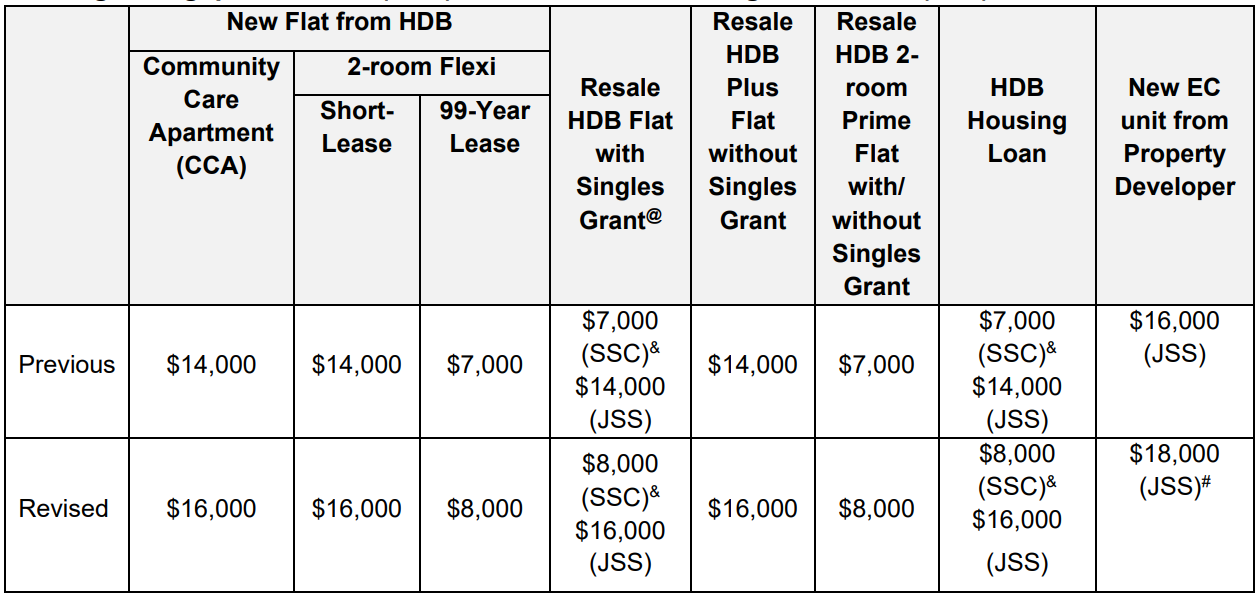
That's well under the recently adjusted $8,000 income ceiling for singles applying for BTO flats, although for this group of homebuyers, the concern leans towards beating the queue and balloting odds more than financing.
Below is a table on the income ceilings for housing and mortgage subsidies for singles under the Single Singapore Citizen (SSC) scheme and Joint Singles Scheme (JSS)*
To find out how much an individual buyer is able to borrow, we did the TDSR/MSR math based on two salaries, $3,500/month vs $5,500/month, to compute the loan ceilings based on the following assumptions:
- MSR cap: 30% of gross monthly income
- TDSR cap: 55% of gross monthly income
- HDB loan LTV: 75% (this was reduced from 80% since the Aug 2024 cooling measures)
- Max HDB loan tenure: 25 years (HDB’s concessionary loan tenure)
- Stress-test rate for MSR eligibility: 3.0% (MAS's mid-term floor for HDB loans since Sept 2022). This is not the same as the 2.6% rate you actually pay. Your loan ceiling is calculated at 3.0%, but your real monthly cash flow is calculated at 2.6% to create a small buffer.
Based on $3,500 monthly income
| Step | Calculation | Result |
| MSR ceiling | 30% × $3,500 | $1,050/month max instalment |
| TDSR ceiling | 55% × $3,500 | $1,925 |
| Max loan (at 3.0% stress rate, 25-yr) | $1,050 ÷ 0.0047418 | $221,466 |
| Max flat price (loan = 75% LTV) | $221,466 ÷ 0.75 | $295,288 |
| Downpayment (25%, CPF-payable) | $73,822 | |
| Actual monthly instalment (2.6%) | $1,005/month (vs $1,050 ceiling) |
Based on $5,500 monthly income
| Step | Calculation | Result |
| MSR ceiling | 30% × $5,500 | $1,650/month max instalment |
| TDSR ceiling | 55% × $5,500 | $3,025 |
| Max loan (at 3.0% stress rate, 25-yr) | $1,650 ÷ 0.0047418 | $348,018 |
| Max flat price (loan = 75% LTV) | $348,018 ÷ 0.75 | $464,024 |
| Downpayment (25%, CPF-payable) | $116,006 | |
| Actual monthly instalment (at 2.6%) | $1,579/month (vs $1,650 ceiling) |
Conclusion
When this article is published, we don’t know if the government will actually adjust the minimum eligibility age for singles buying new or resale HDB flats. Aside from the comments by the MND minister in July, the government has not shared any new information on the ongoing review.
The government has said it would continue to encourage marriage and parenthood while progressively opening up public housing options to singles.
If the age limit is lowered, many more newly-eligible younger singles will have the option of BTO 2-room Flexi flats. Since BTO flats are the most affordable housing options available to Singaporeans - especially with no resale premium and a number of grants on hand - it's possible that pent-up demand might flow towards the BTO market over resale choices.
This could further temper the overall increase in resale prices, especially among buyers who are willing to wait for a new BTO development to be completed - which can take as short as three years in some projects.
Historically, policy changes tend to result in a short-term impact fueled by pent-up demand from newly eligible buyers, before the buzz tempers to a more stabilised increase.
While the possibility of a change in the minimum age remains up in the air, the segment most exposed are smaller resale flats (two– and three-room flats) in mature estates. The extent of the impact depends heavily on factors including (1) how much the age limit drops, (2) whether the income ceiling is adjusted again, and (3) how fast BTO supply for singles is able to meet demand.
Singles are restricted to two-room and three-room flats (and can't ballot for larger BTO Plus/Prime units), so a lower age limit may direct demand towards that segment of resale.
On whether a two- or three-room purchase makes more sense, Chng says it depends on what buyers are optimising for. “A two-room resale flat keeps the loan quantum small, which suits someone prioritising a light financial commitment and flexibility to upgrade later after the MOP period. Given how oversubscribed two-room BTO flats have been, the resale option is often the faster route to actually getting a flat,” he says.
On the other hand, a three-room flat tends to hold its resale value better, gives more room if life circumstances change (such as taking in a parent or eventually starting a family) and isn't meaningfully harder to finance. Chng observes that a three-room or bigger flat has a wider pool of potential buyers including families, which also affects how fast the property moves and the price it sells at in the future.


0 Comments