



Citing rental yields commonly shows up in property listings, real estate agent pitches, and even in the marketing materials of some new launch projects. It’s almost always a number that attempts to convince a buyer whether that property is worth buying to rent.
The appeal of using rental yields as a marketing tool is pretty straightforward, since it’s a useful way to compare the potential performance across different projects. From a buyer’s perspective, a bigger number tends to look more convincing than a smaller one.
So, we spent the past two months testing how much rental yields explain the performance of a project. Across nine Stacked Pro articles, we ranked condos islandwide, then by age, then by holding costs, then district by district, and finally against the HDB flats that most of these landlords sold in order to get their investment capital.
After taking in everything we compiled, here are eight findings that stood out to us.
1. Higher rent does not always mean a better yield
The clearest case for this can be found in our analysis of Districts 9 and 10, where landlords command some of the highest rents in the country. A three-bedder at The Draycott, which costs $5.8 million, asks one of the highest rents but its rental yield of 1.64% is the lowest of any eligible project across both districts.
But when we turn to a suburban location like District 25, up around Woodlands and Admiralty, this trend seems to reverse. It is one of the most affordable districts we looked at, and the properties there produced the single highest two- and three-bedroom yields anywhere across the country - at 3.91% and 3.93%, respectively.
The conclusion of our analysis indicates that how low the rental yield lands, generally depends on how far the purchase price has run ahead of rental prices. While a tenant living in a prime district property does pay more in terms of monthly rent, it is rarely enough to keep pace with what the landlord paid to acquire the property in the first place.
2. Older leasehold condos often have an income advantage
Among 99-year leasehold projects, yields climbed fairly steadily with age. Two-bedroom yields ran from 3.36% for projects completed in 2021 or later, up to 3.68% for those completed between 1991 and 2000.
But age itself was not the only factor that contributed to these figures. Between that 1991 to 2000 cohort and the newest projects, two-bedroom prices rose 55% while rents for the same units rose only 11%. Since yield is just rent divided by price, when prices climb five times faster than their rent growth it results in a downward compression of the rental yield.
This means that what may initially seem as an older project earning more in terms of rent, could really just be the result of newer projects having their yields compressed due to the higher prices that buyers are paying for them.
We also tested this trend with freehold projects, where the same pattern should appear if age were really the cause. But the pattern did not show up at all, which illustrates how the price trajectory of 99-year leasehold developments tends to behave across a project’s life.
Among that dataset is an outlier - The Hillford - which posted the highest one-bedroom yield we recorded at 5.7%. But that project features a 60-year leasehold instead of the usual 99-year land tenure. That relatively short land lease is exactly what held its price low enough to produce such an attractive yield.
3. Smaller units generally delivered stronger yields
Overall, our series on the rental market concluded that islandwide one-bedroom yields barely moved in tandem with the broader private residential market, regardless of the region: at 4.25% in the Core Central Region (CCR), 4.27% in the Rest of Central Region (RCR) and 4.27% again in the Outside Central Region (OCR).
The spread only widened as homes got bigger, with three-bedroom yields running from 2.66% in the CCR to 3.21% in the OCR.
Our examination of District 21 demonstrated how uneven the performance of one district could be. It held the fifth-highest one-bedroom yield in Singapore at 4.58%, then landed at the very bottom of the two-bedroom table at 2.98%.
Small units also came the closest to paying off their purchase cost. Once we factored in property tax, maintenance and mortgage repayment, the smallest monthly shortfall across our 30 shortlisted projects belonged to a one-bedroom unit at #1 Suites, which needed a top-up of just $17 a month from its owner.
4. Convenience gets priced into the purchase price more heavily than the rent
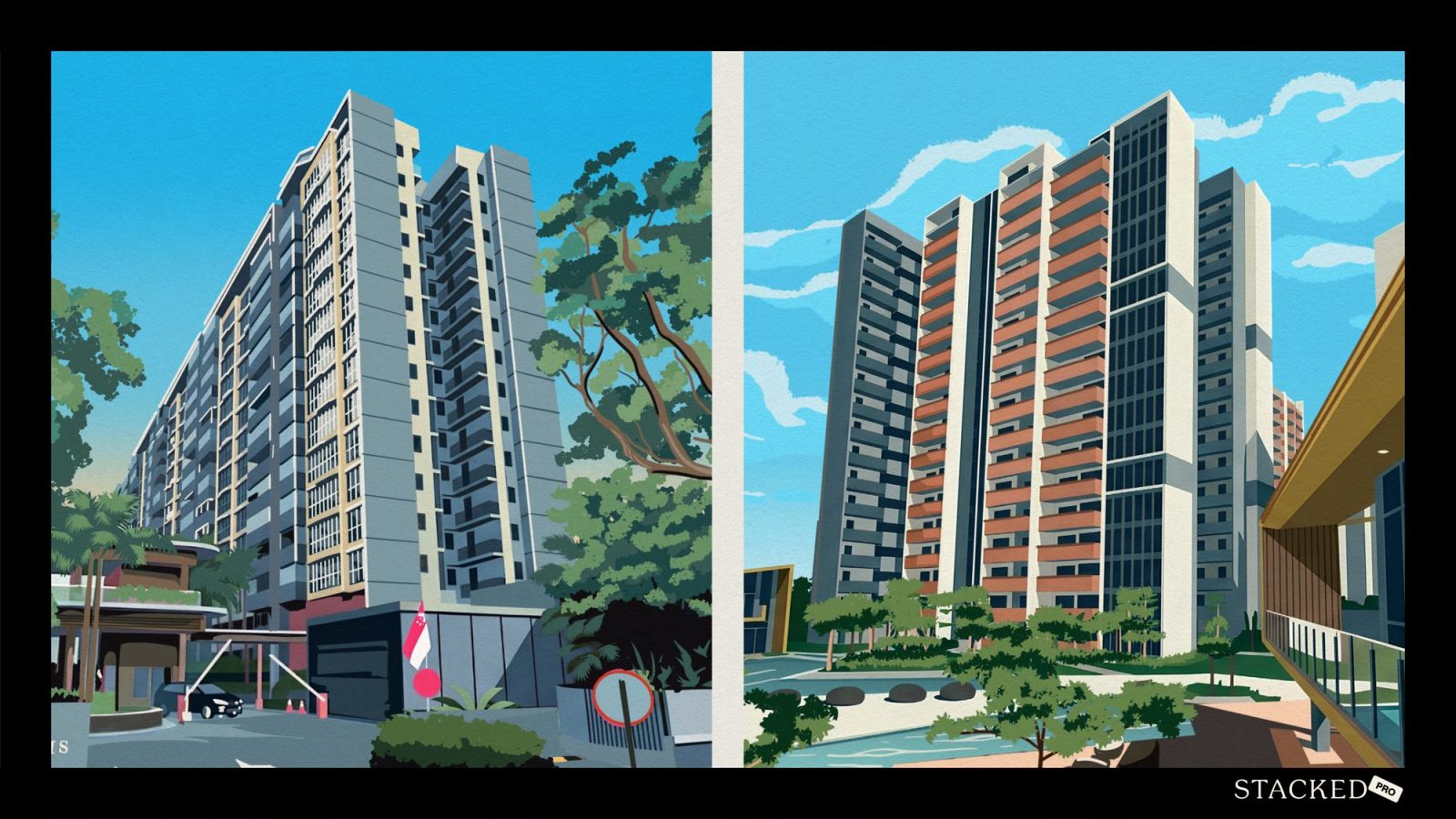
In District 19, the 1,165-unit Kingsford Waterbay is a 10-minute walk to Hougang MRT station on the North East Line. But the project is not an Executive Condominium (EC) and is not new, yet the performance of its units ranked near the top of almost every unit type in the district.
The one-bedroom units at that condo recorded a median price of $720,000 against $830,000 for developments of a similar size. Landlords paid extra for proximity and newness elsewhere in the district, while tenants refused to pay a matching premium in rent.
District 15 showed the same imbalance but with land tenure instead. Freehold owners along the East Coast paid considerably more than their leasehold neighbours, but the rental market never matched that premium, and the gap only widened as units got larger.
5. A strong yield does not mean the property pays for itself
This was the one result that shocked us most. Each of the 30 highest-yielding projects we tracked still needed a top-up from its owner once property tax, maintenance and mortgage repayments were included. And the estimated top-ups ranged from a mere $17 a month to an unappealing $1,625 a month.
Unsurprisingly, the purchase price (and as a result the mortgage) is once again the cause of that gap, and we found that #1 Suites is the best example of this. Its average rent of $3,500 covers the property tax ($277) and maintenance fees ($350) with $2,873 to spare. But its $2,890 mortgage repayment wipes that out, potentially leaving the landlord short of $17.
Another project with a lower yield could even leave a landlord in a better position month to month since the loan is tied to the purchase price. The net yield of 4.14% recorded at Melville Park trailed Eon Shenton's 4.17%, however the average resale price of $920,000 for units at Melville Park sat $262,500 lower than the resale price at Eon Shenton.
As a result, the estimated shortfall of $865 for most investors at Melville Park comes in lower than the estimated shortfall of $974 for most investors at Eon Shenton.
6. Yield and capital growth are not mutually exclusive
When we examined Woodgrove Condominium, a 99-year leasehold project in District 25 that completed in 1999, we saw that most investors raked in a 5.37% rental yield with 8.21% annualised price growth over five years. That yield sits well above the 3.21% median for three-bedders in its own region, and the price growth was not at its expense.
But a high yield could hide a warning, as seen in Eon Shenton's 4.57% two-bedroom yield. It looked strong until we checked its five-year price growth, which came in at negative 2.29%, meaning the yield was climbing because the purchase price kept dipping.
Both of those yields look attractive on their own, but a buyer who also needs the property to hold its value should check the five-year price record before treating these headline numbers as good news.
7. An international school nearby is not a guarantee of stronger returns
We also tested this well-held belief outside of the Pro series, comparing condos within a kilometre and one to two kilometres of five major international schools in Singapore.
Four of the five international schools that we analysed showed almost no significant difference, with two-bedroom yields for condos within a kilometre of UWC Dover recording a yield of 3.29%, compared to 3.25% for two-bedroom units in condos further out.
Likewise, two-bedders in condos that sit within 1km of Dulwich College are about 3.43%, compared to similar units in condos further out that rake in yields of about 3.44%. Both less than 0.05 percentage points apart.
On the other hand, the Singapore American School in Woodlands was the exception, and a wide one. Two-bedroom yields for condos within 1km of the school recorded yields of about 4.84%, and dropping to about 3.57% for developments further out, with The Woodgrove posting the best figures in both the two- and three-bedroom tables.
We conclude that Woodlands sits far enough from the rest of the private market that its own local supply, and not the school by itself, is setting those prices. For landlords specifically on the hunt for this tenant pool, we think the focus should be to look for a good project at a fair price near a school, without paying up for the last few hundred metres.
8. HDB flats out-yielded condos, but keeping one is the challenge
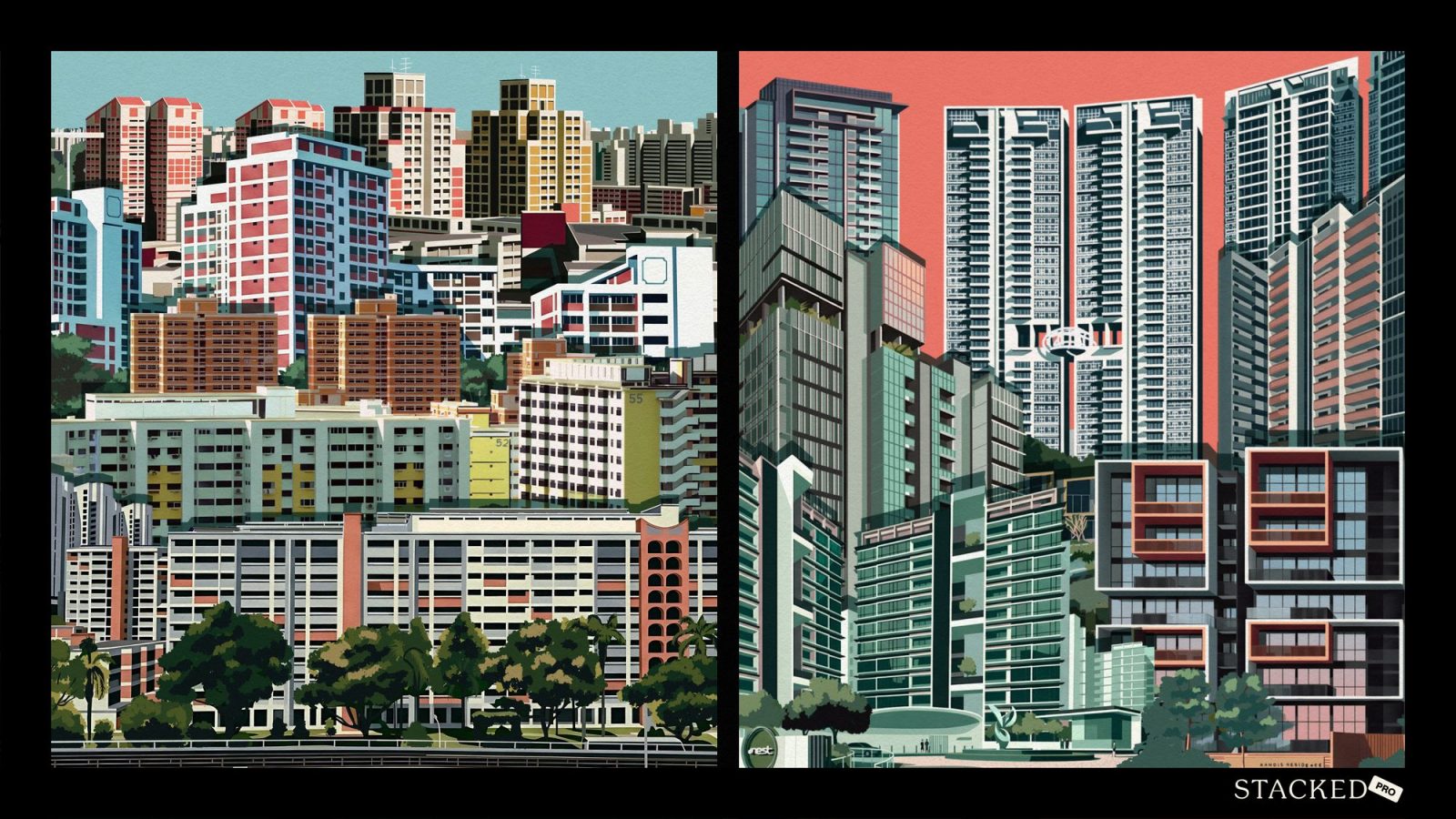
HDB flats beat their matched condos in every pairing we tested across 25 towns. The widest gap sat at the smallest end, where three-room flats returned a median of 7.50% against 3.42% for two-bedroom condos in its corresponding towns.
Geylang topped every town at 9.08%, followed by Toa Payoh at 8.81% and Clementi at 8.37%, all well-located mature estates where a flat still commands strong rent at a resale price below a nearby condo's.
Before anyone reads that as an argument for keeping the flat, those yields only reach an owner who has served the Minimum Occupation Period (MOP) and can rent out the whole unit. For most upgraders, selling the flat is what funds the condo in the first place.
Holding onto both also means paying Additional Buyer's Stamp Duty (ABSD) at 20% of the condo price. Earning that back from the flat's rent alone takes between 6.5 years, for an Executive flat against a $1.5 million condo, and 17.9 years for a three-room flat against a $3 million condo.
There is one arrangement that avoids the stamp duty, where the flat remains in a single owner's name and the essential occupier buys the condo alone, so it counts as that buyer's first property. That structure has to be in place long before the upgrade, which makes this not as straightforward of a choice for most buyers.
Overall, we found that price drove the outcome here as much as other deep-dives in this series. Geylang and Pasir Ris recorded exactly the same median three-room rent of $2,800, yet the Geylang flat cost $370,000 against $605,000 in Pasir Ris, resulting in considerably different yields of 9.08% and 5.55%, respectively.
An amendment partway through the series lifted every net yield we computed
Two days after the article on holding costs was published, a reader wrote in to point out that we had computed property tax on the full annualised rent. The Inland Revenue Authority of Singapore (IRAS) assesses a property's Annual Value below its market rent, since it excludes furniture, fittings and maintenance fees.
The effect of that revision was larger than we expected. Property tax fell by 40% to 50% across the dataset and net yields improved by roughly 0.3 to 0.5 percentage points, though the rankings themselves stayed essentially unchanged.
We had simply been too conservative, and every project in that analysis looked slightly worse than it should have.
Even after the revision, these remain best-case scenario figures, since they exclude maintenance fees, agent commissions and income tax, and gross yield on its own measures nothing beyond rent against purchase price.
We would also point out that the Urban Redevelopment Authority (URA) does not disclose which floor a lease was signed on, the unit's facing, or attributes like renovation quality and furnishing. Every figure we’ve cited is therefore a project-level average, and any individual unit could return a good deal more or less.
That said, we think these comparisons still hold up for the decision most landlords are weighing, which is usually the location or size of a unit.
A property worth buying for rental income needs a demand steady enough to maintain the rent, a purchase price low enough to make that rent worth collecting, and holding costs the landlord can still cover in the months when it sits empty. How well those three factors work together will tell you far more than where a project lands in any ranking, including ours.
Each of the nine instalments, with the full rankings and tables behind them, is on Stacked Pro.


0 Comments