


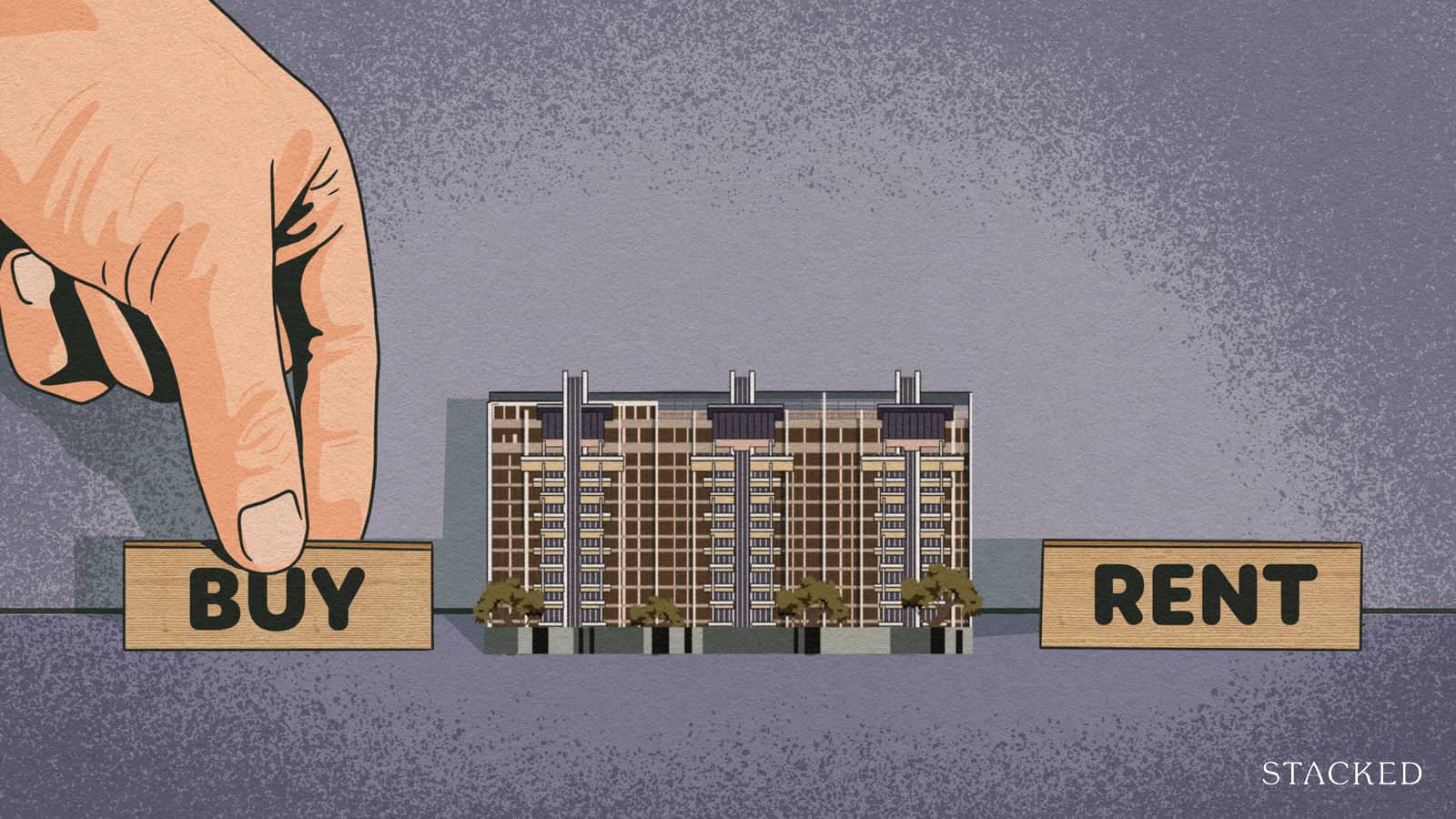
Home ownership is largely widespread in Singapore, and most solutions to a change in living needs tend to start from there.
We’ve consistently maintained one of the world’s highest home ownership rates at around 90% - the idea of buying a home is part of our social culture, and among many Singaporeans there’s an assumption that renting is money down the drain. It’s a last ditch move for young singles who need to be away from home, or a temporary arrangement while the new home is done up. But this mentality carries a real risk of unnecessary commitment.
Just this week, for instance, I came across a homeowner who had barely lived in his unit for four years. But he was already looking to sell it and buy a new place. I presumed this was a typical short-term flip, but no - in fact doing so would likely result in negative gains, after accounting for his renovation (he’d spent over $50,000 doing up his two-bedder), stamp duty, and other transaction / relocation costs. He would have to come close to the highest transaction in his block, just to break even.
So why then did he decide to sell and move? The reason was a new company he was running, and the location of its business incubator. This was somewhere in the Kent Ridge area, whilst he lived in Eunos. But here’s the thing: how long does a business stay in an incubator? Assuming it’s just a year or two, how likely is it that the next location is anywhere near Kent Ridge?
He did say that every property agent he’d spoken to immediately started listing options to buy, although admittedly he opened the conversation by asking about purchasing. He’d never even considered renting and it wasn’t presented to him as an option.
But renting made more sense in his case
Upon consideration, it was more logical to rent near his place of work. In the meantime his two-bedder - which needs a longer holding time to appreciate - can also be rented out. The benefit here isn’t just selling at a better price later, instead it’s about flexibility. He’d be free to buy elsewhere if he finds a more permanent place of work, or to rightsize if things don’t work out.
I saw something similar to this in one of our recent case studies this week (see below). A family wanted to be near their children’s school, but there wasn’t any property nearby that was right for them. Rather than force the move, the agent instead advised them to rent near the school while renting out their current unit.
Having to be near the school was temporary: eventually children are independent enough to travel on their own. At the same time, renting wasn’t really “money lost” since the rental of their existing home more or less covered the costs.
In this case study, I also noticed one particular issue: most property agents (the ones initially consulted) immediately started by recommending places to buy and how to sell. I don’t blame them for taking that approach because that’s their go-to direction - but the agents who stand out are the ones who are focused on fixing the problem first. And in some situations, the correct response is not to buy. Some milestones in life bring permanent long-term changes. But just as many can be fleeting, and don’t require overcommitment like buying a new home.
If you’re buying a new launch, there’s also the risk of changing circumstances, by the time of completion
The typical internal monologue goes something like this: “My child is entering primary school in a few years,” or “My grandparents are helping with my infant, better buy NOW while there’s a new launch in the VIP phase.”
And don’t get me wrong this can be a smart move, but it can also mask another risk. Between the day you complete the transaction, and the day you actually get your keys, life doesn’t pause. In my experience, many buyers who regret their purchases do so because - in the three to four years of construction time - something unexpected happens.
Their children end up not going to that school after all. Their parents move. They get a new job on the other end of the island. Their income is different. The possibilities are endless, and not all of them are great for handling a new, probably bigger mortgage. If you already sold your existing home however, you don’t have an easy “undo” button.
So while you do get a better deal when buying earlier, the wider context still matters. If the change is something with a limited time frame (e.g., the first few years of Primary school, or the brief years of preschool), it may not be worth permanently surrendering a comfortable home to move.
This is especially true if you have an older project, with a degree of spaciousness that would price you out in the current market. When I first started writing about property in the 2010s, a three-bedder in the OCR was around 1,200 to 1,400 sq ft, and cost around $1.6 million. Today, a unit like that - still in the OCR - might cost $2.5 million or more.
So before you commit, ask yourself the ‘temporary-or-permanent’ question
The next time a life change makes you think of buying, pause a minute and ask how permanent the change is. A new job, school priority, a need for grandparents’ help or a good preschool can all feel urgent and life-defining in the moment. And being told a “rare new launch opportunity” is nearby can fuel that enthusiasm.
But these shouldn’t be confused with deeper necessities like a long-term change in household size, which the older and larger home may actually accommodate better. Likewise, bear in mind the age of when dependents can or cannot travel on their own.
It helps to remember what's actually at stake if you guess wrong: buying and selling within a short holding period brings a real risk of loss. It’s not just about Sellers Stamp Duty, agent commissions, or renovation costs, although those play a role. It’s the very real possibility that the market will move, or new policies like loan curbs and cooling measures will kick in. Sometimes, this can prevent you from buying the same unit size or location as what you enjoy right now; even if you see modest gains from buying a new launch early.
As far as housing solutions go, we need to stop seeing renting as some kind of failure or desperate move. Sometimes it's the more prudent choice; one that retains your flexibility, and the ability to sell without urgency.
Meanwhile in other property news…
- Check out the aforementioned case study at Dunearn House. While it does ultimately involve a purchase, note how the main solution is still rental-based.
- If you’re looking to buy a flat soon, you’ll want to make sure your HFE letter is ready to go. Here are some of the main things to watch for.
- On the commercial front, interest rates are rising - here’s what it means for commercial properties and the possible impact.
- For those looking for a Lakeside property, or anywhere near Jurong East, check out our price review of new launch Lucerne Grand for what to expect.
Follow us on Stacked for more news and updates on the Singapore property market.


0 Comments