


This is a contributed article written by Adrian Lim, Head of International Residential Services, at Savills Singapore.
Over the past year, a growing number of my conversations with Singapore-based clients have started with some version of the same question: "Should I be looking at Johor?"
Usually this question is prompted after they, or a friend, have recently been to a showflat promoting a new project in the Malaysian state. But as I quiz my clients further, I realise that many of them haven’t really separated the two very different bets that "Johor" actually contains.
There are many things that Singaporean buyers and investors who are keen to capitalise on the growth of Johor need to keep in mind, and I’ll try to lay it out plainly before you lock in your purchase.
The Real Driver in Johor: the JS-SEZ and the RTS Link
Formalised through an agreement signed by Malaysia and Singapore on 7 January 2025, the Johor-Singapore Special Economic Zone (JS-SEZ) is the linchpin behind the promised development and investment opportunities taking shape in Johor.
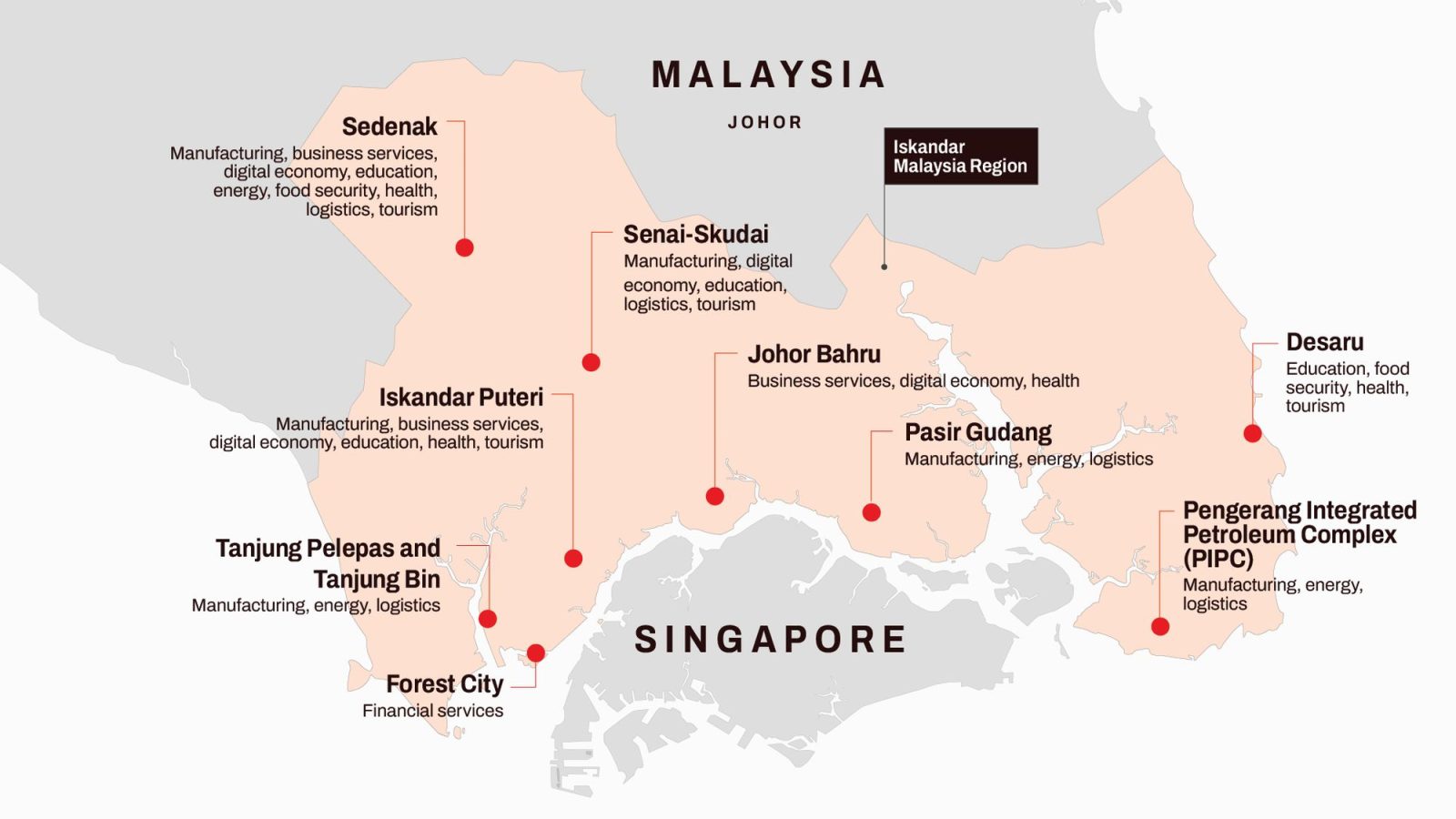
The JS-SEZ spans more than 3,500 km² — over four times the size of Singapore — encompassing Iskandar Malaysia, Pengerang, and nine designated flagship zones across 11 promoted sectors.
Those nine zones are Johor Bahru, Iskandar Puteri, Tanjung Pelepas and Tanjung Bin, Pasir Gudang, Senai–Skudai, Sedenak, Forest City, Desaru, and the Pengerang Integrated Petroleum Complex.
There are two issues that matter directly to aspiring residential buyers and investors:
- Johor Bahru City Centre — business services, digital economy, health.
- Iskandar Puteri — business services, digital economy, education, health, tourism.
Based on what has been revealed, the incentive framework is genuinely aggressive by regional standards: a special corporate tax rate as low as 5% for up to 15 years for qualifying investments in flagship zones, against Malaysia's standard 24%, plus a flat 15% personal income tax rate for eligible knowledge workers.
Applications for this incentive are processed by the Malaysian Investment Development Authority (MIDA), and are open until 31 December 2034. The stated initial target is 20,000 highly skilled jobs across 100 high-impact projects over ten years.
For residential buyers, the tax package isn't directly relevant to your purchase.
But, it is worth keeping in mind because it's the mechanism from which tenant demand in the JS-SEZ will be primarily derived. But it's a distinction which I find gets lost quickly in developer marketing.
The RTS Link
Meanwhile, anticipation is building for the Johor Bahru-Singapore Rapid Transit System (RTS). The 4km cross-border light rail will eventually connect Woodlands North in Singapore to Bukit Chagar in Johor Bahru, with a journey time of roughly five minutes.
The RTS stations on both ends will include co-located Customs, Immigration and Quarantine facilities. This means that passengers clear both authorities at the point of departure and don't have to queue again on arrival. The authorities say that peak capacity is up to 10,000 commuters per hour in each direction.
In Singapore, The Land Transport Authority's (LTA) stated target for the commencement of passenger service is February 2027. There has been much progress made throughout this year, and the first train completed its demonstration run into Woodlands North in February 2026.
But with the recent announcement that delayed the start of operations from January 2027 to the following month, we should brace ourselves for the possibility of further delays.
There are two important caveats that I usually share with investors. First, this project has slipped repeatedly since it was first announced in 2010, including a restructuring from a heavy MRT to a light rail configuration.
Second, the expected completion timeline has slipped before, especially as systems testing progresses. For now, I would treat February 2027 as an official target, not a settled fact, and I urge residential investors to stress-test their holding costs against the possibility of a later start.
But the enhancement in cross-border connectivity matters beyond the investment case. It will also change how Singaporeans think about living in Johor Bahru day-to-day, and this ties in well with the asset-class question that most investors face.

The "RTS Condo" - City Centre / Bukit Chagar
The impending completion of the RTS has spurred many investors to take a closer look at the high-rise apartments and serviced residences within walking distance of Bukit Chagar and JB Sentral, inside the Johor Bahru City Centre flagship zone.
In this case, the proximity to the RTS terminus at Bukit Chagar is the expected demand driver. Daily-commuter demand — Singapore-based professionals trading rent for space, JB-based workers accessing Singapore employment — supports a yield-and-liquidity play.
According to the Johor state authorities, the planned rezoning of the Johor Bahru (JB) city centre aims to attract more companies in the technology and digital economy sectors, as well as firms in the healthcare industry. This should support a jobs-and-tenant tailwind on top of the enhanced cross-border connectivity.
Overall, this should catch the eye of yield-focused investors - namely, buyers who prioritise tenant depth and resale liquidity over the unit floor area. I expect we will see more residential investors who have a shorter or more flexible hold horizon, and need the option to exit into an active secondary market.
But here’s my honest input on the risks that this investment approach might entail.
- Supply: This is the market factor with the most material impact. Property data indicates that there were roughly 9,018 unsold serviced apartments in Johor in 3Q2025. This makes it the largest serviced-apartment overhang of any Malaysian state.
Exacerbating the residential supply situation are approximately 3,293 unsold but completed residential units. Much of that is the hangover from the Iskandar building boom, where supply ran ahead of projected demand that never fully materialised.
In recent months, a wave of new RTS-adjacent project launches has hit the Johor Bahru property market, complicating an already-oversupplied high-rise market. This elevates the risk that yields will continue to be heavily compressed.
- Tenant price sensitivity. The commuter tenant base is, by definition, cost-driven. Many of these tenants will choose to rent in JB over Singapore precisely because of the rent price differential. That makes rents more elastic than a purely local tenant base would be.
- Management quality. In general, building management standards vary considerably across JB, even among the stock of high-rise residential buildings. We have observed that weak management standards have a direct impact on the development’s resale pricing.
The "Iskandar Villa" - Puteri Harbour / Iskandar Puteri
This investment approach focuses on the landed and low-density homes around Puteri Harbour.
Most investors also consider the established Iskandar Puteri townships which sit inside the Iskandar Puteri flagship zone - the waterfront locations, marina-facing neighbourhoods, as well as proximity to international schools and healthcare.
Broadly speaking, these buyers are in search of large living spaces, a laid-back lifestyle, and proximity to amenities. Other considerations like nearby education centres, as well as health and tourism rezoning play a part too.
Among the clients that I have worked with who have pursued this approach, this is a second-home and longer-horizon capital-growth proposition, rather than a yield play strategy.
The typical buyer profiles are usually second-home buyers with families, as well as investors with long holding power, a lower income-yield requirement, and the balance-sheet capacity to support this purchase.
For buyers approaching this as a genuine second residence rather than a pure investment, it's worth understanding how the Malaysia My Second Home (MM2H) programme interacts with an ownership decision.
To put it simply, the MM2H is a residency programme, not a prerequisite for buying property. I often see prospective investors conflating this more often than they should.
But there are risks involved with this strategy as well.
- Thin rental market. Our research shows that the tenant pool for landed stock in Iskandar Puteri is materially shallower compared to the catchment for high-rise residential developments in the city-centre. Moreover, vacancy periods are usually longer and more costly to landlords. We also see that yields for these landed properties typically run below the average condo yields.
- Distance from the RTS. Iskandar Puteri is car-dependent and roughly 25–30km from Bukit Chagar. To date, none of the planned infrastructure or public transport master plans by the state authorities appear to enhance commuting connectivity.
- High-rise legacy in the same postcode. I would caution aspiring investors and buyers to not import the wrong comparable. Serviced apartments in Medini and parts of Puteri Harbour have, in some cases, transacted well below their 2013–2015 launch prices. Meanwhile, established landed stock in townships such as Horizon Hills and East Ledang has held value considerably better.
These are different markets that happen to share the same district, but it is a distinction I see buyers miss more often than any others in this residential segment.
- Holding period burden. Maintenance fees, management and security costs on landed property are higher and harder to manage remotely if you are a landlord or owner primarily based in Singapore.
The Decision Matrix
| Axis | RTS Condo (Bukit Chagar / JB City Centre) | Iskandar Villa (Puteri Harbour / Iskandar Puteri) |
|---|---|---|
| Primary objective served | Rental yield and liquidity | Lifestyle use and capital growth |
| Typical entry quantum | Lower absolute quantum; more units clear the foreign-buyer threshold at the entry level | Higher quantum, particularly for landed and waterfront stock |
| Yield orientation | Higher gross yields; condo stock across JB typically transacts in a mid-single-digit gross range⁸ | Lower gross yields; landed stock generally yields below condo stock⁸ |
| Tenant pool | Deeper — commuters, local professionals, corporate lettings | Thinner — expatriate families, corporate relocations, longer search cycles |
| Void risk | Lower, but rent-sensitive | Higher, with longer letting periods |
| Resale liquidity | Better; more comparable transactions, more active secondary market | Weaker; fewer buyers, longer marketing periods |
| RTS proximity | The core investment case | Not a direct beneficiary; car-dependent |
| Lifestyle and amenity | Urban convenience; limited space | Marina, international schools, healthcare, low density |
| Supply risk | High — significant serviced-apartment overhang statewide⁷ | Moderate for established landed; high for Medini / Puteri Harbour high-rise⁷ |
| Holding and management cost | Lower per unit; strata management quality varies | Higher; landed maintenance and remote management burden |
| Suits a hold of | 3–7 years, with exit optionality | 10 years-plus, or indefinite for own use |
Foreign-ownership rules
Johor applies a minimum purchase price of RM1 million for foreign buyers of residential property, whether it is strata or landed.
There is one significant exemption: new strata units purchased directly from a developer within the Medini Iskandar zone in Iskandar Puteri fall outside the state-imposed minimum purchase price. But that exemption does not extend to Bukit Chagar or central Johor Bahru.
Moreover, State Authority consent is required for each property purchase by a foreign buyer. It's usually handled by your solicitor after the sale and purchase agreement has been signed, and meeting the price threshold does not guarantee this approval.
Transaction costs have materially changed throughout 2026
The property market in Johor has significantly shifted this year, as sellers and developers respond to the heightened investment interest. Johor authorities have also amended some regulations.
In 2025, Johor residential prices rose 5.3% y-o-y in the most recent annual NAPIC data - the Malaysian government’s property database - against the national average price growth of 0.7% over the same period. Likewise, transaction volumes in Johor have grown ahead of the national rate.
This is a substantial outperformance that reflects the impact that the JS-SEZ and RTS are having on price and performance expectations in Johor.
| Cost item | Current position | Effective from |
|---|---|---|
| Stamp duty on transfer (foreign buyers) | Flat 8%, replacing the previous fixed 4% rate | 1 January 2026 |
| Johor state foreign-buyer levy / consent fee | 3% of purchase price, or RM30,000, whichever is higher | 1 July 2025 |
| Legal and conveyancing fees | Scaled; budget conservatively | — |
Based on our experience working with investors looking to increase their property exposure in Johor, there are two crucial points of detail that are easy to overlook.
First, the Johor levy is charged under Section 433B of the National Land Code as part of the State Authority consent process, and a higher minimum — RM50,000 — applies to serviced residences priced below RM1 million.
This is relevant to property purchases in Medini that fall under the threshold exemption.
Separately, the levy replaced a previous 2% / RM20,000 structure, so older guides and developer material still in circulation have understated this cost.
When we take these changes into account, I generally advise buyers to budget an amount that is 10–13% above the headline price. On an RM1 million purchase that's roughly RM100,000–130,000 before financing costs — enough to reshape a yield calculation, and enough to require a longer hold before capital growth clears the entry cost.
Thus, on the one hand, the property market in Johor is experiencing strong buying demand - as seen in the yearly price growth and transaction volumes - but it is also true that the supply situation is holding back the market.
In my view, the reconciliation is that Johor is not a homogenous market. Well-located landed stock and RTS-proximate condo units are performing very differently from legacy high-rise inventory in Medini and Danga Bay.
On the "RTS rental premium"
As the opening date of the RTS draws close, speculation and estimates have been disseminated that try to predict how this will impact property values in JB city. Anecdotally, it seems that some observers are putting a 15% to 25% price premium for units within walking distance of Bukit Chagar.
However, I believe this estimate is derived from property portals and developer marketing material, with a limited basis on primary transaction data.
Broadly speaking, transit-proximity premiums are a well-established pattern in Malaysian property, and it is reasonable to expect this will be the case around Bukit Chagar as well.
But I won't pin a specific premium figure without a primary source behind it, and any buyer should treat a quoted percentage as a marketing claim until it's been tested against comparable transaction evidence for the specific building and unit type.
But, if pressed, this is how I would approach this analysis.
- Outline your objective, then use it to frame the type of property. Before you start scouring for listings, write down whether your goal is rental income, liquidity, capital growth, or for family use.
Most of the poorly made Johor purchases that I've seen usually begin when a buyer only visits showflats, rather than outlines their investment objective.
- Test the threshold before you fall in love with a unit. The RM1 million minimum price eliminates a large share of the JB market for foreign buyers. It is prudent to confirm at the outset which specific unit types in a development qualify.
- Underwrite the full entry cost. Model the 8% stamp duty and 3% state levy into your break-even estimates. After that, calculate how many years of capital growth are required to recover them.
- Look at the supply overhang in your specific sub-market. Statewide overhang figures are a blunt instrument. What matters is the unsold completed inventory that would compete with the development of your choice.
- Run the due-diligence checklist. This includes developer track record and delivery history; tenure (freehold vs leasehold); foreign-buyer eligibility for the specific unit; financing terms and loan-to-value available to non-residents; realistic exit liquidity.
- Take cross-border advice before you start looking for a property, not after. The tax, ownership and financing interactions between the two jurisdictions are where I see the greatest number of avoidable mistakes. And it’s almost always because someone signed up to buy a property before asking the tough questions.
Data Notes
Rules on foreign ownership thresholds, state consent, stamp duty and state levies are current as at the date of publication but are subject to change and to case-specific interpretation. The 8% foreign-buyer stamp duty and the 3% Johor state levy are recent changes and should be confirmed with a Malaysian conveyancing solicitor before any commitment. Yield and price ranges are indicative market observations and vary by sub-market, building, unit type and negotiation; they are not valuations. RTS Link timing reflects the official target as stated by the Land Transport Authority and is not a guarantee of commencement date. This article is general market commentary and does not constitute financial, tax, valuation or legal advice.



0 Comments