



As a young and single Singaporean who can’t afford to buy my own public housing at the moment, I find myself exploring beyond the borders of our little red dot for alternative housing options that would appeal to myself and fellow kindred spirits.
Last November, Singapore-based ferry operator Batamfast shared that they were exploring the possibility of a new ferry route from Tanah Merah in Singapore to Pasir Gudang in Johor, Malaysia.
When I read the news, it sparked curiosity on the viability of living in either Johor or Batam in Indonesia, where the housing markets are much more affordable compared to Singapore, and commuting regularly by ferry.
Travel by sea, unlikely traffic jams at immigration checkpoints, but still close to Singapore. Sounds like a dream.
And so, I started taking a look at the property markets around these overlooked transport nodes. And what I found was more nuanced and data-rich than what I had initially expected.
Singapore’s increasing ferry connectivity with Malaysia and Indonesia
Over the years, several ferry routes have conveniently linked ports in Malaysia and Indonesia to Singapore. Some of the most frequently travelled routes serve areas in nearby Batam, such as Nongsa, Harbour Bay, Batam Centre terminals, and Bintan’s resorts; as well as ports in Johor like Tanjung Pengelih and Desaru Coast.
As the network of ferry routes between the three countries expanded over the years, the same narrative tends to surface: Shorter travel times and more reliable accessibility would lead to a spillover effect in the housing markets in Batam, especially from professionals working in Singapore.
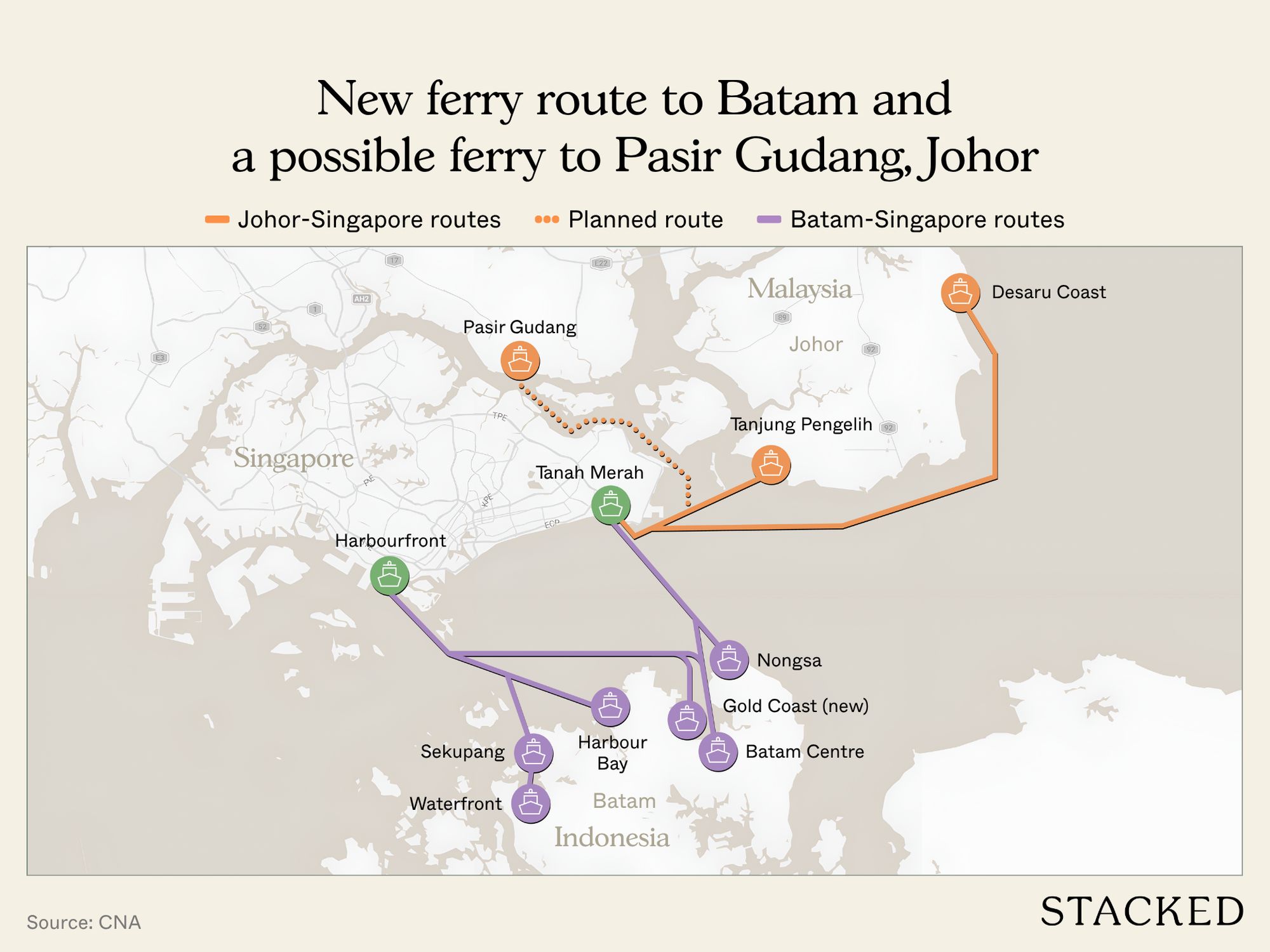
Current ferry routes from Singapore to Indonesia and Malaysia. Source: CNA Graphics
However, history has demonstrated that improved transport links alone are rarely enough of a pull-factor to significantly move the needle on housing demand in these housing markets. It is often state and federal level infrastructure projects, proximity to employment clusters, and other urban improvement schemes from Malaysian and Indonesian authorities which have bolstered the property markets in Johor and Batam.
In Batam, local and federal authorities are working on an ambitious 7km Batam-Bintan bridge project to integrate the Riau islands, as well as plans to modernise Batam’s international airport in order to promote the island as an aviation logistics hub.
If ferry services between Tanah Merah in Singapore to Pasir Gudang in Johor materialise, how might the expanded ferry connectivity change the housing plans of some Singaporeans? We should also consider who might be the likely buyers that would find this arrangement appealing.
Lessons from existing ferry-connected markets
The performance of the Johor property market may offer an instructive example. At the start of this year, the average residential property price in the Malaysian state was approximately RM471,485 (around S$138,000), according to data from the Valuation and Property Services Department (JPPH).
However, state-level averages mask a wide variation that differs across different towns and regions. In general, the clearest price denominator is a property’s proximity to Singapore, rather than ferry routes.
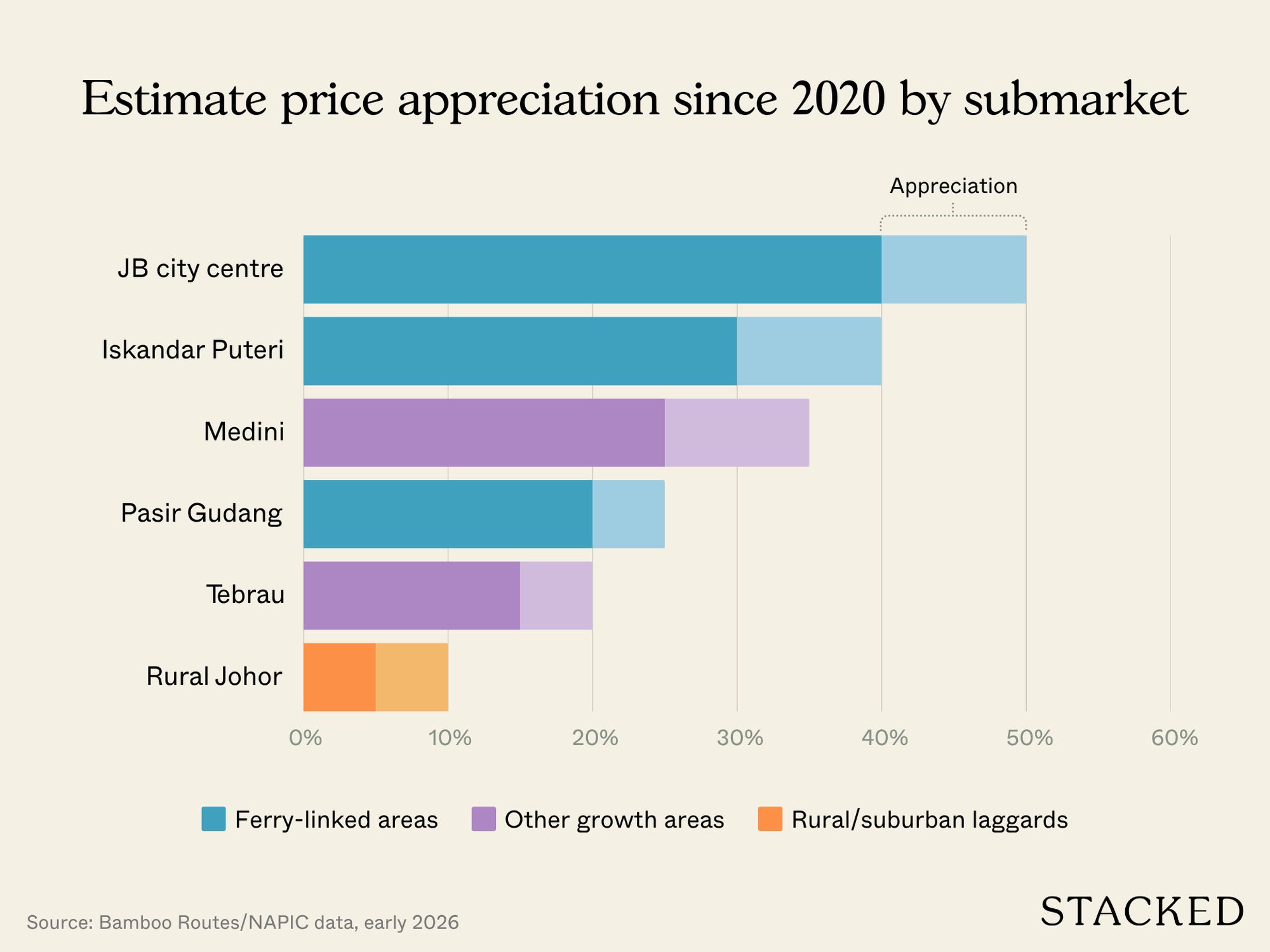
Properties in the city centre of Johor Bahru have recorded a price appreciation of 40–50% since 2020. This largely stems from development and buying activity around Bukit Chagar Rapid Transit System (RTS) Link to Woodlands North in Singapore, as well as the Johor-Singapore Special Economic Zone (JS-SEZ).
Other notable growth areas include Iskandar Puteri which has notched a 30–40% price increase over the same period, mostly supported due to its planned city status.
On the other hand, the housing market around Pasir Gudang - which is primarily an industrial district - has seen a more modest property price growth of 20–25% over the same period. Most of the residential demand stems from port proximity and logistics employment rather than lifestyle appeal or cross-border connectivity.
According to transaction data by Brickz, a Malaysian property research portal, median home prices in Pasir Gudang were RM390,000 (S$114,000) across 20,246 statewide residential transactions, based on transaction data compiled from May 2024 to March 2025.
In contrast, median home prices in Johor Bahru were RM590,000 (S$173,000) and RM653,000 (S$191,000) in Tebrau over the same period.
The transaction data clearly suggest that ferry connectivity is not the most significant factor that sets property values in those areas. Instead, employment density, infrastructure maturity, and planned infrastructure investment are the real drivers.
A look into Indonesia
In Batam, the story is similar but with a different flavour. Property prices in Batam have been increasing at a higher rate compared to Jakarta, according to multiple market analyses in 2025.
Secondary areas like Sekupang and Tiban have seen annual price increases that range from 6.5 - 7.5%, while the broader Indonesian residential property index grew at an average yearly rate of 3 - 7%.
The most significant catalyst behind Batam’s property growth is its free trade zone status, which was formally declared in 2009. The Batam-Bintan-Karimun region is home to five special economic zones that offer tax concessions, expedited permits and licensing, and dedicated infrastructure for foreign investors.
The economic opportunities of this free trade zone, coupled with major new integrated developments that have broken ground in Batam in recent years, have successfully targeted many Singaporean investors.
Notable developments in the ferry towns
Batam (Indonesia): Opus Bay and Nuvasa Bay
The most significant new development in Batam targeting Singapore buyers is Opus Bay, a 125-hectare fully integrated township in Sekupang developed by Singapore-mainboard-listed Tuan Sing Holdings. The project is designed by Kohn Pedersen Fox Associates; the firm behind Hudson Yards in New York and Roppongi Hills in Tokyo. An unusual pedigree for the island.
Opus Bay Phase 1 comprises 277 resort-style villas (Cluny Villas) and 559 apartments (Balmoral Tower), alongside a private ferry terminal linked directly to Harbourfront in Singapore by a 40-minute crossing. Entry prices for apartments start from around SGD81,000 for studios, while villas start from the SGD300,000-plus range. The development has an 80-year tenure from 2004, and last we checked, units are sold out.
In the Nongsa area, Nuvasa Bay offers a different proposition: a 228-hectare luxury township on a 1.2km beachfront with an 18-hole golf course, with Singapore’s skyline visible from the shoreline. Located near the Nongsa Point Marina ferry terminal, it targets the resort-lifestyle buyer rather than the everyday resident.
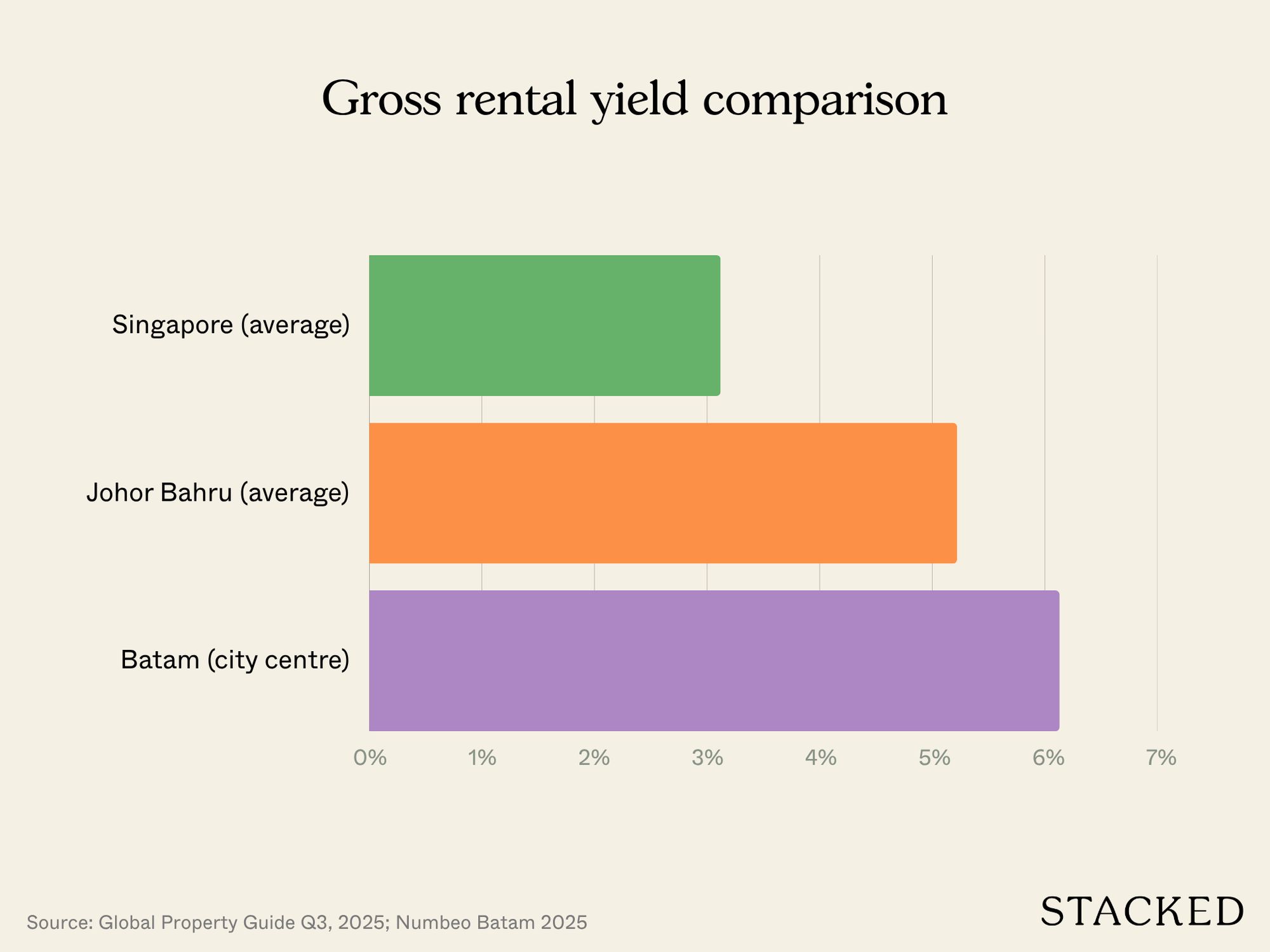
Gross rental yields in Batam’s city centre average around 6.13%, compared to 5.24% in Johor Bahru and just 3.13% in Singapore as of Q3-Q4 2025. The yield premium compared to Singapore’s residential market is noteworthy, but so are the trade-offs: leasehold-only foreign ownership, Indonesian administrative requirements, and thinner resale liquidity compared to JB.
Pasir Gudang and Desaru (Malaysia): Meridin East and the industrial spillover story
Pasir Gudang doesn’t have a splashy headline development targeting Singaporeans, but it does have Meridin East, a Mah Sing Group township spanning 531.3 hectares in the eastern zone of Iskandar Malaysia, with an estimated gross development value of RM5 billion.
This project delivers landed homes with a freehold tenure: double-storey terrace houses tha are being sold in phases, with prices starting from around RM440,000 (S$129,000). That's a detached-ish house with a garden, not a shoebox apartment.
Prices across Pasir Gudang generally run from RM2,600 to RM3,600 per square metre; the cheapest end of the Johor market. The reason is pretty straightforward: this is an industrial town, not a lifestyle destination. You will be buying near port facilities and factories, not cafes and malls.
If a ferry connection to Singapore ever materialises, that could change its appeal if it proves reliable and attracts ancillary commercial development.
Further east, Desaru Coast and the area around Pengerang, which sits near the Tanjung Pengelih ferry terminal, tell a different story. Landed homes here routinely clear RM900,000, and RM1 million-plus is a reasonable budget for a three- to five-bedroom house in a resort-style enclave.
The catch is that this market runs on weekend visitors and Malaysian resort buyers more than on actual residents. So, if you ever need to sell, you'll be fishing in a small pool of potential buyers.
What Singaporeans can actually buy: a submarket snapshot
Johor Bahru
In Johor, foreign buyers purchasing residential property face a minimum price: RM1,000,000 for high-rise units and RM2,000,000 for landed homes. Moreover, state consent fees were also raised to 3% or a minimum RM30,000 from July 2025).
At RM1,000,000 (approximately S$293,000), you can expect a mid-size condominium in or near JB town or Iskandar Puteri, in a standard development with local rental appeal and proximity to the upcoming RTS Link.
Desaru Coast and Pengerang
More suburban than JB; Median landed houses in these resort-oriented enclaves easily reach RM900,000 - RM1.3 million (around S$264,000 - S$381,000), primarily because of supply scarcity and larger plot sizes. RM1 million-plus typically buys a three to five-bedroom house, often freehold.
Pasir Gudang
The most affordable submarket in this cluster. For RM1 million-plus, you’re looking at a decent-sized condo apartment in an area that resembles a non-mature estate in Singapore. The area is less polished than central JB, but closer to industrial employment nodes and upside potential, if the ferry connectivity delivers. It’s kind of like buying in Sengkang before the MRT arrived.
Batam
For Singaporeans, the minimum foreign buyer threshold for apartments in Batam is approximately Rp1 billion (around S$76,500) — a dramatically lower entry point than any Johor option. At this price, you can generally expect a one– to two-bedroom condo in central or mid-tier complexes in Batam Centre or Sekupang, typically on a 25–30 year Hak Pakai (Right to Use) leasehold with renewal options.
At the premium end, Opus Bay’s waterfront apartments start from around S$81,000 for a studio and scale up from there, with villas well above S$300,000. Batam’s price per sq m for apartments currently runs around IDR17,500,000 (S$1,340 psm) — a fraction of the typical price of condos in Singapore suburbs, or Outside Central Region (OCR).
A new playbook for those seeking alternatives
Singaporeans who may be looking across the water for more affordable housing alternatives may find plausible alternatives in Johor and Batam, but it requires a fresh mindset. The previous narrative of “buy a condo in JB, rent out HDB” isn’t the only way to play it.
Ferry connectivity, new visa routes, and emerging markets like Pasir Gudang, Tanjung Pengelih, and Batam lower the friction for people who already have a reason to be there.
That said, the data does support a few clear takeaways for Singaporeans considering a cross-water option. In Johor, Pasir Gudang is the only submarket where a ferry connection could plausibly unlock near-term price momentum that hasn’t already been priced in.
In Batam, the Opus Bay development represents the most structured, Singapore-familiar entry point into the market, with the added comfort of a Singapore-listed developer and a private ferry terminal.
Young Singaporeans who have been unsuccessful in applying for a new Build-To-Order (BTO) flat, and don’t want to commit to a resale purchase due to rising HDB prices, can treat Batam as a semi-permanent base.
Social visas and KITAS options allow extended stays, while lower entry prices mean you can secure a foothold with relatively modest capital. The yield premium over Singapore is also real if you decide to rent it out while away.
Retirees have more options than the typical Malaysia property playbook. A retirement KITAS in Indonesia does not require the huge RM1 million price tags that Johor state floors demand, and Batam’s growing infrastructure gives it more liveability depth than a decade ago.
The key takeaway: it’s less about chasing the “next big capital gain” and more about balancing lifestyle, affordability, and legal stay options.
The data shows that Singaporeans have a wider playbook utilising ferry routes, emerging markets, and long-stay visas to live closer to home without being boxed in by traditional local constraints. Whether that translates into sustained demand for property in these markets will ultimately depend on whether the ferries keep running and the employers keep hiring.


0 Comments