


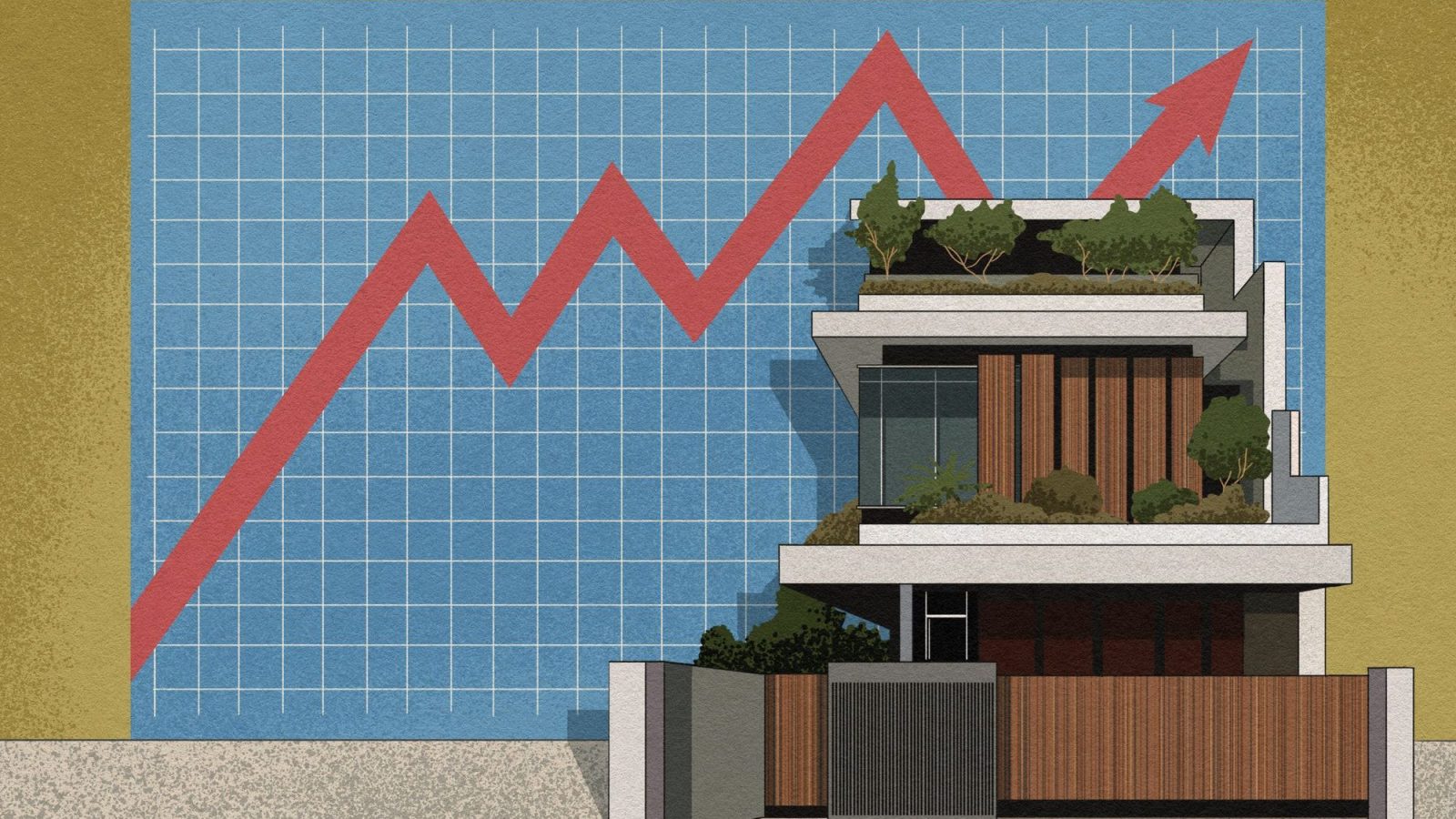
Families who search for freehold landed houses tend to end up viewing at least one strata landed home along the way, since both have similar configurations at overlapping prices.
With a strata landed home, you own the house but not the land it stands on. That land is shared by everyone in the development, the same way the grounds of a condo are.
A common term for a gated strata landed housing development with shared facilities is a cluster home. But the category is wider than just cluster homes; it also includes strata landed homes without a gated compound, such as Pollen Collection, and the landed units inside condominium developments like D'Leedon.
This series aims to cover all of them, including both freehold and leasehold projects, measured against conventional landed houses, where the owner owns the land as well.
What we're actually comparing
The Urban Redevelopment Authority (URA) records the size of an ordinary landed house by the land it sits on, and the size of a strata landed home by its floor space.
This means the $PSF of a landed house and a strata landed home measures different things, so we compare the two on total purchase price throughout the series for a fairer analysis.
In the first half of 2026, a freehold terrace averaged $5 million against $3.95 million for a freehold strata landed home, a gap of about $1.05 million.
But that gap has not always been this wide, and the two have not grown uniformly over the years.
Here's what we'll be looking at
Four of our 12 articles in this series help set up the market context, and the other eight cover individual developments.
We have categorised the dataset into four groups, freehold and leasehold on both the landed and strata landed side. This means each article works towards the same three questions:
- What does a strata landed home get me for the price?
- What do I give up against a conventional landed house or a large condominium?
- How have earlier buyers of strata landed homes performed?
The third question is the hardest to answer, because strata landed homes are a thin market, with only 57 freehold transactions in the first half of 2026 against the 447 for freehold terraces.
Our four analysis pieces cover the price gap, past gains, space per dollar, and how often buyers made a loss. Between them, these questions arise:
- Has freehold or leasehold mattered more for conventional landed houses than for strata landed homes?
- Do the years left on a lease show up in what sellers later made, or does that matter less than when they bought?
- How much space does the same budget buy in a strata landed home against a large condominium, and how much of that space is usable?
- How often did buyers of each type sell for less than they paid, and what did the loss-makers have in common?
Each of our individual strata landed development pieces then runs the same eight sections: what you are buying, what it costs, the landed homes within a kilometre, other options within three kilometres, useful space from the floor plans, ownership costs, past gains where the data supports them, and lastly who it suits.
How we picked the eight developments
We started our shortlist with every named strata landed development in Singapore, ranked them by how many resales they had seen over the last two years, then kept only those with freehold landed resales within a kilometre.
That last requirement did most of the cutting, since a development with no landed neighbours leaves a reader nothing to compare against. The Shaughnessy has more recent sales than any other strata landed project in the country, but no qualifying landed neighbours at all, so it is not included in our dataset.
Our eight are Cabana and Horizon Gardens in Ang Mo Kio, Este Villa and Belgravia Villas in Serangoon, D'Manor and The Springfield in Bedok, Hillcrest Villa in Bukit Timah, and Dalla Vale in Yishun.
Three of those are pairs sharing an estate, which makes the comparison cleaner; both developments in a pair are measured against the same landed neighbours, so what differs is the development itself.
But there were two exceptions we made to the qualifying developments. They both came down to the same thing, and we did not want to cover the same ground twice.
Firstly, The Teneriffe had enough recent resales to make the eight, but it sits in Bukit Timah next to Hillcrest Villa, which was already on the list, and both are surrounded by the same very expensive semi-detached houses and bungalows. So we gave its place to Dalla Vale, which had fewer resales but is the only freehold development on our list in the north.
Secondly, Alana and Horizon Gardens tied on resales count, so we only kept Horizon Gardens because it has more freehold terraces within a kilometre than anything else on the list. Alana also draws on the same landed neighbours as Cabana.
How we're measuring all of this
Our figures come from sub-sales and resales, never new sales, since launch pricing reflects the conditions of one particular month rather than the market. The national figures run from 2016 to June 2026, district comparisons from 2024 to June 2026, and in the development articles, "recent" means August 2024 to July 2026.
We count 999- and 946-year leases as freehold, treat leasehold as 60 to 115 years, and measure years left on a lease to 1 September 2026 throughout.
Landed houses and strata landed homes are compared on total price alone, though strata landed homes and condominiums both record floor area, so those two we do compare on $PSF. Where floor area matters we check it against the floor plan, since a recorded area may include a roof terrace, a basement or a car porch.
We work in averages instead of medians, so we have stated the transaction count beside every average figure. Two or three expensive houses can lift the average of a category with only a handful of sales in half a year. But across the hundreds of freehold terraces sold in the same months, those expensive houses would barely show.
We also separate the house types, since a detached house averages several times a terrace.
A development needs eight resales in two years before we quote a price range, and below that we list every sale instead. Past gains need 20 homes bought and later sold again; between 10 and 19 we describe them as examples, and below 10 we don't mention the gains at all.
Anyone who bought at launch is reported separately, and a loss means sold for less than bought, before stamp duty, agent fees and interest. The actual losses will look higher than ours.
Nearby means within a kilometre, and the wider comparisons run to three kilometres at up to 15% either side of the price.
No developer is a partner in this series, so our individual development articles are kept as fair as possible.
What to expect from us
Not every question in this series will get a clean answer. Some of the groups we are comparing are small, and where the numbers are too thin to carry a conclusion, we will not force one. Some of these findings may also not be what an owner hopes to read, since we report each development's resale record regardless of gains or losses.
We are not ranking the eight against each other, and nothing is a recommendation to buy or sell. What we are after is something a buyer or a seller can actually use: a way to compare strata landed homes against the landed houses nearby, and to see what that difference has meant for the people who already owned one.
All twelve articles will be published on Stacked Pro. Whether you are looking to buy one of these homes or thinking about selling the one you already have, we hope they give you something solid to work from.



0 Comments