


Do the rules really support the en-bloc sale of ageing projects?
On August 4, the government proposed changes that govern en-bloc consent thresholds in the Land Titles (Strata) (Amendment) Bill. The changes include a proposed 70% threshold for 40–59-year-old developments, and 65% for developments over 60 years old. It also floated the possibility of tiered thresholds, where older developments would require progressively less consent.
The stated aim of the adjustments is to spur the redevelopment of large and ageing properties, which would contribute to the supply of new private residential developments and offer an ‘out’ for property owners faced with the eroding property values due to decaying land leases.
But here’s what I think will happen, under the current circumstances: The number of en-bloc attempts will go up, but the low success rate will remain the same.
The proposed legislative changes, if they pass, will go a long way toward bringing more ageing properties to market, by helping more collective sale committees launch the sale of their properties. But the proposed changes deal with one particular bottleneck - namely, the process of getting sufficient owner consent to launch a collective sale tender - but does very little to address the economic bottleneck.
Part of this boils down to the availability of Government Land Sales (GLS) sites and other development opportunities developers might prefer to take up.
Since GLS sites offer an alternative source of development land, the government supply of land for tender competes with the private en-bloc market. And between the two choices, some developers typically prefer GLS sites.
The bidding process for GLS sites is more straightforward compared to the complexities of some en-bloc negotiations. There’s no need to deal with minority objections to the sale, changes to the reserve price, or last minute legal action by dissenters.
As a result, it is a significant factor when the government has significantly ramped up GLS supply in recent years. In 2024, the total GLS supply translated to about 11,110 new private homes coming online - the highest increase in new condo supply since 2013.
This was followed by close to 9,800 units as a result of all of the successfully tendered GLS sites from the 2025 programme. This year, the 2H2026 Confirmed List alone contains another nine sites, capable of yielding at least 4,745 private homes.
It’s not just the fact that the quantity of GLS sites has been high, but the quality of the sites being released has been hard to ignore.
Consider the New Upper Changi Road site in Bedok, which closed earlier this week. You might think that the bid price of $1.4 billion ($1,537 psf per plot ratio) by UOL Group, CapitaLand Development, and Singapore Land, would be off-the-charts for a suburban location like that. But I, and other developers, seem to think that it isn’t.
In general, most developers know what they’re doing when it comes to putting a value on land, and the catchment of buyers that they can rely on for their new project. And Bedok provides a very deep pool of potential buyers. It’s close to several estates that have a large and underserved catchment of HDB upgraders, and the site is close to an MRT station and malls in the neighbourhood.
In contrast, consider some of the en-bloc hopefuls that have appeared on the market in recent months, such as High Point. This is a freehold condo at 30 Mount Elizabeth, in prime District 9. The development just relaunched its collective sale tender, after its fifth attempt in April this year closed without a successful bidder.
The asking price in terms of $PSF is much higher of course ($2,645 psf), although the total comes to just around $580 million. But I would argue that between the two options - the GLS site in New Upper Changi Road and High Point - the GLS site is the safer and more reliable option for some developers.
In that case, simply making it easier for the owners of an old condo to launch a collective sale attempt doesn’t make much difference. Even if the required level of consent is achieved, the high number of appealing GLS sites will see a lot of them get overlooked, even in traditionally prestigious and prime locations.
The effective land rate of the New Upper Changi Road GLS site also reflects a related issue: the cost of a replacement unit for en-bloc sellers
There was a time when an en-bloc seller could simply look just beyond their immediate neighbourhood, if they found themselves priced out of a replacement in the same location.
But in 2026, there’s less certainty of that. Most of us are used to viewing the areas and neighbourhoods in the OCR as traditionally the most affordable geographical segments of the housing market. But the steady increase in the price of development sites, like the New Upper Changi Road plot, throws that perspective into question.
Broadly speaking, the gap between average land prices in the OCR and more central regions has narrowed substantially over the past few years. Average condo prices in the CCR were around $1,942 psf in 2014, with prices in the RCR reaching $1,401 psf and $1,069 psf in the OCR.
By 2025, these prices had risen to around $2,620 psf, $2,357 psf, and $1,769 psf, respectively. (We covered this price trend in a previous article). In short: CCR was around 82% more expensive than the OCR in 2014, but only about 48% more expensive by 2025.
Yes, the OCR is still cheaper; but its relative discount has become considerably less pronounced. And bear in mind, an ageing condo facing the negative impact of lease decay could see even lower prices in the en-bloc market.
This places owners attempting a collective-sale in a difficult position. They need sufficiently high sale proceeds to buy a suitable replacement home, and even if they settle for an OCR alternative housing prices have become relatively more expensive. But reaching for higher reserve prices in their enbloc, the less likely developers will bite.
So en-bloc sellers face a double whammy: GLS sites compete for developer dollars, and even in a successful sale owners may end up having to compromise on the size or the location of their replacement home.
From my perspective, simply reducing the quota needed for consent starts to look anaemic, in light of this much more significant bottleneck.
Then there are Land Betterment Charges (LBC), which aren't exactly getting cheaper either.
This is a tax payable when a site is enhanced, such as intensifying the land use by building a new condo with more units than the building it replaced. Developers pay the LBC and the rates are reviewed twice a year.
From September 2026, we saw LBC rates for non-landed residential use increase by an average of 3.4%. Rates rose in 70 out of 118 sectors in Singapore, ranging from about 1% to 29% increases.
This is another factor that developers will have to take into account, when it comes to accessing how much they’re willing to fork out to pay for an enbloc site. Given the narrowing margin between owners' needs, and what developers can afford, raising the LBC does little to help. This brings me back to the same issue: we’ve lowered the consent threshold, but all of this is still going on in the background.
If the objective is the vital urban renewal of ageing residential properties, perhaps the incentives need to be more targeted
I don’t think the solution is to make every en-bloc sale easier or more profitable. The last thing we want is another late 2010s en-bloc frenzy, which was even worse for how high it pushed new launch prices.
Instead, it may make more sense to identify specific ageing developments, where redevelopment is vital, and tweak the rules for these one-off cases. And this could take several forms: certain sites - like gigantic former HUDC estates - might come with longer ABSD deadlines for developers, flexibility on LBC, or related incentives.
At this point, someone is going to protest that every old condo owner gets an en-bloc windfall in this way. But I very much doubt it will come to that: for the very oldest estates, the remaining lease hampers any lottery effects. A 50- to 60-year old project on a declining 99-year leasehold tenure will already sell for much lower, even if there’s a premium over resale values, this is balanced out by the higher replacement property costs.
This is especially true for owners of older, larger units. Even with a marginal premium, they will likely find that the same amount of space, in a comparable location, requires a substantial top-up.
So, I don’t think targeted assistance is the equivalent of “winning the en-bloc lottery” as we saw in earlier decades. For now though, the proposed changes make it easier for the collective of owners to say ‘yes’, but there’s still no change that prompts a developer to say yes as well. As a result, I expect the new rules will produce more en-bloc attempts. But whether they produce more successful en-blocs is what I still hold in doubt.
Meanwhile in other property news…
- Over the past few months, we looked at the performance of over 260 condos with two-bedder units over five years. Here’s a rundown on the top performers and what they have in common.
- What can we expect from The Serra Residences? Here’s some initial insights from agents and others on the ground.
- Is an Executive Maisonette (EM) a good buy for a larger family, and what are the later factors to consider? Check it out in our reply to a reader.
- Is District 14 (which includes Geylang) a good place for rental assets and rental yield? Check out the intricacies of this challenging area, in our Stacked Pro deep dive.
Weekly Sales Roundup (24 - 30 August)
Top 5 Most Expensive New Sales (By Project)
| PROJECT NAME | PRICE S$ | AREA (SQFT) | $PSF | TENURE |
| CANNINGHILL PIERS | $8,388,800 | 2788 | $3,009 | 99 yrs (2021) |
| RIVER MODERN | $6,842,000 | 1830 | $3,739 | 99 yrs (2025) |
| GRAND DUNMAN | $5,862,000 | 2379 | $2,464 | 99 yrs (2022) |
| THE CONTINUUM | $5,482,000 | 1905 | $2,877 | FH |
| VELA BAY | $4,765,000 | 1582 | $3,011 | 99 yrs (2025) |
Top 5 Cheapest New Sales (By Project)
| PROJECT NAME | PRICE S$ | AREA (SQFT) | $PSF | TENURE |
| GRAND DUNMAN | $1,577,000.00 | 710 | $2,220.00 | 99 yrs (2022) |
| THE SEN | $1,629,000.00 | 678 | $2,402.00 | 99 yrs (2025) |
| COASTAL CABANA | $1,638,000.00 | 872 | $1,879.00 | 99 yrs (2024) |
| HUDSON PLACE RESIDENCES | $1,857,000.00 | 689 | $2,696.00 | 99 yrs (2025) |
| UNION SQUARE RESIDENCES | $1,900,000.00 | 700 | $2,716.00 | 99 yrs (2024) |
Top 5 Most Expensive Resale
| PROJECT NAME | PRICE S$ | AREA (SQFT) | $PSF | TENURE |
| FOUR SEASONS PARK | $7,883,000 | 2260 | $3,487 | FH |
| DRAYCOTT EIGHT | $6,600,000 | 2896 | $2,279 | 99 yrs (1997) |
| ST THOMAS SUITES | $5,850,000 | 2605 | $2,246 | FH |
| BALMORAL POINT | $5,630,000 | 2530 | $2,226 | FH |
| GRAMERCY PARK | $5,600,000 | 1948 | $2,874 | FH |
Top 5 Cheapest Resale
| PROJECT NAME | PRICE S$ | AREA (SQFT) | $PSF | TENURE |
| THE INFLORA | $660,000 | 463 | $1,426 | 99 yrs (2012) |
| PALM ISLES | $665,000 | 517 | $1,287 | 99 yrs (2011) |
| SEA ESTA | $696,000 | 517 | $1,347 | 99 yrs (2012) |
| KINGSFORD WATERBAY | $700,000 | 484 | $1,445 | 99 yrs (2014) |
| URBAN VISTA | $722,000 | 441 | $1,636 | 99 yrs (2012) |
Top 5 Biggest Winners
| PROJECT NAME | PRICE S$ | AREA (SQFT) | $PSF | RETURNS | HOLDING PERIOD |
| THE HILLSIDE | $5,180,000 | 2648 | $1,956 | $3,592,000 | 26 Years |
| KENSINGTON PARK CONDOMINIUM | $2,920,000 | 1668 | $1,750 | $1,882,000 | 31 Years |
| THE TAMPINES TRILLIANT | $3,000,000 | 2121 | $1,415 | $1,775,000 | 14 Years |
| THOMSON 800 | $2,650,000 | 1281 | $2,069 | $1,556,000 | 18 Years |
| KERRISDALE | $2,330,000 | 1270 | $1,834 | $1,472,000 | 18 Years |
Top 5 Biggest Losers
| PROJECT NAME | PRICE S$ | AREA (SQFT) | $PSF | RETURNS | HOLDING PERIOD |
| DRAYCOTT EIGHT | $6,600,000 | 2896 | $2,279 | -$929,600 | 19 Years |
| ONE SHENTON | $3,050,000 | 1593 | $1,915 | -$802,030 | 15 Years |
| REFLECTIONS AT KEPPEL BAY | $3,000,000 | 1798 | $1,669 | -$650,000 | 12 Years |
| URBAN TREASURES | $1,100,000 | 635 | $1,732 | -$300,000 | 2 Years |
| OUE TWIN PEAKS | $1,065,000 | 549 | $1,940 | -$295,000 | 10 Years |
Top 5 Biggest Winners (ROI%)
| PROJECT NAME | PRICE S$ | AREA (SQFT) | $PSF | ROI (%) | HOLDING PERIOD |
| SIMSVILLE | $1,850,000 | 1249 | $1,482 | 330% | 21 Years |
| THE SPRINGBLOOM | $1,433,000 | 893 | $1,604 | 269% | 23 Years |
| THE HILLSIDE | $5,180,000 | 2648 | $1,956 | 226% | 26 Years |
| WHITEWATER | $1,275,000 | 1130 | $1,128 | 214% | 24 Years |
| BAYWATER | $1,880,000 | 1270 | $1,480 | 210% | 21 Years |
Top 5 Biggest Losers (ROI%)
| PROJECT NAME | PRICE S$ | AREA (SQFT) | $PSF | ROI (%) | HOLDING PERIOD |
| OUE TWIN PEAKS | $1,065,000 | 549 | $1,940 | -22% | 10 Years |
| URBAN TREASURES | $1,100,000 | 635 | $1,732 | -21% | 2 Years |
| ONE SHENTON | $3,050,000 | 1593 | $1,915 | -21% | 15 Years |
| REFLECTIONS AT KEPPEL BAY | $3,000,000 | 1798 | $1,669 | -18% | 12 Years |
| DRAYCOTT EIGHT | $6,600,000 | 2896 | $2,279 | -12% | 19 Years |
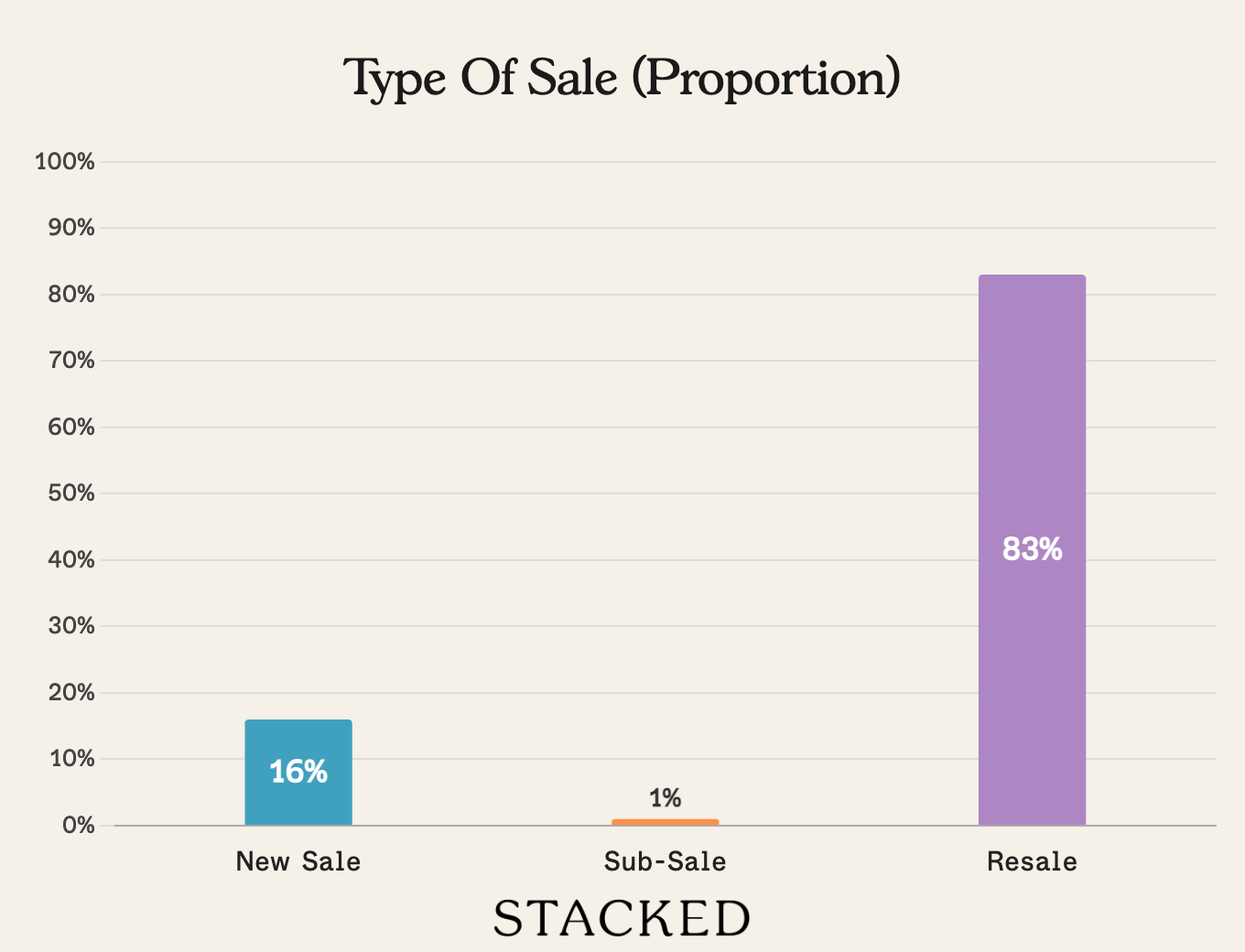
Transaction Breakdown
Follow us on Stacked, for news and updates on the Singapore property market.

0 Comments