


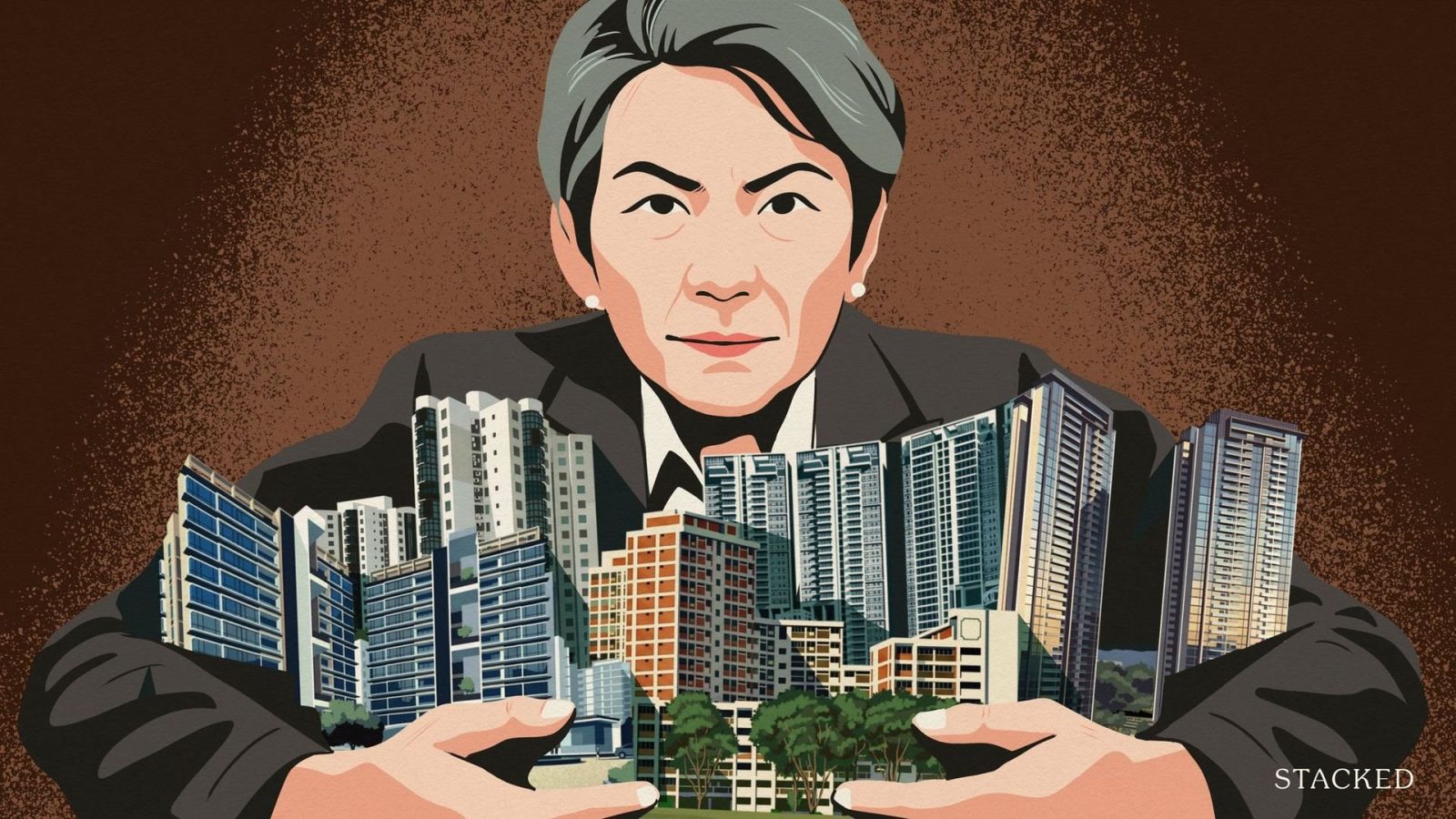
Do we have a problem with wealthy Singaporeans “hoarding homes?”
That’s been a topic of discussion raised by some Memebers of Parliament of late; and with property prices being what they are, I can see why it’s easy to agree. I’ll start off by saying that there is, in fact, an issue that needs addressing here - although I have a somewhat different take on the effects on wealth inequality.
I believe the whole argument needs to drill deeper into what exactly we’re trying to release into the housing market, for whom, and how this may all be more of a capital allocation issue.
For Starters, We Should Remember That The Lived Experience of Most Singaporeans Is HDB Ownership
Around 80% of Singaporeans live in HDB flats. This is the core of Singapore’s approach to housing, and no one can own more than one HDB flat. If “hoarding” happens, it’s going to be within the private market.
But the fact is that private housing has always been aspirational, rather than a necessity. With some exceptions (e.g., people who are ineligible to get a flat but need a home), it’s hard to argue that a condo or landed home is essential.
Does it feel unfair that someone has a pool and a gym or a private driveway, when some people are unlikely to get beyond a 3-room flat? Probably. But does that oblige a government to make those luxuries accessible? That’s a much stickier question.
I do believe that, if the intent is to provide more housing for the average Singaporean - whatever their age - the solution will come from HDB policies first. Changes to the private market are likely to have a much smaller effect: even if we pressure “property hoarders” to release more condo units or landed homes into the resale market, these are not accessible to the vast majority of Singaporeans. Most young couples, for instance, are not in the price range of a two-bedder.
It may seem that way if you read a lot of property news, and see new launch sale numbers; but we should keep in mind that the private market consists of only around 20% of our homeowners.
Which leads to another important question:
Even If The “Property Hoarders” Are Compelled To Let Go Of Their Units, What Is Being Released Into The Market?
It’s questionable if the release of several condo units into the resale market benefits many Singaporeans. This is partly a matter of cost - young couples, for instance, are unlikely to benefit unless they’re in the affluent group able to start off with a condo (likely with help from parents).
But a greater concern is the type of units that investors may let go off. During the height of the “sell one, buy two” period, a lot of the investment units purchased were one- or two-bedders. The idea was that the larger property would be the family home, while the compact unit would be rented out. Now if it turns out a lot of the units released into the resale market are of this sort, that’s significantly less useful than it seems.
Most condo buyers are HDB upgraders. That means they’re family units; and a sudden release of one- and two-bedders into the market aren’t very useful to them. It also begs the question: do we want young couples buying these small units? There are scenarios where this could end up being disadvantegous.
Consider a young couple buying a 650 sq ft unit because it feels right for them at the time. When the family grows in a few years, they may need a larger home. They can’t buy an HDB flat while holding the property though; so now they have to sell - but there’s no surety about the state of the market at that point. And as we’ve pointed out earlier, who’s buying their compact unit? The buyer pool is much thinner compared to true family-sized units.
I don’t disagree that the right forms of taxation can see the release of these units into the market; but we also need to focus on what types of units consequently enter the market.
Would An Inheritance Tax Help Wealth Inequality?
Possibly, if it’s carefully targeted; but if this goes far beyond the realm of just real estate. Singapore had this sort of tax back in 2008. If it’s brought back the same way (i.e., flat out taxing large transfers of wealth from inheritance), it would be quite different from a tax on multiple properties, or an attempt to push landlords to sell.
Philosophically, I agree with the position. To be blunt, the rising value of properties is fueled by the wider success of other Singaporeans. It happened because of our infrastructure, political stability, safety, etc. Since this is something that everyone helped to build, it’s fair to say the advantage should be shared more widely, when it passes to the next generation.
But the devil, as the old cliche goes, is in the details. For example: consider if the inheritance tax hits an elderly household, whose only major asset is the appreciated family home. Likewise, the tax policy has to maintain protection for a surviving dependent (e.g., ageing spouse or special needs child), even if the inherited property is high value. Not everyone is in a fit condition to move, and we may need something like deferred tax payment options; especially if the estate is asset-rich in this sense, but the beneficiaries are all cash-poor.
Finally, if the intent is to target wealth inequality, it doesn’t make sense to only target the properties; not while leaving an equally valuable portfolio of shares, businesses or other investments untouched. The inequality will still persist, only the means to store it will have changed.
What Added Taxes Might Solve, However, Is A Capital Allocation Problem
I do see a more immediate benefit to reducing “property hoarding,” although I wouldn’t claim it’s reducing inequality per se. Rather, what it could do is fix a capital allocation problem.
Capital that’s locked up in big real estate portfolios is capital that’s not moving into the stock market, local businesses, or general innovation. Singapore will struggle to maintain its competitive edge if we devolve into a rentier economy, where everyone’s sole aim is to buy property and get rental income; or to buy and flip for profit. The idea of buying a second home to “shake leg and collect money” is deeply unhealthy, if we let it grow past a certain extent.
(I know some of you readers even say we already passed that point, as far back as the aftermath of the 2008 Global Financial Crisis).
It’s going to be very unpleasant to explain this to a subsequent generation of Singaporeans, whose parents and perhaps grandparents may have had the advantage of doing that. Even today, I meet Singaporeans who are unhappy that they drew the short straw - unable to buy without Additional Buyers Stamp Duty (ABSD) or debt servicing ratio, unlike those who got in decades earlier.
If higher taxes or an inheritance tax happens, we should brace for unhappiness from the latecomers, now locked out of the game.
Are There Alternatives To Taxing Multiple Properties?
Since HDB flats are the most essential form of housing, any attempt to stop “property hoarding” should probably be focused here. It may be time to consider whether Singaporeans should still be allowed to hold on to their HDB flats, if they buy a private property after the five-year Minimum Occupancy Period (MOP)*.
*You can buy a private property and still keep your flat, if you buy the private property after the required MOP. You can’t do it the other way around.
This will raise the existing supply for young couples in a practical way, as a flat is what they can afford. It’s also more justifiable since HDB flats are meant to be homes, not rental assets.
Another option is to target the financial engine behind the market: that is, available financing. At present, banks already lower the maximum loan quantum if you have outstanding home loans; but we might consider lowering the loan quantum for second, third, etc. properties even if there’s no outstanding loan. This will reduce the amount of leverage available to investors, making real estate less attractive to some.
One other advantage here is that investors may not raise rents or prices to reflect rising taxes, and in so doing, push the burden onto tenants and buyers.
Meanwhile in other property news…
- Interested in a shophouse home for under $3 million in Joo Chiat? This project is down to its last three options.
- Is it worth paying $280,000 more for a 5-room flat versus a 4-room flat? Check out our deep dive here.
- Why did these buyers choose the new launch Continuum over resale options in the East? Check out our case study this week.
- How affordable are resale condos within enrolment priority of Methodist Girls School, and how well do they perform? Check it out with Stacked Pro.
Weekly Sales Roundup (28 September - 04 October)
Top 5 Most Expensive New Sales (By Project)
| Project name | Price S$ | Area (sqft) | $PSF | Tenure |
|---|---|---|---|---|
| THE CONTINUUM | $5,239,000 | 1,905 | $2,750 | FH |
| UNION SQUARE RESIDENCES | $4,657,000 | 1,518 | $3,068 | 99 yrs (2024) |
| PARKTOWN RESIDENCE | $3,975,000 | 1,679 | $2,367 | 99 yrs (2023) |
| ELTA | $3,519,000 | 1,313 | $2,680 | 99 yrs (2024) |
| LUCERNE GRAND | $3,509,000 | 1,432 | $2,451 | 99 yrs |
Top 5 Cheapest New Sales (By Project)
| Project name | Price S$ | Area (sqft) | $PSF | Tenure |
|---|---|---|---|---|
| UNION SQUARE RESIDENCES | $1,408,000 | 506 | $2,783 | 99 yrs (2024) |
| LUCERNE GRAND | $1,510,000 | 624 | $2,419 | 99 yrs |
| LENTOR GARDENS RESIDENCES | $1,623,500 | 678 | $2,394 | 99 yrs (2025) |
| ALTURA | $1,628,000 | 980 | $1,662 | 99 yrs (2022) |
| HUDSON PLACE RESIDENCES | $1,663,000 | 646 | $2,575 | 99 yrs (2025) |
Top 5 Most Expensive Resale
| Project name | Price S$ | Area (sqft) | $PSF | Tenure |
|---|---|---|---|---|
| NASSIM PARK RESIDENCES | $16,000,000 | 3,477 | $4,602 | FH |
| THE DRAYCOTT | $6,000,000 | 2,637 | $2,275 | FH |
| THE MEYERISE | $5,480,000 | 2,056 | $2,665 | FH |
| ASTRID MEADOWS | $4,600,000 | 2,045 | $2,249 | FH |
| RIVIERE | $4,288,000 | 1,507 | $2,845 | 99 yrs (2018) |
Top 5 Cheapest Resale
| Project name | Price S$ | Area (sqft) | $PSF | Tenure |
|---|---|---|---|---|
| PRIME RESIDENCE | $590,000 | 398 | $1,481 | FH |
| SEASTRAND | $749,999 | 581 | $1,290 | 99 yrs (2011) |
| THE JOVELL | $750,000 | 527 | $1,422 | 99 yrs (2018) |
| RIVERFRONT RESIDENCES | $780,000 | 463 | $1,685 | 99 yrs (2018) |
| SIMS URBAN OASIS | $795,000 | 409 | $1,944 | 99 yrs (2014) |
Top 5 Biggest Winners
| Project name | Price S$ | Area (sqft) | $PSF | Returns | Holding period |
|---|---|---|---|---|---|
| NASSIM PARK RESIDENCES | $16,000,000 | 3,477 | $4,602 | $2,500,000 | 11.1y |
| THE SEA VIEW | $4,100,000 | 1,410 | $2,908 | $1,920,000 | 10.0y |
| N.A. | $2,280,000 | 883 | $2,583 | $1,880,000 | 23.5y |
| HAIG COURT | $2,280,000 | 1,076 | $2,118 | $1,641,112 | 21.5y |
| THE CENTRIS | $2,135,000 | 1,356 | $1,574 | $1,454,219 | 19.8y |
Top 5 Biggest Losers
| Project name | Price S$ | Area (sqft) | $PSF | Returns | Holding period |
|---|---|---|---|---|---|
| SEASCAPE | $3,368,000 | 2,174 | $1,549 | -$2,419,000 | 16.4y |
| UP@ROBERTSON QUAY | $1,160,000 | 570 | $2,033 | -$309,000 | 13.9y |
| ST PATRICK'S RESIDENCES | $3,000,000 | 3,186 | $942 | -$300,888 | 14.2y |
| BELLE VUE RESIDENCES | $3,168,000 | 1,399 | $2,264 | -$132,000 | 5.2y |
| 76 SHENTON | $1,160,000 | 592 | $1,959 | -$83,500 | 16.5y |
Top 5 Biggest Winners (ROI%)
| Project name | Price S$ | Area (sqft) | $PSF | % Return | Holding period |
|---|---|---|---|---|---|
| N.A. | $2,280,000 | 883 | $2,583 | 470.0% | 23.5y |
| HAIG COURT | $2,280,000 | 1,076 | $2,118 | 256.9% | 21.5y |
| THE CENTRIS | $2,135,000 | 1,356 | $1,574 | 213.6% | 19.8y |
| HILLTOP GROVE | $1,465,000 | 1,238 | $1,183 | 138.2% | 24.0y |
| AVA TOWERS | $1,880,000 | 1,173 | $1,602 | 135.0% | 18.2y |
Top 5 Biggest Losers (ROI%)
| Project name | Price S$ | Area (sqft) | $PSF | % Return | Holding period |
|---|---|---|---|---|---|
| SEASCAPE | $3,368,000 | 2,174 | $1,549 | -41.8% | 16.4y |
| UP@ROBERTSON QUAY | $1,160,000 | 570 | $2,033 | -21.0% | 13.9y |
| ST PATRICK'S RESIDENCES | $3,000,000 | 3,186 | $942 | -9.1% | 14.2y |
| 76 SHENTON | $1,160,000 | 592 | $1,959 | -6.7% | 16.5y |
| THE JOVELL | $968,000 | 678 | $1,427 | -4.2% | 4.9y |
Transaction Breakdown
| Type Of Sale (Proportion) | |||||||||||||||||||||
| |||||||||||||||||||||
| 538 private home sales: 401 new, 5 sub-sale, 132 resale | |||||||||||||||||||||
 |
Follow us on Stacked for news and updates on the Singapore property market.


0 Comments