


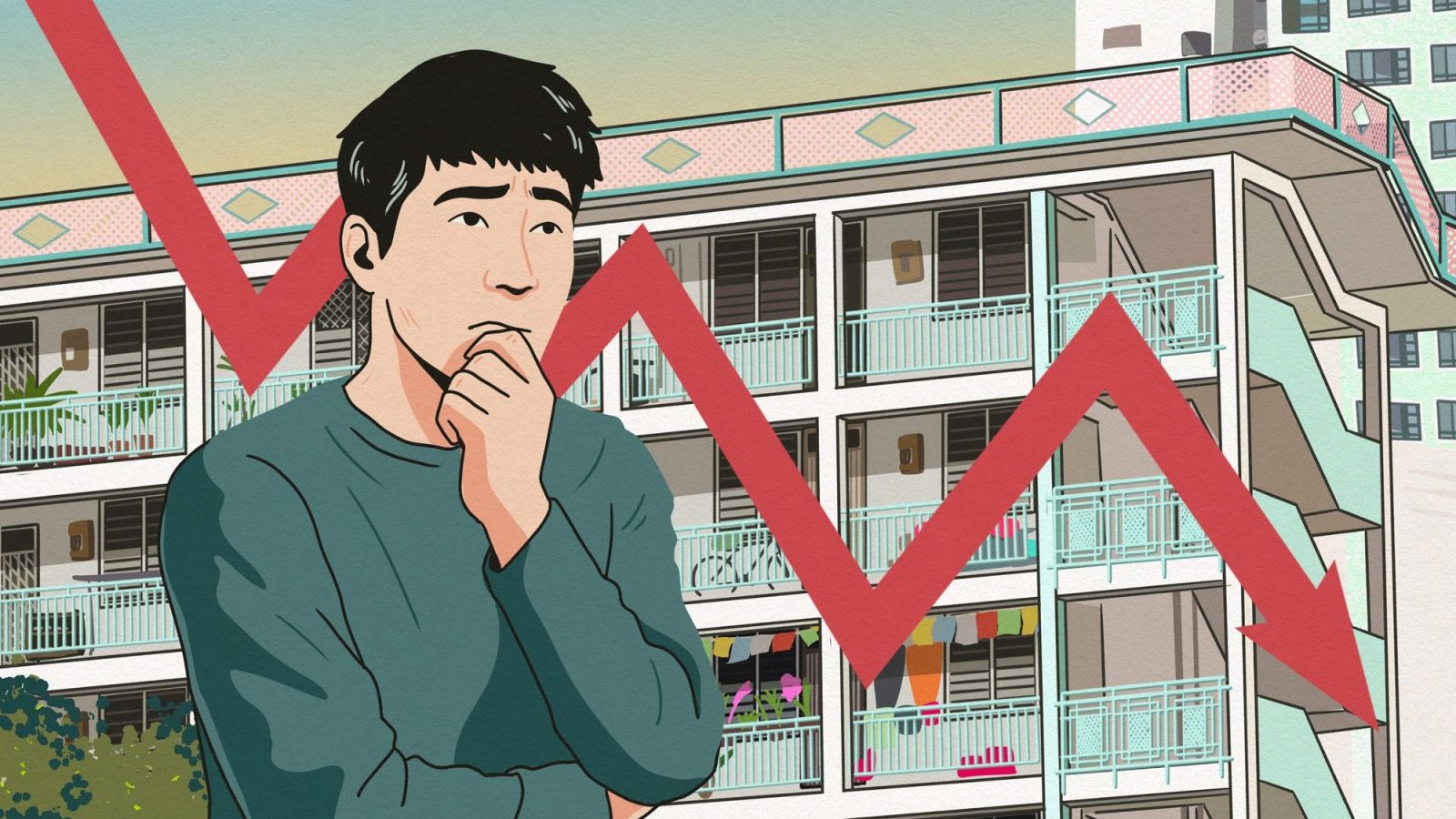
The widening price gap between the HDB housing market and the private residential market made headlines recently, with observers noting that the two housing markets may start pulling in separate directions.
In 2Q2026, the HDB resale price index fell by 0.3% q-o-q. That’s not a very substantial figure, but it was significant because it was the third straight quarterly decline. On the other hand, private residential prices rose by 0.5% q-o-q during the same period. Thus, the private housing market has been growing for seven consecutive quarters.
This price growth is important because we generally expect both the public and private residential markets to move in tandem. That’s not to say their prices are in lockstep mind you, just that generally speaking, when one rises the other tends to go up as well, and vice versa.
This is the pattern of price movement that we’re used to seeing.
When we don’t see this pattern - such as recently when HDB prices dipped but private property prices rose - there’s a chance that it could fuel a ‘Fear Of Missing Out’ (FOMO) effect. As a result, there’s a chance that some HDB upgraders start to worry that, as average flat prices fall but average condo prices rise, it will be harder for them to sell their properties and bridge the price gap.
NUS Provost’s Chair Professor of Real Estate Tien Foo Sing recently argued that these fears may be overblown. He makes a strong point that property price movements of less than a year (three quarters in this case) shouldn’t be mistaken as a big structural change. And to be fair, I do see the merits of his point.
Actually, there have been several periods in the past when HDB and private property prices moved in different directions. But each time the two housing markets fell back into balance.
For example, the HDB resale price index stood at 77.1 at the end of 2004. By the end of 2006, it was around 2.9% below its end-2004 level. Meanwhile, private residential prices rose by around 3.9% in 2005 and another 10% in 2006. So over those two years, private property prices rose by roughly 14%, while HDB resale prices remained below where they had started.
A similar pattern also appeared recently. HDB resale prices fell by about 1.5% in 2017, followed by another decline of around 0.9% in 2018 (see the same link above).
On the other hand, private residential prices rose by 1.1% in 2017 and then jumped by another 7.9% in 2018. Over those two years, HDB resale prices fell by around 2.4%, while private residential prices rose by roughly 9%.
In both cases, HDB prices subsequently recovered. So it absolutely is true that three quarters of divergence is a bit early to panic.
But that being said, the markets don’t need to decouple for an aspiring upgrader to feel priced out.
Consider an HDB owner with a flat worth $700,000, and who hopes to upgrade to a $1.5 million condo. The initial price gap to achieve this property upgrade is about $800,000.
Now suppose the price of both properties rise by exactly 10%. The price of the HDB flat appreciates from $700,000 to $770,000, a gain of $70,000. The price of the condo rises from $1.5 million to $1.65 million, a gain of $150,000.
Both HDB and private markets have moved by exactly the same percentage, but the real gap has widened from $800,000 to $880,000. There was no need for any so-called ‘decoupling’ between the two housing markets for this upgrader to be potentially priced out.
Or if you want to flip it: If a $1.5 million condo rises by 10%, it gains $150,000 in value. So for a $700,000 HDB flat to gain the same $150,000, it would need to appreciate by around 21.4%. Overall, it suggests that the HDB market needs to do much more than just stay in tandem with the private residential market for upgraders to maintain their shot at affording a condo.
This is also why I’m less convinced that today’s urgency is simply “fear-based”
Professor Tien also warns that fears of decoupling could encourage fear-driven buying. Some households may be rushing into the private property market because they believe they’ll otherwise be priced out.
I agree that this can happen. There are always some FOMO cases in the property market (or arguably, any market at all). This could result in some buyers making poor decisions, especially the ones with a fixed belief that prices of any property will always rise.
But I think there’s also a danger in treating all urgency as irrational. The first reason is what I’ve already highlighted above: even if both HDB and private markets are largely in tandem, upgraders can struggle in terms of the absolute quantums involved.
The other reason is that buyers today are much more informed compared to buyers in the past, and their purchase concerns may be entirely rational.
Case in point, Lentor Garden Residences. Even before Lentor Gardens Residences launched, buyers already knew that the subsequent Lentor Central site had been acquired at a substantially higher land rate.
The site that would be developed into Lentor Gardens Residences was acquired for around $920 psf ppr, while the subsequent plot attracted a top bid of around $1,278 psf ppr. That’s almost 39% higher. Buyers didn’t need to believe that “property prices always go up” to conclude that the next comparable development was unlikely to be cheaper.
River Modern provides another interesting example. When it launched in March 2026, its site had been acquired by GuocoLand for around $1,420 psf ppr. At the time, buyers were made aware that another River Valley GLS site was due to be tendered, and that land prices were trending upwards.
(And yes, we were also one of those who sounded off on this issue. Timothy’s launch-weekend report specifically connected River Modern's strong sales to the upcoming Parcel C and rising land prices. We also pointed to GLS land prices being on an upward trajectory, citing the then-recent $1,278 psf ppr Lentor Central bid.)
River Modern went on to sell around 90% of its 455 units during its launch weekend, at an average price of about $3,266 psf. Was this FOMO?
Well, the neighbouring River Valley Green Parcel C attracted a top bid of $1,730 psf ppr when it closed in June 2026. This was 21.8% higher than the $1,420 psf ppr paid for River Modern's site.
The new parcel is also expected to be the last GLS site in the immediate River Valley vicinity for at least the next few years. So I wouldn’t consider the buyers irrational, for the rush, as their argument for buying clearly had legs.
There are also other, more micro-reasons why buyers today perceive scarcity.
An example of this can be seen among condos with only one or two residential towers. In these instances, failing to rush for a unit could mean that the next alternative is several floors up, and that could mean some buyers face being priced out.
And in the resale market, there’s even less certainty when another unit with the right layout, facing, floor and price will be listed. In these cases, urgency is not necessarily based on FOMO or the belief that prices will rise. It may simply be true that not rushing means not getting a unit. There are also some other reasons we’ve covered here, such as the unit mix.
Sometimes, the most viable and affordable options means there are only a limited number of the two-bedder or three-bedders. If you decide to wait, you had best be prepared to buy elsewhere altogether, especially if the bulk of buyers rush for those units first.
In my experience, these highly localised and specific reasons are why most buyers are often in a rush to close a deal. We don’t often hear that a buyer is rushing because “HDB prices are not in tandem with private prices” or some other such abstract reason. Those types of buyers do exist, but I haven’t experienced them making up the majority.
I do wonder if sometimes, this can get conflated with FOMO when viewed through the lens of wider market data.
The divergence in price that really matters is that of the lived experience and aggregate market data.
For someone who needs a three-bedder, and who watched the quantum climb to $2 million or above in the past few years, there’s little relief in knowing that HDB and private prices might move in tandem again. The panic is real, when their main asset is a four-room flat still hovering at $700,000.
The same goes for someone watching the only viable replacement units climb in price. It’s not FOMO on their part if they’re watching prices tick past their budget in real time, so to speak.
So, while I fully agree that you need to buy within your means, I don’t believe we should swing too far to the opposite direction as well. There’s a need to acknowledge two things: first, if you wait too long, there’s a chance you could be priced out of the specific unit you had in mind.
It doesn’t matter what the wider market numbers are if buyers can’t find a three-bedder near School X in neighbourhood Y at their budget. It’s not always FOMO when you really can get priced out, and sometimes you can see this happen in the context of rising land prices or unit availability.
Next, we need to accept that being priced out can happen, even if we “did everything right”. You may not have given in to FOMO - you may have bought at a fair price, researched the future land plots, saved as aggressively as possible, and yet still find your upgrade is out of reach. That’s not a failure on your part, it’s just something that happens.
And just in case it does, we should buy as if there may be no chance to upgrade. That’s regardless of how rosy or ugly the wider market looks.
Meanwhile in other property news…
- Tiong Bahru is one of Singapore’s most iconic neighbourhoods; but it used to be a swamp lined with graves. Here’s how a largely unplanned, and very unexpected, transformation took place.
- Did you know Singapore had rent control twice, and the last time it lasted around 62 years? Here’s how that post-WWII quirk also ended up helping to conserve our historical shophouses.
- Bishan is an established hot spot, but the top performing condo for two-bedder units might surprise you. It’s actually this project closer to Sin Ming, rather than being in the heart of Bishan.
Weekly Sales Roundup (03 - 09 August)
Top 5 Most Expensive New Sales (By Project)
| PROJECT NAME | PRICE S$ | AREA (SQFT) | $PSF | TENURE |
| ELTA | $4,190,000 | 1776 | $2,359 | 99 yrs (2024) |
| DUNEARN HOUSE | $3,880,000 | 1184 | $3,277 | 99 yrs |
| CHUAN PARK | $3,356,500 | 1206 | $2,784 | 99 yrs (2024) |
| ARINA EAST RESIDENCES | $3,268,000 | 1087 | $3,006 | FH |
| LENTOR GARDENS RESIDENCES | $3,215,800 | 1346 | $2,390 | 99 yrs (2025) |
Top 5 Cheapest New Sales (By Project)
| PROJECT NAME | PRICE S$ | AREA (SQFT) | $PSF | TENURE |
| UNION SQUARE RESIDENCES | $1,432,000.00 | 506 | $2,831.00 | 99 yrs (2024) |
| NARRA RESIDENCES | $1,495,000.00 | 721 | $2,073.00 | 99 yrs (2025) |
| VELA BAY | $1,537,000.00 | 484 | $3,173.00 | 99 yrs (2025) |
| DUNEARN HOUSE | $1,575,000.00 | 527 | $2,986.00 | 99 yrs |
| LENTOR GARDENS RESIDENCES | $1,579,100.00 | 646 | $2,445.00 | 99 yrs (2025) |
Top 5 Most Expensive Resale
| PROJECT NAME | PRICE S$ | AREA (SQFT) | $PSF | TENURE |
| NOUVEL 18 | $6,600,000 | 1862 | $3,544 | FH |
| RIVERGATE | $6,360,000 | 1938 | $3,283 | FH |
| WATERFALL GARDENS | $5,620,000 | 2196 | $2,559 | FH |
| LEONIE PARC VIEW | $5,450,000 | 2013 | $2,708 | FH |
| REGENCY PARK | $5,330,000 | 2260 | $2,358 | FH |
Top 5 Cheapest Resale
| PROJECT NAME | PRICE S$ | AREA (SQFT) | $PSF | TENURE |
| THE INFLORA | $650,000 | 463 | $1,404 | 99 yrs (2012) |
| THE INTERWEAVE | $660,000 | 388 | $1,703 | FH |
| THE VUE | $678,000 | 420 | $1,615 | FH |
| PRESTIGE HEIGHTS | $680,000 | 409 | $1,662 | FH |
| THE GREENWICH | $810,000 | 603 | $1,344 | 99 yrs (2009) |
Top 5 Biggest Winners
| PROJECT NAME | PRICE S$ | AREA (SQFT) | $PSF | RETURNS | HOLDING PERIOD |
| OCEAN PARK | $4,280,000 | 2110 | $2,029 | $2,930,000 | 29 Years |
| RIVERGATE | $4,670,000 | 1507 | $3,099 | $2,885,300 | 20 Years |
| RIVERGATE | $6,360,000 | 1938 | $3,283 | $2,330,000 | 9 Years |
| WATERFALL GARDENS | $5,620,000 | 2196 | $2,559 | $2,220,000 | 11 Years |
| PALM SPRING | $4,580,000 | 2121 | $2,160 | $2,162,000 | 30 Years |
Top 5 Biggest Losers
| PROJECT NAME | PRICE S$ | AREA (SQFT) | $PSF | RETURNS | HOLDING PERIOD |
| MARINA BAY SUITES | $2,750,000 | 1572 | $1,750 | -$1,043,000 | 16 Years |
| MARINA ONE RESIDENCES | $3,325,000 | 1539 | $2,160 | -$175,000 | 8 Years |
| SIXTEEN35 RESIDENCES | $1,005,000 | 753 | $1,334 | -$133,000 | 3 Years |
| MIRO | $2,200,000 | 1249 | $1,762 | -$100,000 | 16 Years |
| MEYER MANSION | $2,020,000 | 689 | $2,932 | -$85,600 | 4 Years |
Top 5 Biggest Winners (ROI%)
| PROJECT NAME | PRICE S$ | AREA (SQFT) | $PSF | ROI (%) | HOLDING PERIOD |
| HILLINGTON GREEN | $2,588,888 | 1528 | $1,694 | 228% | 23 Years |
| OCEAN PARK | $4,280,000 | 2110 | $2,029 | 217% | 29 Years |
| BUTTERWORTH 8 | $2,652,888 | 1313 | $2,020 | 199% | 25 Years |
| STRATFORD COURT | $2,060,000 | 1938 | $1,063 | 197% | 22 Years |
| PALM GARDENS | $1,000,000 | 958 | $1,044 | 174% | 28 Years |
Top 5 Biggest Losers (ROI%)
| PROJECT NAME | PRICE S$ | AREA (SQFT) | $PSF | ROI (%) | HOLDING PERIOD |
| MARINA BAY SUITES | $2,750,000 | 1572 | $1,750 | -28% | 16 Years |
| SIXTEEN35 RESIDENCES | $1,005,000 | 753 | $1,334 | -12% | 3 Years |
| MARINA ONE RESIDENCES | $3,325,000 | 1539 | $2,160 | -5% | 8 Years |
| VIDA | $1,085,000 | 517 | $2,100 | -5% | 9 Years |
| MIRO | $2,200,000 | 1249 | $1,762 | -4% | 16 Years |
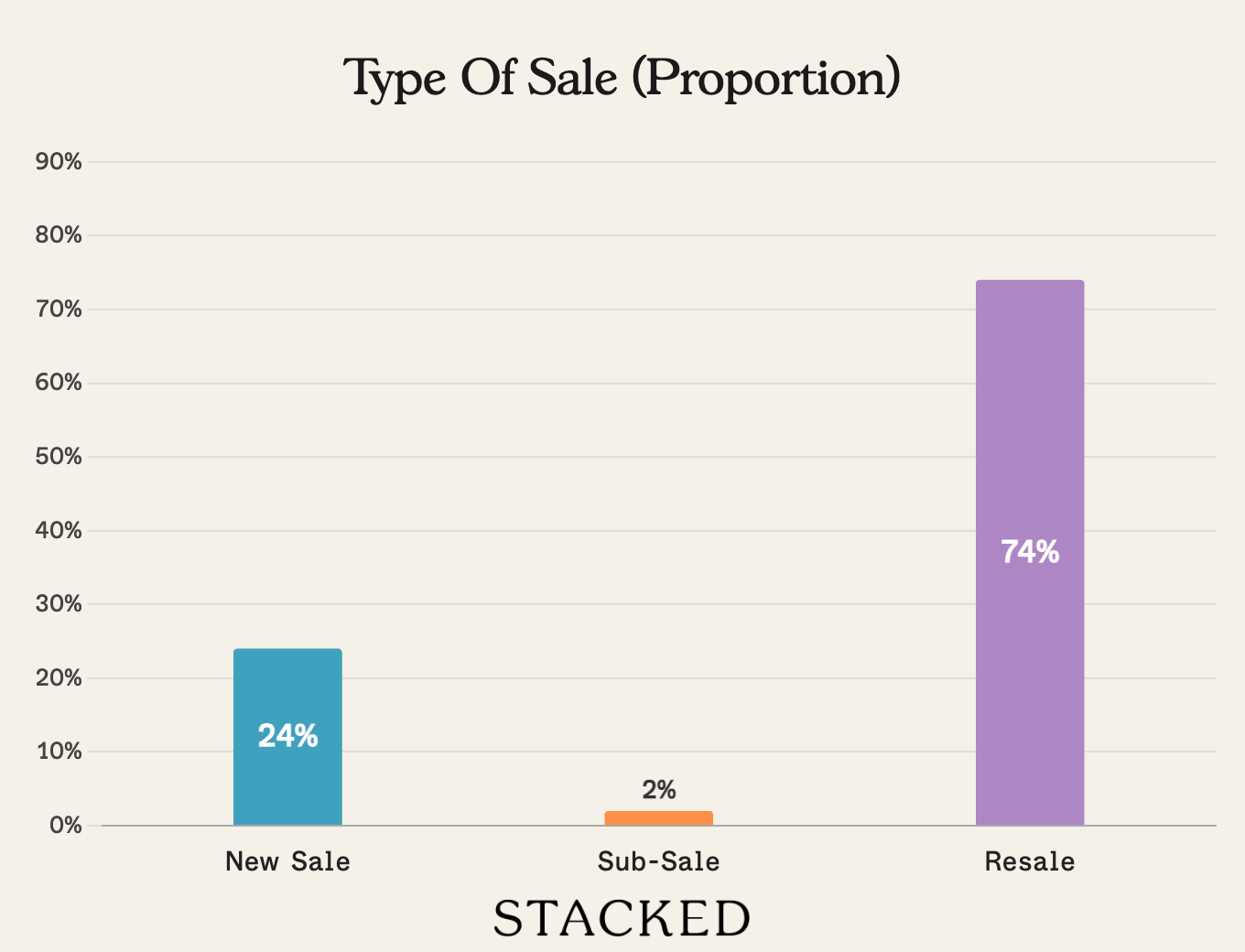
Transaction Breakdown
Follow us on Stacked for news and updates on the Singapore property market

0 Comments