


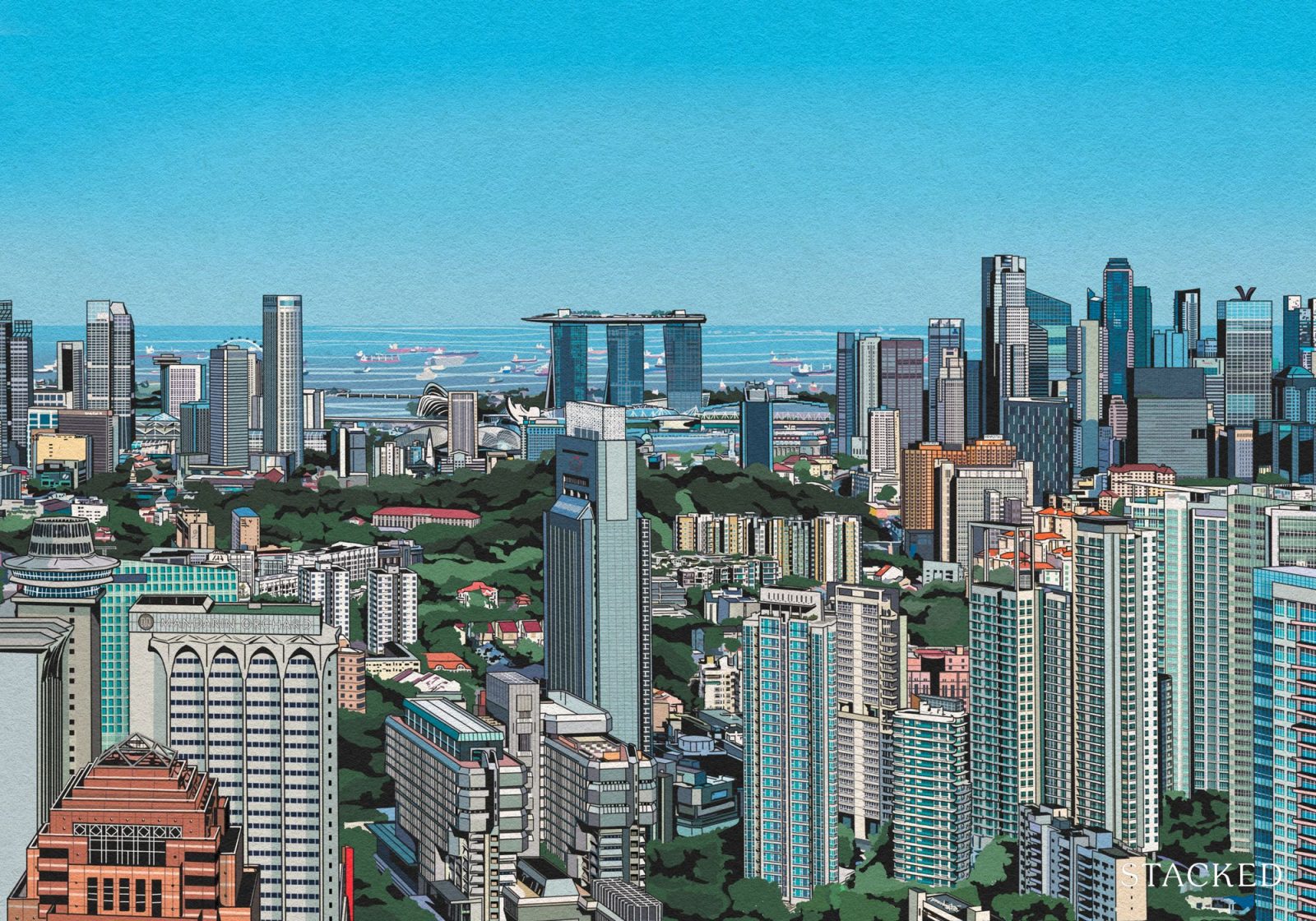
A condo that consists of just one or two high-rise towers can look imposing, while a low-rise development with a handful of blocks can feel charming. But this introduces complications that buyers may overlook.
An issue is the subject of substitution within the same development. Case in point: there’s a certain new launch project in the Great World area that entered the market in recent months. The starting price for units was around $2,877 psf, which is very competitive for a location with such strong attributes. But once you get up to the units in the higher floors, prices start to exceed $3,300 psf. It is not unusual to see prices increase the higher it is located, but in this case, the increase is more than gradual.
Let’s say as a buyer, you find a $1.86 million unit, a two-bedder, that perfectly fits your budget. But then, because of bad luck or hesitancy, the units on the ideal floor are sold. Because there’s just two towers, the chances are that the next available alternative (featuring the same size and layout) is several floors up - possibly $2.05 million or higher - and uncomfortably pricey for your budget. In some cases, the price difference is high enough that a buyer may even walk away.
On the flip side, the next available unit may be several floors down. It may not clear the tree line, or that much closer to pick up the noise from activities on the ground floor. This is usually acceptable since the trade off is that the price will likely be lower, but a homebuyer may still find it unappealing and when the unit hits the resale market, other buyers will take it into consideration.
Which leads me to two other issues that some buyers have to contend with, long after the project has launched.
The first is the way price benchmarks are established in the resale market, and how the average price of units on the higher floors can form a price ceiling for the lower floor units.
Specifically, in a two-tower development, most units are comparable within the same stack. That is, there aren’t really many stack facings that are “superior” and which would seriously impact the price. As a result, buyers comparing transactions do so across similar attributes.
This works well if resale buyers follow typical price dynamics. That is, higher floors transact at relatively higher prices compared to units on the lower floors, and the price increases proportionately the higher you go. That’s the textbook scenario. But things can get messy if some outlying transactions break that pattern.
For instance, if a higher-floor unit sells at a relatively lower price - maybe due to the seller's urgency, or it transacts when buying sentiment is weaker - this can weaken the asking price power of other sellers, and lower the overall average price for that stack or block.
For example, a buyer hunting for a mid-floor unit may question why they should pay close to, or maybe higher, than what someone paid for the unit above.
This ends up with a common price anchoring effect: the resale price of your unit could end up being influenced by outlying transactions, rather than innate qualities of the unit. To be clear, this isn’t unique to projects with just one or two residential towers, it’s also visible in boutique condos but the effect can be intensified in projects with just one or two towers. Buyers tend to fixate on what’s directly above or below, and this can affect the offers you get.
The second issue is how pricing can be misrepresented.
In a development with just one or two residential blocks, if a larger share of recent transactions happen to be higher-floor units, the recorded $PSF will skew upward. A seller on a mid- or lower-floor sometimes references those prices to command a higher asking price.
The reverse can also happen. If most recent transactions are from lower floors - perhaps because higher-floor owners are holding out - the recorded $PSF can appear weaker. This may create the impression that prices have softened, even if demand for better-positioned units remains intact.
For example, consider if two or three high-floor units transact earlier at $3,000+ psf but a while later, a dozen low floor units transact at $2,800+ psf. Put it in a graph, and it looks like a project where prices are in decline.
This can even happen in a new launch, if the top floor units sell out first at a higher price: I’ve seen cases where agents had to explain that the developer was not “dropping” the price, it was simply that the top floors were bought out earlier at a higher $PSF.
There’s a psychological factor that’s sometimes involved
Some projects consist of just one or two tall blocks as a way to fit into a tight land area. This tends to result in most facilities interspersed vertically, in elevated decks or rooftop pools. The overall experience can feel quite different from older developments that enjoy larger land plots. Instead of walking through landscaped spaces, the trip becomes a series of lifts and corridors.
For some buyers, the development can start to feel less like a residential estate, and more like a serviced apartment or even an office building. It also influences the social element. In developments with a wide range of facilities distributed evenly on the ground floor, shared spaces are part of daily life. Residents can pass each other more often, on the walking paths or the gardens on your way home. These incidental encounters create familiarity over time.
Some people may have the perspective that in a more vertical setup, interaction becomes more limited and intentional. You move with intent and head to a specific facility, and you may not pass anyone except for those brief moments in a lift (and Singaporeans rarely start conversations with strangers in lifts).
That said, none of this means one- or two-tower developments are somehow inherently worse.
Some of the issues I’ve mentioned above look like plus points to certain buyers.
A smaller footprint can feel more exclusive, less crowded, and more in-line with a premium project. Higher proportions of units tend to enjoy unblocked views, and not just because of more height: you’re simply less likely to end up facing another block.
Vertical facilities can feel more curated and intentional to some buyers; and the rise of the infinity pool has done much to popularise this.
So it’s not that one or two towers are “bad.” My point is simply that this format comes with a different set of trade-offs, which are often less obvious to buyers.
The broader takeaway here is that, when you see there’s only one or two towers, you need to move with more urgency.
When a new launch project only consists of one or two towers, the margin for hesitation is much smaller. Because substitution options are limited, the closest alternative may push some buyers out of their price bracket. This can also make the queue number experience a bit more harrowing.
The same dynamic will apply when the project enters the resale market. You don’t know which floor the next available listing will be on, If you pass on a suitable unit now. There’s also a timing element on the selling side: if a seller on a higher floor is about to transact at a lower price than yours, you may need to move more quickly because that transaction sets a lower benchmark.
As for how you’d know that, well, that’s where having an experienced and well-connected agent comes in. Agents do talk among themselves, and some have very good hearing when it comes to certain areas or projects.
This also adds a good reason to pick a higher floor, if you can afford it: there are fewer units above you to set a price ceiling on your unit.
This week, I had a question from a reader about whether they should buy a Prime category flat.
“Should I buy a Prime BTO flat? This may be my last chance to buy an HDB flat, but I am not sure about the 10-year MOP.”
In general, the 10-year MOP has the biggest impact on HDB upgraders. If your intent is to move to a condo at some point, or even to a bigger flat, then this is a severe drawback.
The thing to keep in mind is that a 10-year MOP means waiting more than 10 years. Assuming construction time of four years, plus the 10-year MOP, this is around a 14-year wait (the MOP countdown begins at the point of key collection, not at the point of sale.)
Do you remember what private home prices were like 14 years ago? Average prices in the OCR were about $800 to $1,100 psf, whilst CCR prices were about $1,300 to $2,000 psf. Today, OCR condos can exceed $2,000 psf. Let that be a sign of how much prices can move within that time span.
Even if HDB flats and condos were to rise at the same pace - say 3% to 5% per annum - the condo’s absolute price is rising faster, as it’s a percentage of a much higher amount. In effect, waiting so long carries the risk that you’ll have to pay a lot more to move to private at the end of MOP.
Also, if you do sell the Prime flat, remember there’s a subsidy clawback, and your subsequent buyers are subject to restrictions like the income ceiling as well as their own 10-year MOP. While we haven’t yet seen a Prime project reach resale, these factors could limit the potential resale gains.
That said, not everyone treats their flat as an investment.
If your goal is truly to stay in a desirable area, without sky high prices or maintenance fees, then none of this is really a drawback. As a personal opinion, I feel the surrounding amenities and accessibility of Prime region flats more than makes up for not having a swimming pool or a tennis court. Unless you’re affluent to the point where transport issues are nonexistent, location should always come ahead of frills like nice facilities.
Get the Prime flat if you’re a pure homeowner. If you’re looking at having private options after MOP, or you want higher resale gains, then perhaps look for something else.
Meanwhile in other property news…
- Hudson Place Residences joins a slate of recent launches at One North; and it reflects on an area in serious transition.
- A flat in Geylang just sold with a whopping COV of $52,000. What happened here?
- Is an Executive Maisonette a good deal for a home when retiring? Check out our response here.
- We also have a pricing review for Vela Bay, located at the new and upcoming Bayshore township
Follow us on Stacked for the latest news and updates on the Singapore property market.


0 Comments