


This case study is based on a recent consultation conducted by Sheng, a property agent and partner property consultant with Stacked. This write-up walks through the key decisions, trade-offs, and market considerations involved, with insights that buyers and sellers may find useful.
A clear objective but a tough decision
When this client first reached out to the Stacked consultancy team, he was not a newcomer to the property market. This was his second time buying a home, and he had a good grasp of in-depth knowledge of how the property market worked.
In particular, he had a clear property progression plan, and he was working his way up to an aspirational goal: to own a large family unit in a prime area. He mentioned the Somerset, Orchard, or Stevens area, and he had already determined that the starting price for a property like this - prior to stamp duties and other costs - would be around $4.5 million.
When he first got in touch with Sheng, this buyer was in the middle of making an important financial decision.
An option available to him was to attempt to buy the over $4.5 million prime region property immediately. He estimated that he could just about manage this purchase, but acknowledged that it may be less than prudent since it would mean stretching the loan quantum to the maximum.
This would mean high monthly loan repayments, and digging deep into whatever capital reserves he had at the time.
The next option was to move up another rung on the property ladder. He had done this before when he previously upgraded from a smaller property. This would see him purchase a more affordable home now, hold it for a few years and then upgrade again from a stronger position.
Shen says he usually advises buyers with an ambitious goal like this to adopt a more conservative approach. “There’s no point acquiring your dream property, only to have to force sell it due to cash flow or savings issues. A high quantum property, like a $4.5 million unit, is also very difficult to offload quickly in a crisis, and any fast liquidation is likely to result in worse losses,” he says.
Eventually, the buyer decided to purchase a more affordable property - one that would be a comfortable home, whilst also having resale potential for his aspirations. This would have to be found on a budget of around $3 million to $3.3 million.
Weighing the alternatives and avoiding past mistakes
With that target in mind, a key factor shaped the buyer’s decision more than his other priorities.
Previously, he had approached the purchase of a two-bedroom unit as an investment asset as well as an own-stay property. On paper, it made sense. In practice, it was uncomfortable: the unit was too small for a family of four, and he didn’t want to go through the same issues.
As a result, having sufficient living space was non-negotiable this time around. Even if the property was just another rung on the ladder, it had to be fully liveable.
In addition, the client was familiar enough with property markets to have a contingency plan. In the off-chance he couldn’t upgrade, it had to be a property that he was content to spend the rest of his life in.
This presented a challenge to Sheng. The shortlist had to meet two very different criteria at once: strong own-stay liveability, with credible resale potential. That combination is not easy to find. To top this off, the client’s intent would be a fairly short-term hold of about five years. This is not a long runway in which to accrue gains.
Fortunately, in subsequent conversations, Sheng found that the buyer had a rare trait: being location-agnostic
Since the client understood that this home was a stepping stone, he was not fixated on a particular location - that was something reserved for his ‘ultimate’ property in the aforementioned prime areas.
For now, he was happy to accept any unit that could fit the dual criteria of comfort and resale potential.
Another advantage was that his children were already in the school of their choice. There was no need to worry about whether the new unit would be in the priority enrolment range of one kilometre. This freed up many more options for Sheng for the client to consider.
To start, Sheng began looking around the new launch market. This was partly because of the need for resale gains and price appreciation: developer sales typically see properties sold at their lowest point, before they appreciate and are sold for higher on the resale market.
For more details on how developer pricing and buying early work, check out our explanation here.
The shortlist included some new projects such as Vela Bay, Tengah Garden Residences, Faber Residence, and Springleaf Residence. You’ll notice these could all be in rather different locations, thanks to the client’s flexibility.
Arriving at the decision for Springleaf Residence
Vela Bay was one of the projects that the client and Sheng went to view. This new launch project had a strong first mover advantage, being the first condo in the upcoming Bayshore estate. The sea-facing element also added an appealing lifestyle draw.
But when the client explored some of the realistic unit options within his budget, the compromises became more obvious.
Given his budget of $3 to $3.3 million, the choices at Vela Bay were between the smallest four-bedder, or at best one of the larger three-bedder options. The available units at this price range also didn’t capture the best offerings of the project. They found that if they wanted a higher floor with a sea view, the cost would climb to about $4.5 million.
Going for the premium units at that price would defeat the entire purpose, it was already on par with the prime area properties he was considering for the future.
Sheng notes that another pull factor may have been the client’s awareness of freehold condos in Katong. At the same price range as Vela Bay’s larger units, he could have obtained a freehold unit along the well-known Marine Parade / Katong area.
Thus, Vela Bay was hard to justify as a stepping-stone purchase in this case.
Tengah Garden Residences and Faber Residence also presented challenges
At Tengah Garden Residences, the appeal was quite different from Vela Bay. Here, the argument was centred on price and growth potential. The lower entry price meant a stronger position to capitalise on significant gains in the future, especially given the long-term transformation plans for Tengah.
The price point was so attractive for Tengah Garden Residences that it broke records with a 99% sell out rate at launch.
However, the attractive price aside, the client decided it wasn’t a right fit. Tengah is a still-developing area, and his intent was only to use the property as a stepping stone. Even if the amenities and infrastructure are significantly upgraded in the five-year timeframe, they may be finished just in time for him to move out.
In any case, the client didn’t feel a strong connection to the area, and couldn’t see himself living there indefinitely if his property plan fell through.
At Faber Residences, the highlight was being within one kilometre of Nan Hua Primary school. Even though the client’s children were already enrolled in a school of their choice, the proximity to Nan Hua presented a strong potential upside when it went up for sale again on the resale market.
However, the relatively poor MRT connectivity became a concern for the client. He was concerned that it would inhibit his children’s ability to travel freely, as they had to use public transport. He also felt that the friction from daily commuting to work, and managing family routines, was too time consuming.
Arriving at Springleaf Residence
When the client visited Springleaf Residence, it was with an air of uncertainty since he was not familiar with the area.
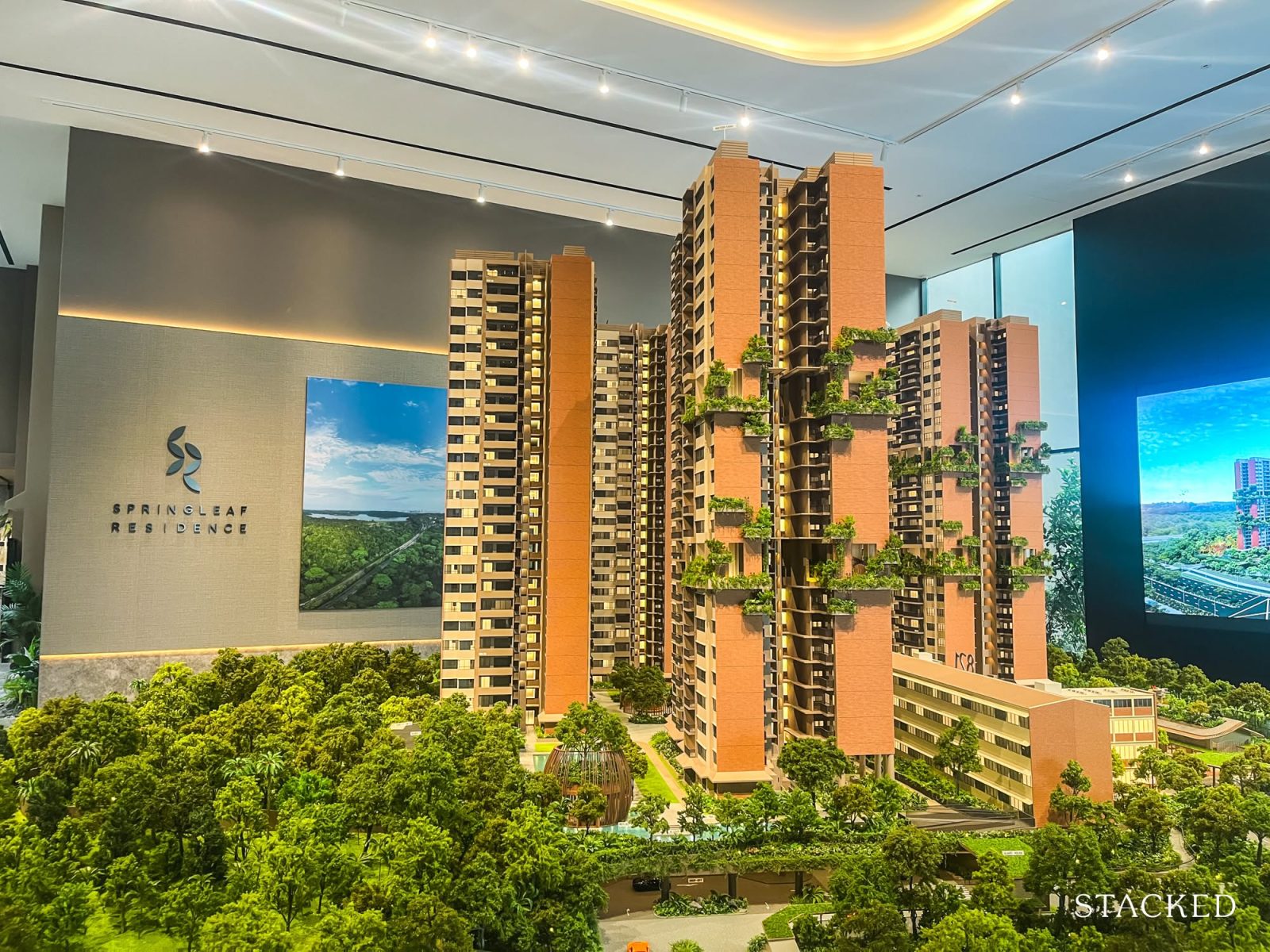
This was a consideration many of the initial buyers faced when the project first hit the market in August 2025. The 941-unit development is the first new major condo to break ground in this locale, which is predominantly a landed enclave.
But as Sheng walked him through the area’s attributes and the project specifications, the client realised that it met nearly all of his considerations.Even though he would be buying later in the launch cycle, the numbers still worked in his favour.
When they visited the sales gallery, the project had already launched for sale, and prices were about 6% higher compared to the starting prices at its first weekend sales launch.
Most of the competitive prices at the initial sales launch phase were behind them, but the prices at the time weren’t too unmanageable. Sheng was also able to pick out a unit that was only priced about 3% higher compared to its initial launch price.
Most of the available units at Springleaf Residence at that time were going for about $600 psf less compared to the indicative selling pieces at Vela Bay. Armed with a purchase price of $3.241 million (approx. $2,197 psf), the client was able to secure a five-bedder unit at Springleaf Residence.
Beyond the attractive price, the layout of the unit was a major pull factor. The 1,475 sq ft size was spacious for the client’s needs, and several of the common rooms still had hackable walls - a much desired flexibility.
Moreover, since the developer - GuocoLand - used continuous herringbone wood flooring throughout the unit, this meant that spaces could be merged more seamlessly. For example, they could merge one of the bedrooms with the living and dining room to extend the space, without having to rework the floor. This would further extend the living and dining room enough to accommodate a 16-seater dining table.
All of this made the decision fairly straightforward. The client moved quickly, making a decision within a week of viewing the project. Even though there were only a handful of units left, the quick response meant the desired unit was secured without any problems.
Final thoughts
This case was aided by the fact that the savvy client had a clear end goal for his property journey, namely, a large home in Somerset, Orchard Road, or Stevens.
Instead of forcing that move too early - and facing a steep $4.5 million, or higher purchase - he chose to take an intermediate step that better aligned with his current finances.
This approach enabled him to secure a spacious five-bedroom home of $3.2 million, while preserving his capacity to upgrade later on. He also learned from his previous experience, and avoided a smaller unit that traded off too much in terms of liveability.
Sheng shares that many buyers tend to focus on whether a property is ‘good’ or ‘bad’ based on their own individual merits. But this client viewed properties in the context of his longer-term plan.
Options like Vela Bay, Tengah Garden Residences, and Faber Residences weren’t without their own appealing merit. But it was clear that Springleaf Residence struck a balance between a lower price point (with a runway for price growth), and spacious enough for a sizable family home.
“Sometimes buyers think they need to get to their ideal property right away. But in reality, it’s often two or three well-planned and executed moves that get you there smoother,” says Sheng.

0 Comments