


Hi Stacked, I am looking to purchase a retirement home under my partner's name. I currently own a three-bedroom unit in District 15, which I will sell and downgrade when I retire. I really like the convenience of living in District 15.
For the retirement home, my budget is limited since it will be our second property, and we have set aside around $1.5 million. We are only able to get a loan tenure of approximately 15 years due to our age, and we will need to keep within a monthly payment budget.
My preference is to stay in a freehold property in District 15, but given the budget, our options are limited to small apartment units. I’m considering 1-bedroom and 1-bathroom units of about 660 sq ft at The Cape. These units seem to be priced from $1.3 million.
I like the location of The Cape and its freehold tenure, but the unit area is a bit small. I’m also worried that it might be a challenge to sell the unit in the future, if an unforeseen event or mishap prompts us to sell it.
Alternatively, we could move into a unit in the OCR, in order to find a sizable unit that fits our budget. In this case, I am considering two 99-year leasehold developments:
- an 840 sq ft two-bedroom unit at eCO at Bedok, which is going for about $1.4 million
- or, an 829 sq ft two-bedroom unit at Q Bay Residences priced from $1.33 million
Personally, I am torn between my preference for a home in District 15, a freehold vs 99-year leasehold property, as well as considerations regarding future price appreciation and the unit’s living space. In your view, which of the three developments would you recommend for livability, price appreciation and ease of sale in the future?
(This is part of an ongoing series where we answer reader questions about the property market. If you have one of your own, send it to stories@stackedhomes.com.)
Hi and thanks for writing in!
While you've framed this as a question about which development to choose, from our perspective the underlying decision is how you would like to optimise the plan for your retirement home.
This is because it is not a short-to-medium-term investment that you’re considering. We think that the usual metrics - namely, which project will appreciate the most or which district has the strongest $PSF track record - may not be the most useful way to approach your case.
A more relevant question that we would pose back to you is: which option gives you the best combination of daily comfort, practical space, and just enough resale flexibility if your circumstances ever change.
With that frame of reference, here's how we would examine each of the three options.
What the trade-off actually looks like
The three options you're comparing represent two different propositions.
First, staying at The Cape in District 15 would give you a home in a familiar and enjoyable neighbourhood for you, as well as a freehold condominium that was only completed in 2014. This is an advantageous lifestyle continuity that comes with staying put.
But the trade-off is living in a 660 sq ft, one-bedroom unit that would be going for about $1.3 million ($1,970 psf). This would be a compact living arrangement for two people who plan to live there through retirement years, especially when marked against larger units of over 800 sq ft two-bedroom options in the OCR that may be priced at a similar or lower price point.
On the other hand, moving into eCO in District 16, or Q Bay Residences in District 18, trades living space for the convenience and familiarity of living in District 15. Both of these developments, eCO and Q Bay Residences, are 99-year leasehold condos in suburban neighbourhoods that are further away from the East Coast neighbourhoods you might be more familiar with.
Let’s begin by examining the price and capital performance of The Cape.
The Cape
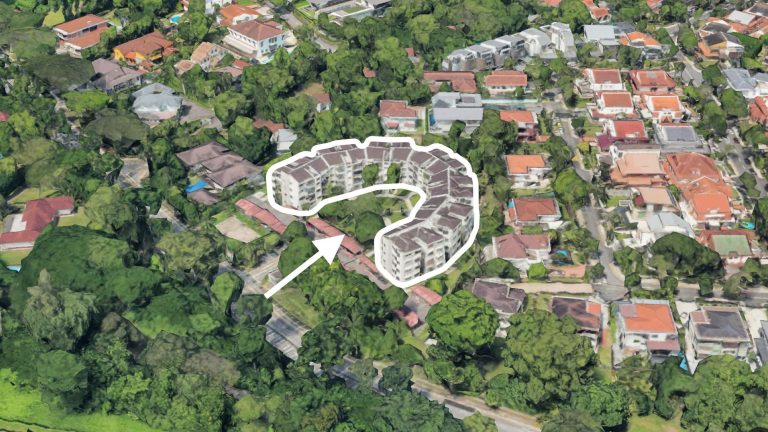
The Cape is a freehold condo on Amber Road in District 15, and the 76-unit development was completed in 2014. Located in the desirable Amber Road residential enclave, it is an area that has long drawn buyers who want a freehold address in the East without paying prime district prices.
Average resale $PSF: The Cape vs benchmarks
| Year | The Cape | D15 non-landed private property | All non-landed private property |
| 2016 | $1,762 | $1,209 | $1,248 |
| 2017 | $2,005 | $1,306 | $1,293 |
| 2018 | $1,799 | $1,325 | $1,323 |
| 2019 | $1,646 | $1,317 | $1,346 |
| 2020 | $1,710 | $1,321 | $1,280 |
| 2021 | $1,727 | $1,458 | $1,354 |
| 2022 | $2,057 | $1,575 | $1,473 |
| 2023 | $1,920 | $1,711 | $1,595 |
| 2024 | $2,132 | $1,805 | $1,681 |
| 2025 | $2,118 | $1,865 | $1,756 |
| Annualised | 2.07% | 4.94% | 3.86% |
Based on transaction data compiled by Stacked, units at The Cape have consistently commanded a premium over most condos in District 15, as well as the islandwide non-landed private residential market.
For example, its average resale price of around $2,118 psf in 2025 was approximately 14% above the average price in District 15, and over 20% higher than the islandwide price average.
However, its annualised $PSF growth of 2.07% trails the D15 average by nearly three percentage points. But this is a typical price trajectory when a project enters the resale market at a significant price premium. To put it simply, there is a shorter runway for prices to outperform when the base price is already relatively high.
Average one-bedroom resale prices: The Cape vs benchmarks
| Year | The Cape | D15 non-landed private property | All non-landed private property |
| 2016 | $1,005,000 | $734,292 | $913,345 |
| 2017 | $1,260,000 | $924,603 | $912,241 |
| 2018 | - | $834,100 | $887,373 |
| 2019 | - | $872,641 | $885,717 |
| 2020 | - | $750,965 | $867,465 |
| 2021 | $1,044,000 | $832,030 | $859,635 |
| 2022 | $1,219,000 | $874,975 | $872,647 |
| 2023 | $1,240,000 | $930,155 | $914,013 |
| 2024 | - | $989,677 | $965,379 |
| 2025 | $1,222,000 | $1,009,787 | $981,764 |
When we examine the price performance of one-bedroom units at The Cape, it brings our analysis into sharper focus. In 2025, one-bedders at the condo - which roughly span 592 sq ft - fetched an average of $1.22 million. The specific unit that you mentioned is slightly larger at 660 sq ft, and its asking price of $1.3 million is also slightly above the average transaction price recorded to date.
Usually, buyers who close deals for units of this type in a boutique freehold development have a specific set of preferences: they desire the lifestyle appeal of a freehold condo in a prime East Coast locale, and they generally don’t buy a unit for its space efficiency.
As a result, this narrows the pool of future buyers, and the transaction volumes at The Cape reflect this.
Annual resale activity logged at the condo has ranged from 0 to six resale transactions per year since 2016, and across several years there were no recorded resale transactions at all. Now, for a development with just 76 units this is not unusual.
But it signals that any future sale, particularly those made while sellers are under time pressures, may take longer for the right buyer to come around and fewer competing offers to consider.
eCO
Meanwhile, eCO is a 99-year leasehold development on Bedok South Avenue 3 in District 16. Situated in the Bedok/Upper East Coast area, this 714-unit development was completed in 2017.
According to recent transaction data, most 840 sq ft two-bedroom units in that condo tend to transact for approximately $1.4 million to $1.45 million. This makes purchasing a unit there the most expensive option, in terms of absolute price, among the three developments we’re reviewing.
Average resale $PSF: eCO vs benchmarks
| Year | eCO | D16 non-landed private property | All non-landed private property |
| 2015 | $1,290 | $1,021 | $1,197 |
| 2016 | $1,163 | $997 | $1,248 |
| 2017 | $1,317 | $990 | $1,293 |
| 2018 | $1,368 | $1,101 | $1,323 |
| 2019 | $1,353 | $1,104 | $1,346 |
| 2020 | $1,256 | $1,109 | $1,280 |
| 2021 | $1,321 | $1,184 | $1,354 |
| 2022 | $1,411 | $1,298 | $1,473 |
| 2023 | $1,482 | $1,409 | $1,595 |
| 2024 | $1,502 | $1,478 | $1,681 |
| 2025 | $1,536 | $1,533 | $1,756 |
| Annualised | 1.76% | 4.15% | 3.91% |
eCO's annualised $PSF growth of 1.76% is also the weakest of the three condos.
The project set an average selling price of $1,290 psf when it launched in 2015, which is a 26% premium over the average price of non-landed private homes in District 16 at the time. But by 2025, average resale prices at the condo were largely in line with the district average.
Average two-bedroom resale price: eCO vs benchmarks
| Year | eCO | D16 non-landed private property | All non-landed private property |
| 2016 | $1,010,000 | $944,081 | $1,233,012 |
| 2017 | $1,147,500 | $969,347 | $1,258,776 |
| 2018 | $1,150,000 | $1,037,160 | $1,284,674 |
| 2019 | $1,160,000 | $1,026,744 | $1,318,309 |
| 2020 | $1,180,000 | $1,065,631 | $1,238,206 |
| 2021 | $1,279,333 | $1,058,860 | $1,250,816 |
| 2022 | $1,304,167 | $1,140,946 | $1,303,588 |
| 2023 | $1,418,400 | $1,254,006 | $1,396,924 |
| 2024 | $1,419,714 | $1,288,441 | $1,483,026 |
| 2025 | $1,453,600 | $1,336,193 | $1,523,138 |
The average price for a two-bedroom unit at eCo has climbed from around $1.01 million in 2016 to $1.45 million in 2025, and this reflects a strong increase in the quantum value of units there.
But eCO entered the market at a noticeable price premium compared to the average price of private homes in District 16, and that price gap has since shrunk as the average district-wide price has caught up over the years.
In terms of resale liquidity, the data indicates that eCO is the stronger performer compared to The Cape. There were 12 resale transactions in 2022, followed by five to seven deals in each subsequent year.
For a retirement home where future flexibility matters, a two-bedroom unit in an accessible suburban location draws a wider pool of buyers than a boutique development with a niche unit profile, and the transaction history at eCO reflects that position.
As far as location goes, Bedok and the Upper East Coast area are closer to District 15 than your next option at Tampines. The Bedok town centre is well-connected and the neighbourhood has elements of the low-rise residential texture of the broader East Coast, but without the premium pricing that comes with a District 15 address.
Q Bay Residences
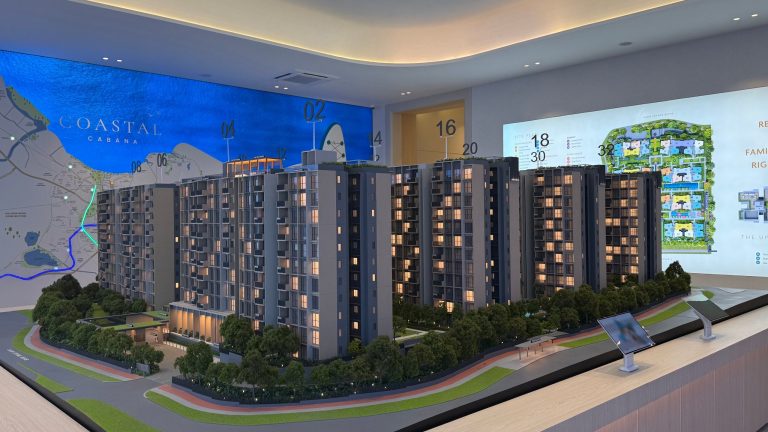
Turning to Q Bay Residences, a 99-year leasehold development on Tampines Street 86. The 630-unit development was completed in 2016 and is located in the Tampines/Pasir Ris area in District 18.
In general, an 829 sq ft two-bedroom unit that is going for $1.33 million may offer you the best space-to-quantum ratio of the three developments reviewed so far.
Average resale $PSF: Q Bay Residences vs benchmarks
| Year | Q Bay Residences | D18 non-landed private property | All non-landed private property |
| 2016 | $1,142 | $857 | $1,248 |
| 2017 | $1,130 | $864 | $1,293 |
| 2018 | $1,118 | $938 | $1,323 |
| 2019 | $1,110 | $936 | $1,346 |
| 2020 | $1,100 | $940 | $1,280 |
| 2021 | $1,151 | $1,009 | $1,354 |
| 2022 | $1,239 | $1,147 | $1,473 |
| 2023 | $1,366 | $1,325 | $1,595 |
| 2024 | $1,424 | $1,413 | $1,681 |
| 2025 | $1,490 | $1,456 | $1,756 |
| Annualised | 3.00% | 6.07% | 3.86% |
Based on the data compiled by Stacked, Q Bay Residences annualised $PSF growth of 3.00% broadly matches the islandwide non-landed private residential benchmark, although it trails the District 18 average by over three percentage points.
However, it is worth pointing out that average resale prices in District 18 have risen sharply in recent years, and Q Bay Residences' competitive market position has eroded as surrounding projects catch up from their lower starting base prices.
Average two-bedroom resale price: Q Bay vs benchmarks
| Year | Q Bay Residences | D18 non-landed private property | All non-landed private property |
| 2017 | $973,200 | $828,159 | $1,258,776 |
| 2018 | $914,148 | $857,305 | $1,284,674 |
| 2019 | $905,500 | $836,448 | $1,318,309 |
| 2020 | $897,800 | $827,138 | $1,238,206 |
| 2021 | $946,143 | $866,160 | $1,250,816 |
| 2022 | $989,640 | $958,983 | $1,303,588 |
| 2023 | $1,134,899 | $1,055,842 | $1,396,924 |
| 2024 | $1,181,899 | $1,088,614 | $1,483,026 |
| 2025 | $1,248,432 | $1,166,433 | $1,523,138 |
Transaction data also illustrates that the average price of a two-bedroom unit at Q Bay Residences has increased from $973,200 in 2017 to $1.25 million in 2025.
Thus, a potential selling price of $1.33 million for the unit you're looking at would sit slightly above the average transaction price recorded at the development in 2025. This means that there’s a strong possibility that you may be buying at the upper end of the current market for this unit type here.
Overall, the volume of resale liquidity here is the strongest of the three options. Q Bay Residences has consistently seen between nine and 17 resale transactions per year since 2019, which gives future buyers a good read on the condo's price trajectory and offers sellers a more active market to work with.
In your case, the primary trade-off is its location. Tampines is a larger shift away from the lifestyle living in District 15 compared to a relatively nearer locale like Bedok. And for someone who has lived in the East Coast area for a long time, that adjustment may turn out to be acute and unwanted.
Does freehold tenure actually matter for this purchase?
This is a common question that comes up when buyers consider different retirement home decisions, and the data at a broad market level may not point in the direction you'd expect.
Average resale $PSF: 99-year leasehold vs freehold/999-year leasehold
| Year | 99-year LH non-landed private property | 999-year/freehold non-landed private property |
| 2015 | $1,051 | $1,366 |
| 2016 | $1,140 | $1,393 |
| 2017 | $1,123 | $1,461 |
| 2018 | $1,164 | $1,524 |
| 2019 | $1,189 | $1,572 |
| 2020 | $1,159 | $1,488 |
| 2021 | $1,227 | $1,586 |
| 2022 | $1,370 | $1,709 |
| 2023 | $1,516 | $1,799 |
| 2024 | $1,616 | $1,856 |
| 2025 | $1,683 | $1,940 |
| Annualised | 4.82% | 3.57% |
Between 2015 and 2025, 99-year leasehold non-landed private properties outpaced freehold and 999-year properties in $PSF growth terms, at an annualised rate of 4.82% versus 3.57%.
This doesn't mean that 99-year leasehold projects are categorically superior. Freehold properties typically command a price premium from the get-go, which tends to moderate their $PSF growth even as price quantums continue to rise. But the data does suggest that tenure alone is not a reliable predictor of relative outperformance.
For a retirement home, the case for freehold is less about capital appreciation and more about what it removes from the equation. There's no lease decay clock in the background. If the property is eventually passed on, the complications of a shortening leasehold tenure don't come into play. And when it's time to sell, you're not working against a narrowing window the way you might be with an older 99-year leasehold asset.
Those are real benefits. But your budget of $1.5 million for a freehold property in District 15 currently constrains you to smaller unit types in boutique developments, with a higher entry $PSF and a narrower buyer pool. Whether that trade-off is worth it depends on how much the specific location matters relative to the practical realities of daily life in a 660 sq ft flat.
Are there middle-ground options in D15?
The selection of properties that you've presented to us should not be the only options in this decision. Within your budget of up to $1.5 million, there are resale two-bedroom units in District 15 with sizes above 800 sq ft. Most are in older developments and come with other trade-offs such as property age, older facilities, and sometimes accessibility.
Based on transactions in 2025, here's a selection of District 15 projects which recorded two-bedroom units of more than 800 sq ft that also transacted for less than $1.5 million.
D15 resale 2-bedroom transactions in 2025 under $1.5 million
| Project | Average transacted price in 2025 | Average size (based on transactions done) | Transaction volume |
| MANDARIN GARDENS | $1,144,808 | 876 | 11 |
| SUITES @ GUILLEMARD | $1,150,000 | 807 | 1 |
| LA VIDA @ 130 | $1,200,000 | 936 | 1 |
| SIGLAP V | $1,224,000 | 974 | 2 |
| EASTCOVE RESIDENCES | $1,270,000 | 904 | 1 |
| THE MEDLEY | $1,280,000 | 807 | 1 |
| SUNSHINE MANSIONS | $1,289,000 | 802 | 2 |
| RESIDENCE 118 | $1,290,000 | 840 | 1 |
| TIVOLI GRANDE | $1,322,800 | 809 | 5 |
| PARC BLEU | $1,332,200 | 921 | 4 |
| TANJONG RIA CONDOMINIUM | $1,380,000 | 867 | 2 |
| SPRING @ LANGSAT | $1,394,000 | 931 | 2 |
| ONE K GREENLANE | $1,400,000 | 883 | 1 |
| THE MINT RESIDENCES | $1,408,888 | 872 | 1 |
| SANCTUARY GREEN | $1,430,000 | 813 | 2 |
| CANTIZ @ RAMBAI | $1,450,000 | 969 | 1 |
| PALM VISTA | $1,468,000 | 861 | 1 |
| CRESCENDO PARK | $1,470,000 | 850 | 1 |
| GOLD LEAF MANSIONS | $1,480,000 | 958 | 1 |
| BELLEZZA @ KATONG | $1,485,000 | 861 | 1 |
| CHELSEA LODGE | $1,500,000 | 958 | 1 |
Please keep in mind that this is not a recommendation of these projects over the three you've shortlisted. We would point out that resale transaction volumes are thin on most of these example properties, and averages based on one or two transactions should be read with caution.
Moreover, some of these developments are considerably older than The Cape, and this brings with it different facility standards and varying levels of accessibility to amenities and public transport.
We would highlight Mandarin Gardens since it stands out based on the resale volume to date. The condo saw 11 resale transactions in 2025, and the average size of units sold was 876 sq ft, while the average price was about $1.14 million. That is a larger unit than the one-bedroom at The Cape and it goes for a lower price quantum, and the development sits within D15, which goes some way toward addressing both of your concerns.
The main question concerning older developments is how much the age of the project matters to your day-to-day, and whether a lower-priced unit in a larger and older condominium feels like a fair trade for the extra space and the familiarity of its location.
So what should you do?
Looking at the $PSF performance data across all three options, the picture is fairly consistent: each has lagged its own district benchmark in terms of $PSF growth, most likely because all three entered the market at a price premium relative to their surroundings. If chasing $PSF outperformance were the primary goal, none of the three would be the obvious answer.
For a retirement home, the ideal decision is one that leaves you in the best position on two fronts: how comfortably you can live there over the long run, and how cleanly you can exit if circumstances change.
On liveability, 660 sq ft for two people is not unworkable, but it is a different experience from units in the 800 sq ft and higher range. If you're currently in a three-bedroom property in D15, the adjustment to a one-bedroom will be noticeable regardless of how good the location is. Storage becomes tighter, hosting gets harder, and the ability to repurpose space as needs change with age simply isn't there. These are practical concerns for a retirement home, and they tend to matter more over time.
On exit flexibility, both eCO and Q Bay have broader buyer pools, more active resale markets, and unit profiles that appeal across a wider range of buyers. The Cape's boutique scale and its one-bedroom profile at a high quantum means the future buyer will also need to specifically want what that unit offers in that location. In a scenario where you need to sell quickly, that is a constraint.
Of the two OCR options, eCO is the smaller lifestyle adjustment for someone who has been living in the East. Bedok sits closer to D15 in both distance and character than Tampines, and the combination of more space, healthier transaction volumes, and an accessible suburban location makes a reasonable case as a retirement home.
If the D15 lifestyle genuinely matters to you beyond the appeal of the postcode, such as the specific coffee shops, hawker centres, routes, and rhythms of that area, then staying in D15 in some form may be the right call, even with the space compromise. It would also be worth spending time searching, as there are units like those at Mandarin Gardens that offer more room without requiring you to leave the district entirely.


0 Comments