


Dear Stacked,
My wife and I purchased our first home at Treasure Crest in Sengkang, a 1,076 sq ft three-bedroom premium unit on a low floor. The unit faces OLA, another executive condominium along Anchorvale Crescent. Some time ago, we decoupled and subsequently bought a unit at Lentoria, with the intention of being closer to a primary school for our child.
Lentoria is expected to receive its Temporary Occupation Permit (TOP) around mid-2027. As we prepare for the move, we are deciding what to do with our Treasure Crest unit: rent it out or sell it.
If selling turns out to be the better option, we would also appreciate your guidance on whether it makes sense to purchase another investment property, and if so, what type of property would be appropriate in the current market.
Thank you.
(This is part of an ongoing series where we answer reader questions about the property market. If you have one of your own, send it to stories@stackedhomes.com.)
Hi and thanks for writing in!
What stood out to us about your case is that you've already done the part most homeowners find hardest to execute: decoupling, then purchasing at Lentoria to position yourself near a primary school. That sequence in terms of your property journey takes strategic planning that many owner-occupiers tend to miss.
With Lentoria's completion and TOP approaching, Treasure Crest shifts from being your family home to an investment asset. That changes how it should be evaluated. The question is what role it serves within your portfolio from this point forward, and whether it's the right asset to keep doing that job.
How resale units at Treasure Crest have performed to date
Treasure Crest is a 99-year leasehold executive condominium (EC) on Anchorvale Crescent in Sengkang, District 19. It obtained its TOP in 2018 and reached its five-year minimum occupation period (MOP) in 2023.
Since all resale transactions at Treasure Crest up to the end of 2025 involve owners who purchased directly from the developer, we'll assume you bought the unit directly from the developer at launch prices.
Typically, the initial batch of EC owners benefit from a post-MOP repricing effect. This means that once the development reaches its MOP and enters the resale market, it begins competing more directly with surrounding fully private condominiums. Understanding how much of that repricing has already occurred is key to deciding what comes next.
Treasure Crest's average $PSF movement from launch till 2025
| Year | Treasure Crest's avg $PSF | D19 non-landed private properties | All non-landed private properties |
| 2016 | $745 | $1,011 | $1,232 |
| 2017 | $783 | $1,054 | $1,304 |
| 2018 | $1,054 | $1,181 | $1,435 |
| 2019 | $1,061 | $1,291 | $1,560 |
| 2020 | - | $1,275 | $1,513 |
| 2021 | $1,076 | $1,273 | $1,600 |
| 2022 | $1,119 | $1,402 | $1,712 |
| 2023 | $1,392 | $1,479 | $1,869 |
| 2024 | $1,434 | $1,788 | $1,886 |
| 2025 | $1,541 | $1,649 | $2,092 |
| Annualised | 8.41% | 5.58% | 6.06% |
From an average launch price of around $745 psf in 2016, prices at Treasure Crest have increased to approximately $1,541 psf in 2025. That works out to an annualised growth rate of 8.41%, ahead of both District 19 non-landed private properties — which recorded growth of 5.58% over the same period — and the broader non-landed private market, which increased 6.06% over the same period.
One caveat worth keeping in mind is that the five resale transactions recorded before the project's MOP required special approval and are not representative of open market conditions. The clearer signal is the step-up from the average of $1,119 psf in 2022 to $1,392 psf in 2023, which captures the repricing that typically occurs when an EC enters the resale market.
There is also a clear profitability trend at the individual transaction level, which is clearly showcased.
Treasure Crest resale profitability
| Unit type | Average ROI | Average gains | Average holding period (years) | No. of tnx |
| 3-bedroom | 92.42% | $733,434 | 7.7 | 162 |
| 4-bedroom | 91.67% | $956,529 | 8.0 | 17 |
Based on resale data compiled by Stacked, all 162 recorded three-bedroom resale transactions at Treasure Crest have been profitable, with average gains of roughly $733,000 over close to eight years.
The sample size of 17 transactions involving four-bedders is too thin to treat as statistically representative, but the returns that we can see from these sales are broadly in the same range as the three-bedders.
It is important to identify what drove these relatively strong profits, since subsequent resale units may not get sold under the same conditions.
Two factors did most of the legwork that fuelled the initial price growth: the subsidised launch prices and the strong growth in private home resale prices after the Covid-19 pandemic.
Based on recent transactions, the average price for a resale unit at Treasure Crest is about $1.5 million, and this is a much higher price compared to what the initial group of buyers paid for their units. Thus, subsequent resale buyers don’t stand to gain from this advantageous position, and the post-MOP repricing tailwind has been largely captured.
This doesn't make Treasure Crest an unappealing or even an uncompetitive development, but the next leg of any price appreciation will be driven by broader private residential market conditions, not EC-specific mechanics.
What the rental yield actually delivers
According to the latest resale data, a typical 1,076 sq ft, three-bedroom unit at Treasure Crest would go for approximately $1.645 million. Rental transactions for comparable three-bedroom units in this size range average around $4,228 per month (pm), which puts the gross rental yield at approximately 3.08%.
District 19 average rental yields by unit type
| Unit types | Average resale price in 2025 | Average rent in 2025 | Rental yield |
| 1-bedroom | $848,507 | $2,864 | 4.05% |
| 2-bedroom | $1,299,847 | $3,579 | 3.30% |
| 3-bedroom | $1,726,850 | $4,439 | 3.08% |
| 4-bedroom | $2,139,213 | $5,739 | 3.22% |
The broad rental performance is a pattern that runs across the private residential market: larger family-sized units tend to garner lower rental yields as a percentage of their capital values, because asset values have risen faster than rents at the upper end of the quantum range.
The 3.08% gross rental yield is before property tax at non-owner-occupied rates, maintenance fees, agent fees, and the periodic cost of maintaining a tenanted unit. Net yield, realistically, will be narrower.
The investment case for holding Treasure Crest going forward therefore rests more on capital appreciation than on rental income.
Option 1: Holding Treasure Crest as a rental asset
The case for holding on to your unit at Treasure Crest starts with your cost basis. Assuming EC launch pricing, that figure is significantly lower than what any buyer entering the market today would pay. That entry price advantage translates into a more comfortable landlord position compared to a current-market buyer, which gives you a margin to handle vacancy periods or rental management expenses.
District 19 also has a relatively consistent base of family rental demand, particularly for larger and more affordably priced units, which fits the profile of a three-bedroom EC reasonably well.
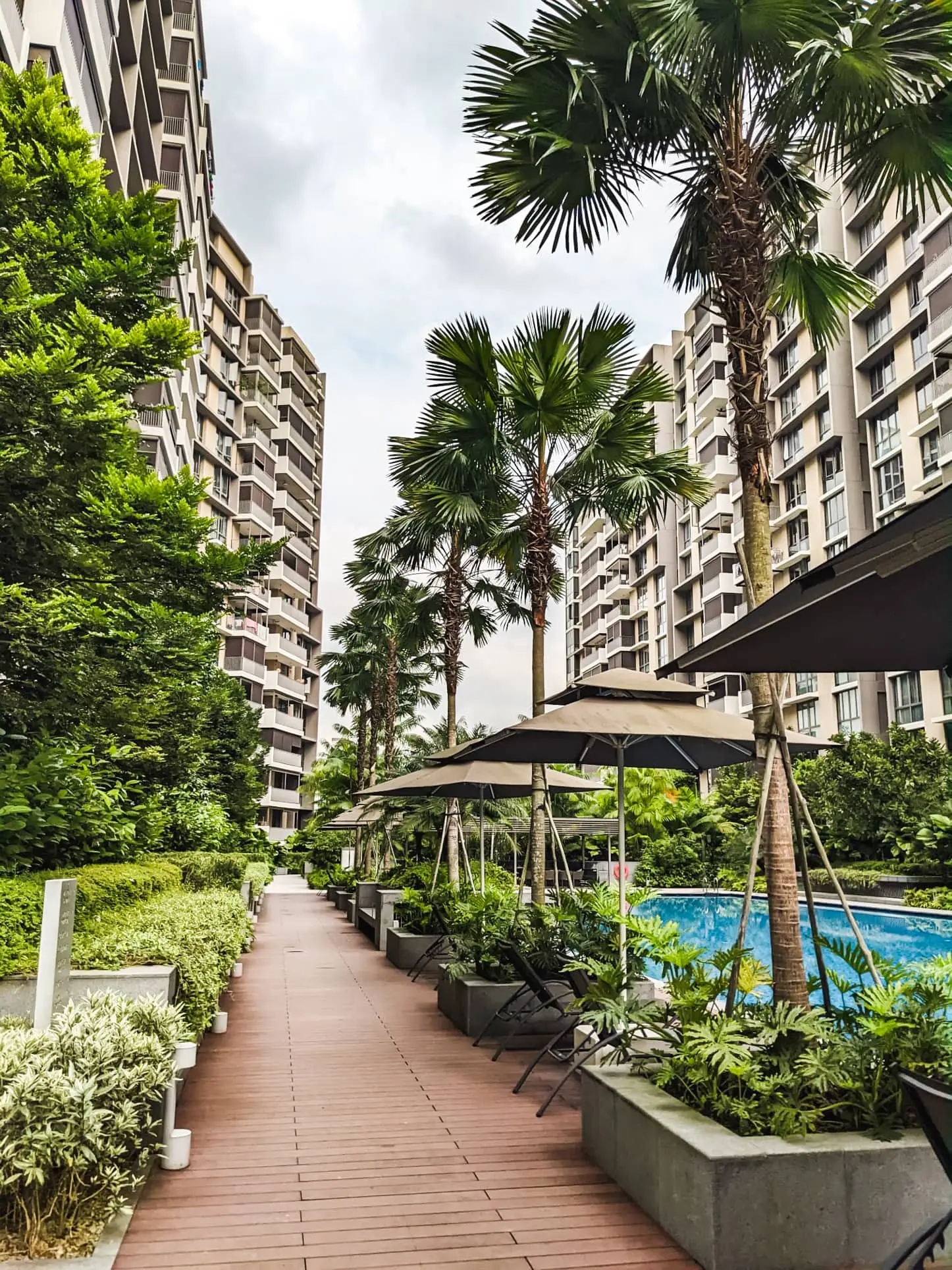
The proposition to continue holding on to the unit at Treasure Crest doesn't require the development to outperform the rental trend of this district. It requires the asset to remain a stable income-generating property that tracks the broader private residential market, and produces a rental stream that justifies the illiquidity.
For owners who are not under pressure to recycle capital and who are comfortable managing a tenanted property, it is reasonable to view a unit at Treasure Crest as a cornerstone of any investment portfolio.
On the other hand, there are opportunity costs that you would be giving up. Assuming a capital value of about $1.6 million, and an investment asset generating a gross rental yield of under 3% before costs, you would be locking in that capital even if it doesn't feel like it on a month-to-month basis.
Option 2: Selling the unit and reallocating the capital gains
How the locked-in capital of owning the unit at Treasure Crest, compared to other investment assets, depends on your age and remaining income runway. In general, the significant price uplift that EC experiences immediately after their MOP is usually a one-time event, and it is one that Treasure Crest has already experienced.
Looking ahead, the project will likely track the private residential price trends in District 19, which has performed well historically but the EC-to-private repricing advantage is behind it.
If you are in your 30s or early 40s, still employed and within the loan eligibility and TDSR headroom to take on a higher quantum, there is a case for recycling the proceeds into an asset that has more runway ahead of it.
Property appreciation comparison at different price points
| Property Price | 10% Appreciation | Absolute Gain |
| $1.5M | 10% | $150,000 |
| $2.5M | 10% | $250,000 |
If we assume the same rate of price appreciation and holding period, a $2.5 million property returns $100,000 more in absolute terms than a $1.5 million property. The window of opportunity to achieve this doesn't stay open indefinitely.
As you get older, the maximum loan you can qualify for shrinks because there are fewer years left on your working tenure to service it. Moreover, a growing portion of your CPF gets locked away for retirement, leaving less available for a property purchase. Going bigger makes the most sense while your income is still at its peak and the bank can lend you enough to make it work.
A well-located new launch three-bedroom unit in a district with stronger long-term capital appreciation fundamentals, or a resale four-bedroom at a favourable entry point, would be the typical direction from this base. Private properties with freehold or longer leasehold tenures tend to carry broader resale appeal and face fewer buyer pool constraints over time, which is relevant if your investment horizon extends ten years or more.
One thing worth noting here is that your decoupling structure actually works in your favour in terms of stamp duties. Assuming the spouse who holds Treasure Crest is not on the Lentoria title, selling Treasure Crest and purchasing a new investment property in that same name would not attract Additional Buyer's Stamp Duty (ABSD).
However, the sequence of the property purchase is important. The sale of Treasure Crest should be completed before the new purchase is made. As always, confirm the specifics of your ownership structure with your conveyancing firm before proceeding.
So what should you do?
Holding on to the unit at Treasure Crest is a reasonable path if stability and passive income are your priorities. Your cost basis as an EC launch buyer puts you in a more comfortable landlord position than someone purchasing a unit now at prevailing resale prices. The trade-off is that around $1.6 million in capital is tied up in a 3% gross yielding asset, and it's likely that the period of time that produced its strongest outperformance is behind it.
The case for selling and repositioning is more compelling the earlier you are in your wealth accumulation years. While income, loan eligibility, and remaining loan tenure are still on your side, recycling the gains into a higher-value asset is the kind of move that pays most dividends over the subsequent decade, not immediately. If you are in your 30s or early 40s, it's worth running the numbers properly rather than dismissing it.
There is also the option of holding for another year or two, using the time after the Lentoria TOP to properly assess what repositioning would look like, accounting for transaction costs, stamp duty, and what's actually available at the price points being considered. That preserves optionality without forcing a decision under time pressure.
What the decision should not be is simply deferred. While Treasure Crest has performed well, a $1.6 million asset with a 3% yield and a growth story that has largely played out calls for a clearer evaluation of what it's being held for. Whether the answer is income stability, capital recycling, or continued market exposure at a higher quantum, the earlier that frame is set, the better the outcome is likely to be.



0 Comments