


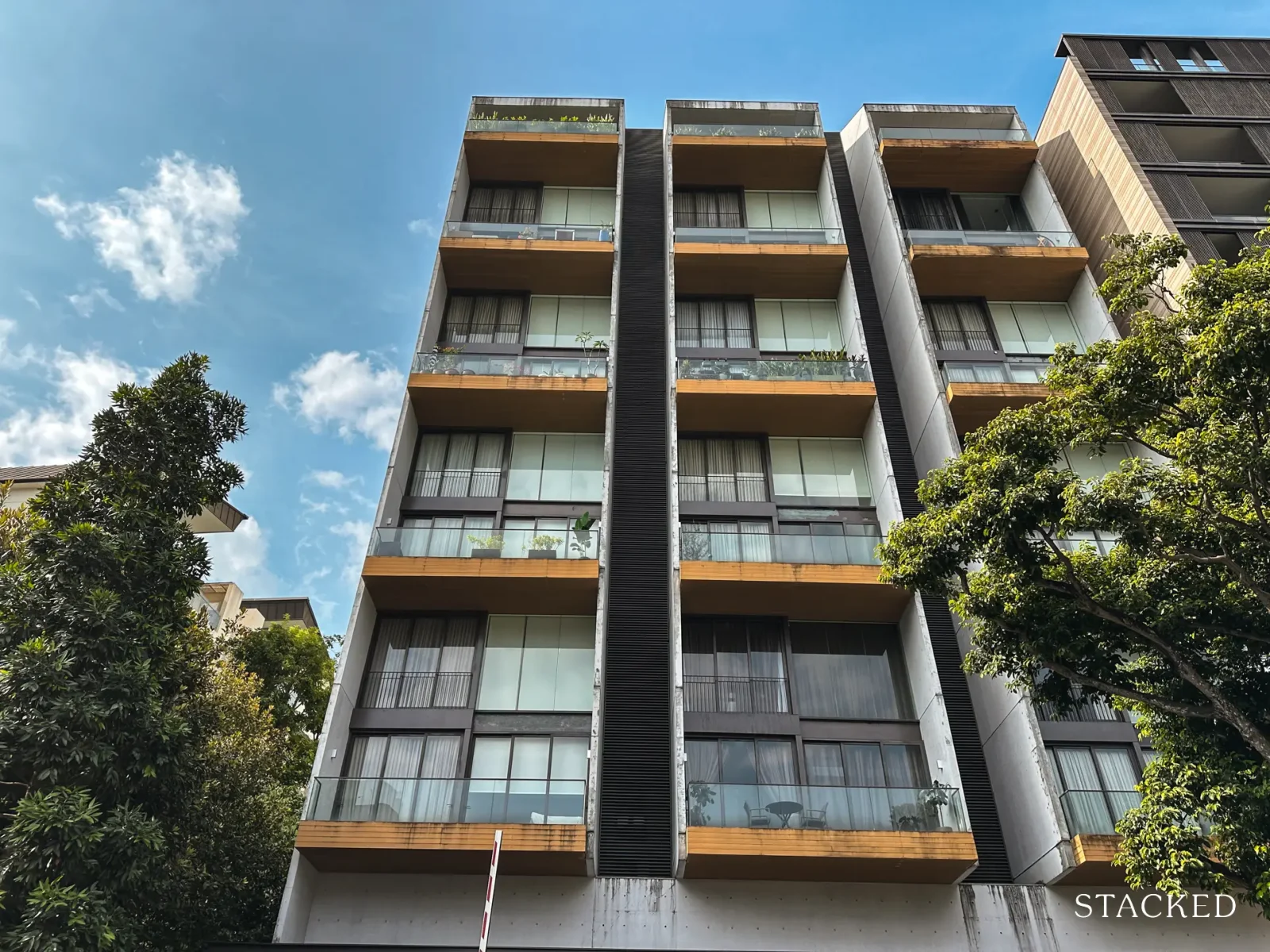
Between a mass-market condominium built by a property conglomerate and a small-scale boutique project by a local developer, which would you probably assume is the ‘better’ development?
Some people might have the impression that it's the latter - the boutique project - based on the assumption that exclusivity and descriptions like ‘bespoke’ or ‘artisanal’ when describing a new residential development implies a high standard.
At face value this seems reasonable, since a team of people working hard on a couple of developments would be done with more care and attention to detail. That’s part of the perception some people may have of boutique condos, but recent findings by the Building and Construction Authority (BCA) suggest differently.
According to the statutory board, which is under the Ministry of National Development, boutique residential projects - defined here as projects with fewer than 50 units - tended to receive worse Construction Quality Assessment System (Conquas) ratings over the past six years.
Conquas is the BCA's framework for assessing construction workmanship and major defects in completed buildings; you can read more about it here.
It noted that among its assessment of 167 private residential projects, 48 received the three lowest Conquas bands (Bands 4 to 6). Of these 48 lower-rankers, 28 were boutique developments.
There were also 119 high-ranked projects which fell within the Band 1 to Band 3 ratings. Among these, boutique projects were greatly underrepresented with only 17 of these types of residential developments making it into these ranks.
Note: The difference between the developer bands can be quite significant. Among Band 1 developers, fewer than one unit in 1,000 had major defects after TOP. But among Band 6 developers, the number rose to around 80 units in 1,000.
But why would this happen?
Interestingly, one possible explanation involves something many Singapore homebuyers actually prefer: Non-Prefabricated Prefinished Volumetric Construction (PPVC).
According to Professor Sing Tien Foo of the NUS Business School (see the linked article), smaller developments tend to rely less on PPVC construction systems. But this method of building benefits from factory-controlled production and stringent quality checks.
Non-PPVC projects involve more construction and assembly work being carried out on site, where workmanship becomes more susceptible to weather conditions and variations. For example, tasks like tiling, waterproofing, or installing windows all depend on the skill and consistency of the workers. Two different builders can produce noticeably different results.
This is quite different from PPVC methods, where everything is made first in a factory - there the environment is controlled, production is more standardised, and inspections happen before the modules leave the factory.
(To be clear: this is not to say PPVC produces better results, just that the results tend to be more consistent.)
This is a bit ironic, since more homebuyers tend to prefer non-PPVC projects because the units that are created tend to give owners more freedom to remove the walls and adjust a unit’s layout to accommodate their lifestyle needs.
But non-PPVC methods are just the tip of a very large iceberg.
There are other factors to consider as well. Larger developments - particularly those backed by highly capitalised property developers - have deeper pockets and are able to reap significant economies of scale in terms of development and construction. They can justify dedicated quality control teams, deploy more extensive testing and inspection, and rely on the best-in-class builders.
At the very least, it is usually the case that developers behind large projects simply have more experience managing the myriad factors that bring a development together. A powerhouse like CapitaLand or Far East Organization have had years to refine their QA systems, whereas a smaller and less capitalised developer may just be on their second or third project. There’s no comparison.
Ironically, one of main draws of a boutique project may also be a contributing factor. Large projects are repetitive - if you’re building over 300 versions of the same three-bedder layout, the work is very efficient, and any defects are quickly spotted and fixed. But boutique projects may only build a handful of units with the same layout, and in some cases nearly each unit is unique or has some individual quirk.
None of this means buyers should suddenly avoid boutique developments.
Singapore has many well-built boutique projects, and BCA's findings only indicate a trend. I’d point out some boutique projects have developers at the top of the game as well.
But it does mean that we need to avoid certain assumptions. Just because boutique projects may feel more bespoke and tend towards a more luxurious feel, doesn;t always equate to the overall quality being higher. We can now see that the results, on average, show the opposite.
But given that Singapore has strict standards and regulations throughout the built environment, the bigger concern for boutique projects will be the usual issues. Namely, fewer facilities than larger developments, possibly higher maintenance fees, and a more volatile resale performance.
Here’s a possible refinement we may need to consider in the future for smaller projects and developers.
Since large and small developers in Singapore are worlds apart, I think the rating systems may need to add more context.
Based on what I’ve been led to understand, right now it’s just a banding number but perhaps we need ways to make certain information more visible, such as how many residential projects the developer has completed, the total number of units delivered, or whether it's a first-time developer.
Two developers may both achieve the same band, but one may have built thousands of homes over several decades while the other has completed only a single boutique project. Thinking aloud, perhaps providing this additional context would give buyers a fuller picture of the experience behind a development, without changing the underlying quality standards.
Developer bandings are based on Conquas track record over the past six years (you can check this on the BCA Quality Housing Portal). A Band 2 developer with 30 projects is quite different from a Band 2 developer that’s now working on its second-ever project. While looking at the list of projects will reveal this, it should be more strongly highlighted for users outside the industry.
Meanwhile in other property news…
- Check out our price review of Lentor Garden Residences, and why based on land price, this may be the last shot at a more affordable Lentor area property.
- We visited the first condo project in the vicinity of the former Turf Club: Dunearn House. Here’s what’s outstanding about it.
- Hazel Park Condominium’s two-bedders manage to stand out, in a part of the West that’s better known for family homes. How so? We took a look on Stacked Pro.
Weekly Sales Roundup (29 June - 05 July)
Top 5 Most Expensive New Sales (By Project)
| PROJECT NAME | PRICE S$ | AREA (SQFT) | $PSF | TENURE |
| RIVER MODERN | $3,327,000 | 904 | $3,680 | 99 yrs (2025) |
| THE ARCADY AT BOON KENG | $3,298,000 | 1281 | $2,575 | FH |
| TERRA HILL | $3,205,000 | 1335 | $2,401 | FH |
| THE MYST | $3,191,000 | 1518 | $2,102 | 99 yrs (2023) |
| LENTORIA | $3,140,000 | 1206 | $2,605 | 99 yrs (2022) |
Top 5 Cheapest New Sales (By Project)
| PROJECT NAME | PRICE S$ | AREA (SQFT) | $PSF | TENURE |
| ARINA EAST RESIDENCES | $1,318,000 | 495 | $2,662 | FH |
| RIVER GREEN | $1,395,000 | 420 | $3,323 | 99 yrs (2024) |
| UNION SQUARE RESIDENCES | $1,400,000 | 506 | $2,767 | 99 yrs (2024) |
| THE SEN | $1,620,000 | 678 | $2,389 | 99 yrs (2025) |
| LUMINA GRAND | $1,678,000 | 969 | $1,732 | 99 yrs (2022) |
Top 5 Most Expensive Resale
| PROJECT NAME | PRICE S$ | AREA (SQFT) | $PSF | TENURE |
| THE PEAK | $8,500,000 | 5522 | $1,539 | FH |
| CAVENAGH COURT | $6,380,000 | 3703 | $1,723 | FH |
| LEEDON RESIDENCE | $6,100,000 | 2110 | $2,891 | FH |
| VIVA | $5,387,250 | 1959 | $2,750 | FH |
| PEACH GARDEN | $5,025,000 | 2766 | $1,816 | FH |
Top 5 Cheapest Resale
| PROJECT NAME | PRICE S$ | AREA (SQFT) | $PSF | TENURE |
| VIBES @ EAST COAST | $710,000 | 398 | $1,783 | FH |
| KINGSFORD . HILLVIEW PEAK | $748,000 | 527 | $1,418 | 99 yrs (2012) |
| MIDTOWN RESIDENCES | $765,000 | 452 | $1,692 | 99 yrs (2013) |
| HILLION RESIDENCES | $838,000 | 474 | $1,769 | 99 yrs (2013) |
| STUDIOS @ MARNE | $838,000 | 560 | $1,497 | FH |
Top 5 Biggest Winners
| PROJECT NAME | PRICE S$ | AREA (SQFT) | $PSF | RETURNS | HOLDING PERIOD |
| THE PEAK | $8,500,000 | 5522 | $1,539 | $5,400,000 | 21 Years |
| VIVA | $5,387,250 | 1959 | $2,750 | $2,562,150 | 17 Years |
| DORMER PARK | $3,475,000 | 1679 | $2,069 | $2,555,000 | 22 Years |
| CRYSTAL RHU | $2,808,888 | 1270 | $2,211 | $1,913,888 | 23 Years |
| LEEDON RESIDENCE | $6,100,000 | 2110 | $2,891 | $1,780,396 | 13 Years |
Top 5 Biggest Losers
| PROJECT NAME | PRICE S$ | AREA (SQFT) | $PSF | RETURNS | HOLDING PERIOD |
| THE SCOTTS TOWER | $1,138,000 | 657 | $1,733 | -$1,058,000 | 13 Years |
| THE ASANA | $858,000 | 398 | $2,154 | -$222,000 | 4 Years |
| STUDIO8 | $1,250,000 | 872 | $1,434 | -$56,000 | 14 Years |
| KINGSFORD . HILLVIEW PEAK | $748,000 | 527 | $1,418 | -$30,050 | 13 Years |
| ONE SHENTON | $1,098,000 | 581 | $1,889 | -$1,225 | 16 Years |
Top 5 Biggest Winners (ROI%)
| PROJECT NAME | PRICE S$ | AREA (SQFT) | $PSF | ROI (%) | HOLDING PERIOD |
| GIFFARD MANSIONS | $2,065,000 | 1755 | $1,177 | 297% | 20 Years |
| DORMER PARK | $3,475,000 | 1679 | $2,069 | 278% | 22 Years |
| KOVAN MELODY | $2,380,000 | 1292 | $1,843 | 222% | 19 Years |
| CRYSTAL RHU | $2,808,888 | 1270 | $2,211 | 214% | 23 Years |
| THE EDEN AT TAMPINES | $1,420,000 | 1238 | $1,147 | 191% | 25 Years |
Top 5 Biggest Losers (ROI%)
| PROJECT NAME | PRICE S$ | AREA (SQFT) | $PSF | ROI (%) | HOLDING PERIOD |
| THE SCOTTS TOWER | $1,138,000 | 657 | $1,733 | -48% | 13 Years |
| THE ASANA | $858,000 | 398 | $2,154 | -21% | 4 Years |
| STUDIO8 | $1,250,000 | 872 | $1,434 | -4% | 14 Years |
| KINGSFORD . HILLVIEW PEAK | $748,000 | 527 | $1,418 | -4% | 13 Years |
| ONE SHENTON | $1,098,000 | 581 | $1,889 | 0% | 16 Years |
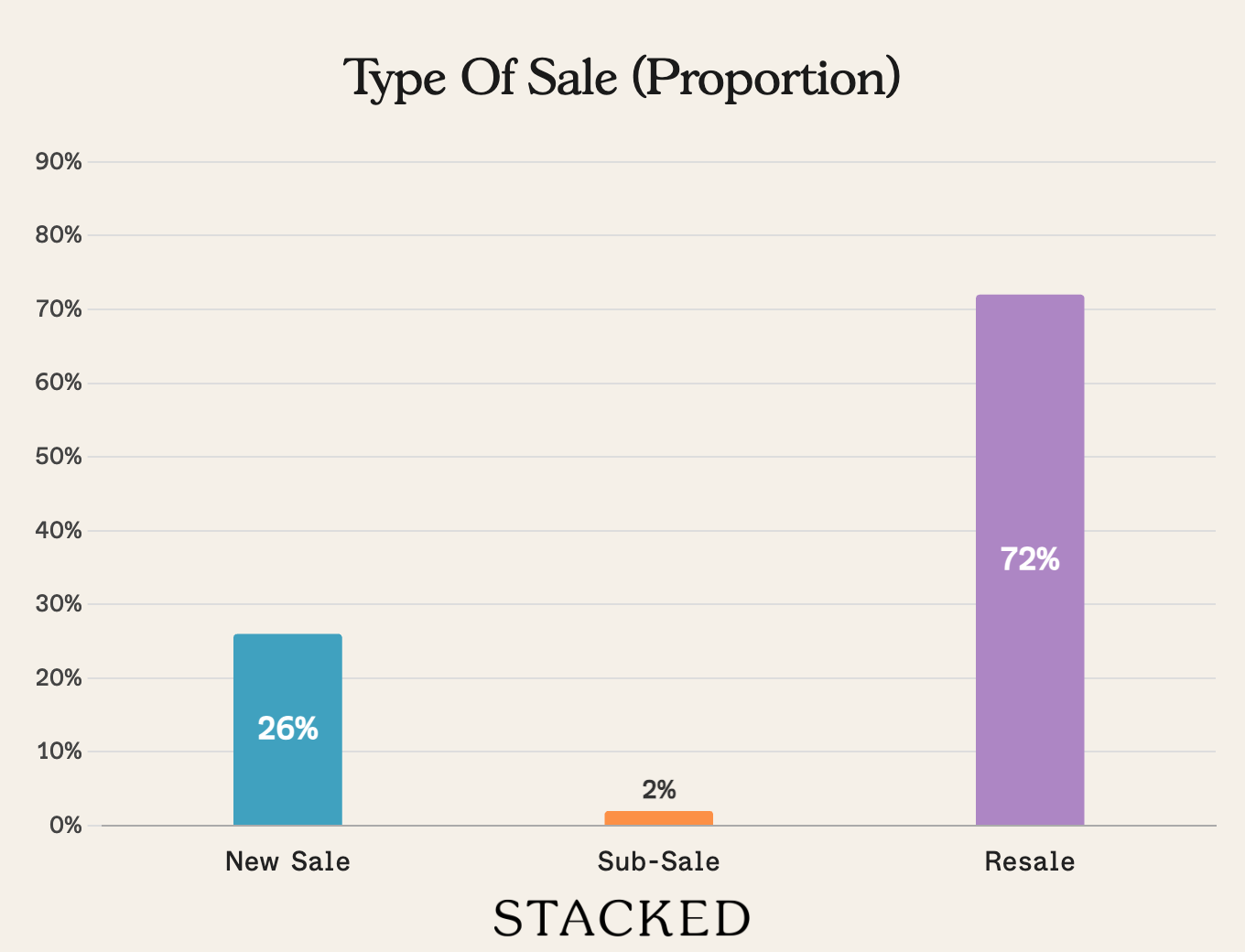
Transaction Breakdown
Follow us on Stacked for more news and updates on the Singapore property market.




0 Comments