


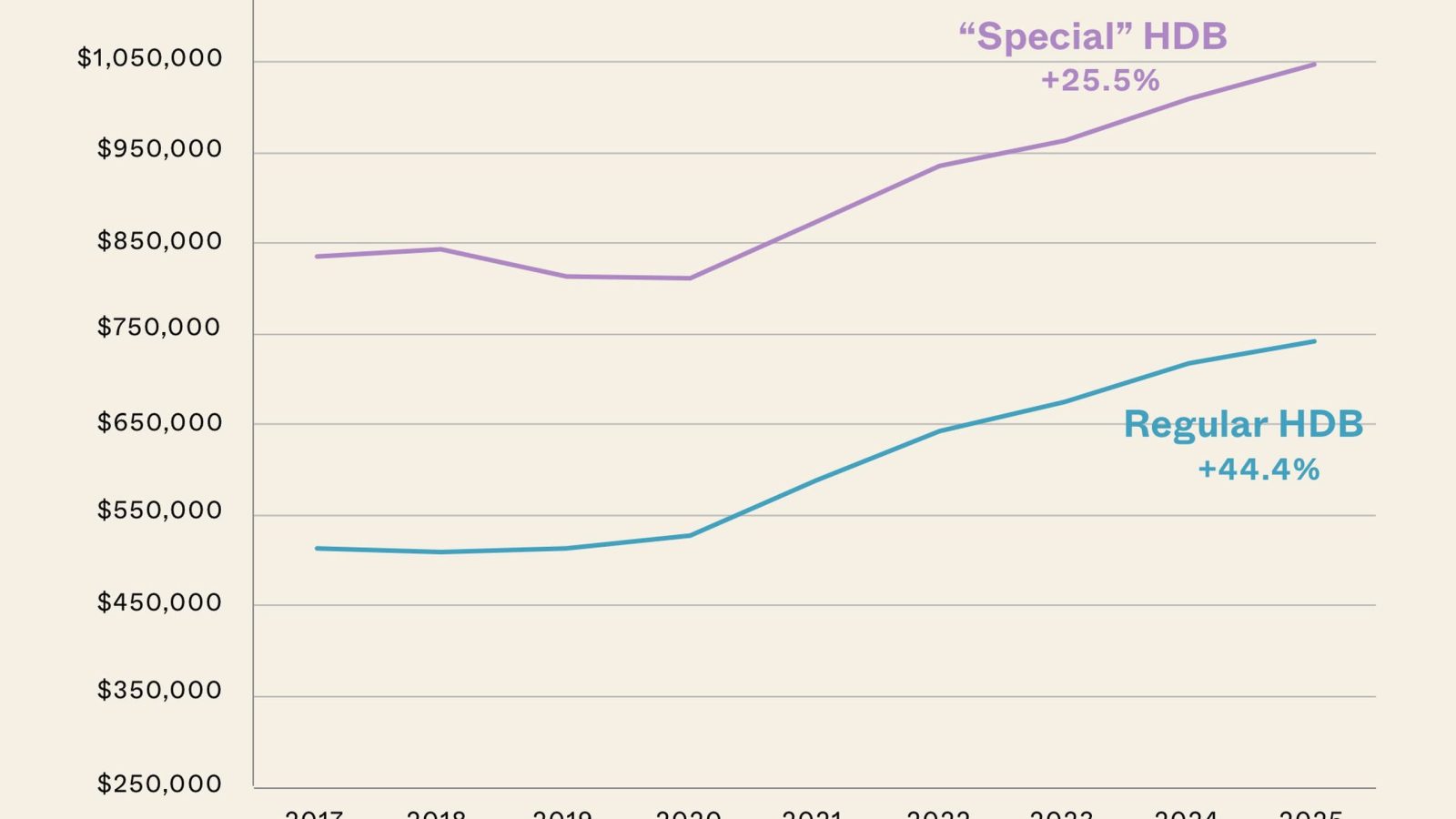
From a new record of $1.73 million for a 5-room flat to a 3-room flat hitting $900,000, the affordability of our resale HDB flats has come into question yet again. As part of the argument, we hear claims that most million-dollar (or $1.5 million+) flats are not "normal" flats. Some readers have also suggested that, if we leave out special flats like DBSS, jumbo flats, maisonettes, etc., the real price growth wouldn't be as high as it seems. For this reason, we decided to take a look at the price growth of HDB flats, both with and without the rare special units:
A quick note on what we mean by "normal" flats:
Our definition of "normal" is flats that do not mean the following criteria:
- 3Gen and Multigenerational
- Adjoined/Jumbo flats
- DBSS
- Any maisonette
- Flats at Pinnacle@Duxton
In addition, we've removed HDB terraced houses from consideration entirely, as these are not typical HDB flats but landed homes. Including them would also distort results, because HDB classifies them as 3-room.
Let's start with an overall picture of price increases in the resale flat market
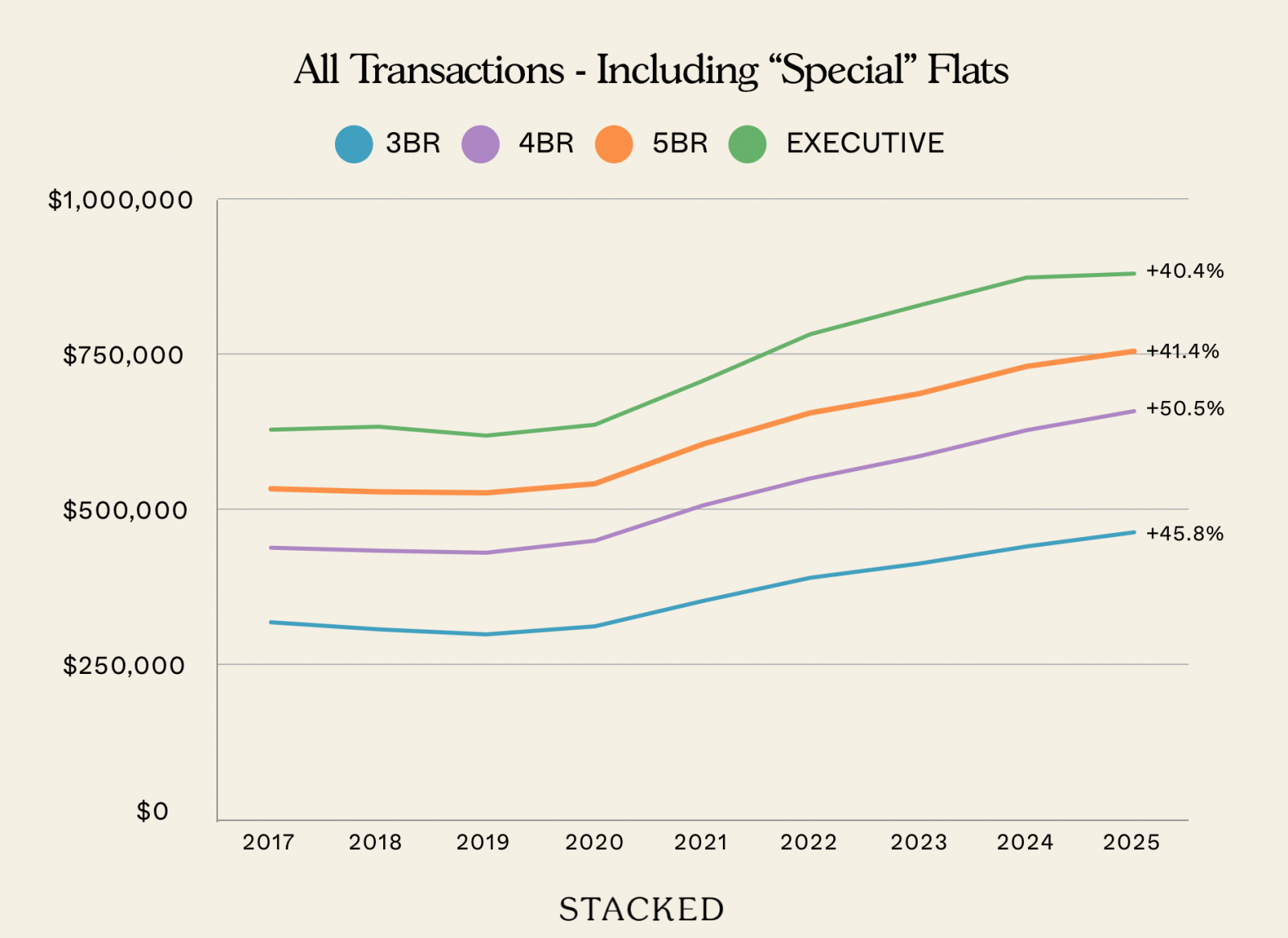
The following shows how much HDB flat prices have risen as a whole, inclusive of all flat types:
| Year | 3 ROOM | 4 ROOM | 5 ROOM | EXECUTIVE |
| 2017 | $316,668 | $437,120 | $532,277 | $627,211 |
| 2018 | $305,331 | $431,753 | $527,635 | $630,780 |
| 2019 | $298,230 | $429,749 | $526,812 | $617,561 |
| 2020 | $311,381 | $448,608 | $541,457 | $635,395 |
| 2021 | $351,378 | $505,095 | $603,990 | $705,559 |
| 2022 | $388,116 | $549,088 | $654,253 | $782,007 |
| 2023 | $411,263 | $584,050 | $685,310 | $829,310 |
| 2024 | $438,732 | $627,383 | $728,632 | $874,651 |
| 2025 | $461,844 | $658,042 | $752,641 | $880,793 |
| Change | 45.8% | 50.5% | 41.4% | 40.4% |
If we make no distinction between the types of resale flats, we can see prices are generally up by 40 to 50 per cent over nine years.
An interesting point of note: prices fell between 2017 and 2019, with the sharpest drop in 3-room flats (down about 5.8 per cent during that period.) This was a continued decline from way back in 2013, when the introduction of the Mortgage Servicing Ratio (MSR), and HDB ceasing to publish Cash Over Valuation (COV) data, caused flat prices to fall.
Prices started to see a sharp rebound after Covid. Between 2020 and 2021, we can see flat prices rising again. Ignoring the distinction between flat types, we can see that 4-room HDB flats had the most growth (50.5 per cent), while Executive flats saw the highest absolute price increase (an increase of $253,582 from 2017 to 2025). While it may not be the highest percentage-wise, an increase of over a quarter-million dollars will certainly hurt, for buyers eyeing an Executive flat.
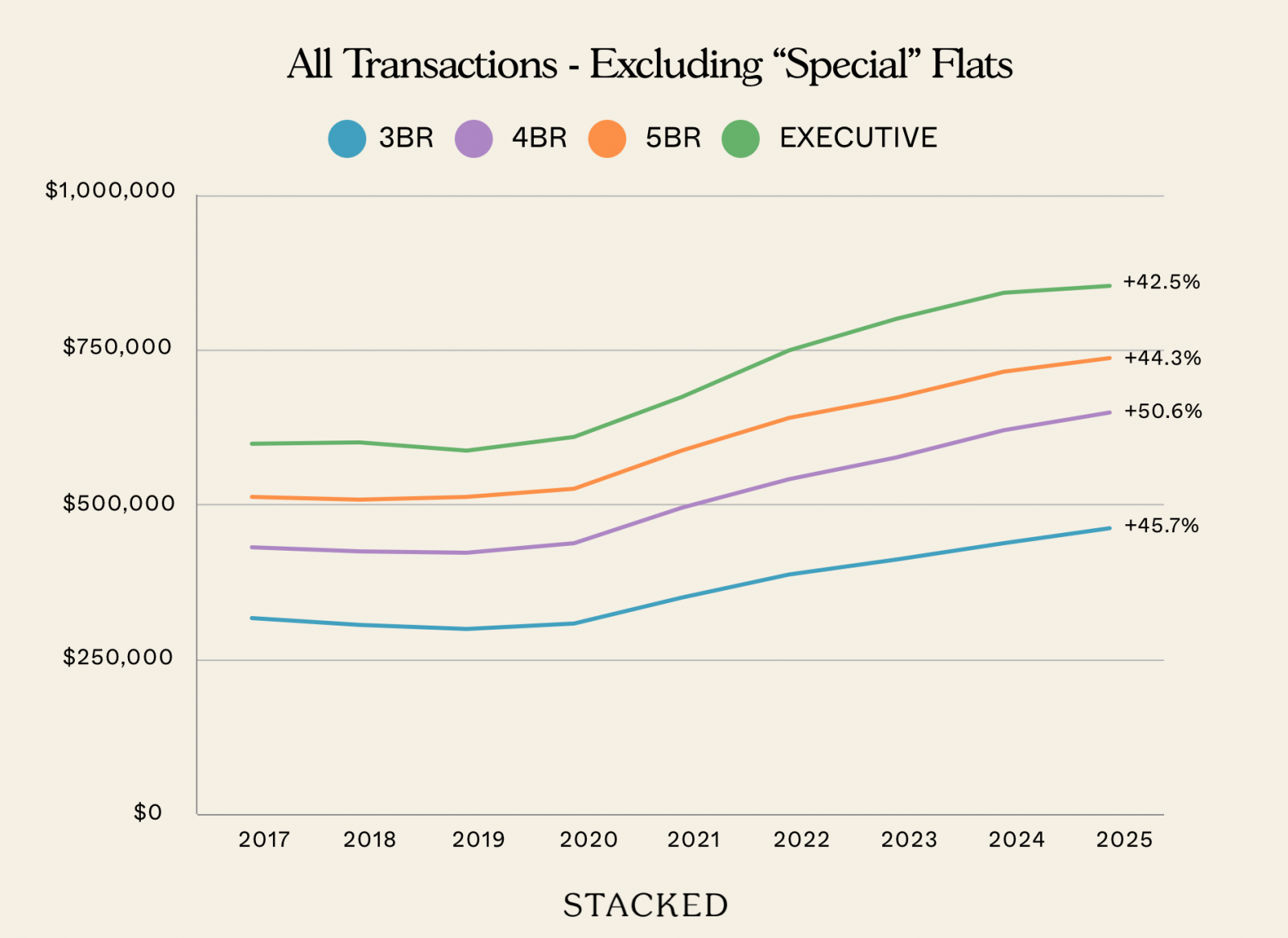
Now let's see the difference if we exclude "special" flats:
| Year | 3 ROOM | 4 ROOM | 5 ROOM | EXECUTIVE |
| 2017 | $315,856 | $432,209 | $513,228 | $598,065 |
| 2018 | $304,678 | $425,844 | $509,639 | $600,946 |
| 2019 | $297,227 | $423,807 | $514,426 | $586,445 |
| 2020 | $307,631 | $439,859 | $527,229 | $608,669 |
| 2021 | $348,576 | $495,715 | $588,479 | $674,012 |
| 2022 | $386,466 | $543,809 | $642,771 | $747,853 |
| 2023 | $409,849 | $578,922 | $674,729 | $798,608 |
| 2024 | $437,925 | $622,741 | $717,010 | $841,328 |
| 2025 | $460,289 | $650,784 | $740,574 | $851,988 |
| Change | 45.7% | 50.6% | 44.3% | 42.5% |
Honestly, the difference is not great; and this throws into question the theory that special flats are responsible for the price growth.
When we remove all the special flats, the rate of appreciation actually increases by a small amount.
3-room and 4-room HDB flats showed almost no difference in price growth, when special flats were removed (an irrelevant 0.1 percentage point). For 3-room flats, the small difference can be chalked up to fewer special flats affecting this category. There are 3-room DBSS flats, but no maisonettes, 3Gen flats, etc.
(Interestingly, we've seen a tiny number of adjoined flats that get shuffled into the 3-room category, but these are rare.)
Conversely, for 5-room and executive flats, the disparity is likely due to more special flats falling into these size categories.
4-room flats though, are the most ubiquitous form of housing; and if the price growth hasn't budged even after removing the special flats, it becomes harder to blame rising prices on DBSS or other special units.
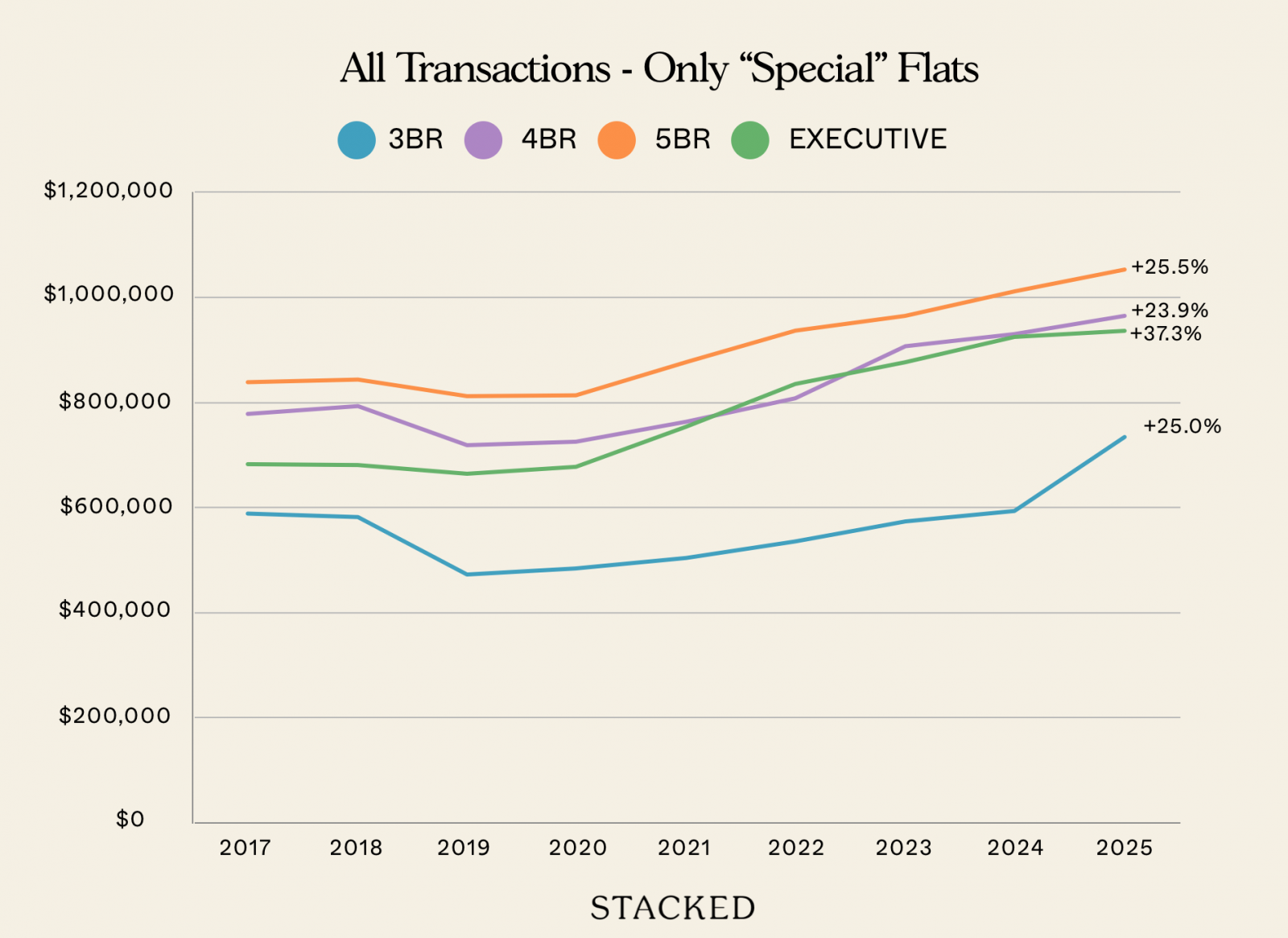
What about the appreciation of only special flats?
| Year | 3 ROOM | 4 ROOM | 5 ROOM | EXECUTIVE |
| 2017 | $588,318 | $778,563 | $837,318 | $680,961 |
| 2018 | $582,333 | $793,358 | $843,225 | $680,448 |
| 2019 | $472,222 | $718,603 | $810,529 | $662,593 |
| 2020 | $484,295 | $725,018 | $811,985 | $676,365 |
| 2021 | $503,523 | $762,536 | $875,322 | $752,498 |
| 2022 | $535,533 | $807,970 | $934,740 | $833,809 |
| 2023 | $573,065 | $907,920 | $963,625 | $876,294 |
| 2024 | $594,336 | $930,391 | $1,009,693 | $924,376 |
| 2025 | $735,444 | $964,421 | $1,050,607 | $934,947 |
| Change | 25.0% | 23.9% | 25.5% | 37.3% |
Across the board, special flats show slower price growth than their regular counterparts.
They all have higher average prices than regular flats, particularly the 3-room flats; this would be on account of their unique traits like larger sizes, unique layouts, etc. The high base price of the special 3-room flats in particular surprised us: in the year 2017, a special 3-room flat ($588,318) could have bought you a regular 5-room flat ($513,228).
This higher base price may account for the much slower pace of growth: normal 4-room flats, for instance, appreciate at more than twice the pace of their standard counterparts.
This may be worth thinking about, for buyers with an eye toward upgrading.
In conclusion, special flats may have an impressive quantum; but it's hard to blame them for rising prices in the wider market
Normal flats didn't need any help from special counterparts, to see significant price gains since 2017. Special flats have made for more attention-grabbing headlines due to higher absolute prices; but they actually appreciate slower than regular HDB flats.
We also wouldn't be surprised if the slower appreciation of special flats becomes more visible over time. This is due to the advanced lease decay for some of these flat types. Maisonettes, for example, were no longer built after 1995. Likewise, jumbo flats were mainly the result of numerous vacancies in the '90s, which led to some flats being merged to form bigger units. This is unlikely today*, when we need more flats than ever.
*Well, you can ask HDB for permission to merge two flats, but we wouldn't get our hopes up.
Also, buyers of these older flats tend to be those less concerned with lease length. They are, for instance, retirees right-sizing from a private property. As the pool of such buyers is limited, it can further constrain price growth.
The other implication here is that we need to pay more attention to normal flats. We should worry less about a DBSS flat reaching $1.6 million, and a lot more about normal 4-room flats creeping to an average of over $960,000. The latter has a much bigger impact on the majority of Singaporeans, even if the quantum seems less impressive.
We can only hope that increased supply in the resale market (which is a bit tight right now) slows the momentum going forward.

2 Comments
There’s an error near the end of the article. “…normal 4-room flats creeping to an average of over $960,000.”
I think you mean over $650,000, right?
Thanks so much for this. I have been saying same thing. Dont look at Milliom dollor flats. Rather see Even in Punggol 3rm Reaching to 500K. Which is major concern.