


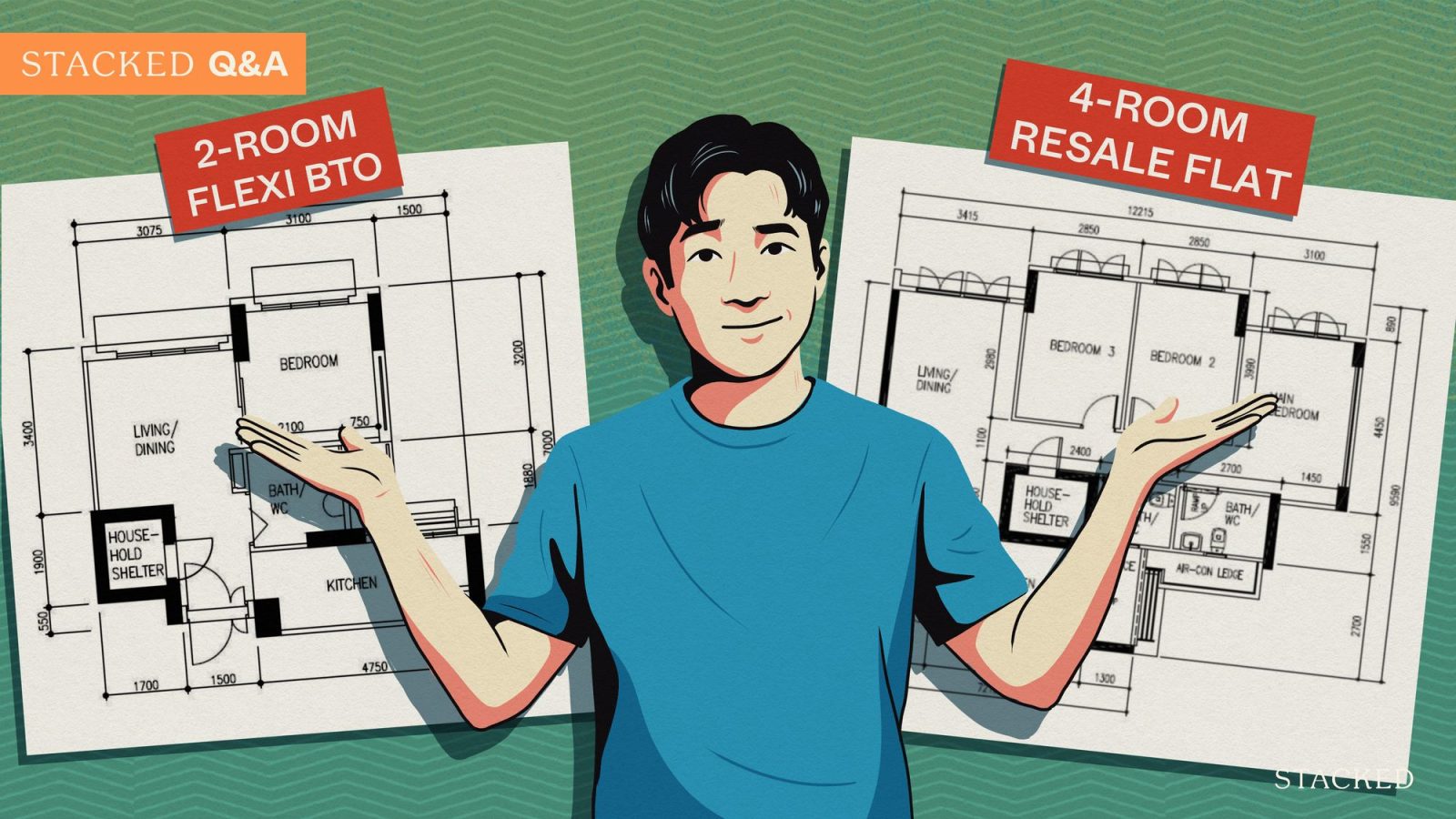
Hi Stacked,
I am single and will be turning 35 years old next year. I am weighing two housing options and would appreciate your advice.
The first option is a 2-room Flexi BTO flat. I would be able to pay for it in full without a loan, while still keeping around $50,000 in cash savings. I plan to live there until it completes its MOP, then sell it to buy a four-room resale flat where I'd live and rent out the other bedrooms to earn rental income.
The second option would be to purchase a four-room resale flat of about $500,000 or more, in areas like Hougang, Sengkang, or Ubi. I would look for flats with a remaining lease of around 55 to 60 years. But this would require a loan of about $150,000 over 10 years. I plan to renovate that flat into a dual-key layout, living on one side while renting the other to help offset the monthly repayments.
I'm not sure if it's better to buy the BTO flat first and enjoy several debt-free years before upgrading after MOP, or buy the four-room resale and start earning rental income sooner, despite the $150,000 loan.
Thank you!
(This is part of an ongoing series where we answer reader questions about the property market. If you have one of your own, send it to stories@stackedhomes.com)
(This is part of an ongoing series where we answer reader questions about the property market. If you have one of your own, send it to stories@stackedhomes.com.)
Hi, and thanks for writing in!
Based on what you've shared, it sounds like you're comparing two routes to the same destination: a resale four-room flat with part of it rented out.
However, you haven't named a specific Build-To-Order (BTO) project, and its classification - Standard, Plus, or Prime - may significantly affect your proposed timeline. A Standard flat has a Minimum Occupation Period (MOP) of five years, while a Plus or Prime flat has an MOP of 10 years.
For example, if you collect the keys to your BTO flat when you are 39 years old - assuming that you successfully ballot for this two-room flexi flat on your first try - you'd only be able to upgrade when you are about 44 years old for a Standard flat.
However, if this was a Plus or Prime flat, that timeline stretches for a few more years and will see you eligible to upgrade when you are around 49 years old.
There's another detail in what you've shared that we think is worth flagging before we go further. This is the planned dual-key layout that you have in mind. Prevailing HDB regulations allow you to rent out spare bedrooms while you continue living in the flat, subject to approval, and you would not need to wait for the resale flat's MOP to do this.
But it is not clear whether HDB's rules on flat renovations would allow a true dual-key partition, with two independently accessed units in the same way that some private condos have.
We recommend checking this with HDB directly before you commence your renovations. But you can still count on the standard room-rental route, where you occupy the flat and lease out a room. But take note that the two-room flexi flat would not offer the same option since the room-rental eligibility requires a three-room flat or larger.
This means that if you picked a resale four-room flat, it could start earning rent for you as soon as you move in and find a tenant. But the BTO flat would have you wait until after the MOP, sell the flat, and then buy the next property before you start earning rental income.
With that context out of the way, we'll compare both options, starting with what you could purchase based on your budget.
What can you actually buy that is within your budget?
To examine the four-room resale option, we analysed resale HDB transactions that were recorded from the start of 2025 to June 2026 in Hougang and Sengkang.
We also considered sales in Geylang as the closest available proxy for Ubi since it falls under that planning area. But the resale figures for Geylang are not representative of the housing market in Ubi specifically.
Average resale price of four-room flats (2025 to Jun 2026)
| Lease start year | Remaining lease in 2026 (years) | GEYLANG | HOUGANG | SENGKANG |
| 1967 | 40 | $639,000 | ||
| 1971 | 44 | $455,000 | ||
| 1975 | 48 | $477,097 | $448,600 | |
| 1976 | 49 | $622,689 | ||
| 1977 | 50 | $608,000 | ||
| 1978 | 51 | $592,320 | $502,989 | |
| 1980 | 53 | $539,176 | ||
| 1981 | 54 | $660,273 | $549,155 | |
| 1982 | 55 | $630,000 | $577,500 | |
| 1983 | 56 | $747,861 | $584,328 | |
| 1984 | 57 | $808,241 | $593,245 | |
| 1985 | 58 | $590,364 | $568,552 | |
| 1986 | 59 | $565,169 | $556,528 | |
| 1987 | 60 | $582,975 | ||
| 1988 | 61 | $568,889 | ||
| 1989 | 62 | $640,000 | $645,923 | |
| 1990 | 63 | $659,200 | $645,063 | |
| 1991 | 64 | $612,148 | ||
| 1992 | 65 | $820,888 | $654,725 | |
| 1993 | 66 | $556,127 | ||
| 1996 | 69 | $832,296 | ||
| 1997 | 70 | $810,341 | $640,172 | |
| 1998 | 71 | $911,923 | $600,306 | $612,861 |
| 1999 | 72 | $615,844 | $596,899 | |
| 2000 | 73 | $835,989 | $683,500 | $583,556 |
| 2001 | 74 | $585,698 | ||
| 2002 | 75 | $569,316 | ||
| 2003 | 76 | $570,391 | $572,053 | |
| 2004 | 77 | $564,468 | $594,493 | |
| 2005 | 78 | $939,750 | $579,641 |
Based on the transaction data compiled by Stacked, and accounting for your preference for flats with 55 to 60 years left on their lease, we found that most resale flats in Hougang fetched an average price range of $557,000 to $593,000. This should be comfortably within your stated budget.
There are more affordable options that fetch less than $550,000, but those flats have relatively shorter remaining leases of 48 to 54 years left on their tenure - several years short of the lease length you're after.
On the other hand, flats in Sengkang can offer a longer lease for a similar price if you're willing to look further afield. Flats there which have remaining leases of 72 to 78 years often change hands in the range of $569,000 to $597,000.
However, since these are the average prices across the town, it is likely that a specific block, a unit's floor, indoor condition, and exact remaining lease may influence the price differently.
In general, the two-room flexi option costs far less upfront cash.
Prices of recent two-room BTO launches
| Launch date | Town/ classification | Selling price (excluding grants) |
| Standard Projects | ||
| June 2026 | Sembawang | From $139,000 |
| June 2026 | Sembawang | From $137,000 |
| Feb 2026 | Sembawang | From $150,000 |
| Plus Projects | ||
| June 2026 | Ang Mo Kio | From $191,000 |
| Feb 2026 | Tampines | From $197,000 |
| Feb 2026 | Toa Payoh | From $203,000 |
| Prime Projects | ||
| June 2026 | Bishan | From $216,000 |
| June 2026 | Bukit Merah | From $247,000 |
| Feb 2026 | Bukit Merah | From $215,000 |
In general, a Standard BTO project tends to have the most affordable price and the shortest MOP. Thus, Standard flats usually make the most sense for securing a lower outlay and a faster path to upgrading.
But that five-year clock only starts once your flat is built and the keys are collected, so the total waiting time that you might be looking at - accounting for the ballot process, construction and MOP - will still set you back roughly 10 years.
This is a much longer time compared to simply moving into a resale flat, which you could move into within months and start to find tenants. Whichever option you decide on, renovation, furnishing and purchase costs should come out of the $50,000 cash savings you mentioned.
How manageable is the resale loan?
Using your estimated $150,000 loan over 10 years, we worked the numbers at 2.6% interest, the current HDB concessionary rate.
| 2-room BTO | 4-room resale | |
| Housing loan | None, based on your estimate | $150,000 |
| Loan tenure | Not applicable | 10 years |
| Monthly repayment | $0 | Approximately $1,421 based on 2.6% interest |
| Total interest over loan tenure | $0 | Approximately $20,506 |
The BTO's advantage is the lower fixed monthly outlay, which leaves more room in your budget to save or invest while you wait out the MOP.
Borrowing lets you move into a home without funding the full price upfront, and part of every repayment builds equity. Of the $1,421 you'd pay monthly, only the interest portion, averaging roughly $171 a month over the 10 years, is money you don't get back in the flat.
Buyer's stamp duty (BSD) also applies to both routes, but they show up as very different amounts. The resale flat comes to about $9,600 to $11,100 for a $500,000 to $550,000 purchase, against $1,370 to $3,140 across the BTO launches in our earlier table.
You may also qualify for a CPF housing grant on a resale purchase, depending on your income and whether you're a first-time buyer, though we can't size that without knowing your eligibility. Either way, work BSD and any renovation into your calculations before assuming the full $150,000 loan covers everything beyond the purchase price.
The bank package you actually get would also depend on your eligibility and the loan size, and some packages currently undercut the 2.6% HDB rate we've used here. An initial low rate shouldn't be assumed to hold for the full 10 years, so it's worth stress-testing your budget against a higher rate before committing.
How much of the mortgage could rental income cover?
Based on property listings for flats in Hougang, Sengkang, and Ubi, it seems like the common rental rate is about $800 to $1,200 a month for a bedroom. If we're generous and take the low end of that rental range, here's what renting out one room looks like against renting out both while you keep the master bedroom.
| Renting one bedroom | Renting two bedrooms | |
| Monthly gross rent at full occupancy | $800 | $1,600 |
| Monthly mortgage repayment | $1,421 | $1,421 |
| Monthly balance before rental expenses | -$621 | $179 |
| Annual rent with one vacant month per room | $8,800 | $17,600 |
| Equivalent average monthly rent | $733 | $1,467 |
| Average monthly balance after vacancy, before rental expenses | -$688 | $46 |
If you were to rent out one room, this could cover more than half the repayment at full occupancy, and still leave the second room free for your own use.
Although renting out both rooms could cover the monthly instalment in full, the marginal gain of $179 is thin and a single vacant month per room each year shrinks it to an average of $46 before any expenses.
Likewise, utilities, maintenance, agent fees, and property tax would all come out of that margin, and the $800 figure reflects the aspirational rent that most landlords are asking.
In short, rental income mostly offsets your mortgage with a little left over as surplus, and we wouldn't let that marginal prospect tip this decision on its own.
Would a BTO first route put you in a stronger position to upgrade later?
The appeal of the BTO route is building funds for your eventual upgrade, through savings and a resale gain. To analyse this, we looked at two-room flats that were completed in 2019 or 2020, and compared their original launch price against their subsequent resale value.
Average resale price of two-room flats completed in 2019/2020 (2025 to June 2026)
| HDB town | Starting 2-room BTO prices in 2015/2016 | Average resale price |
| BUKIT BATOK | ~$80,000 | $378,213 |
| SEMBAWANG | ~$74,000 | $380,228 |
| SENGKANG | ~$81,000 | $391,495 |
In general, the price gap between the starting BTO price and the average resale price is about $298,000 to $310,000. But this isn't the net profit, since the starting figures are launch prices and the resale figures are averages across different units and years. It also fails to account for grants, renovation costs, or transaction expenses.
Even accounting for all of that, the trend seems to suggest that a subsidised first home can substantially fund a subsequent purchase, on top of whatever you save after paying out your mortgage.
Your target flat could also cost more by the time you're ready to buy it. Four-room resale flats with leases starting between 1987 and 1997 have seen a steady price increase, from an average of $402,319 in 2016 to $604,882 in the first half of 2026.
Average resale price of four-room flats with lease start year between 1987 and 1997
| Year | Average resale price |
| 2016 | $402,319 |
| 2017 | $400,929 |
| 2018 | $391,631 |
| 2019 | $388,873 |
| 2020 | $400,450 |
| 2021 | $455,162 |
| 2022 | $494,876 |
| 2023 | $527,888 |
| 2024 | $569,914 |
| 2025 | $605,139 |
| 2026 (Up to June) | $604,882 |
| % change from 2016 to 2026 | 50.35% |
Based on the data that we have compiled, it shows that average resale prices rose by about $203,000 (50.35%) over the past 10 years. But the price increase has not been consistent. Prices dipped to $388,873 in 2019, but significantly recovered after the end of the COVID-19 pandemic.
We do not assume that the trajectory of price growth in the HDB resale market will continue. But the data suggests that while the value of the two-room flat increases while you wait out the MOP, so too will the price of the planned four-room flat that you intend to purchase.
So, what should you do?
According to what you have shared with us, we'd lean toward the BTO route - but not by a wide margin.
The advantage of this choice lies in the years waiting for it to clear its MOP: no mortgage, more room to save, and a potential resale gain that could be sizeable given recent transaction history.
As we pointed out at the start of this article, both options end at the same kind of purchase: a four-room flat you live in and partly rent out. The BTO choice really only changes the financial position you'd be in by the time you get there.
But this means that you could buy a younger flat on a much longer lease compared to what you could afford today, largely funded by savings from those mortgage-free years plus an eventual resale gain. Just remember that as the lease shortens, younger buyers face tighter CPF usage and HDB loan limits, which narrows the pool of potential buyers.
On the other hand, the resale option has its strengths too: namely, that you'd move into the larger home sooner, start collecting rent immediately, and skip a second round of agent fees and renovation costs down the line.
But our analysis suggests that rental income mostly offsets the mortgage, leaving as little as $46 a month once vacancies are priced in with both rooms rented out. We wouldn't let that income be the deciding factor.
If you don't need the extra space urgently, a Standard BTO you'd be comfortable staying in beyond its MOP gives you the most room to reassess your financial and housing position. And you'll be able to access the resale market and your own finances when you're actually ready to act on them.

0 Comments