


Hotel transaction volumes in Asia Pacific have reached new highs this year, with investment sales volume in the sector reaching US$12.0 billion ($15.4 billion) from January to September 2026. This is the highest 9M sales volume that the sector has recorded since 2019, according to a market report by JLL.
The total investment figure in the first nine months of this year is 50% more than the same period last year, and JLL projects that the sector is likely to end this year with a total transaction volume of US$15.0 billion ($19.2 billion), which would surpass the US$13.3 billion ($17 billion) forecast from the start of the year.
"The Asia Pacific hotel investment market has clearly entered a new phase of maturity and conviction," says Nihat Ercan, the Asia Pacific CEO of JLL Hotels & Hospitality Group. "Investors stayed in the market in 2026, and this is reinforced by the current sales volumes, which in the first three quarters of 2026 reached US$12.0 billion," he says.
He adds that the surge in Asia Pacific hotel deals this year is driven by strong hospitality market fundamentals, with revenue per available room (RevPAR) in the region growing 5% y-o-y, partly supported by growing average daily room rates.
Favourable credit markets are also helping, as they provide property investors with deep liquidity and competitive financing, and provide them with favourable conditions for deal execution.
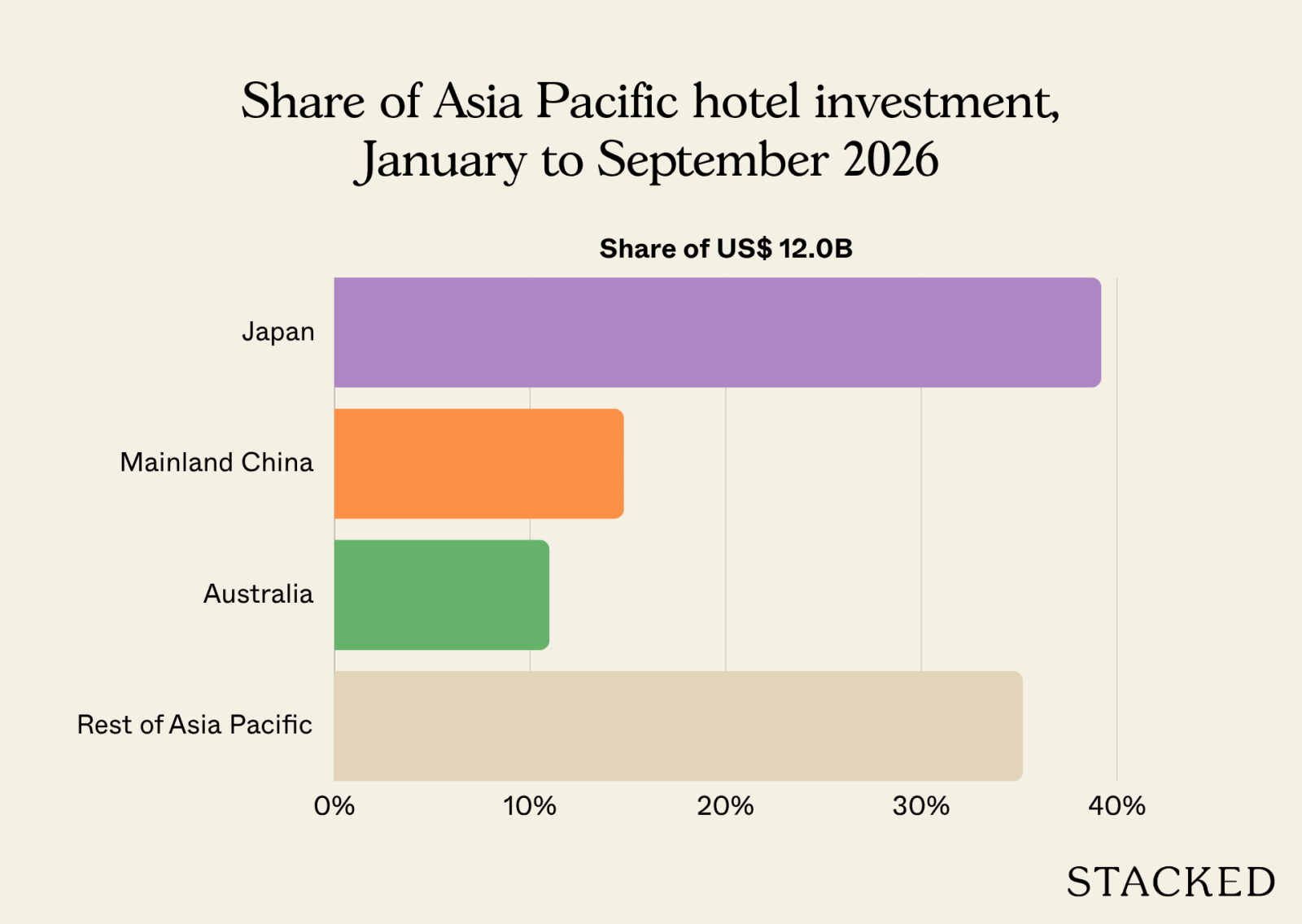
This year, Japan, consistently the region's largest hotel investment market, led with a 39% market cap, followed by mainland China and Australia.
Singapore recorded its highest transaction volume this year since 2019, at US$860 million ($1.1 billion) in the period from January to September. This year, foreign capital made up 54% of that investment volume, twice its share in 2025.
Amid the uncertain global environment this year, investors favoured traditional hotels and hospitality properties at the very top end of the market, according to JLL.
But 58% of investors also expect hotel values to soften. Now, investors are looking for deals where they can add value themselves, says Ercan. These include hotels in regional cities, older properties to refurbish, and properties to convert into co-living or rental housing.
Japan Stays in the Lead
Japan led the Asia Pacific in terms of absolute hotel investment volume this year, at US$4.7 billion ($6 billion), or 39% of the total in this region. Mainland China followed at 15%, and Australia at 11%.
According to JLL, Japan's hotel market is mature and well-established, with deep domestic capital, strong foreign interest and a limited supply of high-quality hotel properties.
Cheap financing also adds to Japan's appeal, as the country still has some of the lowest borrowing costs in the region, although they have risen in recent years. These favourable rates make debt accretive for strong, income-producing assets and reduce the risk of developing and piloting new hospitality concepts.
Beyond major hubs like Tokyo and Osaka, investment capital is also increasingly flowing into secondary cities, including Fukuoka, Sapporo, and Nagoya.
Three Deals Made Up the Bulk of Singapore's Hotel Investment This Year
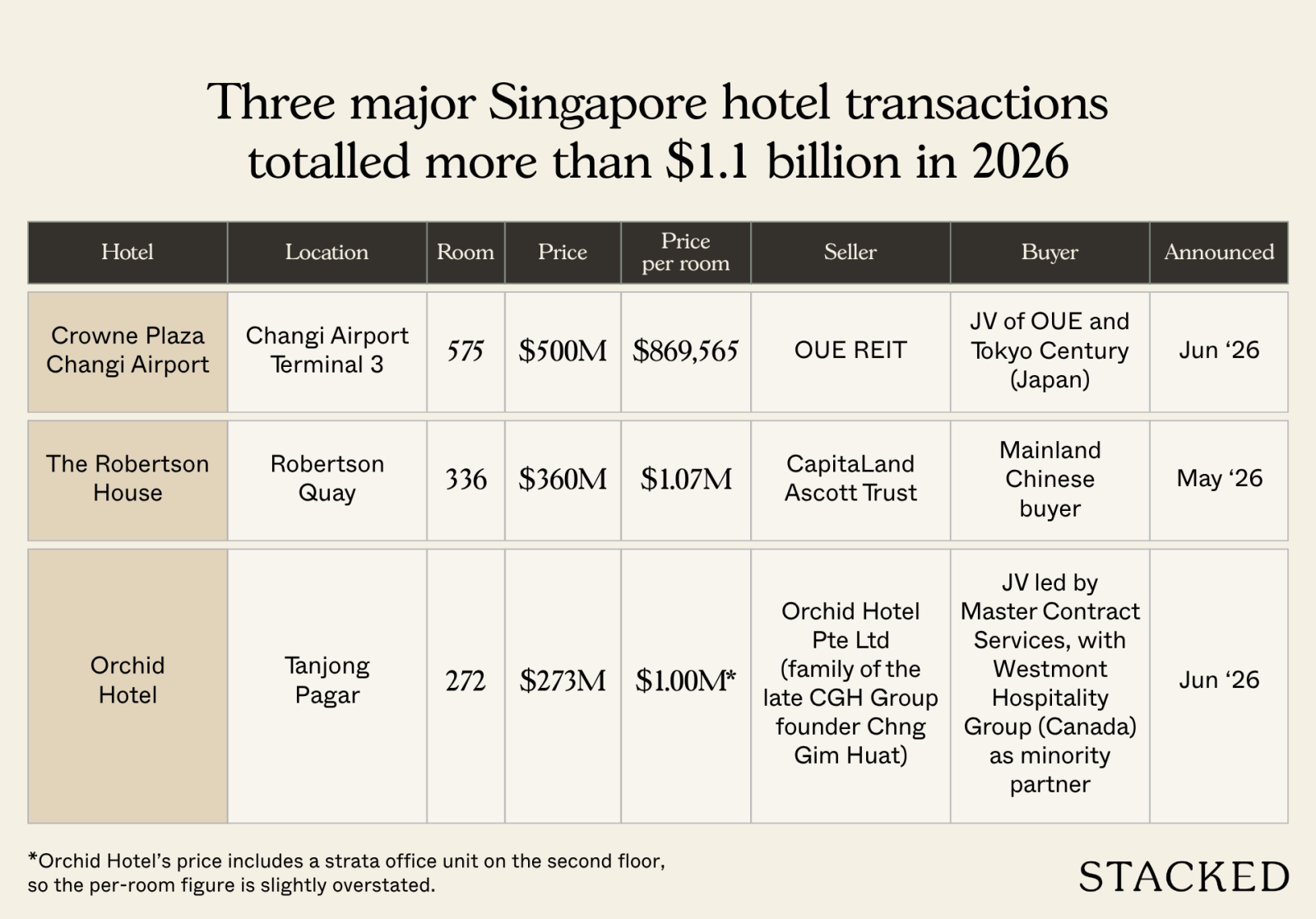
In Singapore, investment sales volume this year was driven by just a handful of big-ticket transactions. According to JLL, three major deals made up the bulk of the $1.1 billion in hotel transactions so far.
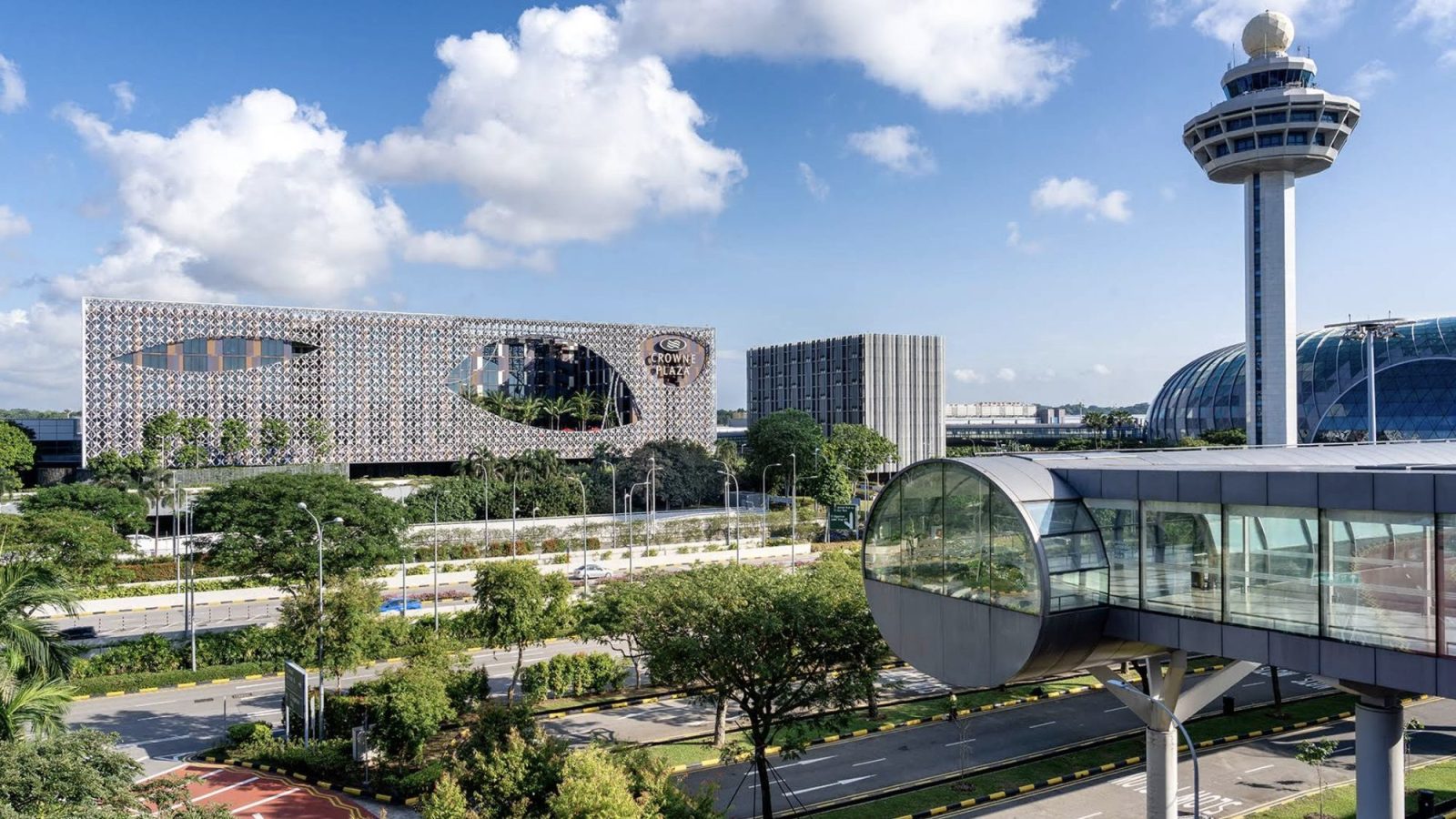
The largest deal this year was OUE REIT's sale of Crowne Plaza Changi Airport for S$500 million. The 575-room hotel is directly linked to Changi Airport Terminal 3 and Jewel Changi Airport. The buyer is a joint venture between OUE REIT's sponsor, OUE, and Japanese financial services firm Tokyo Century Corporation.
In May, CapitaLand Ascott Trust agreed to sell The Robertson House, a 336-room luxury riverfront hotel in Robertson Quay, to a mainland Chinese buyer for S$360 million.
The third was Orchid Hotel, a 272-room, 20-storey property near Tanjong Pagar MRT. Its original developer sold it for S$273 million to a joint venture led by Singapore construction firm Master Contract Services.
JLL says Singapore's investment volume in the hotel sector from January to September has already surpassed the full-year total for 2025. The firm projects the figure this year will reach about US$1.3 billion ($1.7 billion) by the end of 2026.
These deals reflect motives on both sides - buyers and sellers. The sellers are participating in a wider wave of capital recycling this year, as REITs and owners sell assets to pay down debt or reinvest. Buyers were drawn to Singapore's safe-haven reputation and low local interest rates.
But hotel performance has been relatively flat in the last two years. In 2025, Singapore hotels’ RevPAR slipped 0.4% from 2024, due to a 1% drop in average room rates, according to the Singapore Tourism Board (STB).
Visitor numbers have also softened. The first eight months of 2026 saw 11.43 million international visitors come to Singapore, down 1.7% y-o-y compared to the same period in 2025, according to STB data.
Nonetheless, JLL maintains that Singapore's hotel market fundamentals remain strong, backed by limited supply, robust demand, and its safe-haven status.
JLL noted that investor interest in Singapore is currently strongest for well-located assets with repositioning potential, co-living conversion opportunities, and leasehold properties offering attractive yield spreads. Notably, foreign buyers doubled their share of Singapore hotel deals this year compared to last, with overseas capital making up 54% of total hotel investment.
JLL noted that smaller hotel assets in Singapore were more difficult to sell this year, primarily due to the gap between buyer and seller pricing expectations. Owners of highly sought-after assets held firm on pricing, while yield-sensitive buyers remain disciplined.
"Broader deal flow will depend on sellers showing greater pricing flexibility," said Tan Ling Wei, executive vice president of investment sales at JLL Hotels & Hospitality Group Singapore.
More Deals in the Pipeline for 2027
JLL projects that Asia Pacific hotel transaction volumes will dip to about US$13.7 billion ($17.5 billion) in 2027, below the US$15.0 billion it forecasts for this year. But the firm says investors' confidence in the region continues to firm up, with more deals already in the pipeline, despite growing macroeconomic uncertainty.
JLL's survey of 120 owners and investors showed the most interest in Japan, South Korea, Australia, Singapore, and India for the year ahead. Most respondents, at 88%, said they will continue to favour high-income-producing assets, such as traditional hotels and upper-upscale properties.
JLL flagged several risks ahead, including geopolitical tensions remaining high and interest rates volatile across the region. Borrowing costs rose for 63% of investors this year, which squeezed their returns.
The persistent bid-ask spread, or the gap between buyers' and sellers' expectations, remained unchanged this year from last year, at 6%. If the gap doesn't narrow, the firm said, deals are likely to take longer to close.
JLL still sees the hospitality market in this region as fundamentally strong, citing limited new hotel supply, resilient tourism in the region, and plenty of capital waiting to be deployed. Those should be enough to buffer against forthcoming headwinds, supporting transaction momentum into 2027.



0 Comments