


I’m sure most of you would know the drill by now when it comes to general new launch pricing.
Small units equals higher PSF, big units equals lower PSF.
In the past few years where there has been added emphasis on smaller units to cater to investors and the like, it certainly makes a lot of sense (for the developers, that is).
Smaller units are usually easier to move because of the lower quantum, so despite the higher PSF, these would still sell out the fastest.
And even though from a profit maximising perspective it would be ideal for the developers to charge a higher PSF for the bigger units, in this way they are still able to obtain a good average PSF for the development overall.
Let me show you some examples from a number of notable launches from the past few years.
| Development | Alex Residences | Principal Garden | D'Nest | Clement Canopy | Panorama | Commonwealth Towers |
| 1 Bedroom | $1,857 | $1,704 | $1,139 | - | $1,389 | $1,775 |
| 2 Bedroom | $1,917 | $1,659 | $974 | $1,436 | $1,243 | $1,649 |
| 3 Bedroom | $1,733 | $1,688 | $939 | $1,380 | $1,234 | $1,620 |
| 4 Bedroom | - | $1,603 | $963 | $1,284 | $1,225 | $1,607 |
*I excluded penthouse units and some bigger than normal dual key units to make it more accurate
**These were based on new launch prices only
From here, it’s quite clear that the selling $PSF for smaller units are higher than the bigger units.
So this could have possibly contributed to the bigger profits for larger unit types bought in recent years.
Because in the past if you were to buy a brand new 2 bedroom at The Panorama for example, the price you would pay would be about $1,250 PSF.
As compared to a 5 bedroom unit, you would be looking at prices hovering around the $1,100 mark instead.
But look what happens once units reach the resale market - the resale prices for the smaller units and bigger ones end up at almost around the same $1,400 to $1,500 range.
| Date | Size | $PSF Price | Price |
| 6 Nov 2020 | 1,335 | $1,409 | $1,880,000 |
| 5 Nov 2020 | 700 | $1,479 | $1,035,000 |
| 26 Oct 2020 | 452 | $1,526 | $690,000 |
| 19 Oct 2020 | 1,066 | $1,501 | $1,600,000 |
| 29 Sep 2020 | 474 | $1,446 | $685,000 |
| 28 Sep 2020 | 1,001 | $1,536 | $1,538,000 |
| 28 Sep 2020 | 452 | $1,548 | $700,000 |
| 1 Sep 2020 | 1,012 | $1,443 | $1,460,000 |
Which is exactly why those who have bought bigger units in these developments have actually made more overall.
To further illustrate, I have compiled the figures among the same few developments.
I broke down between small units (1 and 2 bedrooms), and bigger units (3 bedrooms and up).
Next, I calculated the profit margin of each transaction based on the initial selling prices.
| Development | No of Tnx | Small Units Profit Margin | No of Tnx | Big Units Profit Margin |
| Alex Residences | 46 | 15.60% | 2 | 13.40% |
| Principal Garden | 10 | 12.50% | 5 | 17.20% |
| D'Nest | 79 | 11.50% | 85 | 12.50% |
| Clement Canopy | 1 | 17.80% | 5 | 17.70% |
| Panorama | 38 | 14.90% | 25 | 20.40% |
| Commonwealth Towers | 46 | 15.60% | 2 | 13.40% |
You might notice that Clement Canopy and Commonwealth Towers go against the grain of the rest, but I would say that because of the relative lack of transactions either for the smaller or bigger units that these would not be as accurate to look at.
Either ways, you can see that the bigger units have been the almost unanimous winners.
So call it a coincidence, but there has been a recent trend of bigger units in new launches being priced very similar PSF wise to the smaller units in the development.
(To be honest, you could also say that the smaller units are being priced more in-line with the bigger units)
So you could say that it’s down to developers capitalising on the work from home trend.
Or you could also chalk it down to the fact that people are starting to realise the importance of space in their homes and hence, they place a higher priority for bigger homes as well.
Or you could also argue that the developers see that larger units will have a higher demand in their respective locations.
Nevertheless, the proof is in the pudding with the new launch prices.
Take Clavon for instance - this is a quick snapshot of the starting launch prices.
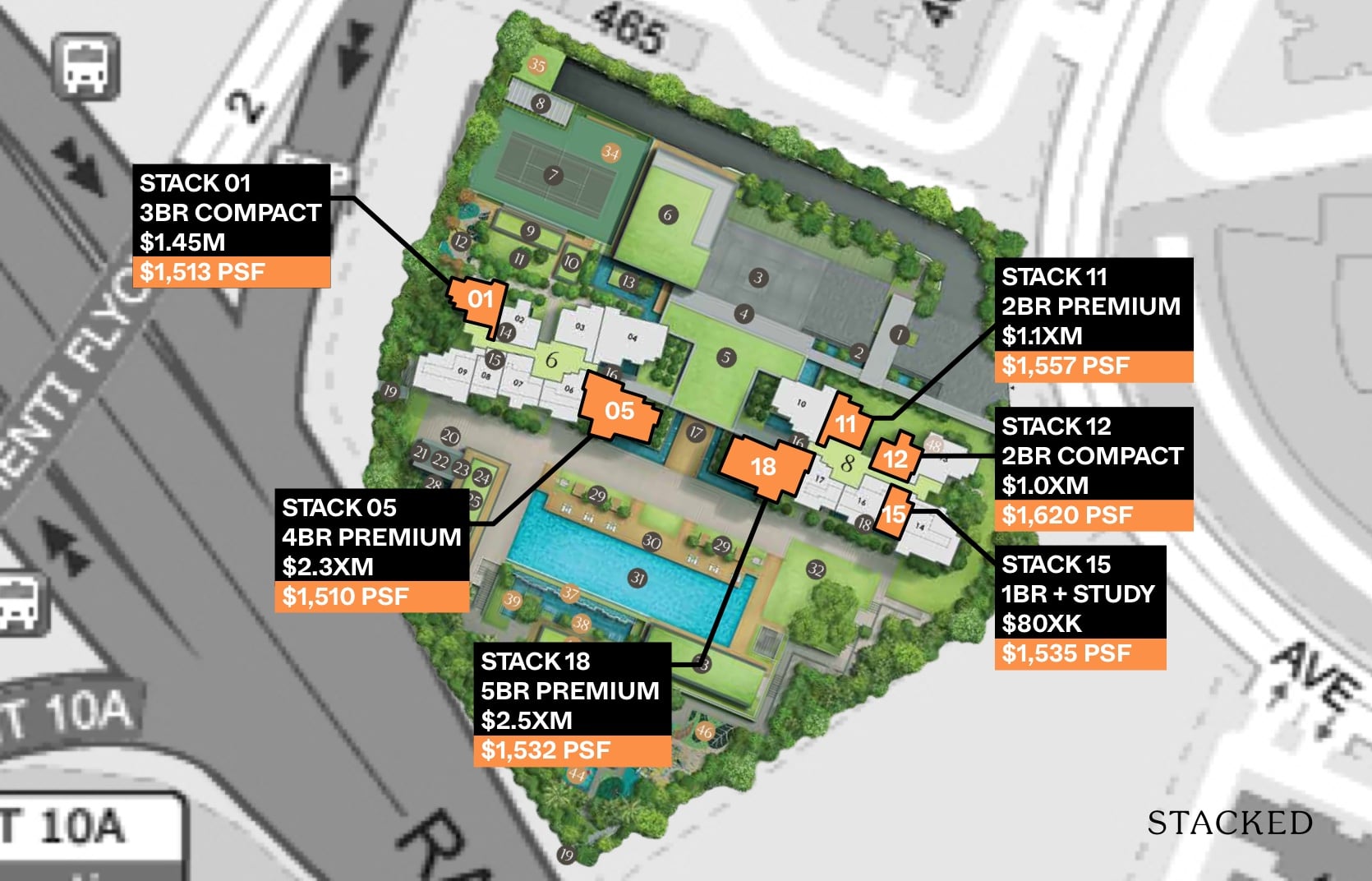
You will notice that the PSF launch prices between all the bedroom types have very similar $PSF.
Same goes for the recently launched Ki Residences, where the average selling PSF for the smallest units (2 bedrooms) had all sold at $1,759 PSF.
Again, this is in contrast to the 3 bedroom units and above at $1,785 PSF. (for all transactions sold on launch)
So here's the important questions that we need to ask ourselves.
Number 1: Will resale change too and follow suit?
Number 2: Will this remain? Or do you think once a development reaches TOP the smaller units will again return to being the higher priced PSF?
I would love to hear your opinions on this. Please feel free to leave a comment below or reach out to me at ryan@stackedhomes.com!



4 Comments
Thank you Ryan for your usual insightful article. This trend is probably because the larger units are not so large anymore compared to older developments.
amazing analysis!