






















This contributed article is written by Sebastian Sieber, founder of Cashew, a Singapore-based digital mortgage platform.
If you took out a private home loan in early 2025, it’s more than likely that you would be paying an interest rate of around 3% or more given Singapore’s interest rate environment a year ago.
But today, the best fixed rate packages are hovering closer to 1.3%.
This kind of shift in the interest rate environment doesn’t happen often, and the fall in benchmark interest rates is happening faster in Singapore compared to the United States, where rates have taken relatively longer to come down.
This raises the question of whether there’s more room for local interest rates to fall, or whether the easy gains are behind us.
What happened in 2025 and what’s changed this year
In Singapore, the three-month (3M) compounded Singapore Overnight Rate Average (SORA) – the benchmark behind most floating-rate home loans – dropped from 3.02% in March 2025 to 1.19% by January 2026.
This represents a 61% decline in less than 12 months. So, why did it fall so fast?
In the years leading up to 2025, Singapore Dollar interest rates ran well ahead of US Dollar rates, driven by strong capital inflows into the city-state and a persistently strong local currency.
This wasn’t simply a case of Singapore riding along on a global easing cycle. Instead, we saw that most of the significant factors that contributed to the decline in interest rates was homegrown, and that’s worth keeping in mind.
But since January, the interest rate environment has shifted. Between January 2 and March 12, the 3M SORA has barely moved, going from 1.18% to 1.09% over this period.
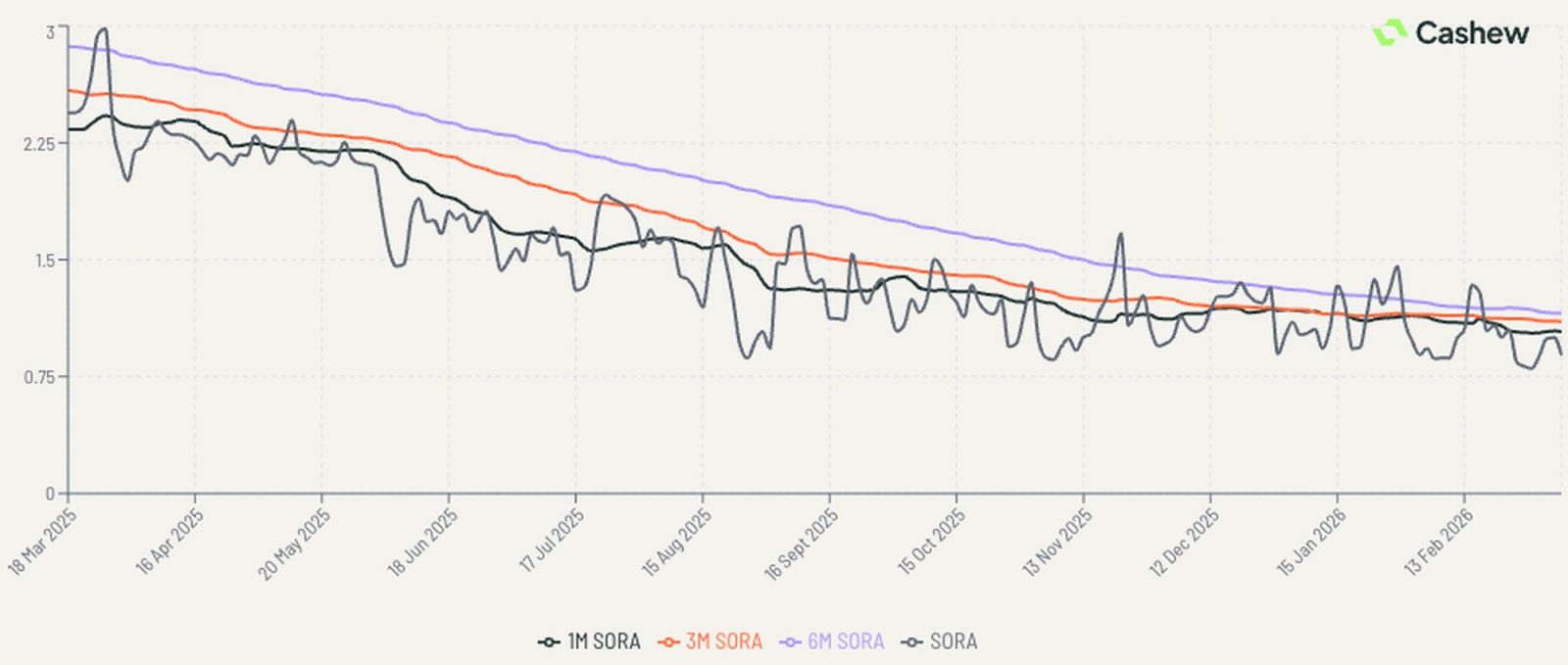
The steep part of the descent appears to be over and local mortgage rates have tracked this closely.
Based on data compiled by Cashew, the best two-year fixed packages currently sit about 0.2 to 0.3 percentage points above the 3M SORA, and three-year fixed rates carry a spread of roughly 0.3 to 0.4 percentage points.
One caveat worth flagging: those headline rates typically assume a larger loan quantum. If you’re refinancing a $500,000 mortgage or less, expect the rate you’re offered to be somewhat higher.
Could rates still fall?
Our opinion is that they might, but probably not by much. There is a case that the SORA could drift a little lower if capital continues to flow into Singapore and the Monetary Authority of Singapore (MAS) maintains its current stance.
But the macro picture is getting more complicated, not less. Geopolitical tensions, particularly in the Middle East, are putting upward pressure on energy prices, which feeds through to inflation.
If inflation turns out to be stickier than markets currently expect, there’s less room for rates to come down. And the favourable SGD-specific conditions that drove last year’s decline can shift just as quickly as they appeared.
Our view is that the bulk of the rate drop is behind us. Whether there’s a bit more to squeeze out or whether rates start to drift back up is anyone’s guess. But either way, the difference between where we are now and where we might end up is small compared to the gap between current market rates and what many homeowners are still paying.
We talk to homeowners every week who are still sitting on mortgage rates of either 2.5% or 2.8%, and in some instances upwards of 3%. On a $600,000 loan, the difference between 2.5% and 1.6% works out to roughly $450 a month, or about $5,400 a year. So, if you’re paying 2.5% or more on your home loan, the cost of doing nothing is real.
You can wait for rates to inch down a little further, but in the meantime, there’s a high chance you might be paying a lot more compared to what’s available in the market.
Four things to sort out before you refinance
- Stop trying to time the bottom. This is the most common mistake we see. People hear rates are falling and decide to hold out a little longer, just in case. Meanwhile they’re paying 2.8% on a loan they could refinance at 1.6%.
- Compare across banks, not just your existing one. When a lock-in period ends, most homeowners either accept whatever repriced rate their bank gives them, or they call their relationship manager and take whatever “special rate” gets put on the table. The problem is your bank already has your loan. They’re not fighting to win your business.
The sharpest rates are reserved for new customers that banks are trying to poach from competitors. A proper comparison across all major banks, not just the two you have accounts with, can save you 20 to 30 basis points. On a larger loan, that’s thousands of dollars over a lock-in period.
- Check whether your lock-in has already expired. This is one of the most common blind spots we come across. Plenty of homeowners don’t realise their lock-in ended months ago, sometimes over a year ago. When it expires, your bank quietly reprices your loan to a less competitive rate. There’s no penalty for switching anymore, but you’re still paying the higher rate simply because you haven’t looked. Pull up your latest mortgage statement. It takes five minutes.
- Understand what refinancing actually costs. It’s probably less than you think. Between legal fees, valuation fees, and administrative costs, refinancing typically runs most homeowners about $2,000 to $3,000. But for loans of $250,000 or more, the bank you’re switching to will in most cases fully cover these charges through legal and valuation subsidies.
In some cases, borrowers can even pocket cash from refinancing rebates on top of the subsidies. Even without any of that, on a $600,000 loan where you’re saving $450 a month, you’d break even within a few months. After that, everything is upside.
What’s available right now
We’ve shortlisted the most competitive packages on the market, broken down by property type and loan size. The best deal for someone refinancing a $300,000 HDB loan isn’t the same as the best deal for someone with a $4 million mortgage on a landed property. Rates, lock-in terms, and subsidies all vary depending on the quantum.
HDB Refinancing
| Best Packages for HDB Refinancing | |||
| Mortgage Rates | $300K Loan Size | $600K Loan Size | $1M Loan Size |
| 2-year fixed | 1.45% | 1.40% | 1.38% |
| 3-year fixed | 1.60% | 1.55% | 1.50% |
| 5-year fixed | 1.78% | 1.78% | 1.78% |
| Floating | 3M SORA + 0.35% | 3M SORA + 0.15% | 3M SORA + 0.15% |
Private Property (Condo and Landed)
| Best Packages for Private Property Purchase (Condo & Landed) | |||
| Mortgage Rates | $800K Loan Size | $1.5M Loan Size | $3M Loan Size |
| 2-year fixed | 1.38% | 1.35% | 1.30% |
| 3-year fixed | 1.50% | 1.40% | 1.40% |
| Floating | 3M SORA + 0.18% | 3M SORA + 0.15% | 3M SORA + 0.15% |
These packages are current as of [xx] March 2026. Rates change frequently, and what’s on the table today may not be there next month.
Mortgage rates in Singapore are about as low as they’ve been in years. There may be a little more room to fall, but the pace of the decline has slowed dramatically and the risks, geopolitical and inflationary, tilt towards rates staying where they are or drifting back up.
If you’re on a rate above 2% the gap between what you’re paying and what you could be paying is costing you every month.
At Stacked, we like to look beyond the headlines and surface-level numbers, and focus on how things play out in the real world.
If you’d like to discuss how this applies to your own circumstances, you can reach out for a one-to-one consultation here.
And if you simply have a question or want to share a thought, feel free to write to us at stories@stackedhomes.com — we read every message.
Frequently asked questions
How much has Singapore mortgage interest rates dropped in the past year?
What factors contributed to the decline in Singapore interest rates in 2025?
Are Singapore mortgage rates likely to fall further?
What should homeowners consider before refinancing their mortgage?
What are some current competitive mortgage packages in Singapore?



0 Comments