














Living in a condo is an aspiration for many people in Singapore. But sometimes, you can be too caught up with the actual price of it – and forget about the costs that you’ll have to pay each month as well.
One of which is the monthly maintenance fee.
Most condo owners fork out about $300 to $400 a month, but this amount can easily be in the thousands for higher-end projects. This isn’t just a pain for homeowners; it eats into a landlord’s net rental yield. Even worse, maintenance fees can be unpredictable – in some projects, the monthly fees may even increase in the future.
And these costs can really add up. For example, at a $400 maintenance fee, this would total up to $96,000 over a period of 20 years. That’s a nice chunk of change.
As such, if monthly costs are something that is on your mind, here are some ways you can spot developments that may have lower fees:
Table Of Contents
- 1. Look for projects with a higher unit count
- 2. Mixed-use developments may have lower maintenance fees, for the residential component
- 3. Go for condos with smaller car parks
- 4. Look for pure apartments only
- 5. Look for condos where the unit size falls just under the next share value category
- 6. Examine the nature of the facilities
- 7. Condos built around 2019 or later may be more cost-effective, in terms of maintenance
A shortlist filtered by price, size or tenure is a useful way to narrow your options, but it won't tell you which property is the best fit for your finances, lifestyle or long-term plans.
That's where the real evaluation begins: comparing the trade-offs between each option to decide which one makes the most sense for your situation.
Over time, that's also why we decided to work with agents who shared the same data-driven and advisory-led approach behind our editorial, consultants who could help readers think through decisions more objectively, rather than simply push transactions.
Today, the team has worked with more than 2,000 clients across over $5B in property transactions.
1. Look for projects with a higher unit count
The bigger the project, the lower the maintenance cost tends to be. This is due to the sheer volume of homes sharing the cost. The most apt example of this would be mega-developments, where there are at least 1,000+ units.
Treasure at Tampines, currently the biggest condo project in Singapore at 2,203 units, has some of the lowest maintenance costs we’ve seen to date. The smallest units (one-bedders) have fees of about $150 to $165 per month, whilst the larger five-bedders are still as low as $240 to $264.
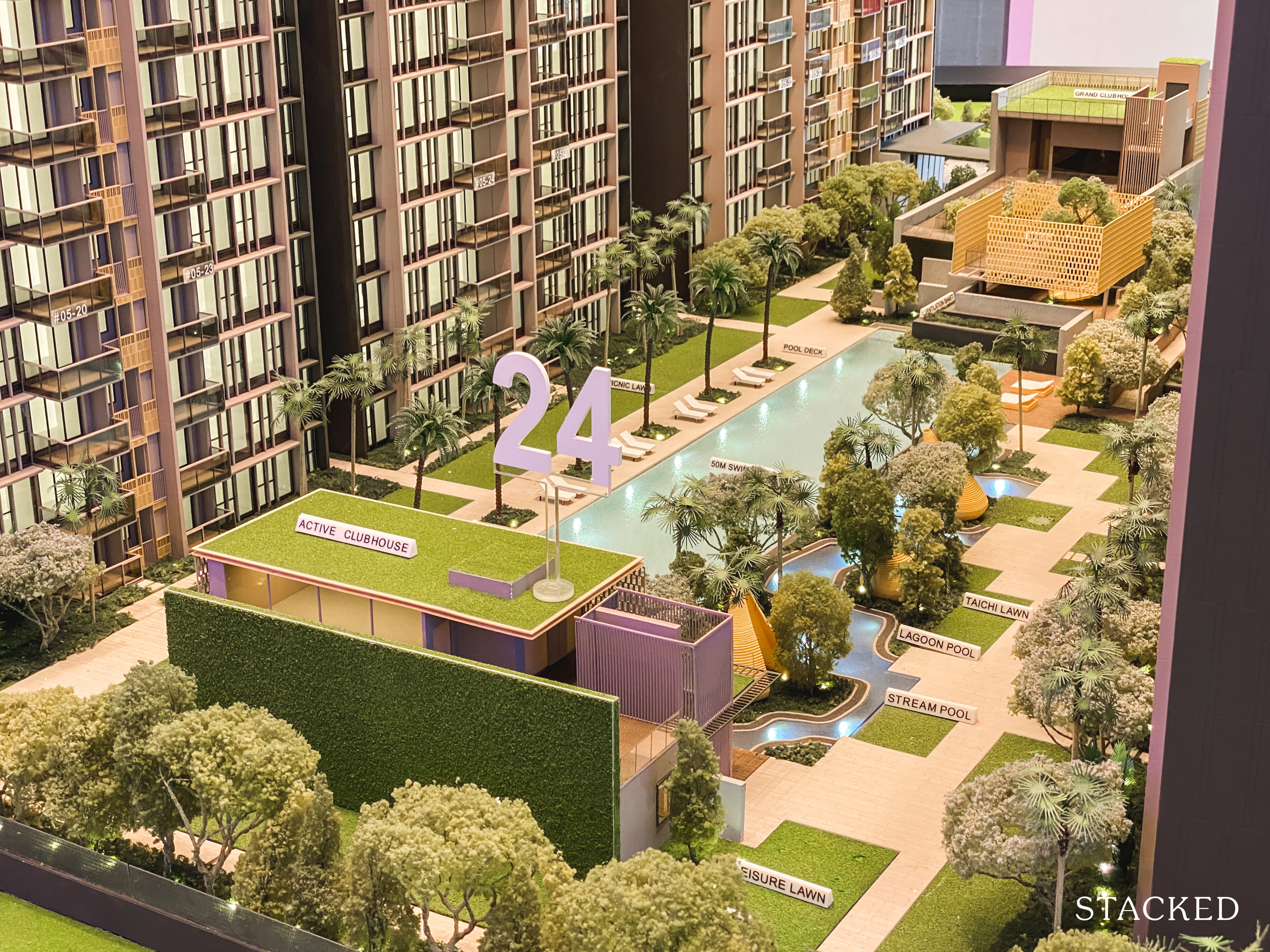
Compare this to a typical mid-sized development like Penrose, with 566 units. The units of 560 to 1,066 sq. ft. have maintenance fees of around $331 per month, with larger units reaching about $387 per month.
For smaller projects of 100 to 200 units, this can be even higher. For example, at the 134 unit Robin Residences, a 2 bedroom unit can have a monthly maintenance fee of more than $400.
Mind you, we’re not saying it’s always true that bigger developments will have lower maintenance costs; a lot depends on the nature of the facilities. But in general, having more homes to bear the costs should keep the fees lower.
This also means that, if you intend to buy a boutique condo (e.g., 50 units or less), the price of exclusivity will almost always include higher maintenance fees.
2. Mixed-use developments may have lower maintenance fees, for the residential component
In point 1, we said smaller developments may have higher costs. So Midtown Bay may come as a surprise: despite being small at just 160 units, maintenance fees for its three-bedders can be at around $500, which is decent considering the number of units.
The reason is likely due to the project’s commercial component: Midtown also includes office space, eateries, and shops – and it’s possible for the commercial side to bear more of the maintenance than the residential units. Typically, city centre condos today also don’t usually come with a car park lot – you’d have to factor in additional costs if you drive (see the next point).
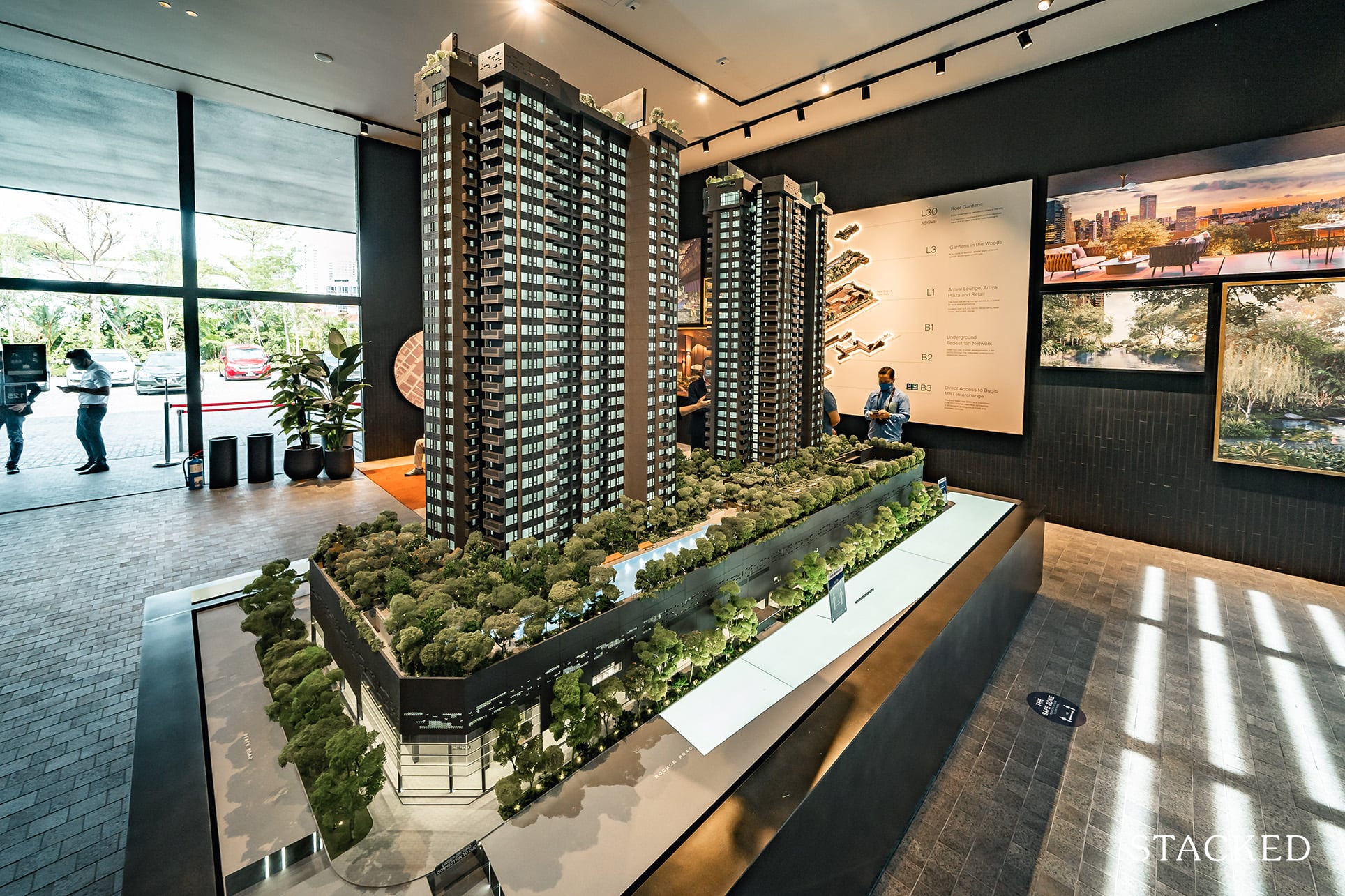
That said, this is far from universal. The sister development of Midtown Bay, Midtown Modern, is also mixed-use; but even its one-bedders have fees of around $327, while its four bedders go up to around $436.
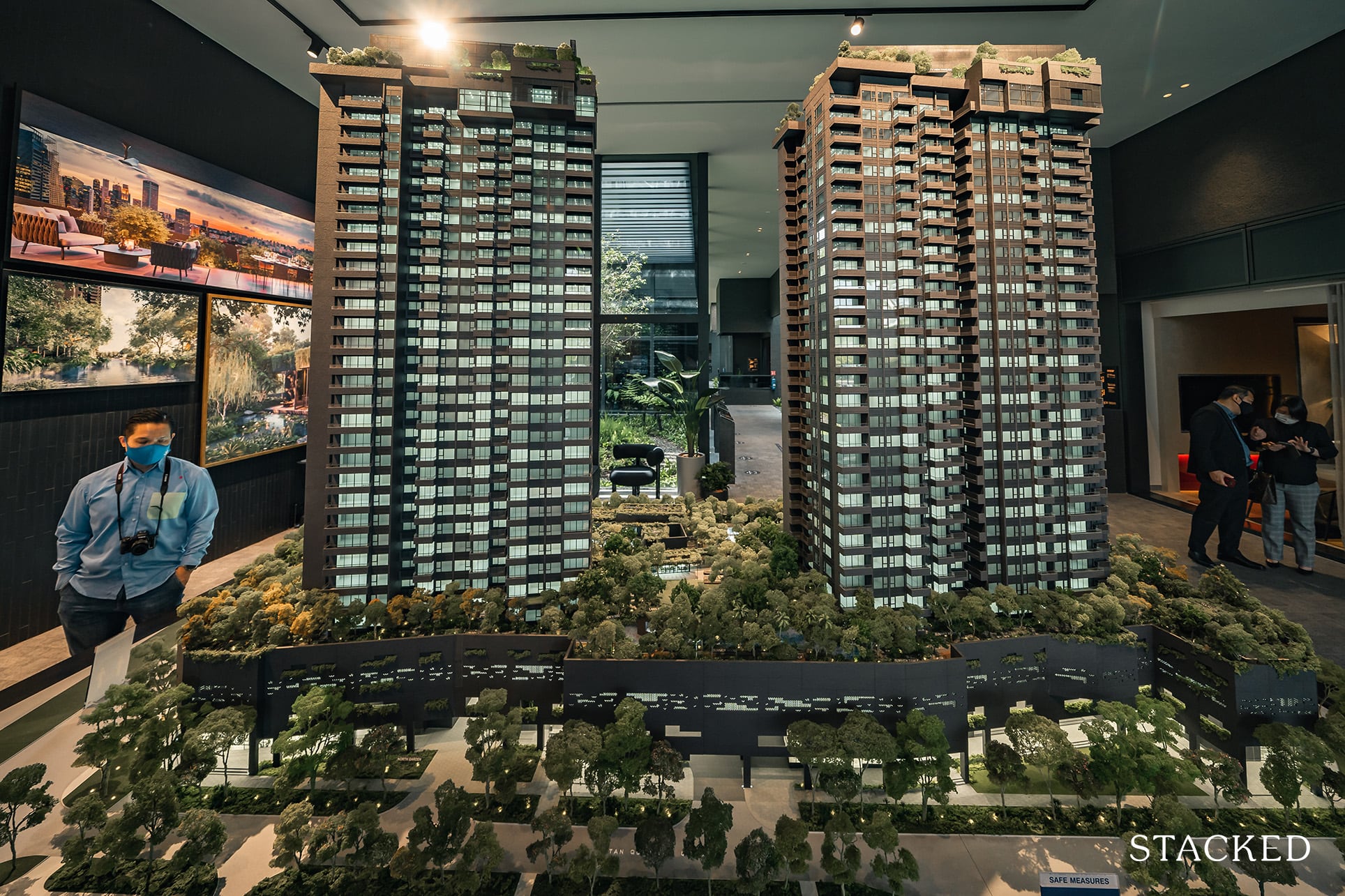
It’s worth querying, for mixed-use developments, if the commercial component will be shouldering most of the cost.
3. Go for condos with smaller car parks
Marina One Residences has surprisingly low maintenance fees, for a prime location condo. Its three-bedder units have fees of about $372 per month, while smaller units at around $324. This would be considered average for most mass-market condos; but unusually affordable for a District 1, CBD-area project.
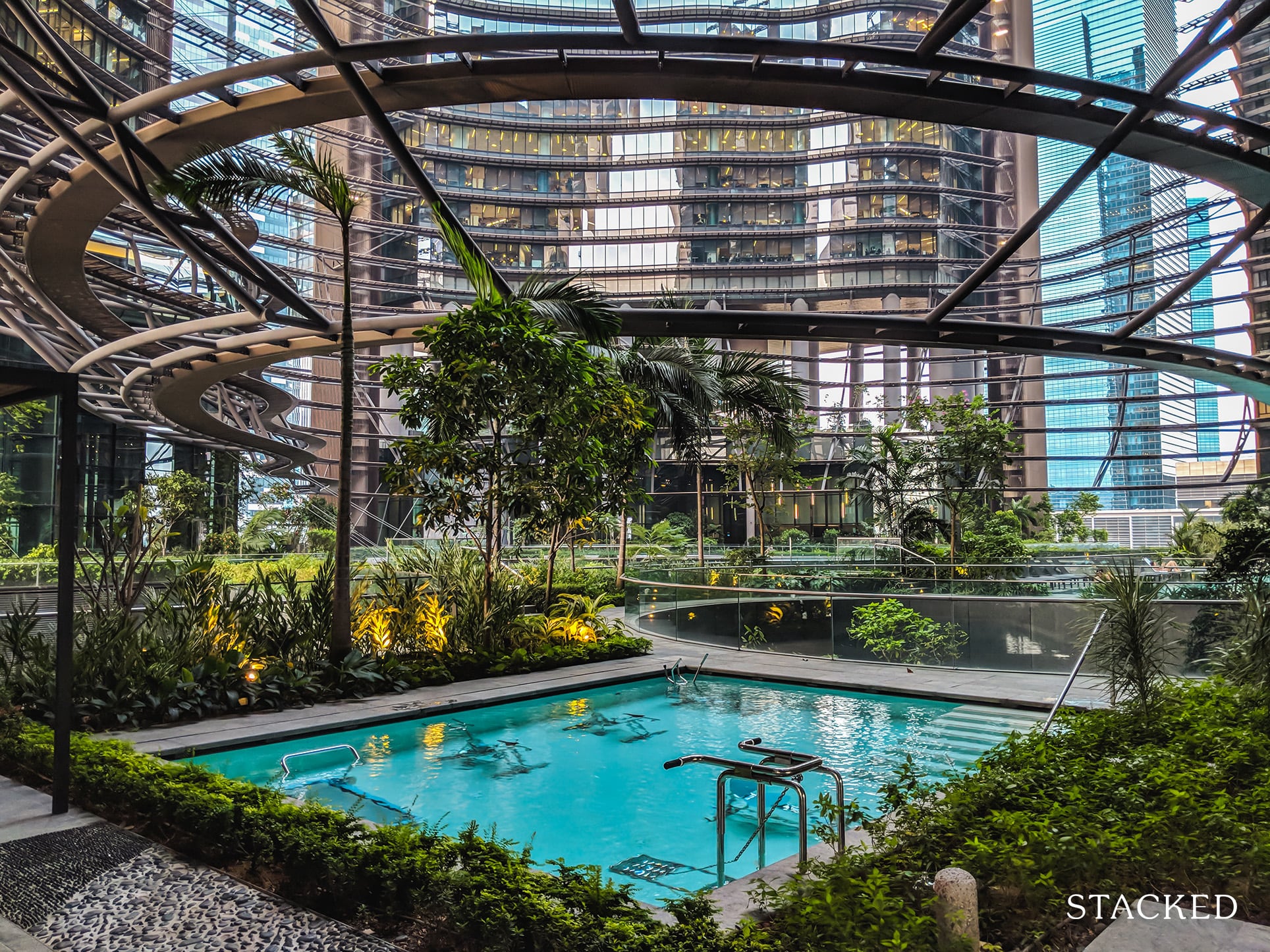
Part of the reason is that Marina One doesn’t provide one car park lot per unit (the other two reasons are the commercial component, and large unit count of 1,042 units; as discussed above).
Another famous example of this is the People’s Park Complex. This project has one of the lowest maintenance fees of any private property ever, as low as $100 per month for some units. The catch? Well, apart from fewer amenities (this is an apartment, see below), the maintenance excludes parking altogether.
Note that, as of 2019, LTA has allowed projects in some central areas, or near MRT stations, to have smaller car parks. This can help to reduce maintenance fees, and you won’t feel the drawback if you don’t drive anyway.
4. Look for pure apartments only
Examples of these would be Lucky Plaza Apartments, Sin Ming Plaza, and the aforementioned People’s Park Complex. These residences either don’t have full suite condo facilities (e.g., no full-length pools or tennis courts), or no common facilities at all. Another thing to look out for is not having onsite security, as this can often be a big contributing cost.
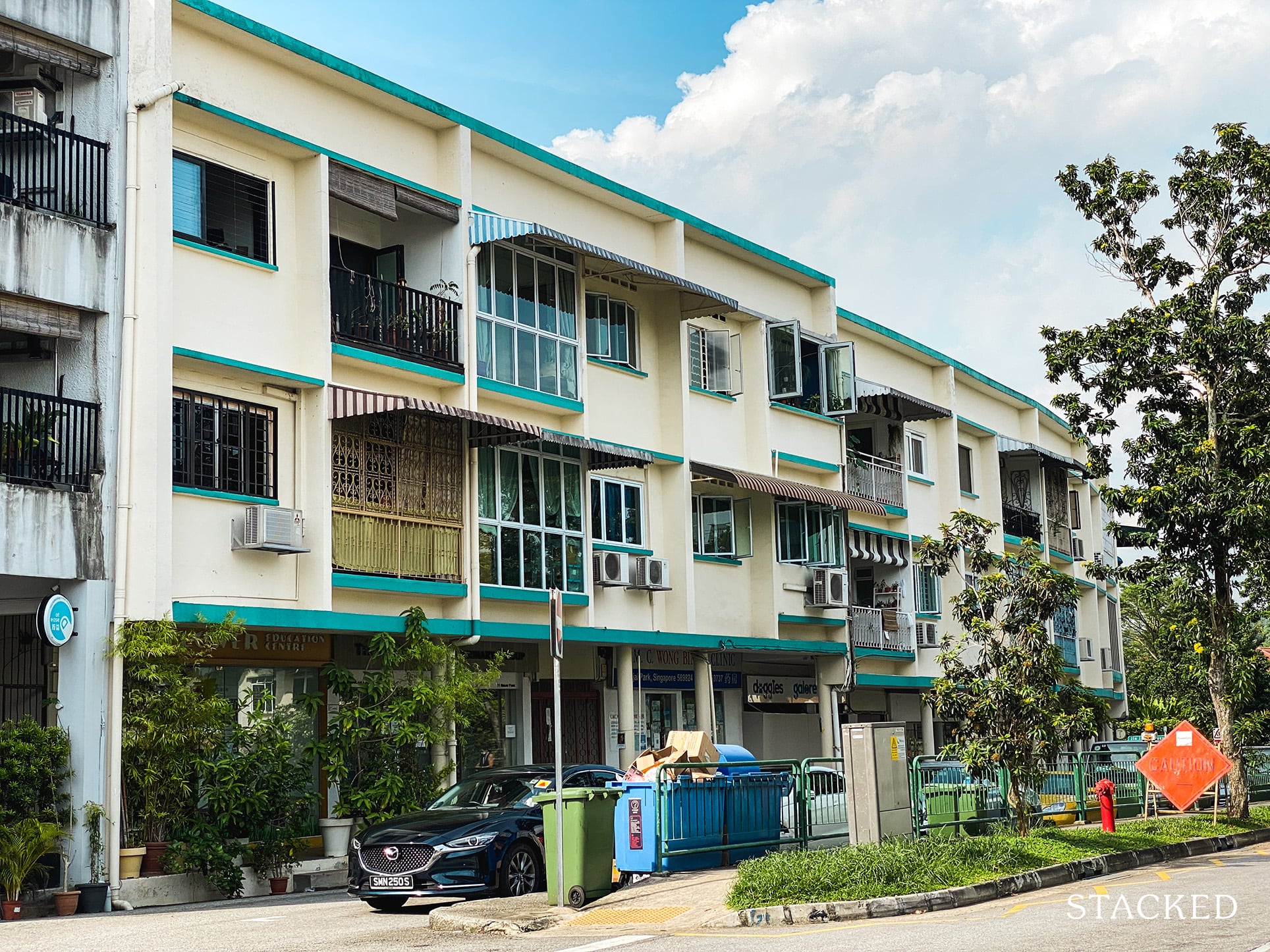
This makes it possible for maintenance fees to be much lower; and on average they can fall to as low as $200 a month (with some exceptions; old ones with very large units may still rack up high maintenance, due to share values).
If you consider walk-up apartments a viable alternative to condos, these can also have maintenance fees of around $200 or under. This is, again, due to the lack of common facilities, and there being no elevators to maintain.
5. Look for condos where the unit size falls just under the next share value category
The maintenance fee is determined by share value. So if the fee is $75 per share value, for example, and a unit’s share value is five, the monthly maintenance would be $375.
The share value starts at five, for units of 50 sqm. or below. This increases by one for every 50 sqm. So a unit with 51 sqm through to 100 sqm., for instance, would have a share value of six.
Now each project has its own mix of units of different sizes – but sometimes, you’ll find a project where a desired unit size falls just under the next rise in share values. For example, you might find all the three-bedders are exactly 100 sqm, whereas in another they’re slightly over (e.g., 103 sqm).
For example, at the recently launched Amo Residence, here’s the maintenance fee structure:
| Unit Type | Size | No. of Units | Est Maintenance |
| 2 Bedroom | 614 – 678 sqft | 92 | $414 |
| 2 Bedroom Premium | 743 sqft | 92 | $414 |
| 3 Bedroom | 958 sqft | 47 | $414 |
| 3 Bedroom + Study | 1,044 sqft | 47 | $414 |
| 3 Bedroom Premium + Study | 1,141 / 1,367 sqft | 24 | $483 |
| 4 Bedroom | 1,292 sqft | 45 | $483 |
| 5 Bedroom | 1,475 sqft | 22 | $483 |
| Penthouse | 2,293 sqft | 2 | $552 |
| Penthouse | 2,497 sqft | 1 | $621 |
From here, the smaller 3 bedroom units do represent better value from a monthly maintenance standpoint.
Note that the share value is not determined by the MCST, it’s always worked out by the Commissioner of Buildings (COB).
Reducing your share value by one can knock off a small amount of your monthly maintenance; at the time of writing, many mass-market condos have fees of around $70 to $75 per share value.
This isn’t a huge amount, but remember it all adds up over time; and if the two condos you’re comparing are neck-and-neck, this could be one of the tie-breakers.
6. Examine the nature of the facilities
The biggest determinant of maintenance fees is the types of facilities available. The fewer the facilities, the lower the cost (as is the case with apartments, in point 4).
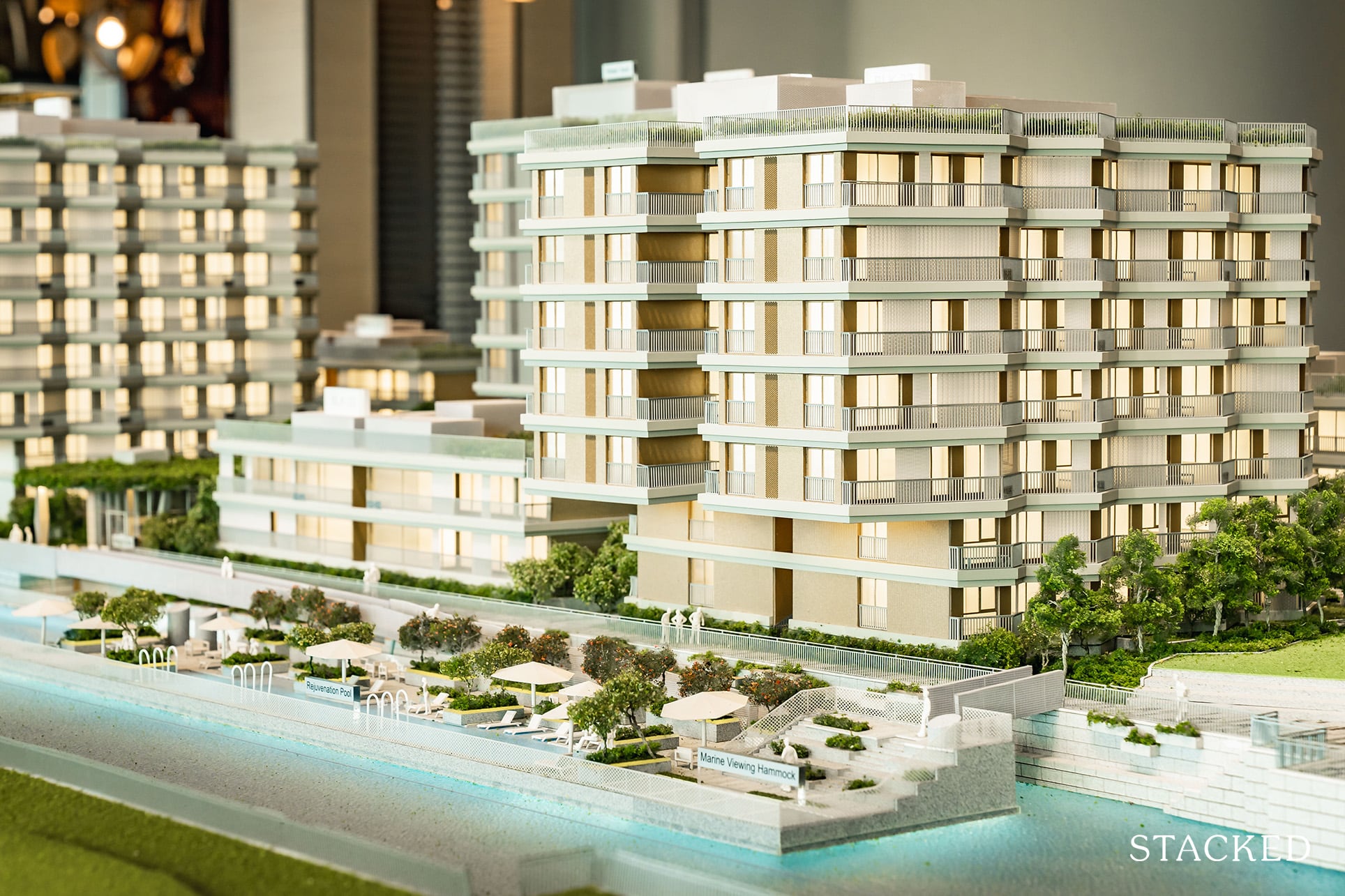
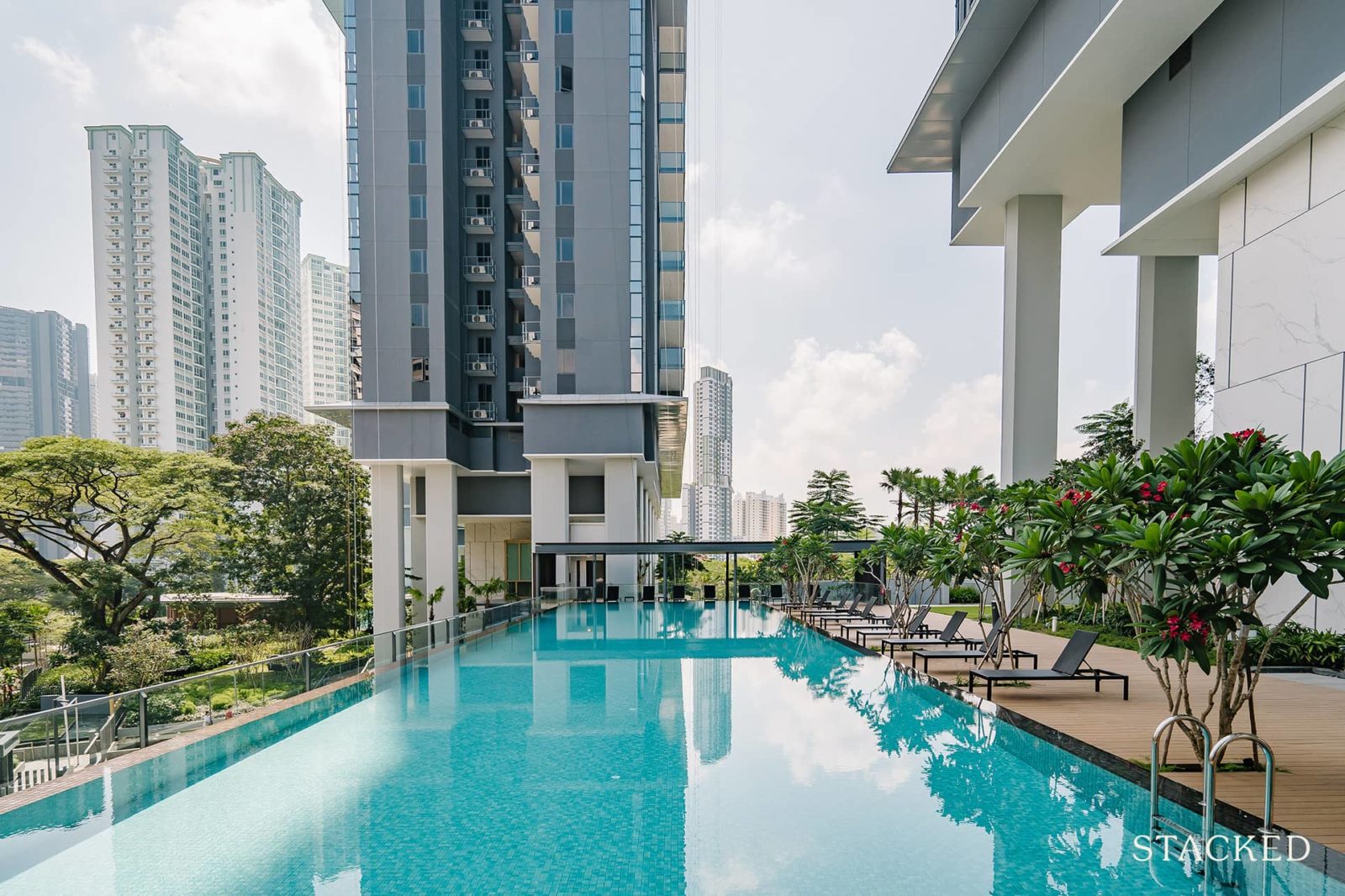
While the pool, gym, and clubhouse are standard, look out for the following facilities which tend to cost a bomb:
- Concierge services, which are usually only for luxury condos – it’s impressive that your front desk can arrange for a restaurant reservation, but consider if you really need to be paying for this
- Unusual facilities like bowling alleys and rock-climbing walls. These are innovative for sure, but the cost of maintaining them is seldom cheap; and how long will the novelty keep you entertained?
- Private elevators, or rare elevators like the sort used for vehicles.
- Multiple large pools, or exotic theme pools. If you see faux waterfalls, beaches, and other elaborate pools, there’s a good chance they’ll take up a bigger chunk of the maintenance budget.
If you’re not big on condo facilities, choosing a simpler development will usually lower maintenance fees.
7. Condos built around 2019 or later may be more cost-effective, in terms of maintenance
This is due to initiatives by BCA to improve our built environment, and the implementation of systems like MIDAS scores.
Prior to this effort, there was a greater divide between the developers, and later maintenance. To generalise a little, developers were inclined to make projects highly marketable, rather than being concerned with future maintenance costs.
This meant facades that used excessive power to light up (often for no reason other than looking majestic at night), elaborate floor-to-ceiling windows that are costly to maintain, or ventilation systems that are so inaccessible, special equipment is needed just for monthly cleaning.
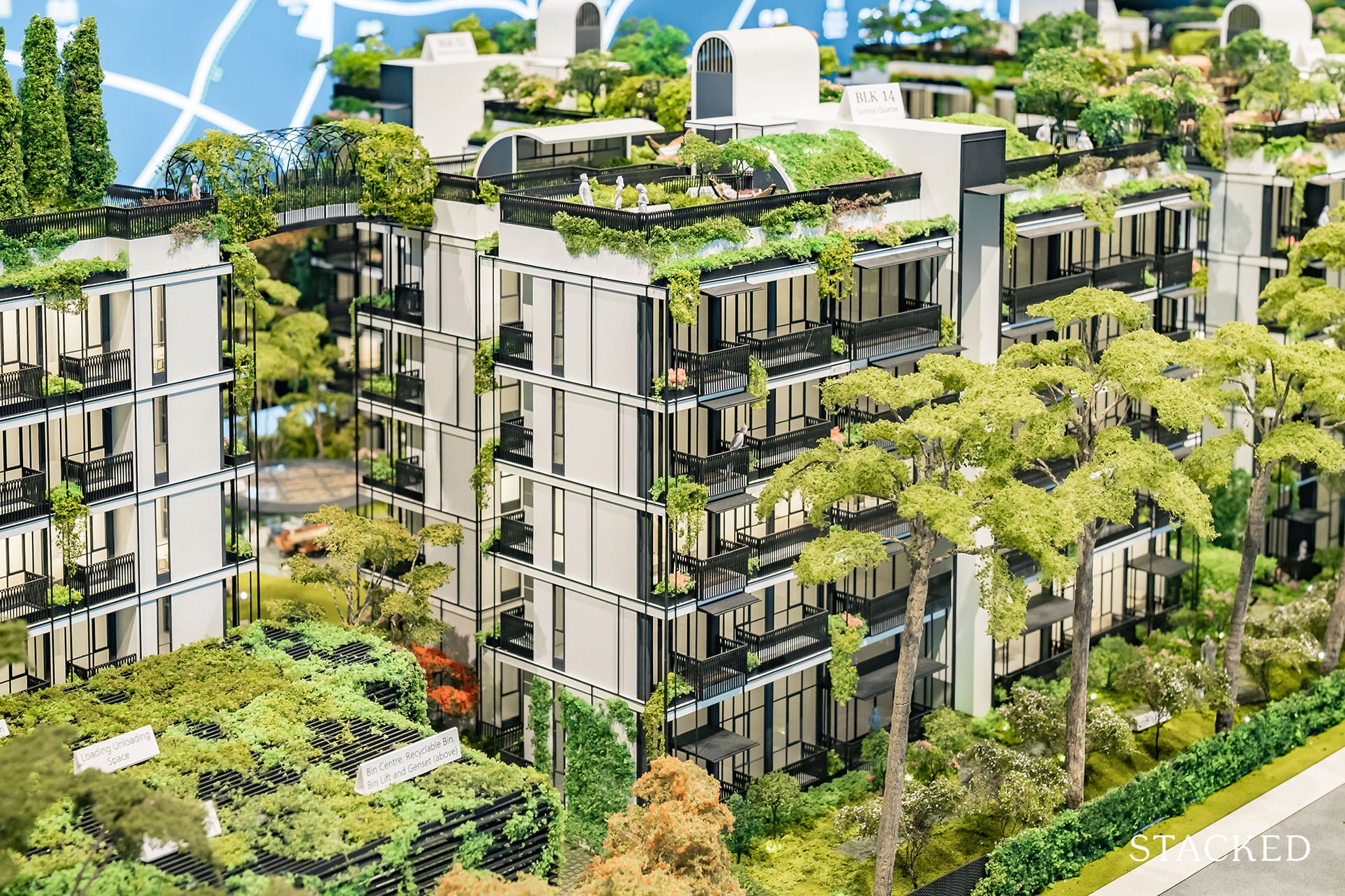
But BCA’s efforts in the past few years – which include the Green Mark award for sustainability – have changed things a bit. Developers are better incentivised to build with downstream maintenance in mind; and that can mean that more recent projects have easier upkeep compared to older ones. Projects like Jervois Mansion come to mind, where it includes the addition of solar panels and smart energy systems for common facilities, extensive roof gardens to dissipate heat, and an automatic water irrigation system with rain sensors.
This is definitely worth considering, before you buy an older project.
For more tips on home ownership or private property investment, follow us on Stacked. We’ll also provide you with in-depth reviews of new and resale properties alike.
A shortlist sorted by one variable is a fast way to narrow your options, but the pick that’s cheapest, biggest, or most convenient isn’t always the one that fits your situation best.
If you’d like to discuss how this applies to your own circumstances, you can reach out for a one-to-one consultation here.
And if you simply have a question or want to share a thought, feel free to write to us at stories@stackedhomes.com. We read every message.
Frequently asked questions
How can the size of a condo unit affect its maintenance fees?
Why do larger condo developments tend to have lower maintenance fees?
Are mixed-use developments usually cheaper to maintain?
What types of condo facilities can increase maintenance costs?
Do newer condos tend to have lower maintenance fees?
How does the number of condo units impact maintenance fees?



2 Comments
I have always wondered why Singapore real estate ads don’t include the monthly maintenance fees as a default.
A friend said that her landlord has been trying to sell her unit for over 3 years and whenever potential buyers during a viewing ask about the maintenance fees($2K), they immediately lose interest. I would have thought the agent would rather not waste his time on low success rate viewings by upfront sharing the maintenance fee with potential buyers.
There are also condo that allow resident to pay a lower maintenance fees if you opt out of the parking. Centro Residence in amk and The Centris is 2 condos that I know.