




So many readers write in because they're unsure what to do next, and don't know who to trust.
If this sounds familiar, we offer structured 1-to-1 consultations where we walk through your finances, goals, and market options objectively.
No obligation. Just clarity.
Learn more here.
A Singaporean’s Guide to Buying Homes in New York City.
If you’re curious about which neighbourhoods in New York City you might enjoy living in, or buying a property, here are some close equivalents to well-known neighbourhoods in Singapore.
One of the wonders of living in Singapore is that wherever in the world you relocate, you’re almost never shocked by property prices there; unless the shock is how big of a house you can get in that country for the price of your flat or three-bedroom condo in Singapore.
As a result, some of the world’s most premium living spaces, such as homes in New York City ‘The Big Apple’, are emerging as alternative investment buys for some Singaporeans today.
Coupled with the fact that additional buyer’s stamp duty (ABSD) in Singapore also applies to locals purchasing their second and subsequent properties, and our familiarity with the housing dynamics of a financial hub, it’s no surprise that New York City is turning up on the radar among some local investors.
A good way to get a general sense of an area, or where to start looking to buy property, is to use familiar analogies. If you’re curious about which neighbourhoods in NYC you might enjoy living in, here are some close equivalents to well-known neighbourhoods in Singapore.
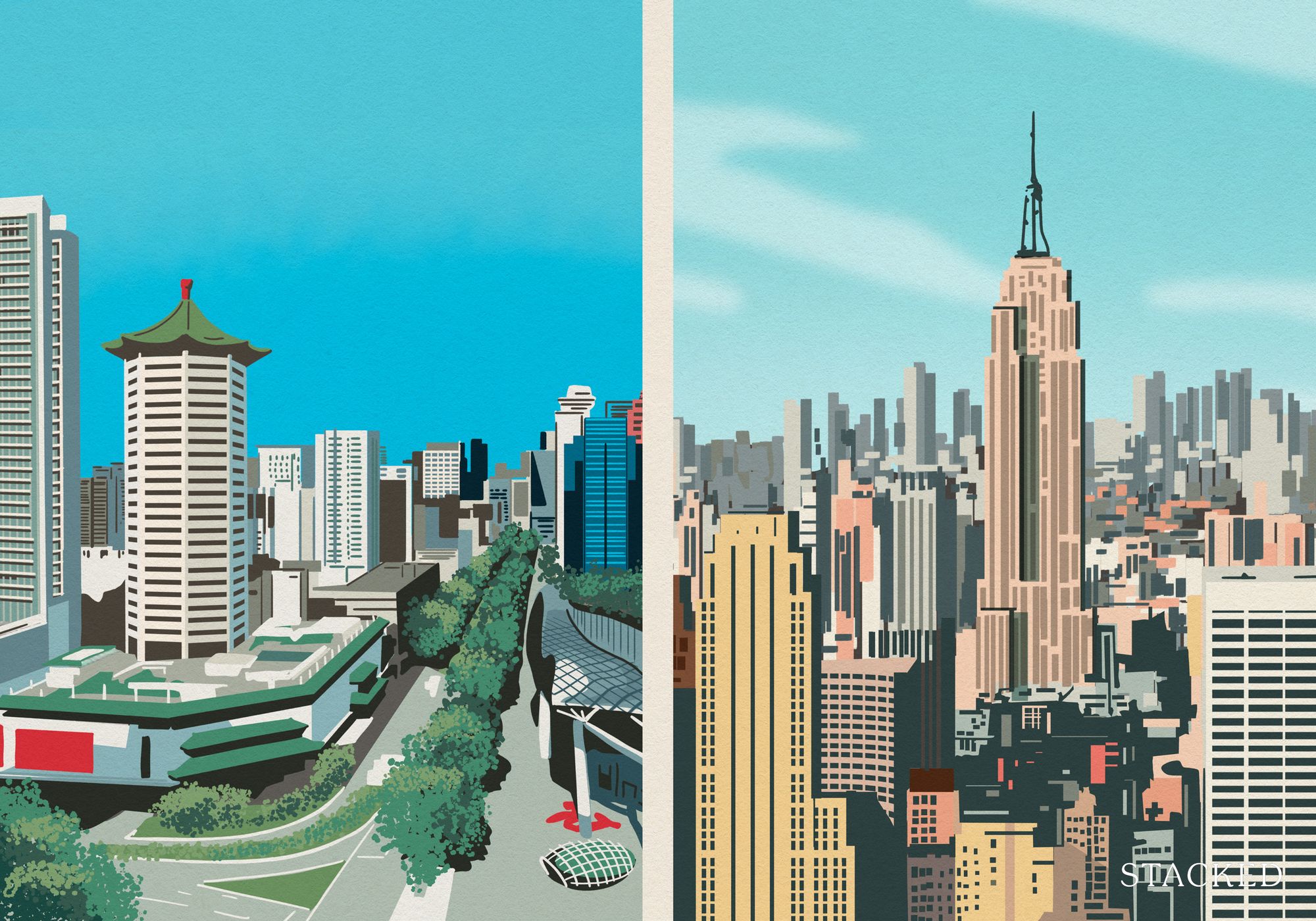
1. Orchard Road → Midtown / 5th Avenue (also known as Billionaire’s Row)
Orchard Road is Singapore’s main shopping belt and its New York analogue is 5th Avenue in Midtown Manhattan. Both areas are known for upscale retail, prestige residences, and high priced properties.
Ultra-luxury retail brands and luxury lifestyle options characterise the retail options along 5th Avenue, which also has its fair share of day-to-day retail shops. From Bergdorf Goodman to the boutiques on Madison and Fifth, you’ll find a lot of boutiques and shops by designer brands. This is also one of the rare areas in New York City with relatively more greenery due to its proximity to Central Park, the largest urban park in the city.
An important consideration to note is that while urban planning in Singapore tends to emphasize decentralisation and diversification, such as rejuvenation plans to transform Orchard Road into a work-live-play green corridor, its counterpart in New York City will likely to preserve its current vibe and reputation.
So if you’re the type of homebuyer who dislikes being near major entertainment and malls, this area may be a bit much for you.
2. Great World City / River Valley → SoHo & Tribeca
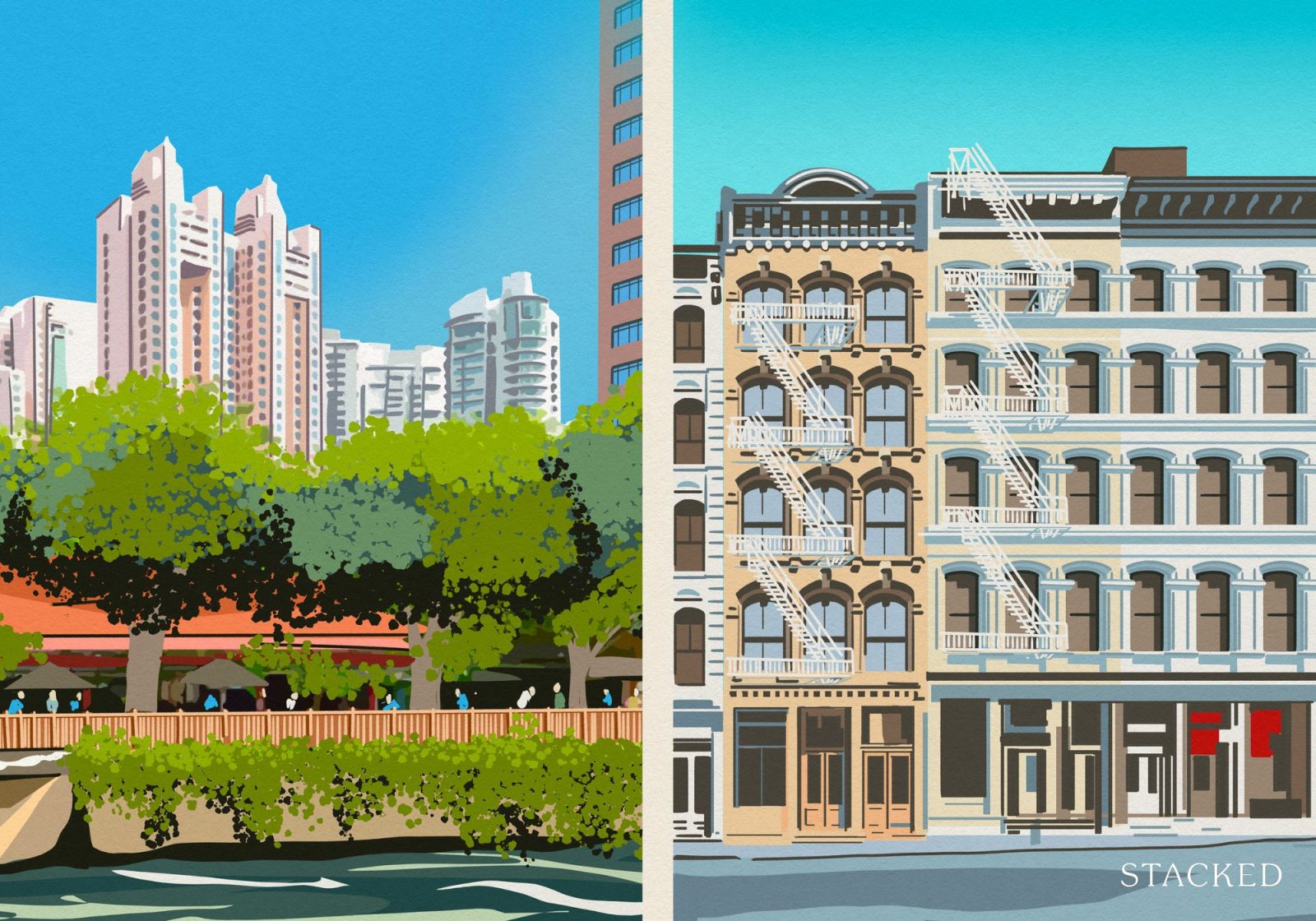
River Valley’s urban-residential sweet spot mirrors two neighbourhoods in Lower Manhattan – the trendy SoHo (short for South of Houston Street) neighbourhood, and the affluent Tribeca (an acronym for Triangle Below Canal Street) neighbourhood.
These are lifestyle districts close to the CBD, and have a visibly older vibe (in a fashionable way) with cobblestone streets and cast-iron loft buildings. There are similarities to Singapore’s River Valley/Great World area, which is characterised by a mix of old and new developments.
SoHo is known for art galleries and designer boutiques, much like the small business establishments you’ll find in parts of River Valley, while Tribeca is a bit calmer and more residential.
Be warned that large unit sizes typically drive up the quantum of the price of homes in these areas, which often prices out a lot of buyers. It’s common to find SoHo loft apartments with 12-foot pressed-tin ceilings and cast-iron columns, or Tribeca penthouses with three to four bedrooms, private terraces, and parking (a rare feature in Manhattan).
3. Tiong Bahru → East Village / Lower East Side
The East Village and Lower East Side (LES) are Manhattan’s historic counter-culture belt. Like Tiong Bahru, these neighbourhoods have a more gritty, older vibe – think Haji Lane in the 2000’s before it evolved to cater to more tourists.
The East Village, which is located east of 3rd Ave around St. Marks Place, is known for punk rock, indie theaters, vintage shops, tattoo parlors, and decades-old Ukrainian diners next to ramen joints. Like Tiong Bahru, this isn’t a cheap area and is fashionably cheap (read: expensive, but pretending to be poor to keep it real). This area has good communal vibes though, which might appeal to some own-stay buyers.
The eclectic LES neighborhood, located south of East Village, is more diverse. It’s historically a Jewish immigrant quarter but is now mixed with hip galleries, music clubs, and a burgeoning Chinese community – this place is just on the eastern edge of Chinatown.
Besides the boutique shops and Bohemian vibe, the LES does draw a lot of barcrawl types and the Alphabet City area, a bohemian-inspired residential neighbourhood, has some dive bars and live music. Probably not for those who like quiet evenings but good for younger buyers.
4. Marina Bay → Hudson Yards
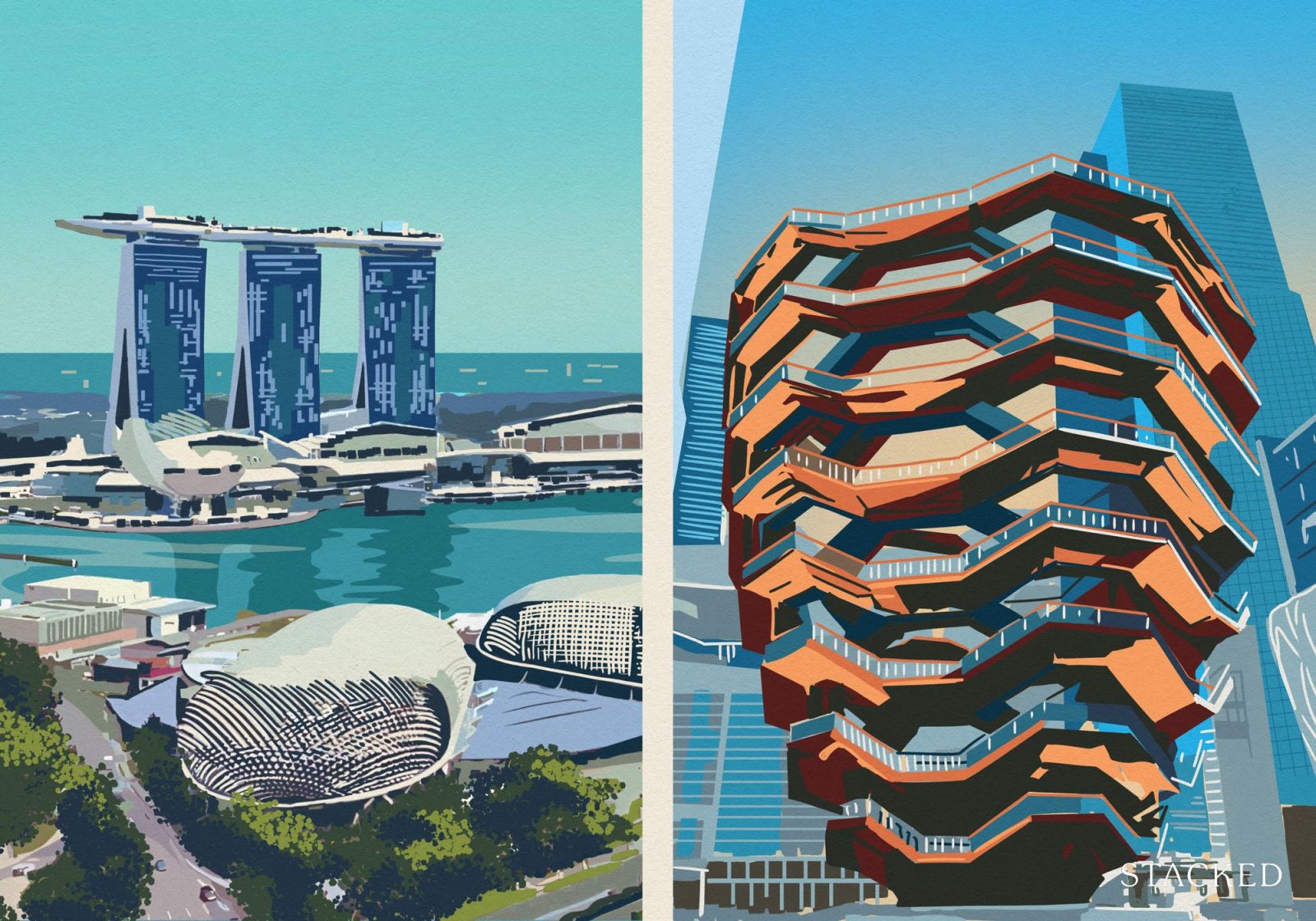
These two areas are pretty much identical to each other. Both areas combine Grade-A offices, integrated projects, and architectural landmarks (such as Marina Bay Sands in Singapore ↔ The Vessel/The Shed in New York City). They also share waterfront promenades and event spaces, and largely cater to professionals in the finance industry.
If you get the sense that the Hudson Yards area is as choreographed as Marina Bay, you’re not far off. Hudson Yards was built-for-purpose and the vibe of the area, as well as its community, is still developing. Almost everything here is new, shiny, and curated. It can actually feel a bit quiet at the street level since much of the action like shops and restaurants is inside the massive Hudson Yards Mall or within the glittery office towers.
That said, the High Line Park is here and it was here before Singapore started converting our rail tracks into parks and green spaces too. High Line Park is built along an elevated stretch of rail and provides a green space within an otherwise very dense and built-up urban area.
Developments next to the Hudson River are among the most premium in the city, and offer excellent sunset views along the waterfront.
5. Katong / Joo Chiat → Little Italy & Chinatown
Although culturally different, Katong/Joo Chiat in Singapore share the same spirit as Little Italy and Chinatown in New York City. All three are heritage-rich districts that have been heavily shaped by immigrant communities and preserved architecture.
Chinatown has markets with fresh produce and live seafood, and is a bit more raw than Singapore’s own Chinatown. You’ll see elderly locals practicing tai-chi in Columbus Park each morning, and this area looks a little like our Chinatown used to back in the 1990’s.
Little Italy, which borders Chinatown to the north, is a smaller neighbourhood today; it is essentially a few blocks centered on Mulberry Street. But it retains a nostalgic vibe with old-school Italian restaurants and cafes. The annual San Gennaro festival is held here, and the streets become lively and bustling with food stalls and music.
Walkability is great here although sidewalks can be packed, and the vibe is definitely more casual than polished. That said, due to the densely packed area and crowds, this isn’t for those who like quiet enclaves. You’ll also hear opinions from locals that these areas are better known as food spots than as residential options, which isn’t untrue.
6. Sentosa Cove → West Village
The West Village used to be considered Manhattan’s most picture-perfect neighborhood. While some of that charm has faded in recent years, it still has leafy streets with brick townhouses and cafes, an atmosphere that’s equal parts Sentosa Cove and Emerald Hill. Or, perhaps Holland V back in the early 2010’s.
The streets of New York City are laid out in a grid pattern in most areas, but in the West Village it becomes more organic with meandering lanes, some still paved with cobblestones. So yes, you will get lost and need your GPS possibly, but the trade-off is as a neighbourhood with an authentic quality and quasi-European vibe.
As a bonus, you won’t find as many high-rises here, instead it’s mainly low-rise brownstones and walk-ups. It’s also more quiet and residential compared to other downtown areas. A lot of celebrities love the West Village for its privacy and feel they are less likely to be bothered here; stroll around and you might bump into a famous actor.
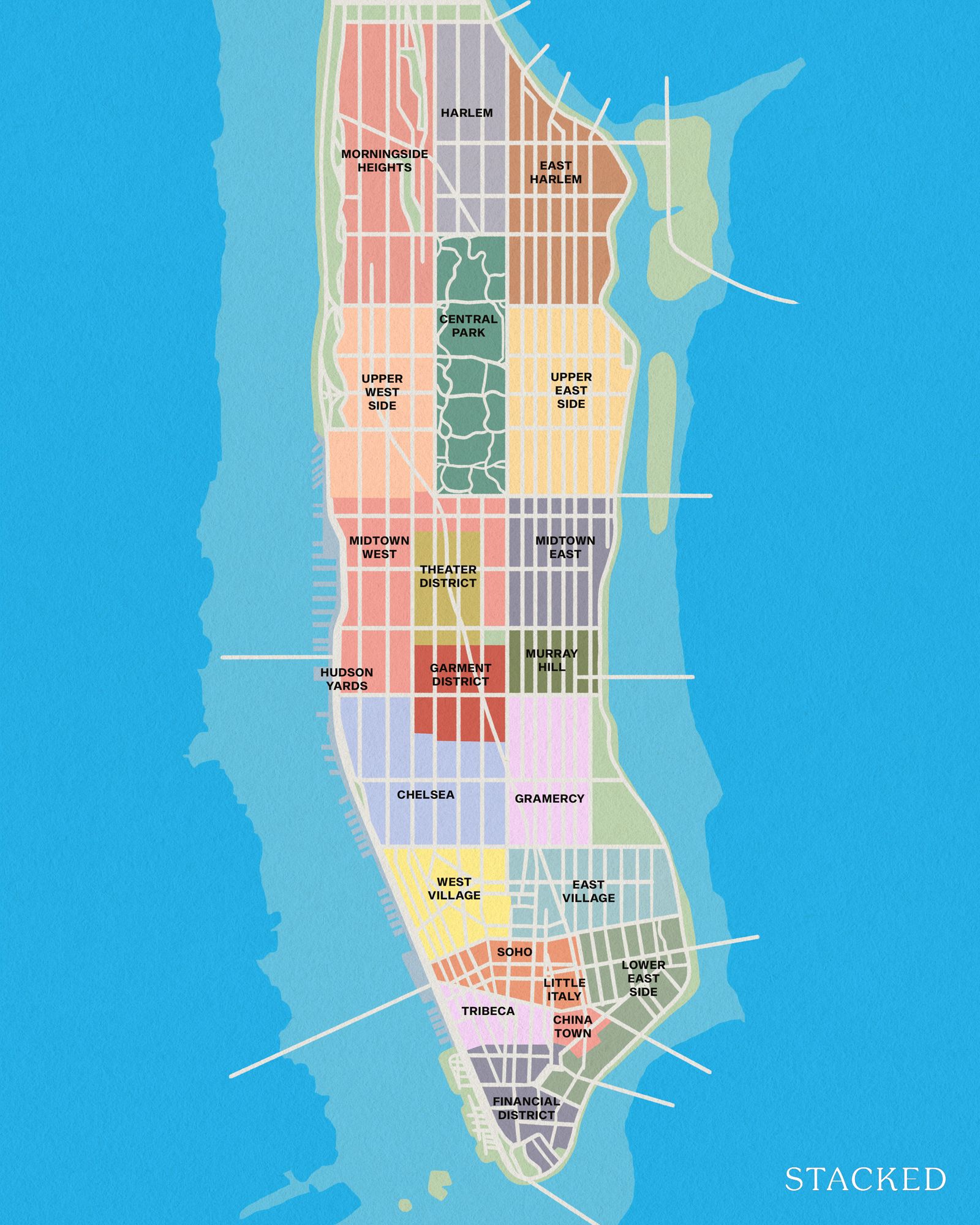
7. Bukit Timah → Upper East Side & Upper West Side
New York City is not as green as Singapore, especially in Manhattan, but the Upper East Side and Upper West Side areas come as close to it as you can get. These areas span from Central Park East to the East River, above 59th Street, and are characterised by a number of high-end residential developments like Bukit Timah in Singapore.
These two areas have proper tree-lined streets that run past pre-war apartment buildings. You’ll often see these residences with uniformed doormen and the area is also known for a number of private schools (look for chauffeured SUVs out front.)
This area does have an “old money” reputation, but there is a spot around 2nd Avenue that’s more contemporary – you’ll find bars and brunch spots for younger professionals here. The “Museum Mile” – a stretch of Fifth Avenue by Central Park – has the Metropolitan Museum of Art, Guggenheim, and other cultural landmarks.
Final thoughts
Despite New York City and Singapore being worlds apart, many New York City neighbourhoods share comparable emotional and lifestyle elements as some neighbourhoods in Singapore. Perhaps that’s true of most metropolitan capital cities which tend to end up looking a bit like each other wherever in the world you go.
In any case, one of the biggest qualities that Singaporeans will feel comfortable with is that New York City is a melting pot of people, cultures, and identities. Most people in the city were not originally born there, so like Singapore the sense of being an outsider fades quickly.
At Stacked, we like to look beyond the headlines and surface-level numbers, and focus on how things play out in the real world.
If you’d like to discuss how this applies to your own circumstances, you can reach out for a one-to-one consultation here.
And if you simply have a question or want to share a thought, feel free to write to us at stories@stackedhomes.com — we read every message.
Frequently asked questions
What are the New York neighborhoods similar to Orchard Road?
Which NYC areas are like Tiong Bahru in Singapore?
Where in New York is comparable to Marina Bay in Singapore?
What NYC neighborhoods are like Katong or Joo Chiat?
Which parts of NYC are comparable to Sentosa Cove?


0 Comments