

Dear Stacked Homes
Being an avid reader of your materials, I was wondering if you provide some (free) advice on our situation:
01. We are already in the process of selling our current joint-named property.
02. The following will be the financial standing after the sale, clearing of loan, and the return to their respective:
Male (M)
- ... 49 years old
- ... CPF OA = $790K
- ... CPF SA sufficient for FRS
- ... Annual income $180K
Female (F)
- ... 49 years old
- ... CPF OA = $380K
- ... CPF SA sufficient for FRS
- ... Annual income $60K
Total available cash
... $1.8M
03. General Information
- ... We are a family of 5
- ... Husband + Wife + 3 teenage boys
- ... Considering to purchase and stay in a 4BR Condo
- ... Condo should be within 500M of an MRT station (giving up the cars)
- ... Prefer D3, D4, D5 districts
- ... Need more than 1300sqft
04. What are our options?
... (a) Low-Budget 4BR = Split the budget between 1x4BR (own-stay) and 1x2BR (rental-income)(not-considering-1BR)
... (b) Mid-Budget 4BR = Split the budget between 1x4BR (own-stay) and 1xCommerical-Unit (Less than 1M)(rental-income)
... (c) Max-Budget 4BR = Put everything into 1x4BR (own-stay)
... Do (a) (b) or (c) make better sense?
05. Any recommendations for condo projects in support of (a), (b) or ©
06. Additional information
... In consideration of splitting the budget between (a) Low-Budget 4BR = 1x4BR (own-stay) and 1x2BR (rental-income), we might be open to include D21 + D22 for the 4BR unit.
07. Objective
- ... Maximize potential capital appreciation for the 4BR in 5-10 years
- ... Maximize returns for an remaining funds
- ... We already have other investments in equity, so this is our "property" pool
- ... A little flexibility, in the case of a need for money (in writing this, I realize that Option (C) seems contradictory!)
Hope to be able to get your advice, either in print as a case study or otherwise.
Thank you!
Hello,
Thanks for writing in and for clearly structuring your question.
Considering the proceeds from your property sale, you seem to be in a secure position. Additionally, having other avenues of investment further solidifies your strong financial footing.
Let’s start by assessing your affordability.
The challenge for many buyers today isn't access to information.
It's interpreting that information in a way that makes sense for their finances, goals, and stage of life.
Over time, that's also why we decided to work with agents who shared the same data-driven and advisory-led approach behind our editorial, consultants who could help readers think through decisions more objectively, rather than simply push transactions.
Today, the team has worked with more than 2,000 clients across over $5B in property transactions.
Affordability
Husband’s affordability (Presuming he buys the own stay property)
| Maximum loan based on age of 49 with an annual income of $180K, at 4.6% interest | $1,119,775 (16 year tenure) |
| CPF funds | $790,000 |
| Cash (We will allocate a larger share for the own stay property) | $1,000,000 |
| Total loan + CPF + cash | $2,909,775 |
| BSD based on $2,909,775 | $115,088 |
| Estimated affordability | $2,794,687 |
Wife’s affordability (Presuming she buys the investment property)
| Maximum loan based on age of 49 with an annual income of $60K, at 4.6% interest | $373,258 (16 year tenure) |
| CPF funds | $380,000 |
| Cash (We will allocate a larger share for the own stay property) | $800,000 |
| Total loan + CPF + cash | $1,553,258 |
| BSD based on $1,553,258 | $47,262 |
| Estimated affordability | $1,505,996 |
Combined affordability
| Maximum loan based on ages of 49 with an annual income of $240K, at 4.6% interest | $1,493,033 (16 year tenure) |
| CPF funds | $1,170,000 |
| Cash | $1,800,000 |
| Total loan + CPF + cash | $4,463,033 |
| BSD based on $4,463,033 | $207,381 |
| Estimated affordability | $4,255,652 |
Given that both of you already have the CPF funds required to fulfill the Full Retirement Sum (FRS), we will not have to worry about selling and buying your subsequent property/properties before you turn 55 years old.
Since you have a substantial amount of cash to put towards the purchase, your individual affordability can be easily adjusted by moving the cash around.
Now that we have a better idea of your budget, it’s safe to say the options you’re considering are feasible. Let’s run through them!
Potential pathways
Option 1. Buy a 4-bedder for own stay and a 2-bedder for investment
As your planned holding period of 5 - 10 years, is not exactly a very long amount of time, you can consider looking at leasehold developments but perhaps something that is younger so any lease decay concerns are mitigated.
And while you do have a healthy budget of $2.79M, the truth is that when it comes to 4 bedders, there are not many units that match all your requirements. Those that do match are older in age.
So in order to get better matches, moving another $200K from the investment property towards the purchase of your own stay property (increasing your budget to $2.99M) would help.
As such, these are some 4-bedroom units that are currently on the market which comes under the new budget:
| Project | District | Tenure | TOP | Size (sqft) | Asking price |
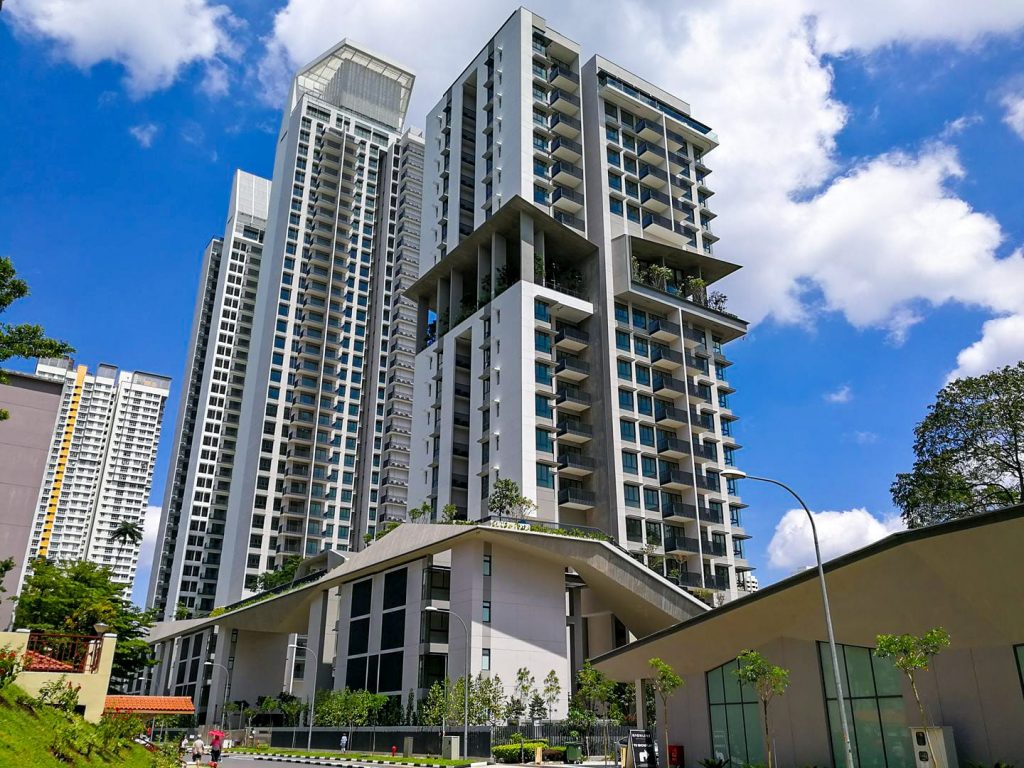
| The Trilinq | 05 | 99 years | 2017 | 1,764 | $2,680,000 |
| One-North Residences | 05 | 99 years | 2009 | 1,615 | $2,980,000 |
| Meraprime | 03 | 99 years | 2006 | 1,313 | $2,800,000 |
If you are open to walking a slightly longer distance of under 1KM to an MRT station, there will be a handful more options.
Do note that these units are picked out purely based on the fact that they match the criteria you have brought up and fall within your budget of $2.99M. They may or may not be suitable and we strongly advise that you consult a property agent for further analysis.
Let’s now look at the costs involved. For calculation purposes, we will use a holding period of 10 years.
Assuming you buy a 4-bedder at The Trilinq. From January till date, there were 6 4-bedders sold, with 2 being penthouses. Excluding the penthouses, these units transacted at an average price of $2,302,525. We will use this as the purchase price. Do note that these transacted units ranged from 1,109 - 1,518 sq ft.
| Purchase price | $2,302,525 |
| BSD | $84,726 |
| CPF + cash | $1,990,000 |
| Loan required | $397,251 |
Costs incurred
| BSD | $84,726 |
| Interest expense (Assuming an interest rate of 4%) | $118,560 |
| Property tax | $49,510 |
| Maintenance fees (Assuming $450/month) | $54,000 |
| Total outcome | $306,796 |
Potential gains
We will use the annualised growth rate of private residential properties over the last decade of 2.21% to do a simple projection.
| Time period | Price | Gains |
| Starting point | $2,302,525 | $0 |
| Year 1 | $2,353,411 | $50,886 |
| Year 2 | $2,405,421 | $102,896 |
| Year 3 | $2,458,581 | $156,056 |
| Year 4 | $2,512,916 | $210,391 |
| Year 5 | $2,568,451 | $265,926 |
| Year 6 | $2,625,214 | $322,689 |
| Year 7 | $2,683,231 | $380,706 |
| Year 8 | $2,742,530 | $440,005 |
| Year 9 | $2,803,140 | $500,615 |
| Year 10 | $2,865,090 | $562,565 |
Potential gains if you were to buy a 4-bedder and hold it for 10 years: $562,565 - $306,796 = $255,769
We’ll now look at your investment property.
These are some 2-bedroom units under $1.3M that are currently on the market and have a decent recent yield:
| Project | District | Tenure | TOP | Unit type | Size (sqft) | Asking price | Avg rent (Jun - Aug) | Rental yield |
| Twin Vew | 05 | 99 years | 2021 | 2b2b | 710 | $1,300,000 | $4,606 | 4.3% |
| Sol Acres | 23 | 99 years | 2019 | 2b2b | 711 | $998,000 | $3,500 | 4.2% |
| Kingsford Waterbay | 19 | 99 years | 2018 | 2b2b | 689 | $950,000 | $3,442 | 4.3% |
Let’s assume you were to purchase a Sol Acres. From January till date, there were 68 2b2b units transacted at an average price of $1,043,860. We will assume this to be the purchase price.
| Purchase price | $1,043,860 |
| BSD | $26,354 |
| CPF + cash | $980,000 |
| Loan required | $90,214 |
Typically, major banks in Singapore do not provide loans for amounts less than $100,000 to $200,000, depending on the specific bank selected. If the purchase of your primary residence does not max out your affordability, it is probable that you will still have surplus cash available to pay off the investment property in full. However, for the sake of calculations, let's assume a loan amount of $100,000.
Costs incurred
| BSD | $26,354 |
| Interest expense (Assuming an interest rate of 4%) | $29,845 |
| Property tax | $60,000 |
| Maintenance fees (Assuming $250/month) | $30,000 |
| Rental income (Assuming $3,500/month) | $420,000 |
| Agency fees (Payable once every 2 years) | $18,900 |
| Total outcome | $254,901 (Gains) |
We will also use the annualised growth rate of private residential properties over the last decade of 2.21% to do a simple projection.
| Time period | Price | Gains |
| Starting point | $1,043,860 | $0 |
| Year 1 | $1,066,929 | $23,069 |
| Year 2 | $1,090,508 | $46,648 |
| Year 3 | $1,114,609 | $70,749 |
| Year 4 | $1,139,242 | $95,382 |
| Year 5 | $1,164,419 | $120,559 |
| Year 6 | $1,190,152 | $146,292 |
| Year 7 | $1,216,455 | $172,595 |
| Year 8 | $1,243,338 | $199,478 |
| Year 9 | $1,270,816 | $226,956 |
| Year 10 | $1,298,901 | $255,041 |
Potential gains if you were to buy a 2-bedder and rent it out for 10 years: $255,041 + $254,901 = $509,942
Total gains if you were to take this pathway: $255,769 + $509,942 = $765,711
Option 2. Buy a 4-bedder for own stay and a commercial property for investment
Generally, investors seeking commercial properties are often motivated by a desire to circumvent the Additional Buyer's Stamp Duty (ABSD) levied on residential properties. Fortunately, in your case, having the financial capacity to acquire two properties individually means that ABSD wouldn't be applicable to you. As demonstrated earlier, even with a budget of $1M allocated for the investment property, there are viable residential options available that can deliver decent rental yields.
There are several important things to take note of when it comes to buying a commercial property.
- You will not be able to utilise your CPF funds for the down payment or monthly mortgage repayments
Given that you do have a healthy amount of cash, this may not be an issue. Additionally, if the unit is being rented out, you can possibly use the rental income to offset the monthly repayments as well.
- GST may be payable
On top of the usual BSD, there is also a GST charge if you’re purchasing a commercial property from a GST-registered seller. The GST payable is dependent on the purchase price and is currently set at 8%. However, this will be increased to 9% in January 2024. The GST is also payable only in cash.
- LTV and interest rates
You can potentially borrow up to 80% of the property's value, which exceeds the LTV limit applicable to residential properties, capped at 75%. However, the LTV ratio can vary and might be more conservative if you're acquiring a commercial property for investment purposes, as banks often perceive them as carrying higher risks. Additionally, it's worth noting that interest rates for commercial properties tend to be comparatively higher than those for residential properties.
- Property tax
Unlike residential properties where the percentage of property tax payable varies depending on whether the unit is owner-occupied or otherwise, for commercial properties, the property tax is a flat rate of 10% of the annual value.
- Change of use
Commercial properties are also subjected to various zoning as outlined in the URA Master Plan. Depending on the specific property type and its designated purposes, you might be required to seek planning permission from the URA should you or your prospective tenant wish to modify its intended use.
- Property type and location
Commercial properties encompass a range of categories, including office spaces, retail premises, and industrial properties. Each category comes with its distinct set of factors to evaluate and potential risks to consider. Depending on the property type, location could be crucial for the success of your investment. For instance if you're investing in a retail shop, factors like accessibility, foot traffic, proximity to transportation hubs, and the overall business environment in the area may hold significant relevance. As a landlord, you may also find yourself having to deal with licensing agencies, so the administrative effort could be something you might want to think about.
- Other risks
Commercial properties come with risks since the inherent use of the property may change for the worse. For example, if you intend to purchase an F&B for example that sells alcohol till 2AM, you might find yourself in a situation where residents from nearby homes complain later on about the establishment after your purchase. This could result in a reduced hours for how long your tenant can sell alcohol which also reduces revenue and in turn, reduces the rent you can charge.
Now that we understand some of the nuances with commercial properties, let’s take a look at the numbers.
Assuming you were to purchase a commercial property at $1M, let’s see how this will change your affordability.
| Purchase price | $1,000,000 |
| BSD | $24,600 |
| GST | $8,000 |
| Cash (Assuming you only pay for the down payment and take the maximum loan of 80%) | $200,000 |
| Loan required | $800,000 |
As your wife is only eligible to take up a maximum loan of $373,258, the shortfall of $426,742 will have to be topped up in cash. This means the total cash required will be $659,342 (20% down payment + loan shortfall + BSD + GST). After paying for this, the cash remaining that can be put towards the purchase of your own stay property is $1,140,658.
Husband’s new affordability
| Maximum loan based on age of 49 with an annual income of $180K, at 4.6% interest | $1,119,775 |
| CPF funds | $790,000 |
| Cash (We will allocate a larger share for the own stay property) | $1,140,658 |
| Total loan + CPF + cash | $3,050,433 |
| BSD based on $3,050,433 | $122,625 |
| Estimated affordability | $2,927,808 |
The difference in affordability between this scenario and Option 1 is marginal, and it wouldn't substantially expand your choices for your own stay property. Nevertheless, with a budget of $2.9M, you already have the capacity to secure a 4-bedroom property in your preferred districts, so this is not an issue.
For the commercial property with a $1M budget, a diverse range of options is available. According to a PropertyGuru article, commercial properties typically yield an average rental return of approximately 5%, surpassing that of many residential properties. However, it's essential to consider that their maintenance costs are also higher, falling within the range of $0.80 to $1.50 psf/month.
For calculation purposes, we will assume the purchase of a 300 sq ft unit at $1M with a 5% rental yield and monthly maintenance of $1.50/sqft.
Cost incurred
| BSD | $24,600 |
| GST | $8,000 |
| Interest expense (Assuming maximum loan of $373,258 at an interest rate of 4%) | $111,399 |
| Property tax | $79,980 |
| Maintenance fees (Assuming $450/month) | $54,000 |
| Rental income (Assuming $4,166/month) | $499,920 |
| Agency fees (Payable once every 2 years) | $22,495 |
| Total outcome | $199,446 (Gains) |
Let’s take a look at the price movement of commercial properties over the last 10 years.
| Year | Commercial property avg PSF (resale) | YoY |
| 2012 | $1,201 | - |
| 2013 | $1,418 | 18.07% |
| 2014 | $1,320 | -6.91% |
| 2015 | $1,283 | -2.80% |
| 2016 | $1,230 | -4.13% |
| 2017 | $1,332 | 8.29% |
| 2018 | $1,374 | 3.15% |
| 2019 | $1,157 | -15.79% |
| 2020 | $1,065 | -7.95% |
| 2021 | $1,348 | 26.57% |
| 2022 | $1,243 | -7.79% |
| Annualised | - | 0.34% |
In contrast to residential properties, commercial real estate has shown relatively subdued performance in the past decade. The surge in online shopping has diminished the demand for retail space, considering it is an overhead that businesses can forego. Additionally, the pandemic, which prompted a significant shift towards remote work, resulted in reduced demand for office space. It's crucial to note that the associated risks will fluctuate based on the specific type of commercial property you choose to invest in.
We will use the appreciation rate of 0.34% to do a simple projection.
| Time period | Price | Gains |
| Starting point | $1,000,000 | $0 |
| Year 1 | $1,003,400 | $3,400 |
| Year 2 | $1,006,812 | $6,812 |
| Year 3 | $1,010,235 | $10,235 |
| Year 4 | $1,013,670 | $13,670 |
| Year 5 | $1,017,116 | $17,116 |
| Year 6 | $1,020,574 | $20,574 |
| Year 7 | $1,024,044 | $24,044 |
| Year 8 | $1,027,526 | $27,526 |
| Year 9 | $1,031,019 | $31,019 |
| Year 10 | $1,034,525 | $34,525 |
Potential gains if you were to buy a commercial property and rent it out for 10 years: $199,446 + $34,525 = $233,971
Since your affordability for the own stay property remains more or less similar to Option 1, we will assume the same gains.
Total gains if you were to take this pathway: $255,769 + $233,971 = $489,740
Option 3. Combine funds to buy a 4-bedder
Given your primary objective of maximising profits, opting to pool your funds for the purchase of a 4-bedroom property for your own stay may not be the most ideal choice since this approach relies solely on potential capital appreciation.
On the contrary, by keeping your own residence and investment property separate, you effectively diversify risks. Additionally, the rental income generated from your investment unit can serve to offset expenses incurred.
Moreover, at the current level of interest rates, maximising your affordability also means taking a much bigger loan which could affect your long-term profitability.
So how should we tackle this question?
There’re two cases we’d like to explore here
- First is maximising your budget which means you’ll need to take a bigger loan. This naturally increases costs.
- Next is to consider a cheaper 4-bedroom project that doesn’t maximise your affordability to see the difference.
In both cases, we’ll assume you set aside an arbitrary $200,000 because you mentioned you’d like to have some cash available on the side.
Let’s explore the first case - not maxing out your affordability which also limits the amount of loan you’ll be taking. In this case, you can purchase a condo that’s around $3+ million.
Here are some 4-bedroom projects that went for $3+ million:
| Project | District | Tenure | TOP | Size (sqft) | Asking price |
| Highline Residences | 03 | 99 years | 2018 | 1,292 | $3,300,000 |
| Echelon | 03 | 99 years | 2016 | 1,572 | $3,300,000 |
| Skyline Residences | 03 | Freehold | 2015 | 1,474 | $3,280,000 |
Assuming you purchase a $3.3M 4 bedder at Highline Residences:
| Purchase price | $3,300,000 |
| BSD | $137,600 |
| CPF + cash | $2,770,000 |
| Loan required | $667,600 |
Cost incurred
| BSD | $137,600 |
| Interest expense (Assuming an interest rate of 4%) | $199,245 |
| Property tax | $117,200 |
| Maintenance fees (Assuming $450/month) | $54,000 |
| Total outcome | $508,045 |
As before, we will also use the annualised growth rate of private residential properties over the last decade of 2.21% to do a simple projection.
| Time period | Price | Gains |
| Starting point | $3,300,000 | $0 |
| Year 1 | $3,372,930 | $72,930 |
| Year 2 | $3,447,472 | $147,472 |
| Year 3 | $3,523,661 | $223,661 |
| Year 4 | $3,601,534 | $301,534 |
| Year 5 | $3,681,128 | $381,128 |
| Year 6 | $3,762,481 | $462,481 |
| Year 7 | $3,845,631 | $545,631 |
| Year 8 | $3,930,620 | $630,620 |
| Year 9 | $4,017,487 | $717,487 |
| Year 10 | $4,106,273 | $806,273 |
Total gains if you were to take this pathway: $806,273 - $508,045 = $298,228
Now as a hypothetical example, let’s say you were to get a 4-bedder for $4.25 million which maxes out your affordability. Here’s what the numbers would look like:
| Purchase price | $4,250,000 |
| BSD | $194,600 |
| CPF + cash | $2,770,000 |
| Loan required | $1,674,600 |
Cost incurred
| BSD | $194,600 |
| Interest expense (Assuming an interest rate of 4%) | $499,785 |
| Property tax | $207,800 |
| Maintenance fees (Assuming $450/month) | $54,000 |
| Total outcome | $956,185 |
And here’s the gains assuming a 2.21% increase year on year.
| Time period | Price | Gains |
| Starting point | $4,250,000 | $0 |
| Year 1 | $4,343,925 | $93,925 |
| Year 2 | $4,439,926 | $189,926 |
| Year 3 | $4,538,048 | $288,048 |
| Year 4 | $4,638,339 | $388,339 |
| Year 5 | $4,740,846 | $490,846 |
| Year 6 | $4,845,619 | $595,619 |
| Year 7 | $4,952,707 | $702,707 |
| Year 8 | $5,062,162 | $812,162 |
| Year 9 | $5,174,036 | $924,036 |
| Year 10 | $5,288,382 | $1,038,382 |
Total gains if you were to take this pathway: $1,038,382 - $956,185 = $82,197
What should you do?
Let’s do a quick summary of the costs incurred and potential gains for all 3 options.
| Option 1. Buy a 4-bedder for own stay and a 2-bedder for investment | Option 2. Buy a 4-bedder for own stay and a commercial property for investment | Option 3a. Combine funds to buy a $3.3M 4-bedder | Option 3b. Combine funds to buy a $4.25M 4-bedder | |
| Costs incurred | $51,895 | $107,350 | $508,045 | $956,185 |
| Potential gains | $765,711 | $489,740 | $298,228 | $82,197 |
Out of the 3 options, it’s clear from the table above that Option 1 entails the lowest costs. By being able to produce rental income, you’re afforded some level of safety since you will be realising the returns in the form of rental income.
As a result of that, it’s also the option that yields the highest potential gains.
Additionally, if the investment property's purchase price is below $1M, there may be no need to be saddled with a loan, resulting in further expense reduction - particularly crucial given the prevailing elevated interest rates.
In the case of Option 2, the rental income from the commercial property does help mitigate costs, but the lower appreciation rate translates to comparatively reduced potential gains when compared to Option 1.
Furthermore, the inability to utilise CPF funds for the commercial property purchase means that available funds are not fully optimised. The higher cash investment in the commercial property keeps the budget for your primary residence unchanged from Option 1, so your options are not widened. Additionally, the smaller buyer pool for commercial properties, comprising mainly businessmen and investors, may prolong the time needed to sell in the future.
Finally, Option 3 yields the lowest outcome. The main reason why this is the case is because you’ll be putting all your eggs in one basket, fully dependent on the capital appreciation over 10 years. All this while having to pay an interest expense of 4% which is more than the assumed gains. You can clearly see this with the more expensive property where the potential gains are a lot lower because the interest expense already erodes about half the profit. Moreover, we assumed that the more expensive property would have a higher property tax which eats into the profits.
Considering all of these options, we would prefer Option 1 in trying to maximise your affordability to meet your goal of capital appreciation in 5 to 10 years. It’s also playing the safer side given you can at least enjoy some rental income.
Option 2 is not something we would consider on the grounds that buying a commercial property is fundamentally different from being a residential landlord given the risks and downsides we’ve highlighted earlier. The returns are also potentially worse than Option 1 which seem to be an easier choice than managing a commercial unit.
Finally, Option 3 would be our least preferred choice given it’s very dependent on capital appreciation. It’s also highly dependent on how interest rates move.
At Stacked, we like to look beyond the headlines and surface-level numbers, and focus on how things play out in the real world.
If you'd like to discuss how this applies to your own circumstances, you can reach out for a one-to-one consultation here.
And if you simply have a question or want to share a thought, feel free to write to us at stories@stackedhomes.com. We read every message.


1 Comments
Wow, so rich and yet so cheapskate as to request for free advice