

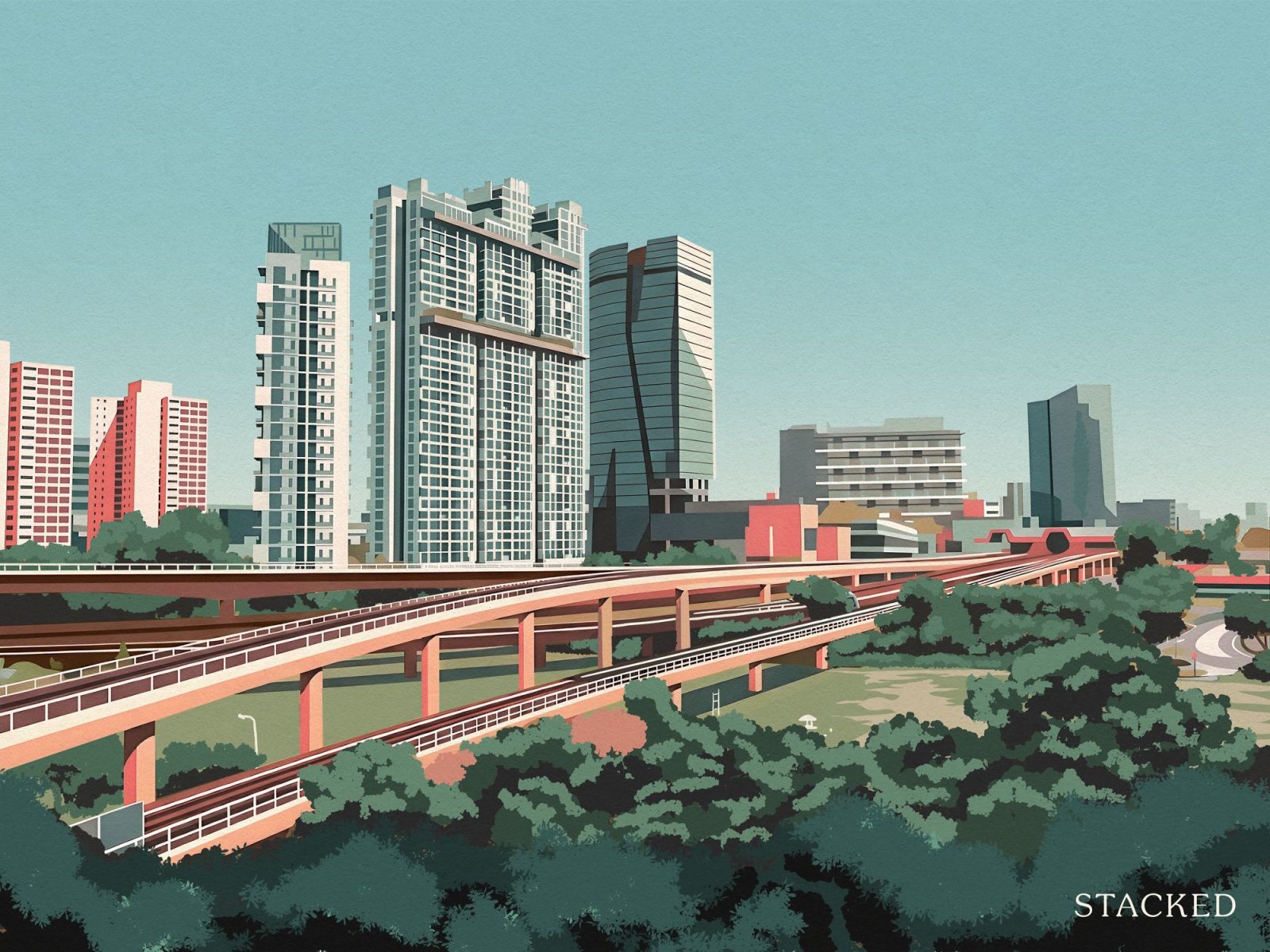
Jurong East is an interesting study for the HDB resale market considering how much urban transformation the region has seen in recent years. Until the 1990s, the region was characterised as a predominately industrial area; it was often considered far flung, inconvenient, and homes there were sometimes seen as a cheaper alternative compared to more central regions.
In 2026, Jurong East is now a major commercial hub and earmarked as Singapore’s second CBD, according to urban plans. How has this affected older flats in Jurong East, particularly those that predate the extensive changes?
In this week’s town-level deep dive, we focus on four-room and five-room flats in Jurong East.
Why are we skipping three-room flats this time around? Well for this town, these are the only flat sizes that met our minimum transaction thresholds, across both 2014 to 2019 and 2020 to 2025. Three-room flats only saw significant resale activity in recent periods, making a proper before-and-after comparison difficult.
That aside, one interesting factor, as we’ll see below, is that the ageing flats in Jurong East tend to hold up better than others in many mature towns.
Let’s examine this by seeing how prices changed after the inflection point where lease decay kicked in.
Note: For those of you who have just joined us, this article is a part of a series examining HDB ageing tendencies in different towns. The inflection point is the point in the lease where prices start to dip sharply. For more extensive details, see the start of the series here.



0 Comments