









Hi Stacked Homes,
My husband and I are in our mid-40s, and this is most likely the last private property purchase we can make. We recently sold our three-bedroom EC and made a good cash profit. We are now looking for our next property.
The question we’re struggling with is whether, given today’s sky-high prices, it still makes sense to buy into a new launch, or if we should consider a resale condo.
We are currently living in Tampines and need to stay in the same area, as our children are studying here.
Our main priority is to buy a four-bedroom condo. However, the four-bedroom units at newer launches in Tampines, such as Parktown and The Pinery, are beyond our reach and are already priced above $3 million. With a budget of around $2.2 to $2.6 million, we would only be able to afford a smaller three-bedroom unit at a new launch.
For resale condos, we are considering projects like The Arc at Tampines and CityLife @ Tampines, which offer larger four-bedroom units within our budget. That said, we are unsure which option would give us better gains if we were to sell in around 10 years, as we prepare for retirement.
Ultimately, we are hoping to strike a balance between having enough space for comfortable living now, while still achieving reasonable capital appreciation to support our retirement plans.
Hope you can provide your insights.
Hi, and thanks for reaching out to us!
We’re glad to hear that you were able to sell your EC unit at a healthy profit and now have room financially for your subsequent property purchase.
You’ve also raised some non-negotiable priorities, such as living in Tampines for your children and a strong preference for a four-bedder condo unit for long-term liveability.
You’ve also highlighted that new launches in the Tampines area typically see four-bedroom units going for more than $3 million, which is well beyond your budget of $2.2 million to $2.6 million. Realistically speaking, buying a four-bedroom unit in a new launch project for you would likely mean settling for a three-bedroom unit.
On the other hand, you’ve shared some resale options, which include projects like Arc at Tampines and CityLife @ Tampines. Both may offer the space you want that is also within your budget, but it raises the common resale questions of age and lease.
Rather than frame this as simply new versus resale (which can sometimes be an oversimplification), we would ask whether you prioritise space and comfort today, or want possible room to capture one more growth cycle before retirement. This ties into how much risk you’re willing to take, in what may be your final property run.
With that in mind, let’s look at the options.
So many readers write in because they're unsure what to do next, and don't know who to trust.
If this sounds familiar, we offer structured 1-to-1 consultations where we walk through your finances, goals, and market options objectively.
No obligation. Just clarity.
Learn more here.
Option 1: Buy a New Launch Project
If you choose a new launch project, you’re most likely to get a new 99-year leasehold project. And if you buy early during the sales period, you might see gains as early as when the condo receives its Temporary Occupation Permit (TOP). For a more nuanced take on why, you can read our article here.
In general, buying a new unit during the earlier sales phase of a new launch often (not always) means you get in at a lower price point, relative to others who might buy units later.
As an added caveat, during previous property market cycles, it was easier for buyers to see more substantial gains by the time a condo reached its TOP. However, today, we’re seeing somewhat elevated launch prices, which suggests future price and capital upside are likely to be more moderate going forward.
The gains are unlikely to be as impressive as we saw in, say, the years immediately following the Covid-19 pandemic.
The main challenge for you, when it comes to new launches, is pricing.
As mentioned, most new launches in this area – and in fact in many parts of Singapore today – tend to cross a price quantum of $3 million for a four-bedder. It is almost a certainty that, at your budget range, you’ll be forced to shop for a three-bedder alternative instead.
So the overall trade-off, if you choose this route, is that you give up living space in exchange for potential price growth.
A reference point for new launch pricing
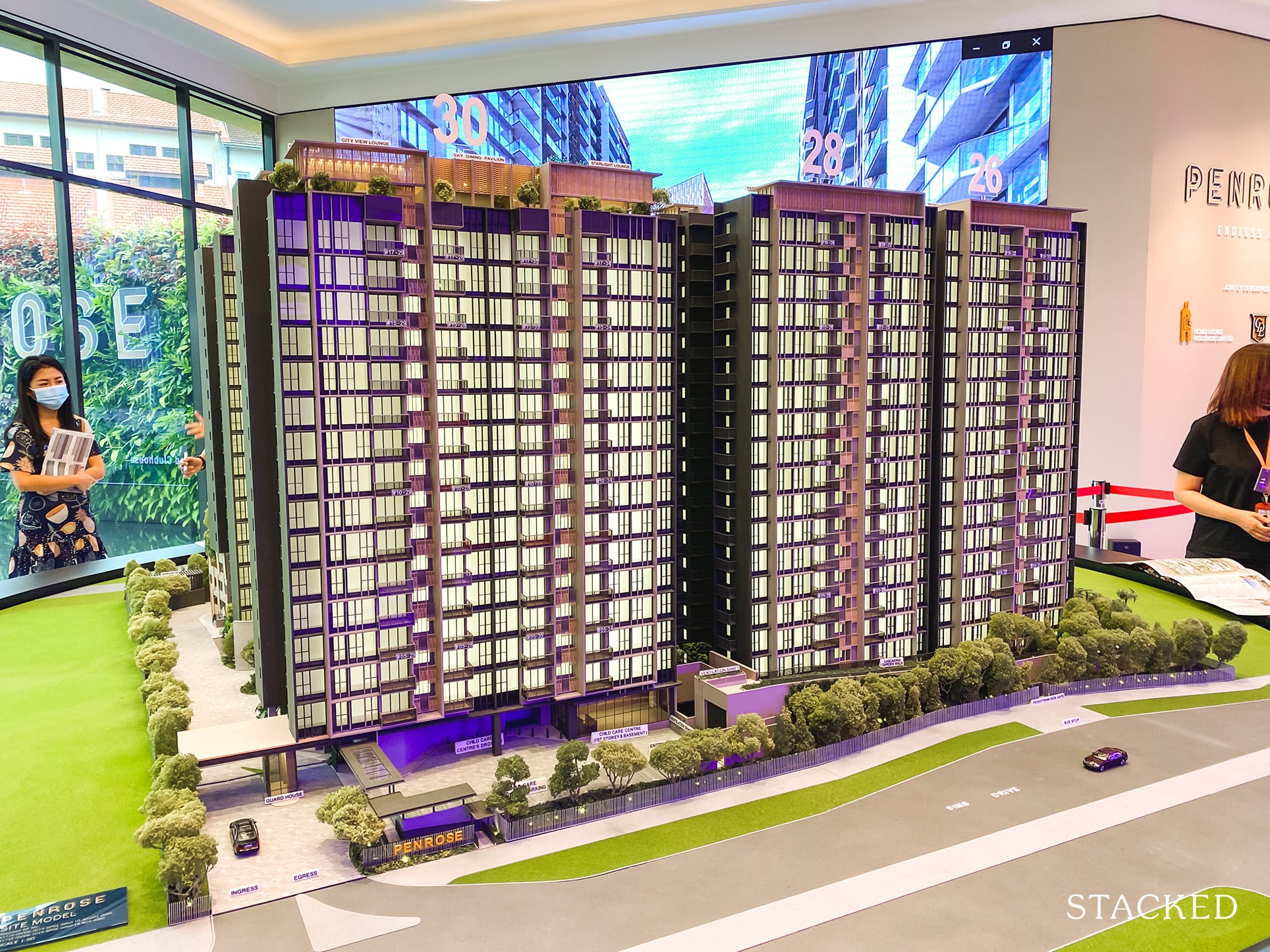
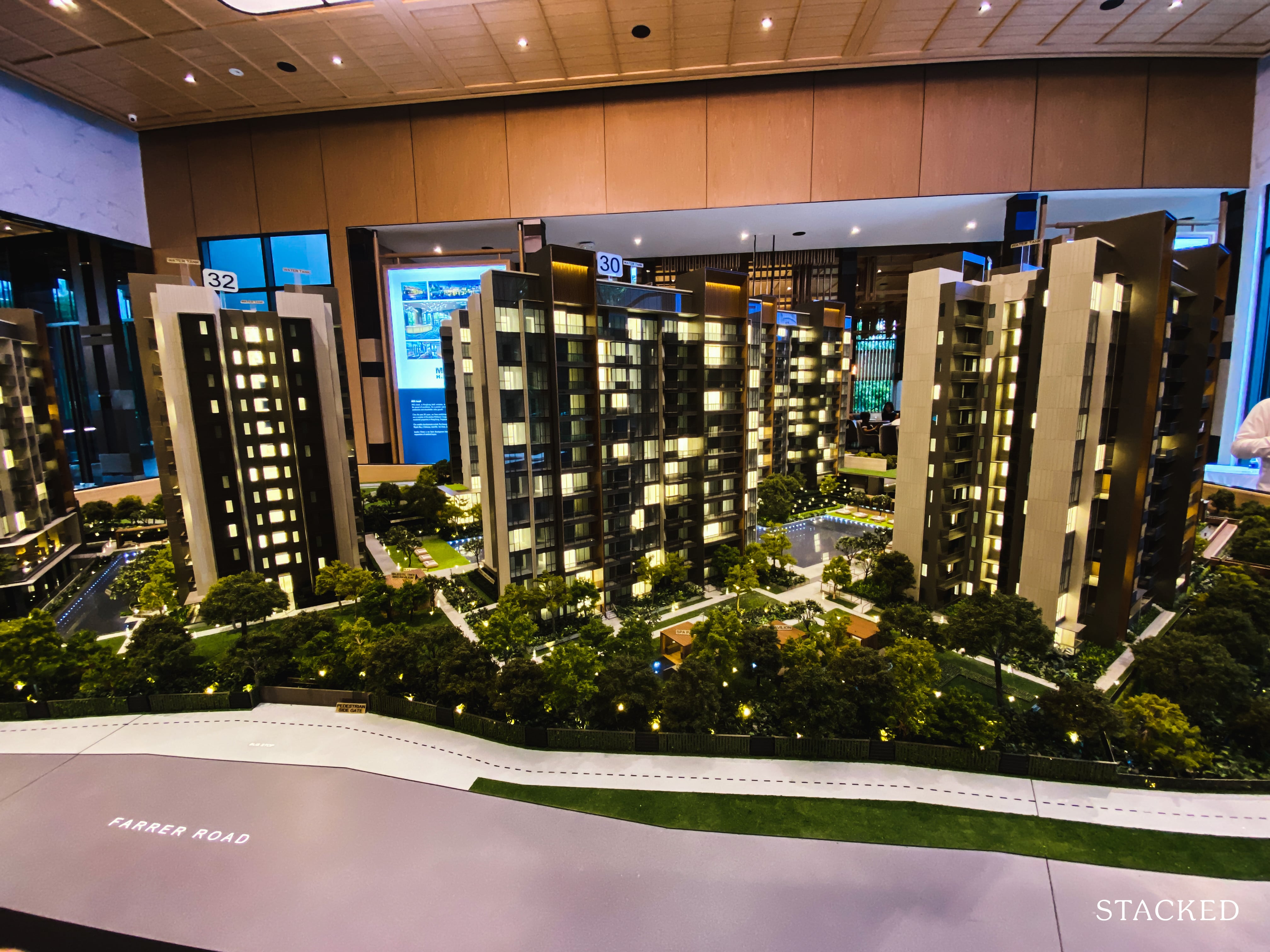
You mentioned The Pinery in your question, but as indicative pricing for The Pinery has not been released, we’ll use the most affordable three- and four-bedroom units at ParkTown Residence (as of Feb 20, 2025) as a reference point.
Parktown Residence is a 1,193-unit condo that launched in February last year. Read our full review of the development here, as well as our comprehensive analysis of the price. The project moved 1,041 units (87%) at an average price of $2,360 psf when it launched over the Feb 22-23 weekend last year. The condo has sold 1,122 units (94%) at an average price of $2,369 psf, based on caveats as of Feb 25.
| Unit type | $PSF starting from | Price starting from | Size starting from (sqft) |
| 3-bedroom | $2,385 | $2,542,000 | 1066 |
| 4-bedroom | $2,399 | $3,203,000 | 1335 |
As you can see, even three-bedders at Parktown Residence are already close to your upper limit of $2.6 million.
So, if you opt for a new launch, you would likely be stretching to afford a three-bedroom unit, with a limited financial buffer. Any unexpected expenses like renovation costs could have an outsized impact on your finances.
In contrast, a resale four-bedroom – kept within your budget – may offer greater financial breathing room over the next decade. Doubly so as you move closer to retirement.
How have recent new condo launches in Tampines performed?
We’ve mentioned that new launches can bring higher gains for the original owners. So let’s substantiate by examining how some newer condos in Tampines have performed so far.
| Year | The Alps Residences | The Tapestry | Treasure at Tampines | D18 99y non-landed private properties | All 99y non-landed private properties |
| 2016 | $1,080 | $983 | $1,166 | ||
| 2017 | $1,065 | $956 | $1,230 | ||
| 2018 | $1,157 | $1,384 | $1,125 | $1,359 | |
| 2019 | $1,222 | $1,336 | $1,339 | $1,199 | $1,474 |
| 2020 | $1,188 | $1,376 | $1,369 | $1,174 | $1,453 |
| 2021 | $1,273 | $1,490 | $1,410 | $1,193 | $1,517 |
| 2022 | $1,344 | $1,578 | $1,540 | $1,223 | $1,595 |
| 2023 | $1,414 | $1,646 | $1,647 | $1,344 | $1,783 |
| 2024 | $1,488 | $1,680 | $1,698 | $1,418 | $1,854 |
| 2025 | $1,520 | $1,702 | $1,769 | $1,868 | $2,092 |
| Annualised | 3.87% | 3.00% | 4.75% | 7.39% | 6.71% |
| Annualised growth rate of D18 99y non-landed private properties based on the respective launch year to 2025 | 7.39% | 7.52% | 7.67% |
| Annualised growth rate of all 99y non-landed private properties based on the respective launch year to 2025 | 6.71% | 6.36% | 6.02% |
Overall, we see steady average price growth of around 3–5%, although this performance trails the broader District 18 (D18) and Singapore-wide averages for 99-year leasehold condos.
This is partly because the three projects on our list launched at prices that were already above average for D18 condos at the time. This resulted in relatively weaker percentage gains (i.e., there wasn’t anything “wrong” with these condos per se.)
Nonetheless, the takeaway is this: If you buy into a project like Parktown Residence, or one priced at levels close to it, you will also be buying a property at a $PSF that’s above the district average. This will reduce your margins for future gains, in percentage and $PSF terms.
Option 2: Buying a resale four-bedder
Projects like Arc at Tampines and CityLife @ Tampines offer four-bedroom layouts within your budget. It’s also the case that most older developments tend to offer larger units compared to recent new condos.
The trade-off for the lower price is the age of the development, and potentially (though not always) plateauing price growth. In 10 years, the price appreciation of these projects is not likely to be as strong as what we’re seeing now.
That said, even after a decade, they will still have over 75 years left on their lease. So it’s unlikely that lease decay will result in any kind of sharp correction – not for a long time yet.
In our view, the resale option represents the more defensive strategy:
- More space and day-to-day comfort
- Lower entry pricing
- Probability of more slow-and-steady appreciation
We would like to add two minor concerns. The seller’s price may not always match the bank’s valuation of the unit, which may mean a slightly higher cash outlay at times. Also, depending on the condition of the resale unit, renovations might cost more than a new unit.
If you believe this is truly the last property you’ve planned to purchase, the drawbacks may pale in comparison to the stability and liveability that a resale four-bedder could provide.
Since you’ve mentioned Arc at Tampines and CityLife @ Tampines, let’s compare them more closely.
| Project | Lease start year | No. of units | Unit mix | Land size (sqm) |
| Arc at Tampines | 2011 | 574 | 2, 3, 4 | 20,600 |
| CityLife @ Tampines | 2012 | 516 | 2, 3, 4, 5 | 20,751 |
The attributes of both projects appear close on paper, although CityLife @ Tampines has fewer units and is on a slightly larger land plot.
Current 4-bedroom pricing (2025)
| Project | Avg 4-bedroom $PSF | Avg 4-bedroom price | Size range (sqft) | No. of units sold |
| Arc at Tampines | $1,413 | $1,836,667 | 1173 – 2282 | 3 |
| CityLife @ Tampines | $1,538 | $2,298,906 | 1152 – 3897 | 14 |
CityLife @ Tampines is the pricer of the two, but that’s unsurprising. You’re paying more for a closer proximity to Tampines MRT, which is on the East-West Line and Downtown Line (EWL, DTL), as well as the convenience of a cluster of malls in the area.
The most important thing is that four-bedder units in both projects are well within your budget.
We did mention that their price growth could be more moderate, so let’s check out the actual numbers.
| Year | Arc at Tampines | CityLife @ Tampines |
| 2015 | $743 | |
| 2017 | $856 | |
| 2018 | $921 | |
| 2019 | $934 | |
| 2020 | $907 | $1,023 |
| 2021 | $947 | $1,087 |
| 2022 | $1,097 | $1,224 |
| 2023 | $1,227 | $1,301 |
| 2024 | $1,338 | $1,446 |
| 2025 | $1,380 | $1,516 |
| Annualised | 6.39% | 8.19% |
CityLife @ Tampines appears to have delivered a stronger annualised growth compared to Arc at Tampines.
However, this isn’t an apples-to-apples comparison as resale units at Arc at Tampines entered the secondary market earlier. To make this more comparable, let’s look at how both projects performed over the same time frame, from 2020 to 2025.
| Year | Arc at Tampines | CityLife @ Tampines |
| 2020 | $907 | $1,023 |
| 2021 | $947 | $1,087 |
| 2022 | $1,097 | $1,224 |
| 2023 | $1,227 | $1,301 |
| 2024 | $1,338 | $1,446 |
| 2025 | $1,380 | $1,516 |
| Annualised | 8.76% | 8.19% |
Over a five-year period, the difference between the two condos closely matches. Price growth at Arc at Tampines pulls a little bit ahead, by less than a single percentage point. As such, it may be better to focus on practicalities (e.g., proximity to the MRT station and layout), rather than potential capital gains between the two.
Now let’s look ahead and consider: what’s a realistic outcome in the next 10 years?
Since you’re hoping for meaningful gains over the next 10 years to support retirement plans, the entry price and positioning are important.
The relatively newer condos in Tampines, like The Alps Residences, The Tapestry, and Treasure at Tampines, have delivered steady growth, but their returns from the sale of units bought at launch are lower than the resale performance of units ar CityLife @ Tampines and Arc at Tampines.
This is due to the entry price – as we mentioned, both The Alps and The Tapestry launched at prices above the district average at the time.
Another reason is the balance of supply and demand for private residential homes in that area.
Arc at Tampines, The Alps, and The Tapestry are located in a relatively concentrated condo cluster in Tampines. When there is a higher concentration of private homes like this, price growth tends to match the pace of growth in the broader market, rather than seeing any one project have dramatic or explosive growth.
Treasure at Tampines might fare differently as it has the distinction of being Singapore’s largest condo project, and was famously competitive on price when it launched. It also entered the resale market when sentiment in the property market was booming. That combination has resulted in a strong growth rate in terms of resale prices.
We feel similar traits can be found at CityLife @ Tampines. Its proximity to Tampines MRT and the surrounding malls gives it a stronger location – one where direct competing supply is more limited. That differentiation helps sustain its price and price growth over time.
That said, both new and resale options in Tampines are likely to deliver steady, market-aligned returns over the next 10 years. How new a development may be has less impact on its capital growth. Instead, it’s entry price and how well-differentiated it is from its neighbours are more significant factors.
Addressing age and “final run” risk
Talking about age is unpleasant, but let’s address the realities head-on. If you were in your early 30s, you might have more leeway to make better property choices in the future. You’d have time to ride through multiple property cycles, and higher possible gains might justify higher rewards.
But in your mid-40s, with this likely being your final major upgrade before retirement, more caution is needed. In 10 years, you may be thinking less about upgrading again, and more about:
- Liquidity
- Capital preservation
- Flexibility
This means the downside of overpaying hurts more than the upside from a few marginal gains. A lower entry price will protect you financially in a way that a pricier new launch couldn’t.
This doesn’t mean surrendering growth. It just means accepting slower but steadier appreciation, alongside a home that works for your family.
What should you do?
Your two core objectives are clear: a comfortable home for the next decade, and sufficient appreciation to support your retirement plans.
Looking at the data above, a resale four-bedroom aligns more naturally with that balance. In particular, CityLife @ Tampines stands out to us for several structural reasons.
The four-bedders are within your budget, and while the price performance is not too different from Arc at Tampines, it has proximity to Tampines MRT and the surrounding malls. This accessibility also tends to support sustained demand over time.
Supply dynamics also matter. CityLife @ Tampines is outside the relatively concentrated cluster of condos around Arc at Tampines, The Alps Residences, and The Tapestry, so it has fewer direct substitutes. Where there’s less competing supply, prices tend to be more resilient.
Note that we’re not saying a new launch three-bedder is entirely unsuitable; just that stretching for new launch status doesn’t always translate into stronger returns, and that the higher entry price may not be a good risk to take in your circumstances.
Ultimately, the right choice is the one you can hold comfortably, in the decades to come. With retirement planning in view, sustainability matters more than squeezing out gains.
At Stacked, we like to look beyond the headlines and surface-level numbers, and focus on how things play out in the real world.
If you’d like to discuss how this applies to your own circumstances, you can reach out for a one-to-one consultation here.
And if you simply have a question or want to share a thought, feel free to write to us at stories@stackedhomes.com — we read every message.


0 Comments