


























One of the worst feelings in the world is getting no responses to your listing, even if you’re in the mid-range of the latest property transactions. While you may be well-capitalised, there’s a definite opportunity cost when waiting – the price of your future home may be rising, and you can’t take availability for granted (especially for new launch condos). In light of that, here are some ways to set limits and decide when it’s better to take the lower offer and get moving:
Market commentary like this is only useful if you can translate it into what it means for your own purchase: your entry price, holding period and exit options.
That's where many buyers get stuck. General market insights rarely tell you whether a specific unit, at a specific price, is the right decision for your circumstances.
Over time, that's also why we decided to work with agents who shared the same data-driven and advisory-led approach behind our editorial, consultants who could help readers think through decisions more objectively, rather than simply push transactions.
Today, the team has worked with more than 2,000 clients across over $5B in property transactions.
1. It partly depends on whether you’re right-sizing or upgrading
In general, property prices will go higher the longer you wait. This is one of the main costs of leaving your listing up instead of accepting a lower offer. But here’s another point of consideration.
If you’re right-sizing, the cost of your replacement home is cheaper. In these instances, you can hold on for longer, as the quantum of your replacement unit is unlikely to become unmanageable. On the flip side, if your replacement home is pricier, then you may want to accept a lower price instead of waiting longer. For example:
Say you’re right-sizing from your condo to an HDB flat that costs $600,000. If prices were to rise by 15 per cent from waiting longer, this would be an increase of $90,000. But if your intended replacement property is a bigger condo priced at $1.8 million, then a 15 per cent increase means paying another $270,000.
So, if you want to wait for a higher offer, the opportunity cost tends to be smaller when right-sizing, but bigger when upgrading.
2. For ABSD remission, set monthly price reviews and beware of greed
If you decide to buy your replacement property before selling your previous home, you’ll need to pay the Additional Buyer’s Stamp Duty (ABSD) upfront.
But if you remain married and at least one of you is a Singapore citizen – and you’re able to sell your previous home within six months – you can attempt to claim ABSD remission. IRAS is quite unforgiving about this, and few appeals are accepted if you miss the six-month deadline.
In these instances, you should work with your agent to set a monthly price review. If there’s no interest despite marketing efforts, you may need to lower your price as early as the coming month.
(By marketing efforts, we mean you can see that your agent is putting up the listing, paying to boost it, and getting it to the top of the page on various portals).
It’s best not to get greedy here, as the ABSD (currently 20 per cent for Singapore citizens) will likely outweigh any slight increases in offers. E.g., 20 per cent ABSD on a $1.8 million condo is $360,000, and it’s improbable you’ll get an offer high enough to cover the loss on such a stamp duty.
3. You’re past the initial period of heightened interest
It’s sometimes possible that the highest offers are received earlier instead of later. Agents told us there’s a period of around one to two weeks, for example, when your listing may see higher interest and offers just on the basis of being new.
This typically happens when there are already people looking around your area. After a few months of seeing the same listings, a new listing popping up can garner significant attention. After about two weeks to a month, however, your listing blends in with the “old” crowd.
The hazard here is that, because the interest and offers come early, some sellers turn them down. The common mindset is that, if an offer comes within the first week, it’s “too early” and the seller would rather wait and see. But you need to accept the risk that, once the two-week novelty period wears off, subsequent offers may never reach the previous peak.
One agent noted the case of a condo which, in its early days of sale, drew a $3.2 million offer. After a few weeks, however, the offers dropped – and the next highest offer was just $3.08 million. The seller had to be convinced to see reason and understand that a $120,000 difference wasn’t worth losing their intended replacement home.
This is why it’s risky to reject offers just for being early. If you do so, you must brace for the possibility of a lower price later, once your listing is no longer a novelty.
4. When another similar unit sells for a lower price
Sometimes another unit on around the same floor, or with the same layout, sells for much lower than your asking price. This is a stroke of bad luck, as it sets (anchors) a lower price for prospective buyers. This is especially true for smaller, boutique projects, where there may be fewer other transactions to support your asking price.

There are some nuances to this. One agent noted that, if the price is clearly an outlier, you can consider ignoring it. If a unit transacts at an illogically low price (e.g., parents selling to children at way below valuation), most prospective buyers will acknowledge that it’s a unique situation, not applicable to other units.
But if the selling price is lower than yours by a reasonable range, such as $50,000 to $100,000 lower, you can expect that subsequent buyers will demand a similar price. In these instances, you may have no choice but to take the lower offer, as the cheaper sale has undermined you.
5. Financing issues can mean having to accept a lower price
This usually applies to older properties, although financing issues can also happen due to location, the state of the property, and other factors (e.g., housing loans may not be eligible for certain parts of Geylang).
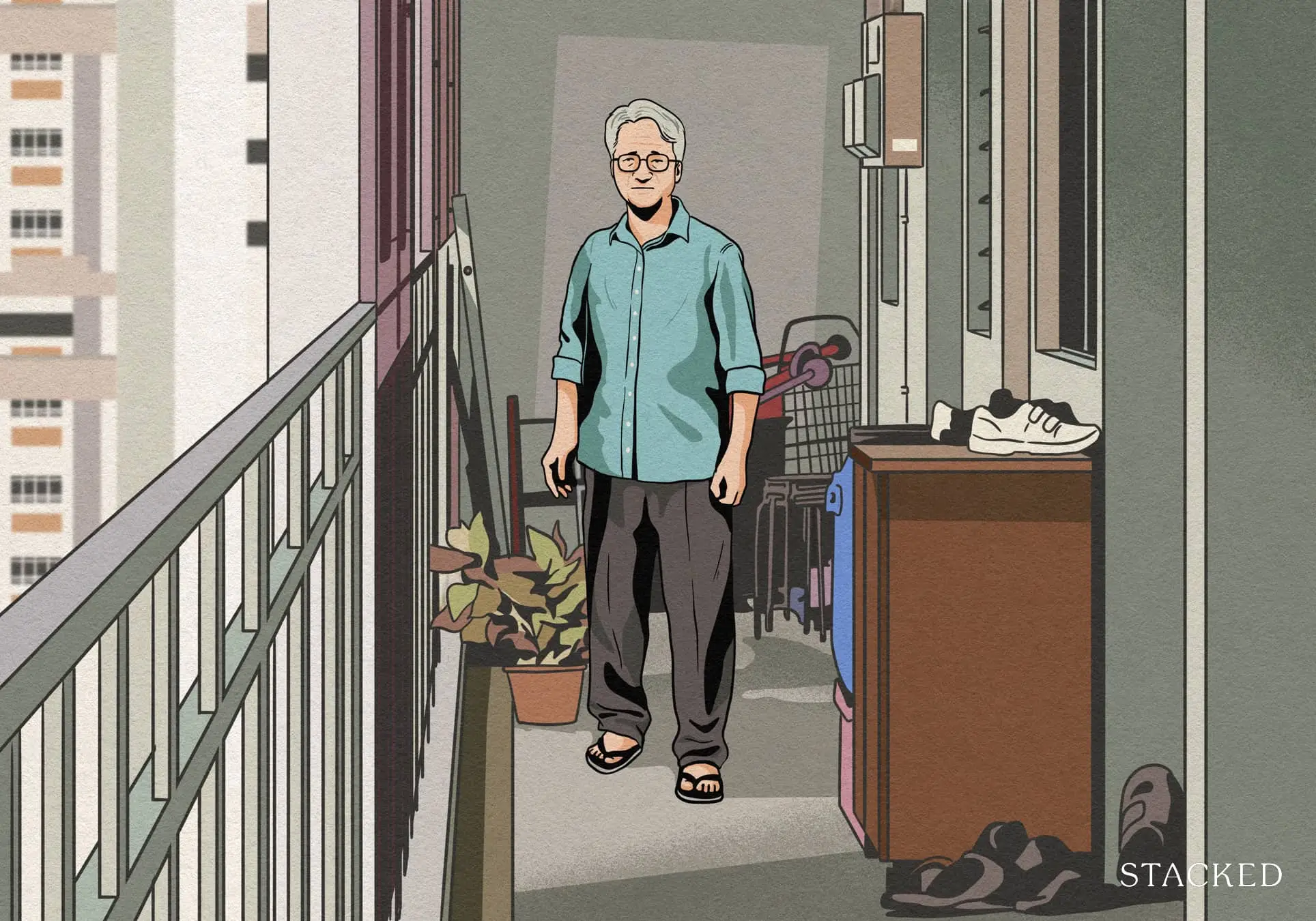
For the most part, though, the cause is age. For properties with 60 or fewer years on the lease, banks may lower the Loan-To-Value (LTV) limit to 55 per cent, and home loans are not usually possible for properties with 30 years or less on the lease*.
Now it could happen that your property crosses this point in age just as you’re about to sell. If so, you may experience a drastic decline in offers compared to previous transactions. This is a natural result of buyers facing a lower LTV and a higher cash outlay.
This is more common with older properties like leasehold walk-up apartments, though, as relatively few condos reach their 40th year. For these cases, there may be no choice but to accept a lower offer, as the longer you wait the worse it can get.
*Mortgage brokers have told us some alternatives exist, such as loans from non-banking financial institutions. However these types of FIs may have higher interest rates than banks.
Commentary like this is useful for understanding the broader market. The harder part is applying those ideas to a specific property, budget or decision you’re actually considering.
That’s often where a second opinion becomes valuable.
If you’d like to discuss how this applies to your own circumstances, you can reach out for a one-to-one consultation here.
And if you simply have a question or want to share a thought, feel free to write to us at stories@stackedhomes.com. We read every message.



1 Comments
Thanks, Ryan. The article is insightful. May I share my experience selling a landed house for right sizing purposes. My first agent, a high flyer with one of top agency handled my house sale in prime CCR and received only 3 offers within 6 months. Those offers were at least 20-25% lower than valuation. Thereafter, I switched agency and my house was sold at valuation within a month. It was a rewarding experience for the wait as the price difference is millions. Guess getting the right agent is equally important too.