











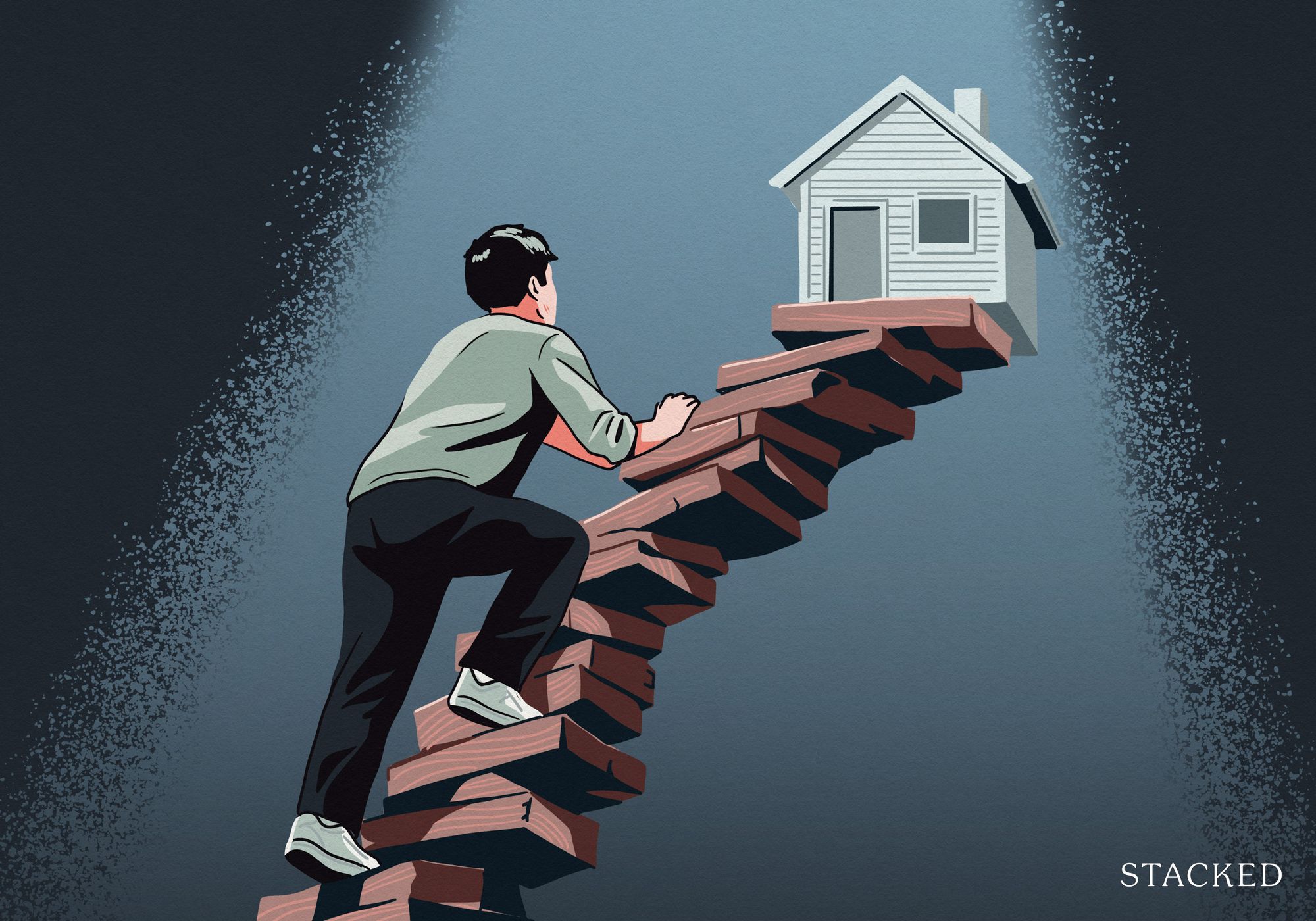





On Thursday, Feb 12, we hear Prime Miister Lawrence Wong deliver his Budget 2026 message in parliament. But as far as the housing market goes, you might notice housing policies took a back seat this time around. Does that mean there’s nothing for us to dissect?
There was no mention of HDB flats, Executive Condos (ECs), or private home prices in Budget 2026. To some, that’s going to be disappointing. From online conversations and realtor discussions, I know there was a lot of hope around the idea of raised income ceilings; particularly for the ever pricier ECs.
However, I would argue that the lack of explicit mention regarding housing is in itself telling.
It was just a few years ago that affordability in the public housing market, andhow many flats HDB was going to build, was a near-constant messaging from the government. You might notice that’s been missing of late (and not just from speeches, I bet you’ve stopped seeing it in void deck message boards too).
Here’s why that may be, along with some other take-aways from Budget 2026.
More supply, more flats reaching MOP, less urgency to intervene
A reason why housing wasn’t as prominent in this year’s budget could be that the alarm bells have largely fallen silent from the government’sperspective. In our review of the HDB market in 2025, we noticed there was finally some moderation in price growth after the hectic aftermath of the Covid-19 pandemic.
For example, over the first nine months of 2025, HDB resale prices rose by just 2.9%, as opposed to the 6.9% increase over the same period in 2024. And full-year price growth this year is expected to land at around 2 – 4% this year.
This is largely attributed to the substantial increase in new public housing supply. In 2025, the government launched close to 30,000 Build-To-Order (BTO) and Sale of Balance Flats (SBF) across three sales exercises. If we go back over five years, around 102,000 BTO flats have been launched, averaging over 20,000 units a year.
Coupled with a bumper crop of around 13,400 flats expected to complete their MOP in 2026, and you can see why the momentum in resale price growth is slowing.
Taken together, the data suggests that the earlier supply interventions are taking their full effect. The reason we may not hear that in the budget speech is simply because it’s not the place for crowing; and the silence is doing a lot of heavy lifting.
As for singles though, well, that’s where things get a bit spicy. There are more two-room options being built, and in Prime and Plus housing too, and the message seems to be that singles enjoy more housing options than ever. I know quite a few who might disagree, and it’s unfortunate that Budget 2026 didn’t touch the issue at all.
Raised income ceilings did not make the cut, as many hoped and expected
For a bit of background on this, especially with regard to ECs, I suggest you check out my earlier round of griping. But to quickly summarise, new launch EC prices have reached a point where, to meet the Mortgage Servicing Ratio (MSR) at the given income ceiling of $16,000, you can’t get full financing. Your initial cash outlay will have to be considerably higher.
With regard to the $14,000 income ceiling for HDB flats, consider that the median household income is now above $12,000. This is not that far below the income ceiling anymore, and quite a few people I’ve spoken to were expecting the government to make some revisions here.
On the surface, it does seem obvious why it’s time to do this. Besides the financing issues for ECs, it could be argued that when people with higher incomes are ineligible, they are more thn likely to turn to the resale or private market. This causes prices to rise in either of those property segments, thus heating up demand in the market that is already living through the effects of rapid price increases in the post Covid-19 pandemic period.
But consider the flip side of raising the income ceiling.
The moment the ceiling is lifted, a larger pool of households will become eligible. Now there could be more dual-income households balloting, and this demographic which was once channeled toward resale or private housing, will now be competing with the rest of the HDB market for flats as well. This has immediate consequences for BTO application rates and competition.
Also, it’s not as if their demand evaporates if they fail at balloting. After a few tries, these relatively more affluent households typically return to the resale market and it still pushes up prices there.
I get that keeping the income ceilings is highly annoying right now, especially among a sandwiched-class of buyers who feel intensely squeezed.
But speculatively speaking, the authorities seem reluctant to do it now when the system has just shown signs of stabilising, and we don’t know if expanding the pool of eligible buyers at this stage could undo some of that progress.
That said, I find it hard to imagine that the income ceilings will remain static for much longer. They will have to go up in the near future, if our household incomes continue to increase at the same pace.
Which brings me to the wage support policies of Budget 2026.
When considering this year’s Budget statement, I feel that it pays to look at the previous year’s Budget statement as well, and maybe a few of the ones before. This avoids a narrow episodic view and it makes any pivots clearer.
In Budget 2024 and Budget 2025, there was more emphasis on providing immediate relief because we were still reeling from the inflation after the Covid-19 pandemic.
At the time, cost-of-living support through CDC vouchers, utility rebates, and cash payouts were relatively more abundant, but their effects were inherently temporary. Perhaps we could characterise that was us metaphorically bailing water out of the boat.
With 2026 however, I argue that we have the time to start plugging the actual holes (metaphorically speaking). This year’s budget has relatively fewer direct handouts compared to the previous years and there is a stronger emphasis is on various wage support policies.
Under the Progressive Wage Credit Scheme, the Government will now co-fund 30% of wage increases in 2026, up from 20% previously; and the scheme has been extended by another two years to 2028.
From July 2026, the Local Qualifying Salary will rise from $1,600 to $1,800, affecting firms that hire foreign workers. While more directly a form of labour policy, its downstream effect will uplift local wages, particularly in lower- and middle-income segments.
From a housing perspective, this is an indirect but important shift.
One-off vouchers may help with day-to-day expenses, but they have very little impact on housing affordability. Sustained wage growth, on the other hand, directly affects loan eligibility, affordability, and the confidence in becoming a homeowner.
As the Mortgage Servicing Ratio (MSR) and Total Debt Servicing Ratio (TDSR) suggest, stable income is the major determinant of which homes are within your reach.
Mind you, this is the kind of thing that makes me prepare to duck when I say it, because I know it’s of little immediate comfort. Wage policies take a long time to filter through, there’s no immediate pain relief.
But as a statement of direction, Budget 2026 is a start on the next phase of housing stability. Hopefully one that successfully shores up incomes, thus lowering the need for heavy-handed housing policies in the future.
So, while there were no attention-grabbing headlines for the residential market this time around, but Budget 2026 seems to imply the system is, for now, moving in the direction policymakers want. Whether it’s going as smoothly as expected, is something we’ll see later in this year or the next.
Follow us on Stacked, and we’ll keep you updated.
-END-
At Stacked, we like to look beyond the headlines and surface-level numbers, and focus on how things play out in the real world.
If you’d like to discuss how this applies to your own circumstances, you can reach out for a one-to-one consultation here.
And if you simply have a question or want to share a thought, feel free to write to us at stories@stackedhomes.com — we read every message.
Frequently asked questions
Why was housing not a major focus in Budget 2026?
Did Budget 2026 include any changes to income ceilings for housing schemes?
How has the increase in new public housing supply affected the housing market?
What is the impact of not raising income ceilings on the housing market?
How does Budget 2026 aim to support wages and what is its significance for housing?


0 Comments