

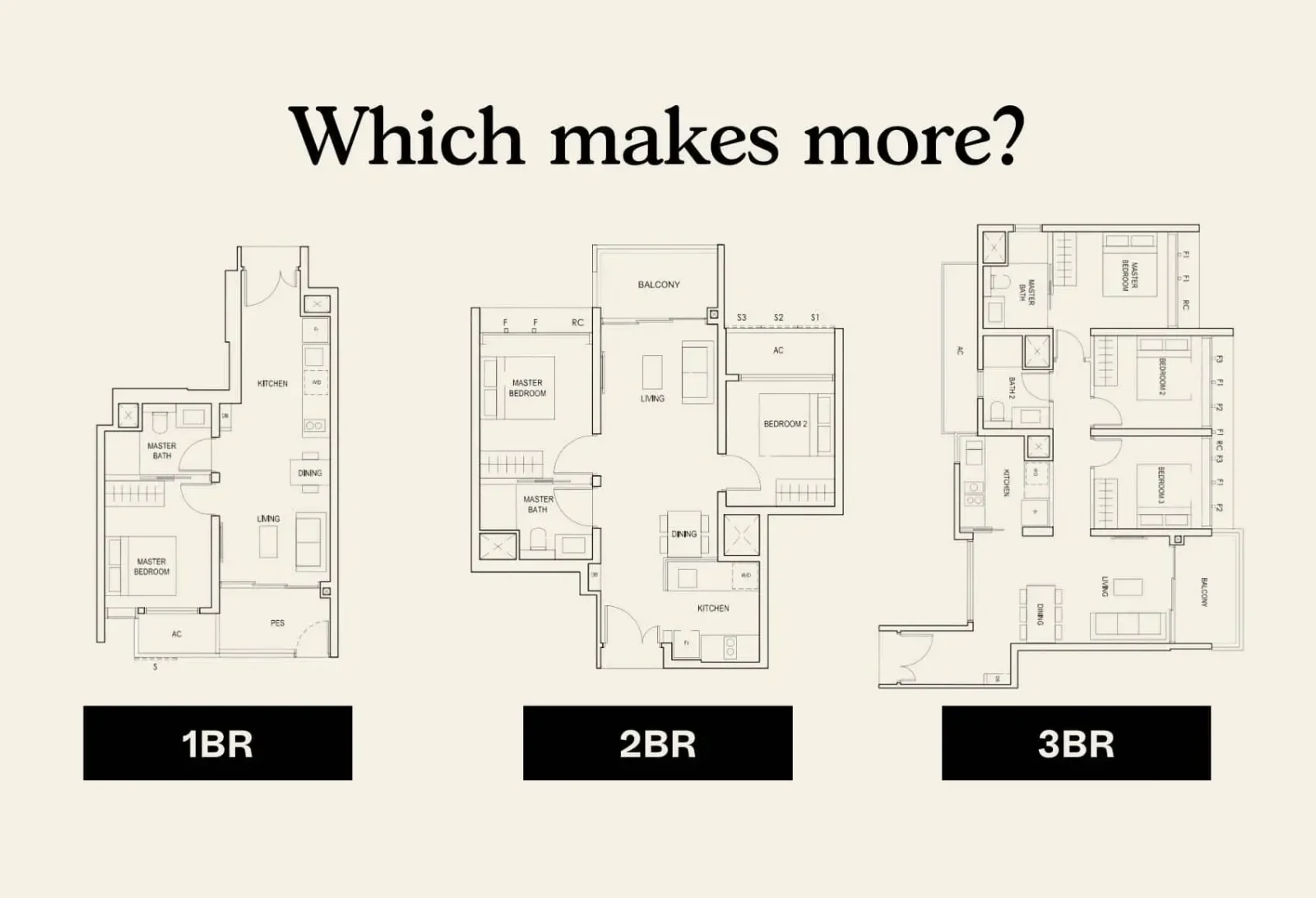
Some property buyers swear by family-sized units (i.e., three-bedders or bigger), whereas others believe in low quantum one and two-bedders. But as far as returns go, which of these unit sizes is actually better for investment? It’s worth a look since the property market has changed a lot, from the shoebox craze in the 2010s to the growing preference for larger homes in the past decade:
The challenge for many buyers today isn't access to information.
It's interpreting that information in a way that makes sense for their finances, goals, and stage of life.
Over time, that's also why we decided to work with agents who shared the same data-driven and advisory-led approach behind our editorial, consultants who could help readers think through decisions more objectively, rather than simply push transactions.
Today, the team has worked with more than 2,000 clients across over $5B in property transactions.
A broad overview of performance
For this study, we compared 65 projects and a total of 2,321 transactions. These 65 projects were considered as we had bedroom information readily available. Considering they were launched within the past decade and had sufficient transactions for our analysis, we decided to use this dataset.
The earliest of these transactions was in Martin Modern in 2017, so we’re only looking at transactions that occurred within the past five to six years as anything before that would be subject to different environments (cooling measures, etc). We only looked at transactions that were from new launch to resale, or new launch to sub sale, as the other transaction types (e.g., sub sale to resale, or resale to resale) only made up 10 transactions, which is too low a volume to consider.
| Bedrooms | Avg. Profit ($) | Avg. Profit (%) | Avg Annualised (%) | Avg. Holding Period | No. of Buy/Sell Tnx |
| 1 | $120,787 | 16.0% | 3.7% | 4.1 | 575 |
| 2 | $213,483 | 19.1% | 4.6% | 4.0 | 1,100 |
| 3 | $367,224 | 24.3% | 5.8% | 3.9 | 646 |
This is largely in line with expectations. Larger units tended to see a higher return, with three-bedders having an ROI that’s almost 50 per cent more than one-bedders; and whilst three-bedders have a shorter holding period, it’s not by a significant margin.
From the opinions of realtors, which we’ve pointed out in many articles, this is due to the majority of condo buyers being HDB upgraders. As upgraders are almost always family units, they don't have much use for small one and two-bedders.
But are the results the same across different regions?
One of the theories you might hear is that, in the CCR, one-bedders can do much better than in the OCR. This is on the basis that more singles, as well as more investors who want to rent to single expats, are more interested in CCR.

So to see if there’s any real difference based on region, we took a look at how these unit sizes perform in the CCR, RCR, and OCR:
| Bedroom | segment | Avg. Profit ($) | Avg. Profit (%) | Avg Annualised (%) | Avg. Holding Period | No. of Buy/Sell Tnx |
| 1 | CCR | $97,624 | 7.5% | 2.0% | 3.4 | 12 |
| RCR | $146,924 | 16.7% | 3.9% | 4.1 | 158 | |
| OCR | $111,277 | 16.0% | 3.7% | 4.1 | 405 | |
| 2 | CCR | $166,576 | 9.8% | 2.4% | 4.0 | 48 |
| RCR | $244,253 | 19.6% | 4.7% | 3.9 | 491 | |
| OCR | $190,566 | 19.4% | 4.6% | 4.0 | 561 | |
| 3 | CCR | $456,174 | 17.7% | 3.7% | 4.4 | 42 |
| RCR | $409,946 | 24.5% | 6.0% | 3.8 | 203 | |
| OCR | $336,281 | 24.9% | 6.0% | 3.9 | 401 |
Clearly, the theory doesn’t hold up. Notice that all the unit sizes, even the one and two-bedders, actually perform better in the OCR than in the CCR. Besides this, the pattern is consistent with the broad overview: the three bedders still perform best, followed by two-bedders and one-bedders.
As an aside, do note that performance between the OCR and RCR is very close; this may be worth keeping in mind when you come across statements like “shoeboxes in the OCR are the worst.” Percentage-wise, the results here suggest they’re no better or worse than RCR shoeboxes.
(But that being said, the RCR does have a higher average profit in absolute numbers)
Next, we look at a breakdown based on specific projects:
| Project | 1BR | 2BR | 3BR |
| AFFINITY AT SERANGOON | 3.1% | 3.5% | 4.2% |
| AMBER PARK | 3.0% | 2.9% | 3.6% |
| AVENUE SOUTH RESIDENCE | 4.0% | 3.3% | 4.6% |
| FORETT AT BUKIT TIMAH | 0.7% | 5.4% | 7.1% |
| FOURTH AVENUE RESIDENCES | 1.1% | 2.7% | 4.1% |
| JADESCAPE | 4.5% | 5.4% | 6.2% |
| KENT RIDGE HILL RESIDENCES | 3.5% | 2.8% | 3.1% |
| KOPAR AT NEWTON | 3.0% | 3.1% | 4.1% |
| MAYFAIR GARDENS | 2.1% | 2.0% | 2.6% |
| MAYFAIR MODERN | 4.5% | 2.1% | 3.5% |
| MIDWOOD | 6.6% | 5.5% | 5.8% |
| PARC CLEMATIS | 5.0% | 5.7% | 7.6% |
| PARC ESTA | 4.1% | 5.9% | 7.3% |
| PARC KOMO | 2.9% | 4.4% | 4.3% |
| PARK COLONIAL | 3.6% | 3.5% | 5.1% |
| PENROSE | 3.0% | 6.4% | 8.3% |
| RIVERFRONT RESIDENCES | 3.8% | 4.2% | 5.7% |
| SENGKANG GRAND RESIDENCES | 2.7% | 4.0% | 5.0% |
| SKY EVERTON | 2.6% | 1.1% | 3.0% |
| STIRLING RESIDENCES | 4.6% | 4.9% | 6.2% |
| THE FLORENCE RESIDENCES | 3.6% | 4.6% | 5.6% |
| THE JOVELL | 4.4% | 4.1% | 5.1% |
| THE LINQ @ BEAUTY WORLD | 6.8% | 9.3% | 7.9% |
| THE TAPESTRY | 2.4% | 3.4% | 5.2% |
| TREASURE AT TAMPINES | 4.3% | 4.7% | 6.3% |
| WHISTLER GRAND | 5.2% | 6.3% | 7.7% |
The same pattern still shows, with three-bedders generally outperforming smaller counterparts in most projects. There is the occasional exception though, such as The Linq @ Beauty World, where two bedders saw a higher ROI (9.3 per cent) versus three-bedders (7.9 per cent); but this irregularity could be an outlier, as there was only a single transaction for each of the one and three-bedder units there.
The advantage of one or two-bedders may be in rental yields rather than resale
For the above, we have looked only at profits upon resale. We haven’t taken into account any additional gains from rental.
For smaller units, rental yields tend to be higher, because of the lower quantum. (e.g. a $900,000 shoebox unit, rented out at $2,800 per month, would give you a gross rental yield of 3.7 per cent. A $1.8 million three-bedder unit, rented out at $4,500, has a gross yield of about three per cent.)
After you add rental gains to the equation, it’s still possible for a one or two-bedder to ultimately outperform a larger counterpart. However, this is immaterial to an owner-occupier or owner-investor, who has no intention to rent out the unit; so if you fall into such a category, you’re better off getting a bigger unit if you can.
Also, several realtors have expressed that - profits aside - three-bedders or larger units are generally quicker to sell. When it comes to resale, it’s a much smaller group of buyers (some retirees, lifelong singles, and other investors) who would consider a one or two-bedder.
The ubiquitous 4-room flat is about 960 to 1,000 sq. ft., and this is the size that most Singaporeans consider to be sufficient for a family. This is about the size of a three-bedder, among condos built since the 2010s.
At Stacked, we like to look beyond the headlines and surface-level numbers, and focus on how things play out in the real world.
If you'd like to discuss how this applies to your own circumstances, you can reach out for a one-to-one consultation here.
And if you simply have a question or want to share a thought, feel free to write to us at stories@stackedhomes.com. We read every message.




0 Comments