

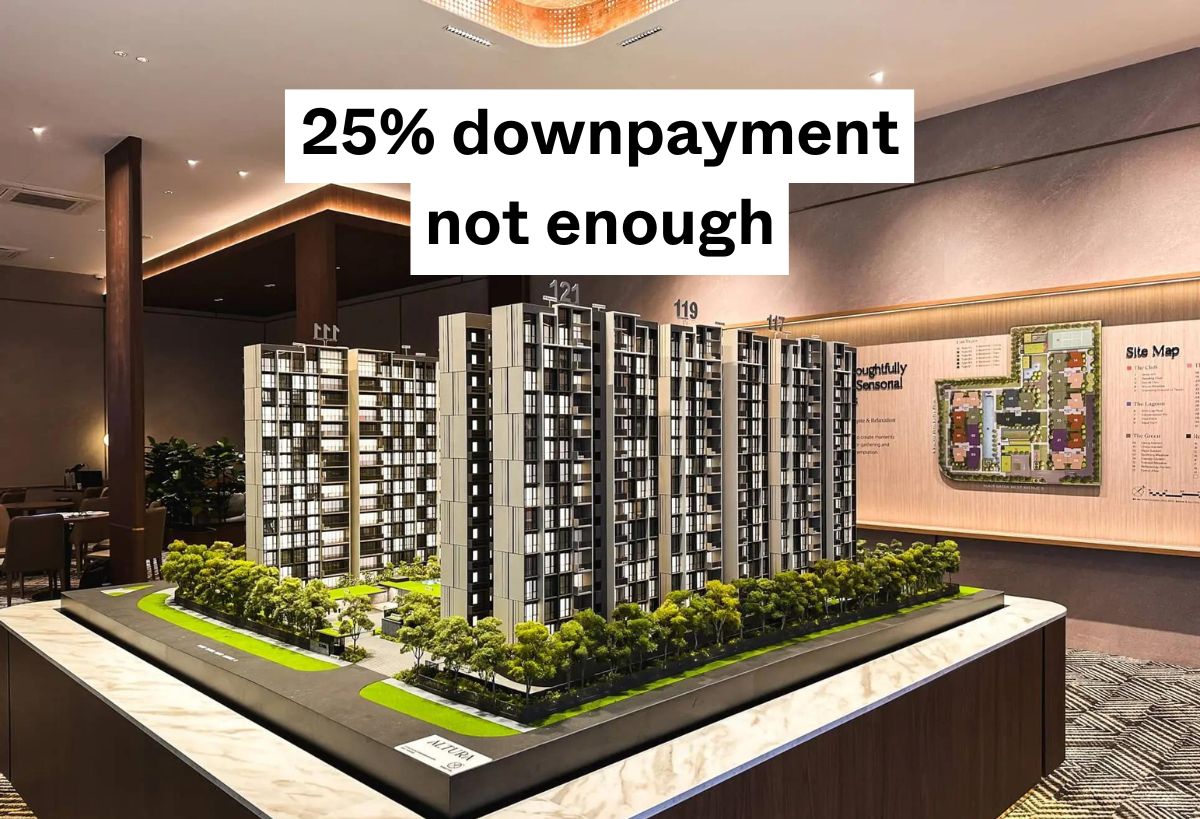
"False ceiling" is now a term we can apply to an interior design feature, and the cash minimums for Executive Condos (ECs). Right now the income ceiling to buy one is $16,000 per month, up from $14,000 (the previous ceiling from 2015 to 2019). This matters for more than just eligibility reasons.
When you buy an EC, the Mortgage Servicing Ratio (MSR) requires that the home loan cannot exceed 30 per cent of your monthly income. If you have a combined income of $16,000 a month (the ceiling), this sets your maximum home loan repayment to $4,800 per month.
Now using the floor rate of four per cent per annum, for a 25-year loan, limits your maximum loan amount to $910,000.
The maximum loan for a private property is 75 per cent of the price or valuation (whichever is lower. For new launches, the price and valuation are the same). For an EC priced at $1.3 million, this comes to a maximum loan of $975,000. Do you see the issue that's arising here?
As mentioned above, you need the loan quantum to stay at or under $910,000, to keep within the MSR (while staying at or under the ceiling of $16,000 per month). So for the $1.3 million EC unit, you pretty much have to take a loan that's under the 75 per cent maximum.
Now I'm all for erring on the side of safety, not having too many overleveraged buyers, etc. But consider that EC prices have continued to rise over the years, and will continue to do so. With progressively bigger down payments required, the sandwich classes are going to feel a tighter squeeze; and it's going to take longer for upgraders to save up the needed funds. It might also prompt upgraders to push for increasingly higher prices for their resale flats, to help them with bigger down payments.
The challenge for many buyers today isn't access to information.
It's interpreting that information in a way that makes sense for their finances, goals, and stage of life.
Over time, that's also why we decided to work with agents who shared the same data-driven and advisory-led approach behind our editorial, consultants who could help readers think through decisions more objectively, rather than simply push transactions.
Today, the team has worked with more than 2,000 clients across over $5B in property transactions.
Then again, there's the argument that keeping the income ceiling forces developers to price ECs reasonably
Maybe the government is applying lessons from the DBSS situation. There was a time when new DBSS flats crept to $700,000 or more, a price tag which was quite the shocker back in the 2010s or earlier. There's also the argument that, given how ECs require bank loans (yes, there are no HDB loans for ECs), perhaps it is best if the loan quantums are lower. Many private bank loans have variable rates, so any sudden spikes could mean financial problems for some EC owners.
Nonetheless, I suspect an upward revision in income ceilings - for both HDB flats and ECs - may come about soon, in light of strong inflation. Give me a shoutout and let me know what you think.
And now, a moment to talk about literal ceilings...and the leaks
An incident this week, along with personal experience, prompts me to point out something about home content insurance. This type of insurance is not the same as your fire insurance or mortgage insurance; it covers the stuff that's in your house (e.g., your fridge, TV, camera, and so forth).
This might also be the same kind of insurance you end up needing if a leak from the upstairs unit destroys something. If you're lucky, it's just a wet sofa or bed. But I've come across situations where it gets far worse than that. Water drips and ruins electronics, like a pricey TV, or a laptop on a desk. In the case of my own unit, dripping water wrecked a painting with a five-digit price tag, despite it being in a supposedly secure frame (thanks, framer).
Now just so you know: even if you have home content insurance, most of the policies have an absolute cap on the amount claimable per item. You might be able to claim just $500 on a wrecked $1,200 laptop, or a $70,000 stamp collection. I would really, really check the claim limits before I put full trust into the insurance policy, and the ceiling.
(If the coverage isn't enough, maybe it's time to buy a small safe for collectables.)
Meanwhile in other serious property news...
- Cheap and new is not a combination that usually goes together; but we found that in these four-bedder condo units, that go from $2.15 million.
- The property market is ever-changing, and here are some of the factors we might see in 2025.
- What affects the price of a condo? Sure, nearby competition, maintenance, MRT stations, and whatnot. But an overlooked factor is the landed enclaves nearby.
- As it turns out, ground-floor units may not be as undesirable or unprofitable as some industry experts may claim.
- Custom cabinetry: it's something to rethink, because a nice wooden container may not be worth an extra year or two of debt.
Weekly Sales Roundup (30 December - 05 January)
Top 5 Most Expensive New Sales (By Project)
| PROJECT NAME | PRICE S$ | AREA (SQFT) | $PSF | TENURE |
| WATTEN HOUSE | $6,178,000 | 1851 | $3,337 | FH |
| LENTOR MANSION | $3,223,000 | 1485 | $2,170 | 99 yrs (2023) |
| PINETREE HILL | $3,031,000 | 1216 | $2,492 | 99 yrs (2022) |
| THE MYST | $2,933,000 | 1518 | $1,932 | 99 yrs (2023) |
| HILLOCK GREEN | $2,872,000 | 1346 | $2,135 | 99 yrs (2022) |
Top 5 Cheapest New Sales (By Project)
| PROJECT NAME | PRICE S$ | AREA (SQFT) | $PSF | TENURE |
| THE COLLECTIVE AT ONE SOPHIA | $1,173,000 | 431 | $2,724 | 99 yrs (2023) |
| SORA | $1,568,000 | 732 | $2,142 | 99 yrs (2023) |
| HILLOCK GREEN | $1,583,000 | 657 | $2,411 | 99 yrs (2022) |
| SORA | $1,649,000 | 732 | $2,253 | 99 yrs (2023) |
| THE ARDEN | $1,837,000 | 1012 | $1,816 | 99 yrs (2023) |
Top 5 Most Expensive Resale
| PROJECT NAME | PRICE S$ | AREA (SQFT) | $PSF | TENURE |
| LEEDON RESIDENCE | $5,950,000 | 2110 | $2,820 | FH |
| 11 AMBER ROAD | $4,880,000 | 2842 | $1,717 | FH |
| V ON SHENTON | $4,250,000 | 1765 | $2,408 | 99 yrs (2011) |
| THE INTERLACE | $3,850,000 | 3208 | $1,200 | 99 yrs (2009) |
| PARC MONDRIAN | $3,300,000 | 2368 | $1,394 | FH |
Top 5 Cheapest Resale
| PROJECT NAME | PRICE S$ | AREA (SQFT) | $PSF | TENURE |
| GUILLEMARD EDGE | $720,000 | 409 | $1,760 | FH |
| RIPPLE BAY | $735,000 | 484 | $1,517 | 99 yrs (2011) |
| HIGH PARK RESIDENCES | $775,000 | 452 | $1,714 | 99 yrs (2014) |
| PARC RIVIERA | $805,000 | 463 | $1,739 | 99 yrs (2015) |
| NORTHVALE | $810,000 | 689 | $1,176 | 99 yrs (1995) |
Top 5 Biggest Winners
| PROJECT NAME | PRICE S$ | AREA (SQFT) | $PSF | RETURNS | HOLDING PERIOD |
| 11 AMBER ROAD | $4,880,000 | 2842 | $1,717 | $2,580,000 | 16 Years |
| LEEDON RESIDENCE | $5,950,000 | 2110 | $2,820 | $1,902,772 | 12 Years |
| VILLA MARINA | $2,350,000 | 1625 | $1,446 | $1,720,000 | 18 Years |
| RIDGEWOOD | $3,230,000 | 1744 | $1,852 | $1,280,000 | 13 Years |
| BISHAN PARK CONDOMINIUM | $1,960,000 | 1475 | $1,329 | $1,110,000 | 15 Years |
Top 5 Biggest Losers
| PROJECT NAME | PRICE S$ | AREA (SQFT) | $PSF | RETURNS | HOLDING PERIOD |
| MARINA BAY RESIDENCES | $2,100,000 | 1130 | $1,858 | -$386,000 | 17 Years |
| ROBIN SUITES | $1,280,000 | 549 | $2,332 | -$135,776 | 11 Years |
| SKYSUITES@ANSON | $1,459,000 | 700 | $2,085 | $23,500 | 13 Years |
| THE CLIFT | $963,000 | 495 | $1,945 | $63,000 | 3 Years |
| PENROSE | $906,000 | 474 | $1,913 | $112,000 | 4 Years |
Transaction Breakdown

For more on the Singapore property market, follow us on Stacked.
At Stacked, we like to look beyond the headlines and surface-level numbers, and focus on how things play out in the real world.
If you'd like to discuss how this applies to your own circumstances, you can reach out for a one-to-one consultation here.
And if you simply have a question or want to share a thought, feel free to write to us at stories@stackedhomes.com. We read every message.



4 Comments
You must declare your high value items beyond the single item limit to your insurer. They can choose to accept the risk and state that it is covered in the policy.
“The minimum loan for a private property is 75 per cent of the price or valuation (whichever is lower. For new launches, the price and valuation are the same).”
You probably mean ‘maximum loan’