

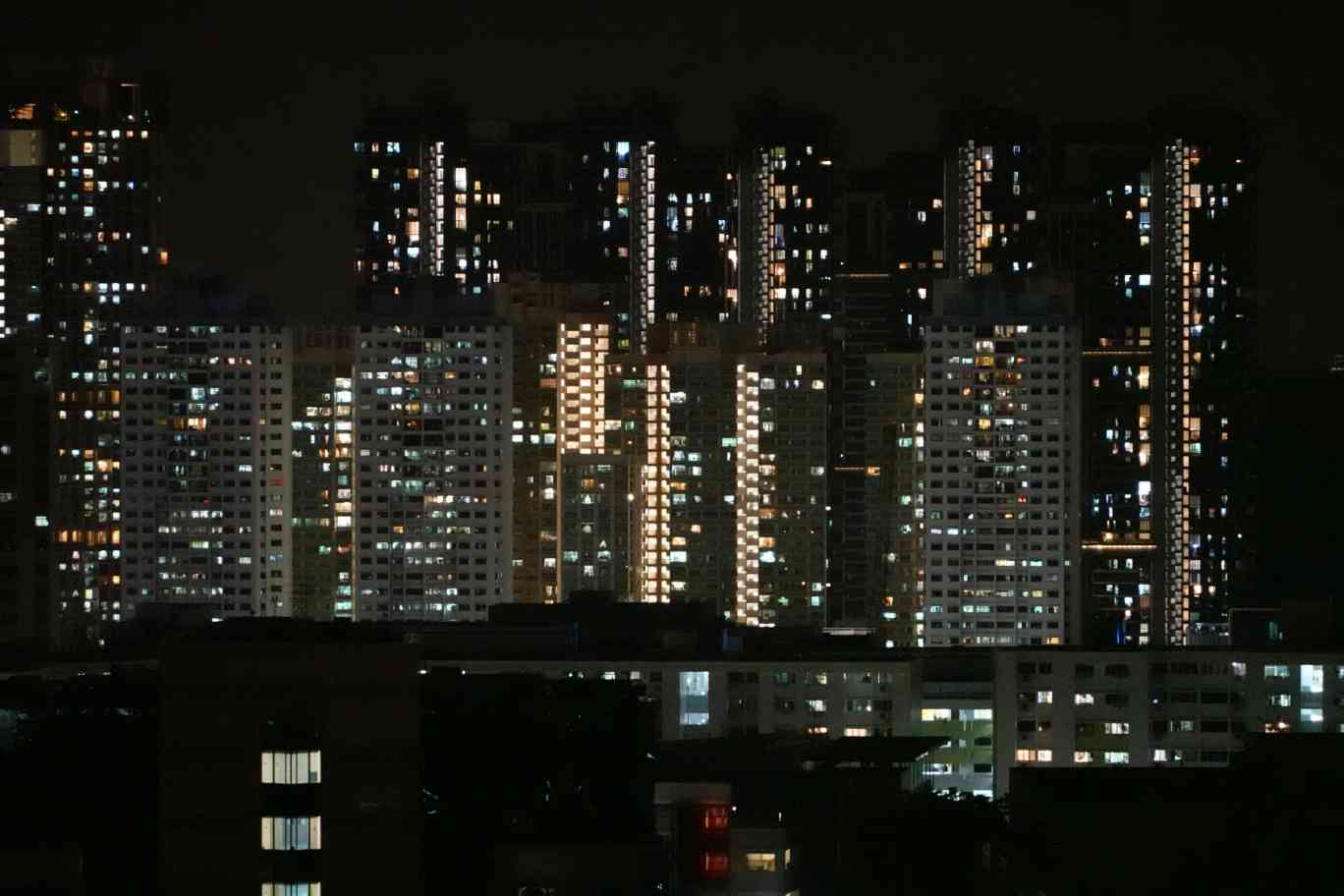
Thomas Hobbes wrote that people accumulate wealth not out of excess, but out of fear.
That’s what comes to mind with this latest report on inequality in Singapore. Now most of that article covers familiar ground: the constant back-and-forth argument about how the GINI co-efficient should be calculated, so as to produce the most soothing results on the financially struggling.
What stands out, however, is a new inclusion. For the first time, the data includes non-owner-occupied housing equity. That is, property wealth which, up till now, did not show up as income. Previously, for example, someone living with their parents while renting out their own property for $4,000 a month could appear far less advantaged than they actually were; at least as far as the inequality radar could detect.
To be clear, I do agree with this inclusion. As Singapore is an ageing society, post-retirement income - rather than employment income - is increasingly what separates the haves and have-nots.
But contrary to the “evil landlord” caricature that’s so easy to hate, I don’t believe greed is the primary driver here. At least, not for most of the landlords I’ve met.
The challenge for many buyers today isn't access to information.
It's interpreting that information in a way that makes sense for their finances, goals, and stage of life.
Over time, that's also why we decided to work with agents who shared the same data-driven and advisory-led approach behind our editorial, consultants who could help readers think through decisions more objectively, rather than simply push transactions.
Today, the team has worked with more than 2,000 clients across over $5B in property transactions.
In most cases I come across, property ownership is more about security than it is about getting rich.
It’s also worth remembering what the journey to becoming a “landlord” actually looks like, for most middle-class households. It is very rarely glamorous. For most, the early years involve stretching finances, servicing a heavy mortgage, and absorbing long periods where rental income doesn’t even cover the full loan repayment and maintenance. For most, it’s only around one lifetime later, when the mortgage is paid off, that a property becomes cashflow positive.
This is, generally speaking, not the path chosen by someone who wants to achieve financial independence quickly. Most of these people are focused on safety - the common emphasis is on post-retirement income, and sometimes legacy planning. In some cases, the primary beneficiaries are not themselves, but lifelong dependents.
(Although I have been told, quite wryly, that to Singaporean parents each child - no matter their station - is viewed as a lifelong dependent.)
Within this context, the behaviour of some landlords also starts to make more sense
Take, for instance, the notion of Income Replacement Rate (IRR). This is a popular metric used locally, where someone might aim to have, say, 70% of their current income even after retirement. This can drive some unusual behaviour in property acquisition.
There are cases where landlords hold a unit with terrible gross rental yield, or limited resale prospects, but shrug it off so long as the rental income meets - or helps to meet - the targeted IRR. They don’t mind because they may never exit the property; the point is to just collect the targeted rental amount to the very end. This is less about wealth accumulation, and more about guarding against a very specific risk: that of having insufficient post-retirement income.
Now one could make the very valid argument that similar security can be achieved in different ways; perhaps one that doesn’t take up a home someone else needs. But property tends to appeal more to those with a certain risk appetite; often those who hold that a stock portfolio could drop to zero, but a physical home is something you can always live in and rent out.
Now I’m aware the accuracy of that can be debated; but my point is that mindset favours the accumulation of properties.
Ironically, our tool to discourage ownership of multiple residential properties may also incentivise these landlords to hold on tighter
I’m referring to the Additional Buyers Stamp Duty (ABSD), which to be clear, I feel is essential as a policy measure. This is not one of those commentaries calling for its removal.
What I’m referring to is this: there are those who purchased a second or subsequent property in the decades when ABSD was nonexistent, or when it used to be much lower. When ABSD was first introduced in December 2011, for example, it was only 3% for Singaporean citizens buying their third or subsequent residential property. In January of 2013, it was only 7% for Singaporeans buying the second property (and 10% for third or subsequent properties), and so forth.
All in, a far cry from the 20% ABSD on a second residential property, which is in effect today. So consider the thought process of a landlord who bought when there was zero ABSD: if they sell the property now, the replacement is going to be bought with 20% tax - an emotionally unpalatable move.
This also has an impact on en-bloc sales by the way. Some owners and landlords will fight tooth and nail against a collective sale agreement for the exact same reason: their rental unit was bought without ABSD, and the replacement - if they still want to have their rental income - will be bought at 20% ABSD. This contributes to the friction against redevelopment of older properties, into higher density projects.
So whilst the ABSD is a needed measure, it also accidentally creates the stickiness that stops more units from entering the resale market, or being developed. This isn’t some kind of massive conspiracy between landlords, but a reaction to the policy environment.
The long term solution might not simply be discouraging multiple home ownership, but credible assurance.
If the behaviour we’re seeing is driven by a need for security, rather than just wanting to get rich, then the long term solution needs to go beyond ABSD. What’s needed is a clear message that we have the resources - and the willingness - to provide for Singaporeans in their retirement.
It may be time to better address an old complaint about social safety nets, and tone down chest-thumping declarations of everyone being obliged to provide for themselves. That’s not to say they don’t have some personal responsibility, but over-emphasising that message is how you encourage asset hoarding.
This is especially pertinent in our increasingly chaotic world, characterised by rising global conflict, and widening cultural rifts. This does appear to be a bad time to grow old, or to be nearing retirement; and in that environment, people tend to hold on tighter to assets, or get more aggressive in acquiring them.
It also makes inequality a much more explosive powder keg.
Meanwhile in other property news…
- The February BTO launch was surprisingly muted, with the exception of one town. Find out why.
- Check out our comments on Budget 2026, and what the radio silence on property might suggest.
- In this week’s Q&A, we provide an extensive answer weighing up ECs versus other options. Check it out if you’re facing the same considerations.
- How does lease decay of HDB flats work in different towns? Here’s a deep dive into the data for Stacked Pro readers.
Weekly Sales Roundup (02 - 08 February)
Top 5 Most Expensive New Sales (By Project)
| PROJECT NAME | PRICE S$ | AREA (SQFT) | $PSF | TENURE |
| UPPERHOUSE AT ORCHARD BOULEVARD | $7,034,000 | 2056 | $3,421 | 99 yrs (2024) |
| NEWPORT RESIDENCES | $4,523,000 | 1227 | $3,686 | FH |
| AMBER HOUSE | $3,784,000 | 1238 | $3,057 | FH |
| THE CONTINUUM | $3,667,000 | 1249 | $2,937 | FH |
| BLOSSOMS BY THE PARK | $3,596,000 | 1507 | $2,386 | 99 yrs (2022) |
Top 5 Cheapest New Sales (By Project)
| PROJECT NAME | PRICE S$ | AREA (SQFT) | $PSF | TENURE |
| NEWPORT RESIDENCES | $1,347,000 | 431 | $3,128 | FH |
| OTTO PLACE | $1,525,000 | 904 | $1,687 | 99 yrs (2024) |
| COASTAL CABANA | $1,580,000 | 915 | $1,727 | 99 yrs |
| THE LAKEGARDEN RESIDENCES | $1,593,000 | 678 | $2,349 | 99 yrs (2023) |
| BLOOMSBURY RESIDENCES | $1,810,000 | 689 | $2,627 | 99 yrs (2024) |
Top 5 Most Expensive Resale
| PROJECT NAME | PRICE S$ | AREA (SQFT) | $PSF | TENURE |
| ORCHARD VIEW | $7,000,000 | 2530 | $2,767 | FH |
| THE TRESOR | $5,980,000 | 2551 | $2,344 | 999 yrs (1875) |
| CAMELOT BY-THE-WATER | $5,950,000 | 3035 | $1,960 | 99 yrs (1996) |
| THE DRAYCOTT | $5,600,000 | 2637 | $2,123 | FH |
| TREASURE ON BALMORAL | $5,050,000 | 2002 | $2,522 | FH |
Top 5 Cheapest Resale
| PROJECT NAME | PRICE S$ | AREA (SQFT) | $PSF | TENURE |
| THE INFLORA | $685,000 | 463 | $1,480 | 99 yrs (2012) |
| STRATUM | $705,000 | 431 | $1,637 | 99 yrs (2012) |
| THE SANTORINI | $730,000 | 527 | $1,384 | 99 yrs (2013) |
| LAVERNE'S LOFT | $748,888 | 463 | $1,618 | FH |
| NINE RESIDENCES | $766,000 | 570 | $1,343 | 99 yrs (2013) |
Top 5 Biggest Winners
| PROJECT NAME | PRICE S$ | AREA (SQFT) | $PSF | RETURNS | HOLDING PERIOD |
| CAMELOT BY-THE-WATER | $5,950,000 | 3035 | $1,960 | $3,696,833 | 25 Years |
| THE TRESOR | $5,980,000 | 2551 | $2,344 | $2,230,000 | 8 Years |
| 11 AMBER ROAD | $3,000,000 | 1442 | $2,080 | $2,175,000 | 19 Years |
| THOMSON 800 | $3,200,000 | 1625 | $1,969 | $2,132,500 | 27 Years |
| THE SEA VIEW | $3,950,000 | 1410 | $2,801 | $1,670,000 | 11 Years |
Top 5 Biggest Losers
| PROJECT NAME | PRICE S$ | AREA (SQFT) | $PSF | RETURNS | HOLDING PERIOD |
| ORCHARD VIEW | $7,000,000 | 2530 | $2,767 | -$1,373,710 | 15 Years |
| ORCHARD BEL AIR | $4,800,000 | 3251 | $1,477 | -$200,000 | 19 Years |
| THE FLORENCE RESIDENCES | $950,000 | 527 | $1,801 | -$161,000 | 4 Years |
| ESPADA | $1,430,000 | 646 | $2,214 | -$111,098 | 16 Years |
| URBAN VISTA | $880,000 | 592 | $1,486 | -$51,591 | 13 Years |
Top 5 Biggest Winners (ROI%)
| PROJECT NAME | PRICE S$ | AREA (SQFT) | $PSF | ROI (%) | HOLDING PERIOD |
| BRADDELL VIEW | $1,800,000 | 1701 | $1,058 | 310% | 23 Years |
| 11 AMBER ROAD | $3,000,000 | 1442 | $2,080 | 264% | 19 Years |
| PARC OASIS | $1,983,000 | 1507 | $1,316 | 261% | 22 Years |
| SOUTHBANK | $1,872,888 | 958 | $1,955 | 244% | 20 Years |
| SUNGLADE | $1,880,000 | 1152 | $1,632 | 211% | 25 Years |
Top 5 Biggest Losers (ROI%)
| PROJECT NAME | PRICE S$ | AREA (SQFT) | $PSF | ROI (%) | HOLDING PERIOD |
| ORCHARD VIEW | $7,000,000 | 2530 | $2,767 | -16% | 15 Years |
| THE FLORENCE RESIDENCES | $950,000 | 527 | $1,801 | -14% | 4 Years |
| ESPADA | $1,430,000 | 646 | $2,214 | -7% | 16 Years |
| URBAN VISTA | $880,000 | 592 | $1,486 | -6% | 13 Years |
| ORCHARD BEL AIR | $4,800,000 | 3251 | $1,477 | -4% | 19 Years |
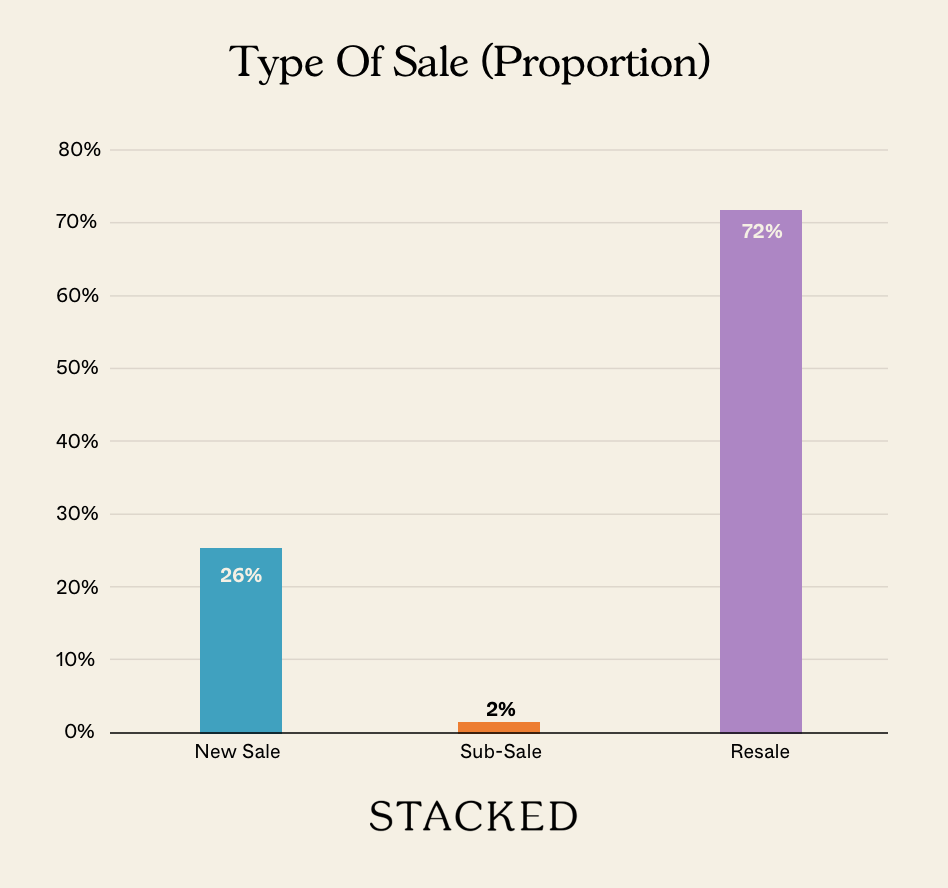
Transaction Breakdown
Follow us on Stacked for news and updates on the Singapore property market, and we wish all readers a Happy Chinese New Year!
At Stacked, we like to look beyond the headlines and surface-level numbers, and focus on how things play out in the real world.
If you'd like to discuss how this applies to your own circumstances, you can reach out for a one-to-one consultation here.
And if you simply have a question or want to share a thought, feel free to write to us at stories@stackedhomes.com. We read every message.


0 Comments