


Our property market may be the only thing with more sudden U-turns than Upper Thomson Road.
I reckon that most of our longtime readers might be able to pick out distinctive design trends in the condominium market. Perhaps some seasoned property agents and real estate investors could even identify the age of a project, even the developer behind a specific project, from a quick glimpse of the unit layout.
But one thing that’s always amused me is how dramatically Singaporean condo buyers can completely reverse their preferences in just around a decade. For example, take the sentiment toward mega-developments. These are projects with more than 1,000 residential units.
About 10 years ago, I recall that most buyers tended to dislike these large projects. The often cited complaints were: ‘It feels too crowded’, ‘it feels like living in a HDB estate', and ‘Later there will surely be problems when selling’.
The prevailing sentiment at the time was that mega-developments would see weaker resale gains and softer rental yields. For example, a large development like Treasure at Tampines, which has 2,203 units, was assumed to eventually see hundreds of listings vying for buyers' attention at any one time.
To be clear, there often are many resale listings at mega-developments that are listed on property portals. I’ve met property agents who groan when their seller owns a unit in a mega-development, because they could end up spending the national budget of a small country on refreshing the listing.
But as our research has shown, resale units in these developments do still sell, and their returns are in no way worse than a typical condo. Recently, I’ve started to see more property agents who like selling units in a mega-development, since the transaction volumes mean that each price point is easily referenced and justified to potential buyers.
Today, I think it's fair to say that a greater number of condo buyers associate mega-developments with a wider range of facilities, lower maintenance fees, and better (instead of worse) resale potential.
The challenge for many buyers today isn't access to information.
It's interpreting that information in a way that makes sense for their finances, goals, and stage of life.
Over time, that's also why we decided to work with agents who shared the same data-driven and advisory-led approach behind our editorial, consultants who could help readers think through decisions more objectively, rather than simply push transactions.
Today, the team has worked with more than 2,000 clients across over $5B in property transactions.
Then consider how the view (literal and metaphorical) toward HDB flats has shifted.
There was a time when private condos farther from HDB clusters were considered more ‘atas’ by some buyers.
Others may even remember the controversy over a particular advertisement marketing a new development, which proudly highlighted that the project was ‘without any HDB in sight’.
(It wasn’t the developer’s advertisement, by the way, and they weren’t too happy with it either.)
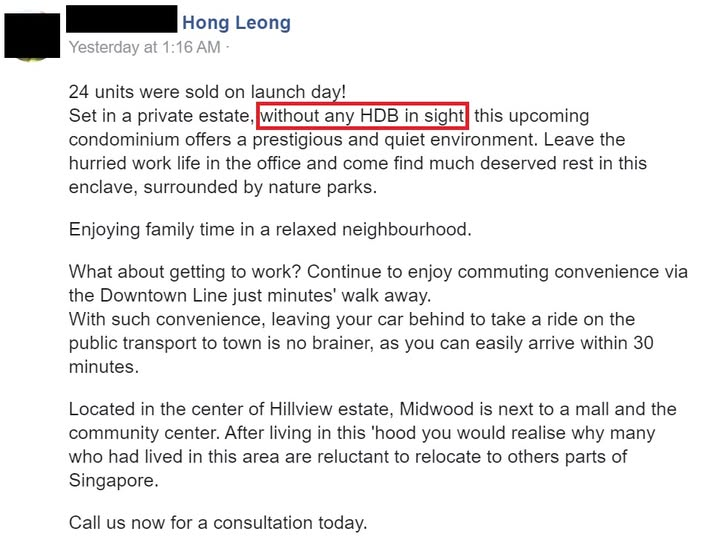
That messaging drew criticism, but it also reflected the sentiment among some buyers at the time: “I can no longer see where 80% of the population lives! Success!”
But today, I meet buyers and property agents who get antsy when there’s no nearby HDB cluster. Having a catchment of public housing flats signals future upgrader demand, likely better heartland amenities, and more active neighbourhood life.
In some areas, I’d even say proximity to mature HDB estates is considered a key part of the exit strategies of some buyers. Flats in mature estates tend to have higher resale values, which helps to bridge the gap for HDB owners stepping into a private property.
Even some layout preferences have seen notable reversals
I’ve mentioned the kitchen situation before. For most of the 2010’s, nearly every new condo seemed to assume Singaporeans needed to see their living room all the time, even when frying rice. There was almost no barrier between the kitchen and the living room. Even HDB got in on the trend: open-concept kitchens became the default.
And to be fair, I still think they look fantastic. Everything feels brighter, and parents can ensure their toddler isn’t about to taste-test their money plant while they’re busy cooking.
But eventually, it caught on that sambal, oil, and other issues were worse to deal with. And as a homeowner, I empathise with not wanting guests to immediately see the dishes I forgot to wash from last night. And possibly last afternoon.
I AM A BUSY MAN, OKAY.
Anyway, now one of the most common selling points I see in newer launches is the ‘enclosed kitchen’. Developers now proudly point out sliding panels, tucked-away kitchen niches, or layouts where the cooking area can be partially hidden from the living room.
And then there’s the issue concerning unit sizes.
There was a time when “bigger is always better” was unquestioned when it came to Singapore’s property market. Property agents would look at a massive 1,400+ sq ft unit with huge bedrooms, dry kitchen, wet kitchen, and enough room to host a tennis match in the TV room and think: “Nice, easy to sell for sure”.
Today, spacious units like these worry agents and sellers. That’s because a growing number of buyers in the market consider purchases in terms of price quantum, not just $PSF prices.
Rising resale private home prices mean that a large unit can fetch more than $2 million, a price point that few HDB upgraders can afford. This is an ongoing issue with some of the large condos in the Central Region, which were once built for affluent buyers who - it was presumed - were less price sensitive.
When only a very specific (read: rich) buyer can afford that type of unit, exit liquidity becomes a bigger concern, as does the limited room for any further price growth. The term “too big” was rarely heard in the 2010’s, but I hear it more often now, especially in regard to older condos.
After all, we’ve reached the point where some buyers view two-bedders as family homes.
That’s one of the understated issues I see with very long holding periods
Long holding periods generally result in better resale gains. But one of the overlooked issues, at the point of exit, isn’t just the market numbers: it’s how buyer preferences may have changed. It’s tough to know which of today’s prevailing consumer preferences will still hold up 10 or 20 years from now.
Much like squash courts, which were considered prestigious and highly sought-after, are now viewed as unnecessary amenities. It will be interesting to see if pickleball courts go this way over time.
This is one advantage that short-term investors have: the positive traits of a condo are likely to still be seen as positive, at the point of resale. They’re less likely to feel the whiplash of the market saying: “Hey, you know that thing we used to like? We hate it now”.
Don’t take this as an endorsement of any particular strategy, though. The point I’m trying to convey is that a faster exit can sometimes have its own advantages too, when it comes to the risk of changing tastes and new market narratives.
Meanwhile, in other property news…
- Fancy a landed enclave free of Singapore’s urban jungle? Then check out something different: Pollen Collection II, which provides practical landed-living opportunities.
- Canberra should just be renamed Executive Condo (EC) Central at this point, because it just got another one added. This next project will be subject to a 10-year MOP, though, and you can check out the details here.
- Bukit Timah and Newton are next to each other, but at the same time are very different neighbourhoods. Join our Stacked Pro readers in understanding how the two differ in terms of price and growth.
Weekly Sales Roundup (18 - 24 May)
Top 5 Most Expensive New Sales (By Project)
| PROJECT NAME | PRICE S$ | AREA (SQFT) | $PSF | TENURE |
| SKYWATERS RESIDENCES | $14,480,000 | 2896 | $5,001 | 99 yrs |
| MEYER BLUE | $5,573,000 | 1733 | $3,216 | FH |
| THE CONTINUUM | $4,515,000 | 1690 | $2,672 | FH |
| NAVA GROVE | $3,919,700 | 1464 | $2,678 | 99 yrs (2024) |
| BLOOMSBURY RESIDENCES | $3,852,000 | 1421 | $2,711 | 99 yrs (2024) |
Top 5 Cheapest New Sales (By Project)
| PROJECT NAME | PRICE S$ | AREA (SQFT) | $PSF | TENURE |
| UNION SQUARE RESIDENCES | $1,328,000 | 506 | $2,625 | 99 yrs (2024) |
| NARRA RESIDENCES | $1,450,000 | 646 | $2,245 | 99 yrs (2025) |
| HUDSON PLACE RESIDENCES | $1,475,000 | 646 | $2,284 | 99 yrs |
| THE CONTINUUM | $1,480,000 | 560 | $2,644 | FH |
| KASSIA | $1,557,000 | 753 | $2,066 | FH |
Top 5 Most Expensive Resale
| PROJECT NAME | PRICE S$ | AREA (SQFT) | $PSF | TENURE |
| NASSIM PARK RESIDENCES | $15,600,000 | 3466 | $4,501 | FH |
| GRANGE RESIDENCES | $10,300,000 | 2852 | $3,611 | FH |
| ONE ROBIN | $4,720,000 | 1948 | $2,423 | 99 yrs (2006) |
| MELROSE PARK | $4,620,000 | 1701 | $2,717 | FH |
| CUSCADEN RESIDENCES | $3,900,000 | 1453 | $2,684 | FH |
Top 5 Cheapest Resale
| PROJECT NAME | PRICE S$ | AREA (SQFT) | $PSF | TENURE |
| THE SERENNIA | $500,000 | 646 | $774 | FH |
| PARC IMPERIAL | $730,000 | 398 | $1,833 | FH |
| EUHABITAT | $788,000 | 624 | $1,262 | 99 yrs (2010) |
| BARTLEY RESIDENCES | $830,000 | 463 | $1,793 | 99 yrs (2011) |
| EIGHT RIVERSUITES | $840,000 | 441 | $1,903 | 99 yrs (2011) |
Top 5 Biggest Winners
| PROJECT NAME | PRICE S$ | AREA (SQFT) | $PSF | RETURNS | HOLDING PERIOD |
| HONOLULU TOWER | $14,200,000 | 5823 | $2,438 | $7,200,000 | 17 Years |
| GARDEN APARTMENTS | $5,850,000 | 2476 | $2,363 | $4,000,000 | 24 Years |
| THOMSON GROVE | $4,138,000 | 2896 | $1,429 | $3,145,000 | 27 Years |
| THE ANCHORAGE | $3,320,000 | 1507 | $2,203 | $2,347,000 | 31 Years |
| BLOSSOMS @ WOODLEIGH | $3,320,000 | 1744 | $1,904 | $2,252,000 | 19 Years |
Top 5 Biggest Losers
| PROJECT NAME | PRICE S$ | AREA (SQFT) | $PSF | RETURNS | HOLDING PERIOD |
| SOLEIL @ SINARAN | $8,000,000 | 4715 | $1,697 | -$1,500,000 | 12 Years |
| NOUVEL 18 | $3,700,000 | 1335 | $2,772 | -$278,000 | 5 Years |
| THE SERENNIA | $500,000 | 646 | $774 | -$187,990 | 17 Years |
| CLUNY PARK RESIDENCE | $2,680,000 | 1216 | $2,203 | -$130,000 | 9 Years |
| UPTOWN @ FARRER | $998,000 | 527 | $1,892 | -$97,353 | 5 Years |
Top 5 Biggest Winners (ROI%)
| PROJECT NAME | PRICE S$ | AREA (SQFT) | $PSF | ROI (%) | HOLDING PERIOD |
| THOMSON GROVE | $4,138,000 | 2896 | $1,429 | 317% | 27 Years |
| CASHEW HEIGHTS CONDOMINIUM | $2,533,000 | 1658 | $1,528 | 290% | 19 Years |
| MANDARIN GARDENS | $970,000 | 732 | $1,325 | 280% | 22 Years |
| THE FLORAVALE | $2,070,000 | 2304 | $899 | 246% | 27 Years |
| THE ANCHORAGE | $3,320,000 | 1507 | $2,203 | 241% | 31 Years |
Top 5 Biggest Losers (ROI%)
| PROJECT NAME | PRICE S$ | AREA (SQFT) | $PSF | ROI (%) | HOLDING PERIOD |
| THE SERENNIA | $500,000 | 646 | $774 | -27% | 17 Years |
| SOLEIL @ SINARAN | $8,000,000 | 4715 | $1,697 | -16% | 12 Years |
| UPTOWN @ FARRER | $998,000 | 527 | $1,892 | -9% | 5 Years |
| NOUVEL 18 | $3,700,000 | 1335 | $2,772 | -7% | 5 Years |
| KOPAR AT NEWTON | $1,168,000 | 517 | $2,261 | -5% | 6 Years |
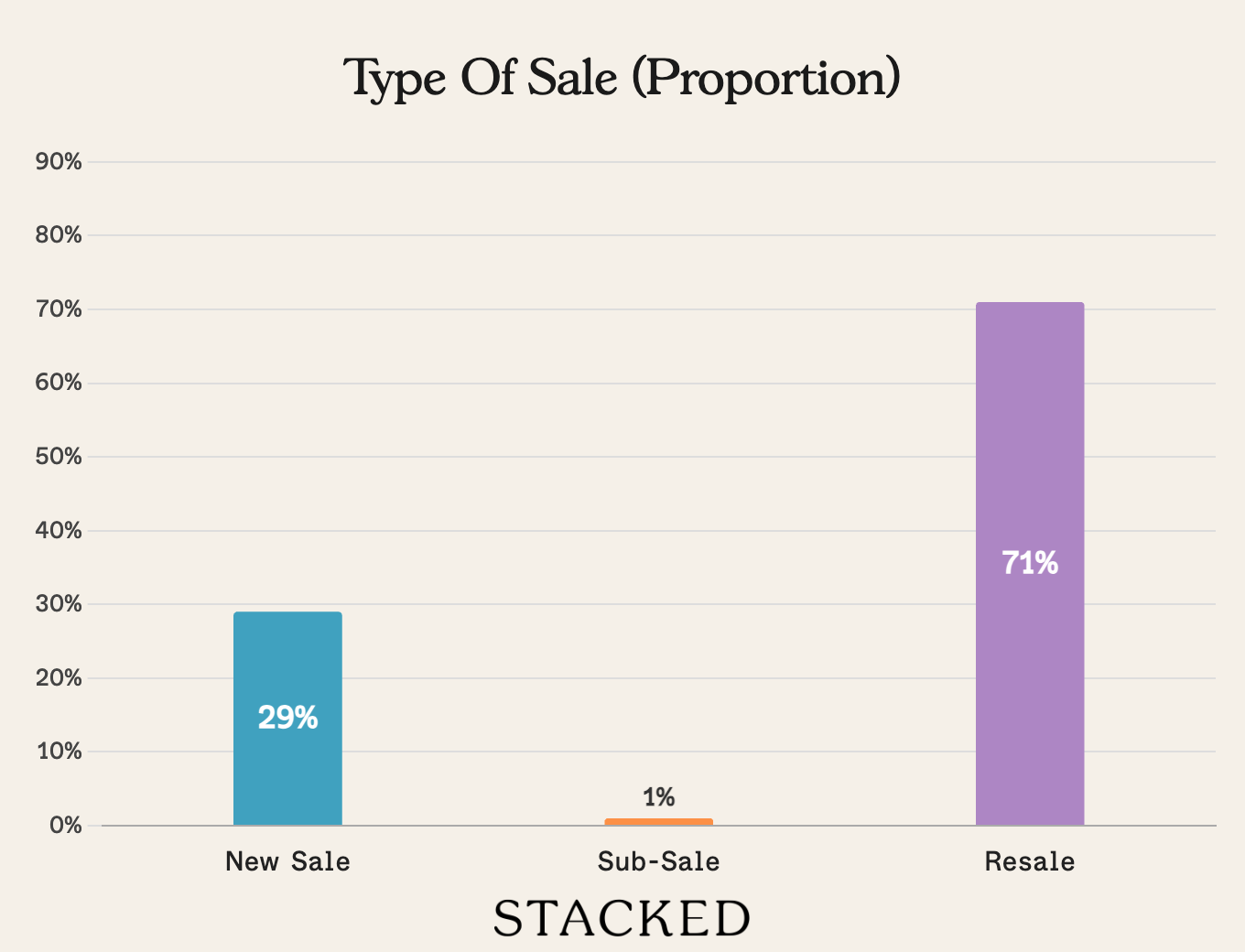
Transaction Breakdown
Follow us on Stacked for more updates and news on the Singapore property market.
At Stacked, we like to look beyond the headlines and surface-level numbers, and focus on how things play out in the real world.
If you'd like to discuss how this applies to your own circumstances, you can reach out for a one-to-one consultation here.
And if you simply have a question or want to share a thought, feel free to write to us at stories@stackedhomes.com. We read every message.


0 Comments